
Key Takeaways
- • Person-in-environment (PIE) diagnostic models require mapping family relationships along with external community stress factors.
- • Utilizing Genosm as the best genogram tool for social workers simplifies kinship care mapping, saving hours of manual documentation during child welfare intakes.
- • Client data must remain fully encrypted and stored locally to meet state-level social services privacy guidelines.
Clinical social work is defined by the person-in-environment perspective, a lens that views the individual not as an isolated actor but as a node within a complex network of biological, familial, and environmental systems. To achieve diagnostic clarity within this paradigm, the integration of ecomaps and genograms has become a professional prerequisite for comprehensive assessment and effective case management.
Clinical social work requires a holistic view of clients within their wider ecological systems. Utilizing a professional genogram tool for social workers allows caseworkers to trace family history and map community connections on a single visual canvas. This comprehensive guide covers clinical techniques, ecomap symbols, and intake workflows designed to simplify kinship care tracking and court reports.
We will discuss bioecological systems theory and how to integrate genogram relationships with external ecomap stressors. Social workers will learn how to identify community supports (like support groups, school plans, and spiritual circles) alongside family dynamics (like estrangements or custody battles). We also address how standardized graphics assist multidisciplinary teams in health and welfare settings.
Finally, we present a detailed comparison of modern mapping software versus manual paper intakes or general chart tools. We answer five targeted social work FAQs regarding export formats, offline browser databases, and ecomap drawing rules. To coordinate student coursework or study teaching workflows, you can also view our free genogram software for students page or our genogram software for educators study guide.
The Theoretical Framework of Social Ecology
The ecological perspective, pioneered by Urie Bronfenbrenner in his bioecological systems theory, posits that human development is shaped by the interaction between the individual and multiple environmental layers. These layers range from the microsystem (immediate family) to the macrosystem (broad cultural and legal frameworks). For social workers, the challenge lies in documenting these transactions with technical precision.
In 1975, Ann Hartman introduced the ecomap as a diagrammatic tool to bridge the gap between abstract systemic theory and clinical practice. While a genogram maps the internal history and lineage of a family, the ecomap visualizes the current social world. It identifies the connections, energy flows, and tension points between the family unit and external systems such as schools, employers, healthcare providers, and legal agencies. This dual mapping strategy provides a high-fidelity image of the client's ecological resilience.
The transactional nature of social work requires a deep understanding of resource reciprocity. Relationships are rarely static, they involve a constant exchange of support, stress, and resources. By utilizing standardized visual notation, social workers can document whether a specific community connection is supportive, draining, or tenuous. This objective visualization is critical for identifying service gaps and crafting ecologically valid intervention strategies.
The Integrated Diagnostic standard
A thorough social work assessment utilizes the genogram to understand intergenerational patterns and the ecomap to understand current social stressors. This integrated approach is particularly vital in child welfare and kinship care. For instance, when determining a foster placement, the genogram reveals biological relatives, while the ecomap reveals which of those relatives have the social support systems necessary to provide a stable environment for the child.
Case application, The Rodriguez Family Assessment
The Rodriguez family is a three-person unit (Maria, 34, and her children, Leo, 8, and Sofia, 5) currently experiencing housing instability and food insecurity. A genogram reveals that Maria migrated from her country of origin ten years ago, leaving her extended family behind. This indicates a baseline of limited familial support.
The ecomap further clarifies the ecological landscape, Sofia’s school provides a supportive environment, but Maria’s relationship with her employer is rendered with jagged lines, indicating high-tension and limited resource exchange. Furthermore, the ecomap identifies a supportive connection to a local community center that Maria had not previously emphasized. This visual realization allows the social worker to leverage existing support networks while addressing the primary stressor of employment instability.
The co-creation of these maps is, in itself, a clinical intervention. As the social worker and client collaboratively draw the systems, the client often experiences an increase in autonomy. The ecomap makes abstract stressors visible, allowing the client to identify their own strengths and resource needs. This strengths-based engagement is a hallmark of professional social work practice, shifting the focus from pathology to systemic resilience.
Research findings in child Welfare and Clinical Assessment
Research published through various child welfare agencies (ChildWelfare.gov) underscores the statistical significance of ecomaps in identifying kinship care options. Studies show that when systemic mapping is used consistently, social workers identify a higher number of potential placement options within the family network compared to traditional interview methods. The visual nature of the tool prompts questions about forgotten or distant relatives who may serve as vital support nodes.
Furthermore, researchers have noted the psychometric potential of quantified ecomaps. By assigning values to the strength and direction of social connections, researchers have found strong correlations between ecomap data and established measures of perceived social support. This suggests that, when used systematically, the ecomap is a reliable diagnostic tool that bridges the gap between clinical observation and empirical research.
Ecological Assessment Metrics
Support Identification, Visual ecomaps increase the number of identified community support resources by 30% during initial intake.
Kinship Placement, Child welfare professionals utilizing genograms are significantly more likely to secure stable kinship care placements.
Engagement Rates, Collaborative mapping has been associated with higher rates of client attendance and retention in services.
The Diagnostic imperative, energy Flow and system Tension
In professional social work, the direction of energy flow is a critical diagnostic variable. An ecomap rendered with arrows indicates whether resources are flowing from the child to the school (supportive), or from the social system to the family (draining). This level of technical nuance allows the clinician to identify "systemic fatigue" before it leads to crisis. If every connection on the ecomap shows energy flowing away from the family unit, the risk of burnout and systemic collapse is high.
Mapping the macrosystemic interactions is also essential. Social workers must document the families interaction with legal, judicial, and public housing systems. These connections are often rendered with high levels of tension, reflecting the bureaucratic friction faced by vulnerable populations. By visualizing this friction, social workers can better advocate for systemic changes or identify more efficient pathways for resource navigation.
Intergenerational trauma patterns are identified through the genogram layer of the assessment. Recurring markers of incarceration, substance use, or foster care placement across three generations indicate a persistent systemic vulnerability. This historical context informs the current intervention plan, ensuring that the social worker addresses both the immediate crisis and the historical drivers of systemic instability.
Clinical Case Simulations: Standardized Mapping in Genosm
Case 1: The Miller-Bennet Assessment (Integrated Genogram & Ecomap)
In this simulation, we analyze the case of Sarah Miller (Age 32), a mother navigating recovery from Opioid Use Disorder while managing a Child Protective Services (CPS) safety plan. The genogram reveals a multi-generational pattern of substance use and sudden loss, including the overdose of her brother and the recent incarceration of her husband, James. By layering the ecomap over this history, the social worker identifies that while Sarah's relationship with her mother is strained, the family possesses a vital support node through a local community church. This integrated view allows for a "Person-in-Environment" diagnostic that prioritizes kinship stabilization and targeted resource allocation for the children.
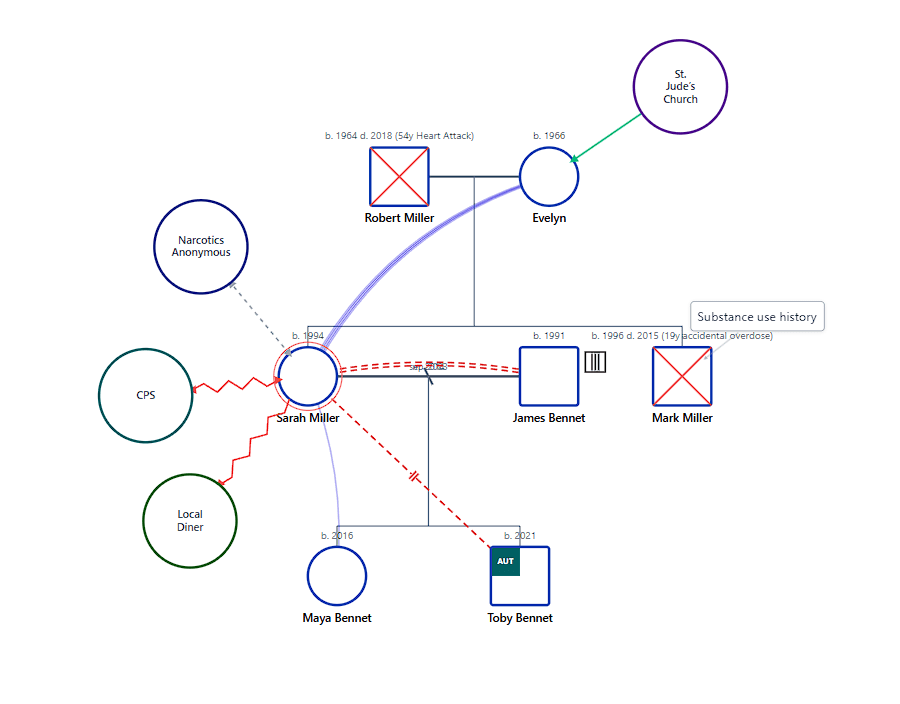
Figure 1: Sarah Miller's Case Overview. Mapping intergenerational trauma alongside active community stressors and support nodes.
Case 2: The Nguyen-Lee Household (Elder Care and Caregiver Burnout)
This case focuses on Kim Lee (Age 42), the primary caregiver for her mother, Lan, who was recently diagnosed with Alzheimer’s. The mapping process visualizes the "Sandwich Generation" dilemma: Kim is physically and emotionally stretched between her high-stress role as a nurse, her responsibilities as a mother of two, and the intensive care needs of her matriarch. The ecomap identifies "Tension" markers at Kim's workplace and a "Fusion" relationship with her mother, while highlighting a critical resilience hub—a Vietnamese Community Center that provides Lan with cultural anchoring. This visualization helps the social worker advocate for respite services, shifting the energy flow from systemic fatigue toward sustainable care.
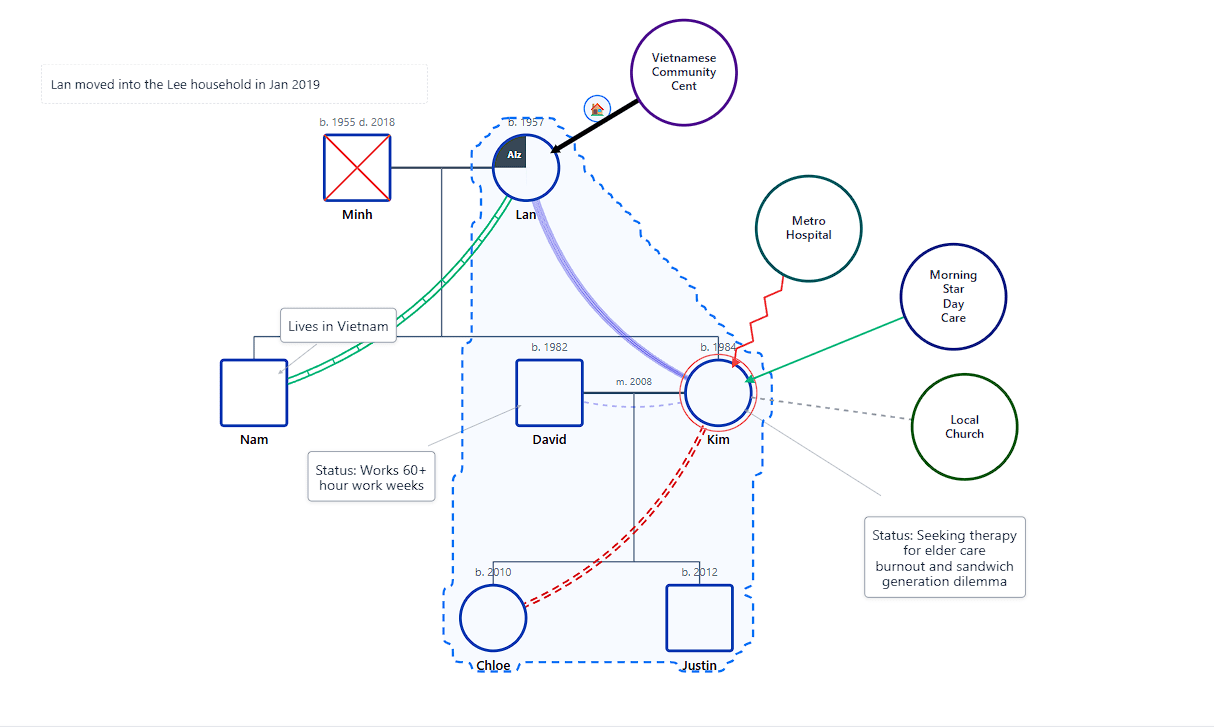
Figure 2: Kim Lee's Caregiver Map. Visualizing the ecological imbalance between clinical employment, parenting, and complex elder care.
Case 3: Anita & Raj Patel (Disability Advocacy and Housing Crisis)
This simulation examines Anita Patel (Age 46), who is living with Multiple Sclerosis (MS), and her husband Raj, who recently faced sudden unemployment. The mapping illustrates the "Systemic Overload" that occurs when health crises intersect with economic instability. The ecomap renders "Hostile" jagged lines toward a property management group due to a pending eviction, while simultaneously identifying "Healing" nodes through Anita’s neurologist and physical therapy team. By visualizing this 'spaghetti' of stressors and supports, the social worker can prioritize immediate housing advocacy while leveraging the strong support of Anita's sister, Priya, to maintain clinical continuity for her MS treatment.
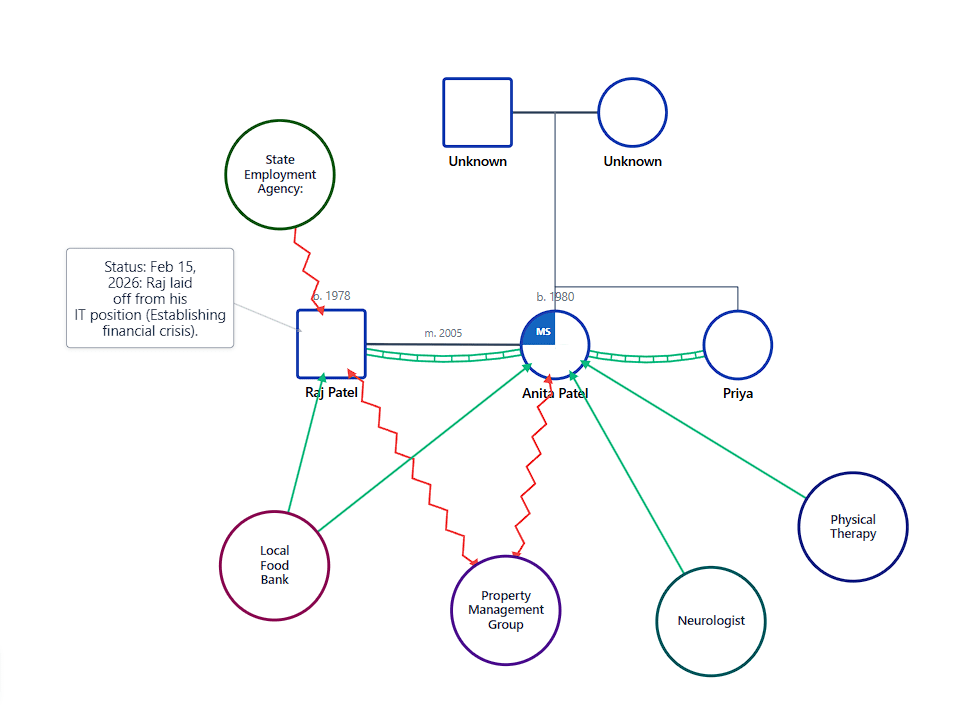
Figure 3: The Patel Family Crisis Map. Visualizing the intersection of physical disability, unemployment, and housing system conflict.
Security, Documentation, and Digital Standards
Modern social work requires professional documentation that meets high security standards. Given the sensitivity of child welfare and legal data, zero-server privacy is a non-negotiable requirement for clinical software. Platforms like Genosm provide a local-first architecture that ensures sensitive personally identifiable information (PII) never persists on third-party cloud architectures. This design prioritization ensures absolute agency control and adherence to HIPAA and GDPR standards.
Administrative documentation time is a significant barrier in high-caseload social work environments. Utilizing AI-augmented mapping engines allows social workers to rapidly translate case files into valid systemic diagrams. Instead of manual drafting, which can take hours, practitioners can focus on high-fidelity clinical assessment and direct patient services. This automation respects the professional standards of systemic mapping while providing a dramatic reduction in documentation burden.
Interoperability through digital standards like FHIR R4 ensures that systemic assessments are ready for integration into electronic health records and agency monitoring systems. When a social worker uses standardized notation, the resulting data becomes a portable, objective record that can follow the client across the continuum of care. This level of technical precision is the hallmark of modern, high-authority social work practice.
Conclusion, The resilient ecosystem
The integration of genograms and ecomaps is the professional standard for ecological assessment. By visualizing the person-in-environment, social workers move beyond narrative fragments to a comprehensive diagnostic map of systemic resilience and vulnerability. This methodology ensures that every intervention is tailored to the lived reality of the client system, promoting better outcomes and more efficient resource navigation.
Software Comparison: Finding the Best Mapping Tool
Case managers require rapid drawing, standard kinship notation, and integrated ecomap overlay systems to document client relationships. Here is how specialized social work software compares with general drawing builders and paper templates:
| Assessment Feature | Genosm Tool | SmartDraw Software | Paper Intake Charts |
|---|---|---|---|
| Ecomap Connections | Built-in outer system circles with stress/flow lines | Generic flowchart connectors only | Manual drawing of circles and icons |
| Kinship care rules | Automated sibling order and custody indicators | Requires manual shape resizing and alignment | Drawn by hand (difficult to edit) |
| Encryption and PII | Local-first browser database prevents cloud leaks | Standard cloud storage (PII shared on cloud database) | Physical file cabinets (vulnerable to loss) |
| Report exports | HD PDF, PNG, and secure JSON case file exports | Image export or proprietary file save | Needs photocopier or scanner |
Generic chart programs like SmartDraw can build diagrams but lack the specific symbology needed for complex family dynamics, which forces social workers to format lines manually while exposing sensitive data to cloud servers. Paper files are secure in a locked office but are slow to draw and impossible to update as household structures shift.
Frequently Asked Questions
How does an ecomap differ from a genogram in case assessments?
While a genogram maps family members, lineages, and emotional bonds across generations, an ecomap captures the household's relationships with external systems like school boards, clinics, support groups, and child welfare agencies.
Is the client information encrypted in this digital database?
Yes, Genosm is designed with local-first security. Your assessment files, kinship details, and notes are encrypted and stored in your local browser database, meaning no private client files are sent to external cloud servers.
Can I generate child custody and kinship charts with this software?
Yes, the software supports standard custody symbols, foster relations, and legal guardianship status. These features are fully integrated into our kinship care mapping canvas.
How do I export charts for court reports or EHR attachments?
You can export completed assessments as high-resolution PNGs or vector PDFs, which can be uploaded directly into your agency case management portal or EHR software.
Does this system support Bronfenbrenner ecological frameworks?
Yes, the tool is built to support ecological social work models. The dual canvas allows you to map immediate family microsystems and external macrosystem entities simultaneously.
Professional Ecological Assessment tools
Implement professional mapping standards with Genosm.
View Pricing