The Definitive Guide to Writing Therapy Notes from Genograms, Ecomaps & Systemic Diagrams
Learn how to translate visual family dynamics, emotional bonds, and social determinants of health directly into audit-proof SOAP, DAP, BIRP, and EMDR progress notes.
- Visual Systems Are Part of the Medical Record: A genogram or ecomap is not just an intake doodle. It is a structured map of relational dynamics, generational trauma, emotional cutoffs, and social determinants of health (SDOH) that justifies clinical medical necessity.
- The Golden Thread Audit Standard Is Non-Negotiable: Insurance reviewers deny claims and claw back payments when progress notes drift away from the treatment plan. Every note must show an unbroken line from diagnosis and active treatment goals to the specific interventions applied in the room.
- Select the Right Framework for the Clinical Moment: Never force every session into a generic template. Match your note structure to the modality: use SOAP for interdisciplinary medical records, DIRP for couples and family dyads, EMDR 8-Phase for trauma desensitization, and BIRP for community and behavioral health.
- Keep Progress Notes and Psychotherapy Notes Strictly Segregated: Under the 21st Century Cures Act Open Notes rule, clients can read their official progress notes on patient portals. Keep your progress notes objective and free of moral judgments, and store private countertransference reflections in a separate, encrypted vault under HIPAA 45 CFR § 164.501.
- Genosm Automates the Bridge with Total Flexibility and Zero-Cloud PHI Protection: Genosm lets you write notes your way: manually with clinical dot-phrases, with 1-click AI generation from your active diagram, or through a conversational AI Co-Pilot to edit targeted sections. Your client data stays completely secure because all identifying information is tokenized locally on your device before any processing, ensuring zero PHI touches external cloud servers.
Genosm Diagram-to-Notes Studio
Tired of typing the same family history twice? Draw your 3-generation genograms, ecomaps, and sociograms on Genosm, then transform them into audit-proof SOAP, DAP, or BIRP notes in seconds with our zero-cloud PHI protection engine.
Section 1: The Clinical Crisis: Why Visual Systems Get Lost in the Chart
Every practicing mental health professional knows the exhaustion of pajama time. You finish seeing six to eight clients in back-to-back sessions. You spent meaningful hours tracking body language, navigating intense relational hostility, drawing family trees on a whiteboard, and exploring community stressors on an ecomap.
Then the evening begins. You sit on your couch, open your electronic health record (EHR), and stare at a blank text box.
Most clinicians end up writing vague, rushed notes:
"Client attended scheduled 45-minute individual session. Discussed ongoing family stress and marital conflict. Client appeared anxious. Provided supportive counseling and explored coping strategies. Plan to continue weekly sessions."
This note represents a breakdown in clinical documentation. It fails to capture the clinical work done in the session. Worse, it puts your practice at risk during insurance audits. An auditor from Medicare, Medicaid, or a commercial health plan reading that note will ask basic questions: What specific interventions were used? What family dynamics were addressed? How does this support the primary diagnosis? Why did this session require 45 or 60 minutes of skilled care?
The tragedy is that the rich data was already there. You drew it during the session. You mapped the three generations of maternal depression. You drew the double zig-zag line showing high relational hostility between the client and their spouse. You circled the adolescent daughter caught in a painful Bowenian triangulation loop. You mapped the ecomap showing high financial strain and zero social support.
The challenge has always been the translation layer. How do you take complex visual systems and turn them into structured, defensible medical records without typing for hours? This guide gives you the exact blueprint to do that across 11 recognized clinical frameworks.
Section 2: Decoding Visual Diagrams into Clinical Documentation
To turn a diagram into a progress note, you must treat your visual symbols as clinical data points. In technical terms, a digital diagram in Genosm operates as an Abstract Syntax Tree (AST). Every line, box, circle, and color carries specific clinical meaning that translates directly into standardized medical terminology.
Genogram Relational Syntax
- Double / Triple Solid Lines: Enmeshment, diffuse boundaries, over-involvement.
- Jagged Zig-Zag Lines: Overt hostility, chronic conflict, verbal friction.
- Broken / Cut-Off Lines: Emotional estrangement, rigid boundaries, avoidance.
- Three-Party Triangles: Bowenian triangulation, deflecting dyadic marital tension.
Ecomap Ecological Syntax
- Thick Inward Arrows: Heavy institutional demands, legal or housing pressure.
- Dotted Fragile Lines: Social isolation, weak community safety net.
- Outward Energy Flow: High caregiver burden, financial or emotional depletion.
- Bi-Directional Green Lines: Mutual, stabilizing ecological support systems.
When these visual facts are translated into clinical language, they immediately support the necessity of skilled psychological intervention.
Section 3: The 11 Clinical Documentation Frameworks (End-to-End Guide)
No single therapy note format fits every clinical situation. A trauma processing session using eye movements requires a different structure than an acute suicide risk assessment or an interdisciplinary hospital consult. Genosm supports 11 documentation frameworks. Here is how each framework works and how your diagrams populate it.
1. SOAP (Subjective, Objective, Assessment, Plan)
EHR Gold StandardThe universal documentation standard across medical centers and commercial insurance panels. Quotes go into Subjective; Genogram Mental Status Exam and visible interaction patterns go into Objective; Bowenian triangulation loops and systemic etiology go into Assessment; Next modalities and CPT cadence go into Plan.
2. DAP (Data, Assessment, Plan)
Private PracticeA streamlined favorite for talk therapy. It synthesizes client statements and observable family interaction into a single Data section, allowing clinicians to document 30% faster without sacrificing diagnostic depth.
3. BIRP (Behavior, Intervention, Response, Plan)
Behavioral Health & InpatientThe requirement for youth residential, community mental health, and substance use recovery. Behavior tracks observable symptoms; Intervention proves exact clinical modalities used; Response logs real-time client reactions; Plan defines continuing safety goals.
4. GIRP (Goal, Intervention, Response, Plan)
Goal-Directed CBTBuilt for Cognitive Behavioral Therapy (CBT) and Solution-Focused Brief Therapy (SFBT). Directly anchors every session action to a numbered Treatment Plan Goal, calculating measurable progress at every encounter.
5. PIRP (Problem, Intervention, Response, Plan)
Crisis & Acute CareIsolates the acute clinical trigger or family escalation addressed during the visit. Ideal for sudden relationship crises, panic episodes, or urgent stabilization.
6. DIRP (Data, Intervention, Response, Plan)
Couples & Family SystemsCaptures dyadic systemic interactions alongside clinician interventions. Specifically crafted for conjoint sessions (CPT 90847) to record relational dances between partners or family members.
7. EMDR (Phase 1 to 8 Adaptive Information Processing)
Trauma SpecialtyFull protocol documentation tracking Target Memory, Negative Cognition (NC), Positive Cognition (PC), Validity of Cognition (VOC, 1 to 7), Subjective Units of Disturbance (SUD, 0 to 10), Bilateral Stimulation (BLS) sets, and body scan clearance.
8. Biopsychosocial Intake Assessment
Diagnostic Baseline (CPT 90791)Comprehensive baseline chart connecting 3-generation hereditary risk markers, trauma timelines, attachment histories, and ecomap social determinants into DSM-5-TR diagnostic formulation.
9. SMART Treatment Plan
Managed Care CompliantFormulates audit-proof treatment goals with measurable behavioral indicators, diagnostic justification, clinical modalities, and session frequency.
10. Stanley-Brown Safety Plan
Suicide PreventionActionable crisis protocol tracking warning signs, internal coping, safe social distractions, trusted contacts pulled directly from ecomap green zones, crisis resources, and lethal means safety.
11. Discharge / Termination Summary
Episode CompletionFormal chart closing documenting clinical growth, comparing baseline genogram conflict with closing differentiation, outcome measures achieved, and relapse prevention referrals.
Section 4: 2026 Regulatory Compliance, CPT Codes & Billing Blueprint
Writing a great clinical note requires more than good clinical thinking. It requires following the strict rules set by insurance auditors, the Centers for Medicare & Medicaid Services (CMS), and federal privacy laws.
1. The CPT Coding Matrix & Exact Time Rules
Psychotherapy billing codes are based on actual face-to-face time spent with the client, not your scheduled calendar slot. In 2026, insurance payers enforce strict midpoint thresholds:
| CPT Code | Service Description | Required Face-to-Face Time | Documentation Key Requirement |
|---|---|---|---|
| 90832 | Individual Psychotherapy | 16 to 37 minutes | Minimum 16 minutes required. Cannot bill for brief check-ins under 16 minutes. |
| 90834 | Individual Psychotherapy | 38 to 52 minutes | Standard outpatient psychotherapy code. A 52-minute session is 90834, not 90837. |
| 90837 | Individual Psychotherapy | 53+ minutes | Demands documented clinical complexity: trauma processing or intensive systemic reframing. |
| 90847 | Family Psychotherapy (with patient) | 26+ minutes (standard 50 min) | Must specify Identified Patient (IP) and connect family interventions to IP diagnosis. |
| 90846 | Family Psychotherapy (without patient) | 26+ minutes (standard 50 min) | Must document how consulting the family directly benefits the identified patient. |
| 90791 | Psychiatric Diagnostic Evaluation | Intake session (typically 60 to 90 min) | Full biopsychosocial assessment and diagnostic formulation. |
| 90839 | Psychotherapy for Crisis | First 60 minutes (30 to 74 min) | Acute crisis intervention addressing immediate life-threatening or severe distress. |
2. The Golden Thread Audit Standard
Auditors routinely deny claims and claw back reimbursements when a progress note stands alone. To protect your practice, maintain the unbroken chain:
Section 5: End-to-End Step-by-Step Writing Guide
Whether you are holding a physical legal pad, typing into Microsoft Word or Google Docs, or working inside Genosm's digital studio, translating visual diagrams into clinical notes follows six repeatable steps. Here is the exact clinical blueprint that makes note writing effortless, even if you are brand new to systemic therapy.
Step 1: Scan Your Visual Diagram for the Day's Dominant Relational Pattern
Do not try to document the entire 30-person family tree in a single session note. Instead, take 20 seconds to identify the two or three graphic elements that directly triggered the client's distress today. Look for: (1) Who attended the session, (2) Active emotional lines (jagged conflict lines, double enmeshment lines, or broken cutoff lines), and (3) Inward stress arrows on the ecomap.
Step 2: Translate Graphic Symbols into Objective Behavioral Language
Under the 21st Century Cures Act, clients have direct access to their notes through patient portals. Translate visual symbols into neutral, observable behaviors. Instead of using subjective opinions, describe the physical seating, vocal tones, interruptions, and direct client statements observed during the encounter.
Step 3: Anchor the Session to an Active Treatment Plan Goal (The Golden Thread Link)
Every therapy claim submitted to insurance must support an active diagnosis and a measurable treatment goal. Ask yourself: "Which numbered goal on the client's signed treatment plan does this genogram or ecomap pattern touch?" Explicitly write down that goal reference in your assessment section.
Step 4: Draft Each Section Using Your Selected Clinical Framework
Now populate the structured sections of your chosen framework. If using SOAP:
- Subjective: Record 1 to 2 direct quotes illustrating the client's internal state regarding the diagram pattern.
- Objective: Record in-session facts, Mental Status Exam snapshot, and structural enactments.
- Assessment: Synthesize the systemic etiology (e.g., Bowenian triangulation, Minuchin boundary diffusion, attachment wounds).
- Plan: Outline specific behavioral homework, interval safety reminders, and the next appointment date.
Step 5: Calculate Clock-Based Time and Match Your CPT Billing Code
Under CMS and commercial insurance rules, billing codes are governed by face-to-face duration, not calendar slots. Check your start and stop times against the CPT midpoint rule: 38 to 52 minutes = CPT 90834; 53+ minutes = CPT 90837; 26+ minutes of family therapy with the patient present = CPT 90847.
Step 6: Separate Process Notes, Apply Clinician Attestation, and Lock
Under HIPAA 45 CFR § 164.501, keep your official progress note (exported to the client's medical record) strictly segregated from your personal process notes (transference, supervisor reflections). Sign the note with your clinical license, NPI, and timestamp, then lock the note against retroactive alteration.
Manual Paper / Word / EHR (35 to 55 min)
- Draw diagram on paper or separate drawing tool.
- Open blank EHR or Word document.
- Type session notes from memory.
- Manually calculate start/stop times and verify CPT thresholds.
- Manually look up past treatment plan goals in separate tab.
- Copy and paste text into EHR.
Visual AST & Co-Pilot (2 to 4 min)
- Update the active visual canvas (nodes, lines, stressors).
- Choose drafting mode (Manual, 1-Click AI, or Conversational Co-Pilot).
- Select from 11 clinical frameworks.
- Review auto-calculated CPT duration and active Golden Thread goals.
- 1-Click sign, lock, and copy formatted note into external EHR.
Real-World Case Study: Cross-Generational Triangulation & Caregiver Burnout
To understand how a visual diagram translates into an audit-proof clinical record, examine this multi-generational clinical case. The diagram below maps 3 generations of the Adebayo family, illustrating how unresolved parental bereavement, filial cultural expectations, and cross-generational triangulation drive acute marital discord and somatic burnout.
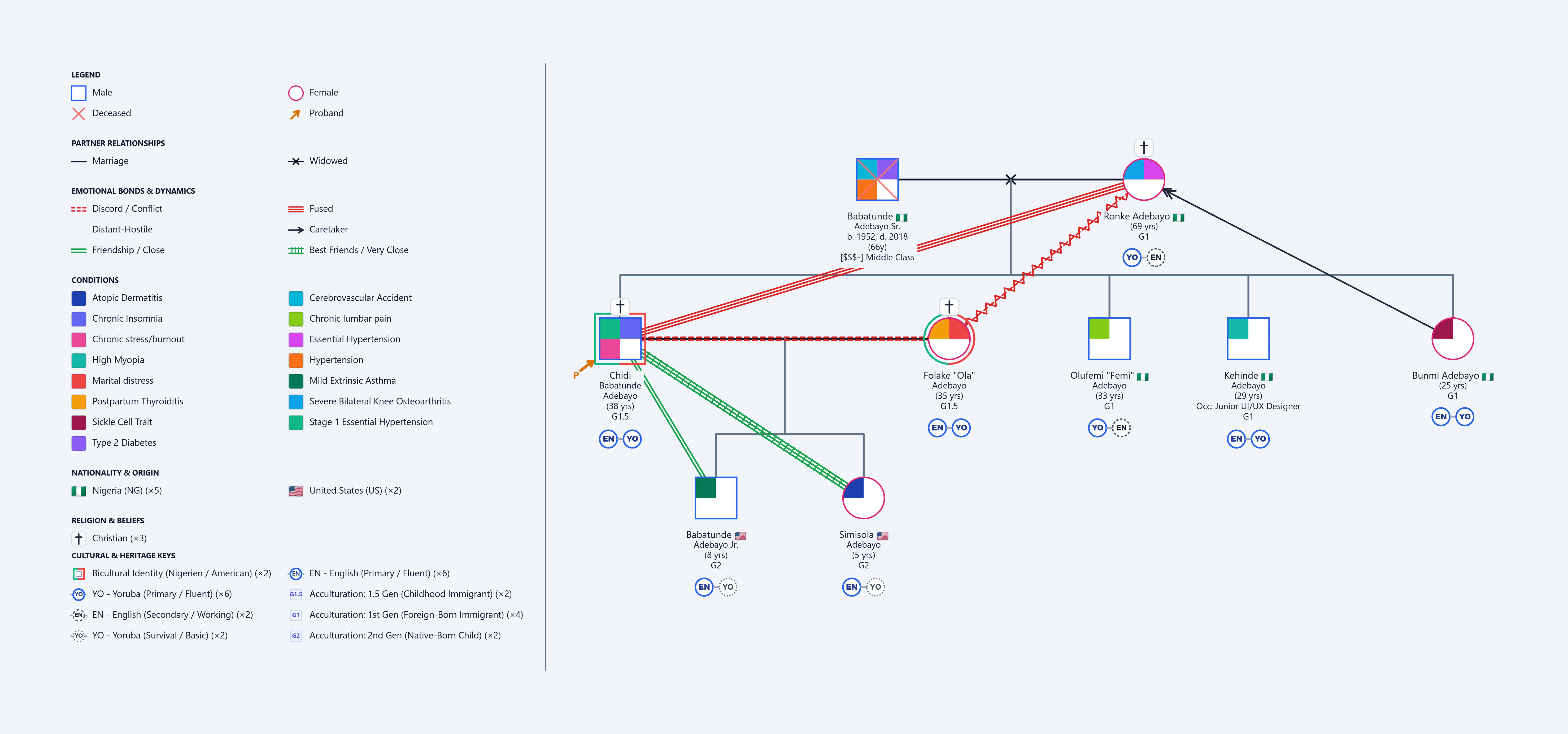
Case Clinical Profile
Session 12: Bowenian De-Triangulation, Acculturation Dissonance & Filial Caregiver Boundaries
Client Narrative & Presenting Distress
Reported interval stressors and direct quotations
Observable Findings & Systemic Enactments
MSE presentation, dyadic interaction, and canvas metrics
Systemic Formulation & Audit Synthesis
Bowenian triangulation, acculturation, and medical necessity
Therapeutic Interventions & Homework
Prescribed homework, medical coordination, and scheduling
Section 6: Clinical, Legal & Billing Do's and Don'ts
| Category | ✅ DO (Audit-Proof & Best Practice) | ❌ DON'T (Audit Denial & Legal Risk) |
|---|---|---|
| Session Timing | Record exact start and stop times (for example: 10:02 AM to 10:55 AM). | Write estimated durations like "about 45 minutes" or "standard session". |
| Family vs. Individual | Identify the Identified Patient (IP) on CPT 90847 and justify medical necessity. | Bill couples or family sessions as general relationship coaching without a diagnosis. |
| The Golden Thread | Reference active treatment plan goal numbers in the note to show clinical progress. | Document interventions that have no connection to the treatment plan. |
| Open Notes (Cures Act) | Write objective, behavior-based progress notes that clients can review on portals. | Use judgmental adjectives like "client was manipulative, rude, or non-compliant". |
| HIPAA Dual-Vault | Store private countertransference musings in a separate, encrypted vault. | Mix raw personal speculations into the official medical record where they can be subpoenaed. |
| Diagram Attribution | Reference visual systemic evidence: "Genogram revealed a three-generation cutoff." | Draw diagrams in isolation and never mention them in the official clinical narrative. |
| AI Documentation | Scrub all Protected Health Information (PHI) locally before using AI assistance. | Paste real client names and identifying narratives into unvetted public cloud AI models. |
Section 7: How Genosm Bridges Visual Family Systems and Therapy Notes
Genosm was built by clinicians and engineers who believe that visual family mapping and clinical documentation belong in a single workflow. Here is what makes Genosm unique:
1. Abstract Syntax Tree (AST) Serialization
Genosm turns every node, relationship line, and ecomap connection into structured clinical data that maps directly into SOAP, DAP, BIRP, and 8 other frameworks without manual re-typing.
2. Zero-Cloud PHI Shield
Client names and identifying details are scrubbed directly on your local device before
processing. The AI engine only analyzes anonymized tokens like [[PERSON_1]] and
graph relationship data. Once the note is generated, your browser rehydrates the real names
locally. No client health information is stored on external cloud servers.
3. Conversational AI Note Co-Pilot
You can edit specific sections without re-generating the entire note. Tell the co-pilot to "expand the Intervention to include somatic grounding" or "shorten the Assessment section", and it adjusts only that section while leaving the rest of your note intact.
4. Local-First IndexedDB with AES-256-GCM Encryption
All clinical notes, client lists, and process notes are stored securely in your browser's local IndexedDB database, backed by optional client-side WebCrypto encryption.
5. Universal 1-Click EHR Export
Format your notes for immediate clipboard copying into SimplePractice, TherapyNotes, Epic, Jane, and Cerner, or export an audit-ready, digitally signed PDF.
Frequently Asked Questions
Genosm supports 11 clinical documentation frameworks directly connected to your therapeutic diagrams:
- SOAP: Subjective, Objective, Assessment, Plan (EHR and commercial insurance standard).
- DAP: Data, Assessment, Plan (streamlined private practice talk therapy).
- BIRP: Behavior, Intervention, Response, Plan (behavioral health and Medicaid audits).
- GIRP: Goal, Intervention, Response, Plan (CBT and solution-focused goal tracking).
- PIRP: Problem, Intervention, Response, Plan (crisis intervention and acute stabilization).
- DIRP: Data, Intervention, Response, Plan (relational systems and couples/family dyads).
- EMDR 8-Phase: Complete Adaptive Information Processing protocol with BLS sets, VOC, and SUD tracking.
- Biopsychosocial Intake: Comprehensive initial diagnostic evaluation chart (CPT 90791).
- SMART Treatment Plan: Audit-ready treatment goals with behavioral indicators and cadence.
- Stanley-Brown Safety Plan: Crisis protocol with means safety and green-zone ecomap contacts.
- Discharge Summary: Treatment episode completion, functional gains, and relapse prevention.
Supported visual inputs include 3-generation family genograms, ecomaps, pedigree charts, and sociograms.
Match your documentation framework to your clinical modality, session participants, and billing requirements:
- Individual Talk Therapy (CPT 90834/90837): Use DAP for fast-paced documentation or SOAP if billing commercial insurance or coordinating with primary care physicians.
- Conjoint Couples or Family Sessions (CPT 90847): Use DIRP or SOAP to capture observable dyadic interactions, boundary realignments, and de-triangulation enactments.
- Trauma & Somatic Sessions: Use EMDR to record target touchstones, bilateral stimulation sets, negative/positive cognitions, and somatic body scans.
- Behavioral Health & Community Clinics: Use BIRP to meet Medicaid audit requirements that demand explicit evidence of clinician interventions and client responses.
- CBT & Solution-Focused Care: Use GIRP to show insurance payers direct progress against numbered treatment plan goals.
- Crisis Encounters (CPT 90839): Use PIRP or Stanley-Brown Safety Plan to document acute risk assessment, de-escalation, and lethal means safety.
Genosm parses your canvas as a live Abstract Syntax Tree (AST). Rather than treating your diagram as a static drawing, the engine interprets every node and line as structured clinical facts:
- Subjective (S): Populated with client quotes, reported interval stressors, and emotional distress descriptions.
- Objective (O): Populated with in-session observations, Mental Status Exam snapshot, and exact relational lines from the canvas (such as fused mother-son bonds, in-law conflict, or marital estrangement).
- Assessment (A): Synthesizes systemic etiology (such as Bowenian triangulation, acculturation dissonance, and parental cutoff) directly connected to the active DSM-5-TR diagnosis.
- Plan (P): Formulates structured behavioral homework, next session cadence, and CPT billing codes based on actual face-to-face duration.
You can generate the note with one click, refine specific sections conversationally with the AI Note Co-Pilot, or author notes manually using built-in clinical dot-phrases.
Yes, Genosm is engineered with a Zero-Cloud PHI Shield that guarantees complete HIPAA compliance:
- Client-Side De-Identification: All client names, birthdates, and identifying markers are stripped and replaced with temporary cryptographic tokens (such as [[PERSON_1]]) directly inside your web browser before transmission.
- Zero PHI Cloud Storage: External AI models only process anonymized relational graph data. No Protected Health Information (PHI) is ever retained, cached, or used to train third-party AI models.
- Local In-Browser Rehydration: Once the generated note returns to your browser, your local device automatically restores the real client names.
- Local-First Encrypted Vault: All client notes and process reflections are stored locally in your browser's IndexedDB database, with optional client-side WebCrypto AES-256-GCM encryption.
Stop Documenting in Silos. Start Connecting Diagrams to Notes.
Join hundreds of therapists who have replaced pajama time with Genosm's Diagram-to-Notes Studio. Create your first note in seconds with complete zero-cloud PHI peace of mind.