Essential Clinical Questions
How is an adopted child accurately represented on a clinical genogram? Can a single diagram effectively visualize both biological heritage and adoptive bonds without becoming illegible? What are the specific symbols for foster care transitions versus legal adoption? These questions represent more than technical hurdles; they are the foundation of understanding a child's multi-layered identity.
In clinical practice, the traditional family tree often fails to capture the complexity of adoption. A standard line of descent does not account for the profound impact of birth parents, foster placements, or the legal finality of a decree. This guide examines the authoritative methods for mapping these relationships, ensuring that every significant bond is documented with precision.
The Symbolic Grammar of Adoption
Clinical accuracy depends on the consistent use of standardized symbols. In the McGoldrick-Gerson style of genograms, specific line types denote the nature of the parent-child relationship. A solid vertical line always indicates a biological connection. To represent a legal adoption, a dashed vertical line is utilized. This visual distinction allows a clinician to see, at a glance, the different layers of a patient's history.
The Adoption Symbol Cheatsheet
-
Legal Adoption: A dashed vertical line connecting the child to the adoptive parents. This signifies legal finality.
-
Foster Care (Long-term): A dotted vertical line. This represents a significant placement that lacks the legal permanence of adoption.
-
Biological Connection: A solid vertical line. This is essential for tracking hereditary medical risks even if the parents are not present in the child's life.
Clinical Line Standards
Biological
Solid vertical line for genetic heritage.
Adoptive
Dashed vertical line for legal adoption.
Foster
Dotted vertical line for foster care.
Treating different types of adoptions requires nuance. In "closed" adoptions, the biological parental symbols may remain empty of names but filled with medical knowns. In "open" adoptions, the genogram must bridge two distinct family systems. This is often achieved through a lateral connection or by placing the biological parents to the side, connected to the child with a solid line that bypasses the adoptive parents' nucleus.
The Open Adoption Triangle
In modern clinical settings, the "Open Adoption Triangle" represents the ongoing relationship between the birth family, the adoptive family, and the child. Mapping this requires a non-hierarchical approach. Instead of placing birth parents as a "past" event, they are positioned as an active branch. The use of "Relationship Indicators" such as solid green lines for positive contact or red zig-zag lines for strained interactions between the two sets of parents provides a level of detail that narrative notes often fail to capture.
When representing the birth parents, it is standard practice to place them to the left or right of the primary family unit. A solid line then drops from the birth parents to the child node, intersecting or running parallel to the dashed adoption line. This visual reinforces that the child belongs to two distinct systems simultaneously. It also helps the clinician identify potential loyalty conflicts or "split allegiances" that the child may experience during developmental milestones.
Practical Application: The Mehta Family
Rahul and Ananya Mehta, married since 2010, share a biological daughter, Aarohi. In 2016, they adopted Kabir, whose biological parents, Vikram and Neha Rao, remain emotionally involved through a legally defined open-adoption agreement. Furthermore, in 2019, the Mehtas became foster parents to Sana Khan, who lives with them full-time but remains legally classified under a government foster-care program with an active biological mother. This case demonstrates how a genogram must function as a living document to maintain clinical clarity across three distinct types of parent-child relationships.
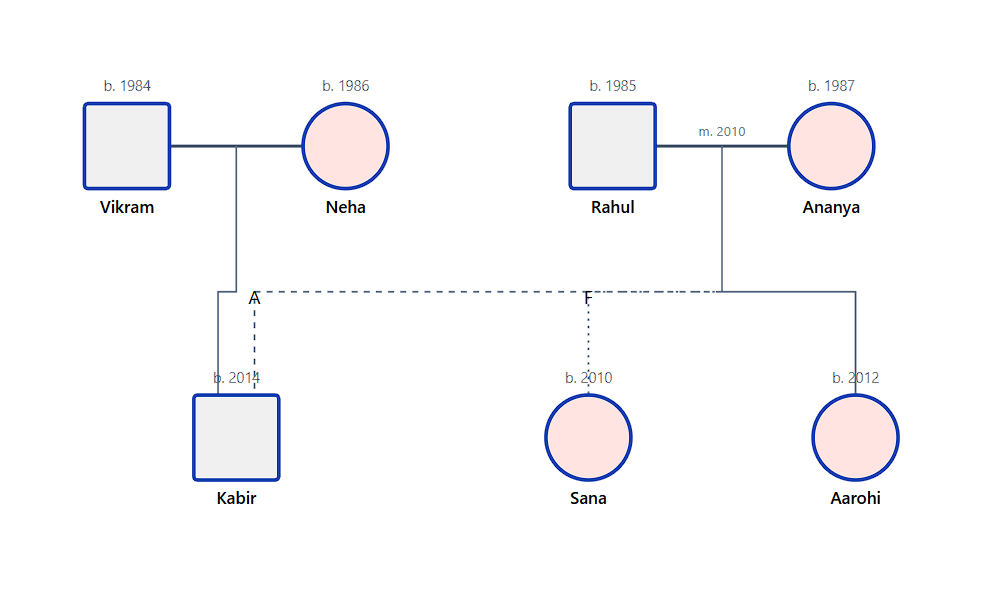
Figure 2: The Mehta Family Genogram. Note the use of solid lines for Aarohi (Biological), dashed lines with 'A' for Kabir (Adopted), and dotted lines with 'F' for Sana (Foster).
Clinical Observations: Identity and Belonging
In this household, the genogram serves as a vital tool for externalizing the internal landscape of each child. For Kabir, the "Dual Root" visualization allows him to acknowledge both "Papa Vikram" and his adoptive father, Rahul, without one relationship threatening the other. The genogram validates Kabir's multi-layered identity by giving his biological parents a permanent, acknowledged space on the family map.
For Sana, the foster-care notation (the dotted line) provides a clear boundary. It acknowledges her deep integration into the Mehta home while respecting her ongoing connection to her biological mother. Clinically, this prevents the "ambiguous loss" that foster children often feel when their origins are ignored or obscured by their current placement. Mapping the "Foster" relationship with clinical precision ensures that the therapist can track Sana's transitions and permanency planning without losing sight of her roots.
Finally, for the biological child, Aarohi, seeing the different lines on the genogram helps her navigate her own role in a complex family system. The map makes the "invisible invisible" visible, fostering a sense of shared, albeit varied, belonging. It proves that a clinical genogram is not just for tracking pathology, but for celebrating the diverse ways families are constructed and sustained.
How to Map Adoption in Genosm
Genosm is designed to handle these non-linear family structures with clinical precision. Unlike generic drawing tools, Genosm allows for the direct definition of relationship types through its AI-assisted canvas.
Step 1: Define the Relationship
When adding a new person under a parent node, the "Relationship Type" dropdown provides options for "Biological," "Adoptive," and "Foster." Selecting these automatically adjusts the line rendering to the correct clinical standard.
Step 2: Utilize Multi-Parent Mapping
To show both birth and adoptive parents, one can drag a second relationship line from a different couple to the same child. Genosm maintains the distinction by applying the specified line patterns automatically.
Step 3: Apply Templates
For a faster workflow, use our pre-built templates:
- • Adopted Child Template – A couple with one adopted child (dashed line)
- • Foster Child Template – A couple with one foster child (dotted line)
These provide pre-configured layouts ready for complex data entry.
Step 4: Annotate Transitions
The "Notes" feature in Genosm is crucial here. One can add timestamped annotations to the foster or adoption lines to document transition dates or legal hearings.
Test Your Knowledge
Students and professionals: Take our free genogram quiz to reinforce your understanding of adoption and foster care symbols.
Take the Genogram Quiz →Includes questions on adoption (dashed lines) and foster care (dotted lines)
The Clinical Impact of Accurate Mapping
Why does this level of detail matter? It matters because an incomplete map leads to incomplete treatment. In cases of reactive attachment disorder or complex trauma, seeing the timeline of foster care placements alongside the transition to a permanent adoptive home provides context for current behaviors. It allows the therapist to spot "anniversary reactions" or patterns of abandonment that a simplified family tree would obscured.
Accuracy also serves the medical needs of the patient. By keeping a solid line for biological parents, even if they are marked as "Unknown" or "No Contact," the genogram serves as a permanent placeholder for future genetic data. It reminds the clinician and the patient that a part of the history is yet to be written.
Furthermore, the process of creating the genogram with an adult adoptee or a child in foster care is itself therapeutic. It validates the child's entire history, acknowledging both their origins and their current belonging. Mapping both families tells the patient: "All of your roots matter."
Life Story Work and Transitional Mapping
In child welfare, "Life Story Work" is a specialized intervention designed to help children in foster care integrate their past with their present. The genogram is the primary visual anchor for this work. By mapping out every foster placement, even temporary ones, using dotted lines and clear dates, the clinician helps the child build a cohesive narrative of their life.
Transitions between homes are often traumatic. When a child can see their journey on a page, the "gaps" in their memory begin to fill. If a child spent three years with "Foster Family A" and two years with "Foster Family B," the genogram documents these attachments as valid parts of their development. This prevents the "erasure" of meaningful bonds that occurred before the final adoption decree. For a child, seeing that their history is documented and respected by an adult professional is a powerful act of validation.
Professional Ethics: Privacy and Confidentiality
Mapping adoption requires a high degree of ethical vigilance. Often, information regarding birth families is sensitive, incomplete, or legally restricted. Professionals must navigate the balance between thorough clinical documentation and the patient's right to privacy.
Standard practice involves using "De-identified Notations" when birth parent names are unknown or when their disclosure could pose a risk. Instead of names, nodes are labeled by their relationship (e.g., "Birth Mother") and populated with general data (e.g., "Age 42 at time of adoption"). This maintains the clinical utility of the map while adhering to HIPAA and other privacy standards. In Genosm, the use of private, local-first storage ensures that this sensitive family data remain strictly within the clinician's control, a vital feature for those handling "high-conflict" or "confidential" adoption cases.
Start Your Complex Family Mapping Today
Download the expert-validated Adopted Child Template or use Genosm's AI to build yours from a simple description.
Recommended Reading
Genogram vs. Pedigree vs. Ecomap vs. Family Tree
A definitive professional comparison of family mapping tools for clinical, medical, and social assessment.
Why Genograms Matter in Clinical Practice
Learn how visual family mapping reveals intergenerational patterns that text-based notes miss.