Genograms in Couples Counseling: Mapping Dyadic Loops & In-Law Dynamics
How to stop the blame game in session one, externalize inherited conflict playbooks, and map multi-marriage families without confusing line crossings.
Key Takeaways for Couples Clinicians
- • Externalizes Spousal Blame: A couples therapy genogram shifts arguments from "You are attacking me" to "Look at the family habits we both learned in childhood."
- • Makes In-Law Triangles Visible: Mapping extended family lines helps partners recognize loyalty binds and enmeshment without the therapist picking sides.
- • Clarifies Blended Families: Clear symbols for divorce, step-children, and remarriage turn chaotic modern households into clear, legible maps.
- • Deconstructs Intimacy Taboos: Incorporating sexual genogram questions reveals how desire discrepancies and emotional scripts started generations earlier.
- • Why Clinicians Choose Genosm: Genosm is the only diagram suite with native sexual genogram markers, split-screen partner comparison, clean remarriage routing, and 1-click CPT 90847 session progress note exports with local-first HIPAA privacy.
The Core Problem: When Two Distinct Family Playbooks Collide
Most couples come to therapy feeling exhausted. In session one, they often recount the same argument they had on the car ride over. The husband complains that his wife is critical. The wife complains that her husband shuts down and runs to his mother for advice.
When you use a genogram for couples, the entire tone of the room changes. When you place both three-generation family trees side by side, partners look at a screen together. The problem is no longer located inside the other person. The problem is visible on the canvas as an inherited relational pattern.
Clinical Case Formulations: 3 Practical Examples
How real clinicians map dyadic loops, in-law conflict, and blended families on Genosm.
The In-Law Triangulation & Loyalty Bind
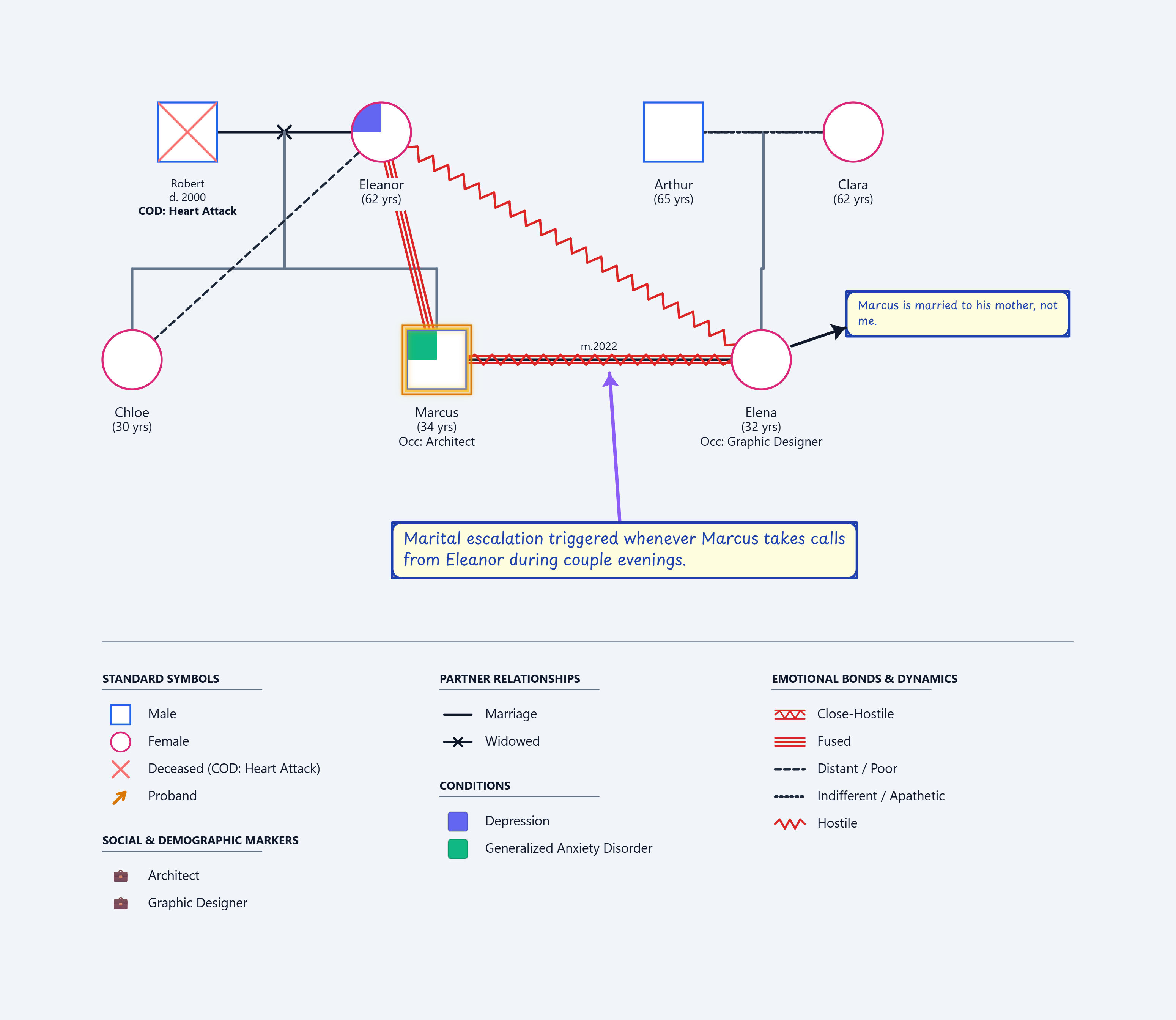
Couples Background: Marcus (34) and Elena (32), married 4 years. Elena states: "Marcus is married to his mother, not me." Marcus says: "Elena hates my family and expects me to abandon my widowed mom."
Genogram Mapping Method:
- Marcus to Mother: Triple solid line indicating a fused/enmeshed relationship. Marcus became his mother's emotional companion after his father died when Marcus was 12.
- Elena to Mother-in-Law: Jagged red line indicating a conflictual/hostile relationship.
- Marcus to Elena: Double solid line with a zigzag center indicating an enmeshed yet unstable, conflictual dyad.
- The Bowen Triangle: Whenever Marcus and Elena experience marital friction, Marcus calls his mother, stabilizing his personal anxiety while escalating the marriage distress.
The Breakthrough: By seeing the in-law triangulation genogram symbol on screen, Marcus realized his loyalty was keeping his marriage in crisis. Elena recognized that Marcus's hesitation was not lack of love for her, but childhood guilt.
The Pursuer-Distancer Cycle (Gottman & EFT)
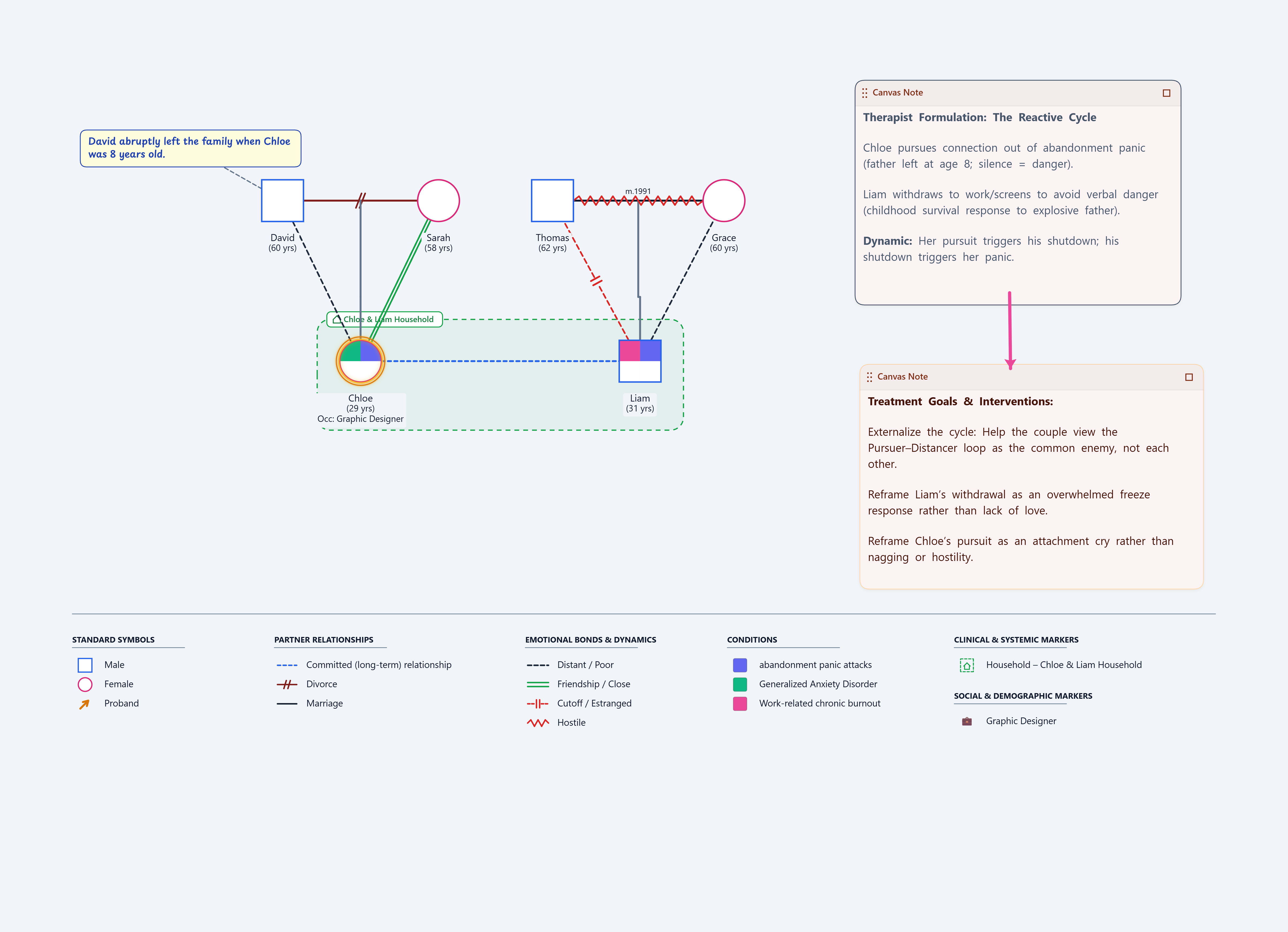
Couples Background: Chloe (29) and Liam (31), together 5 years. Chloe describes herself as constantly begging for connection. Liam admits he stays at work late and retreats to his computer during conflicts.
Genogram Mapping Method:
- Chloe's Family of Origin: Chloe's father abruptly left the family when she was 8. Dotted lines indicate emotional distance and fear of abandonment. Chloe learned that silence equals abandonment, creating her pursuing habit.
- Liam's Family of Origin: Liam grew up with an explosive, hyper-critical father. Liam's relationship with his father is marked with double slash lines representing an emotional cutoff. Liam learned that emotional expression brings verbal danger.
- The Dyadic Loop: Chloe pursues out of panic. Liam stonewalls out of childhood self-protection. Each partner's survival strategy activates the other's worst childhood fear.
The Breakthrough: Mapping pursuer distancer genogram emotional lines allowed Chloe to see Liam's silence as a freeze response, while Liam learned that Chloe's raised voice was an attachment cry rather than cruelty.
The Al-Mansoor & Chen Blended Family: Cross-Cultural Tension, Desire Discrepancy & In-Law Triangulation
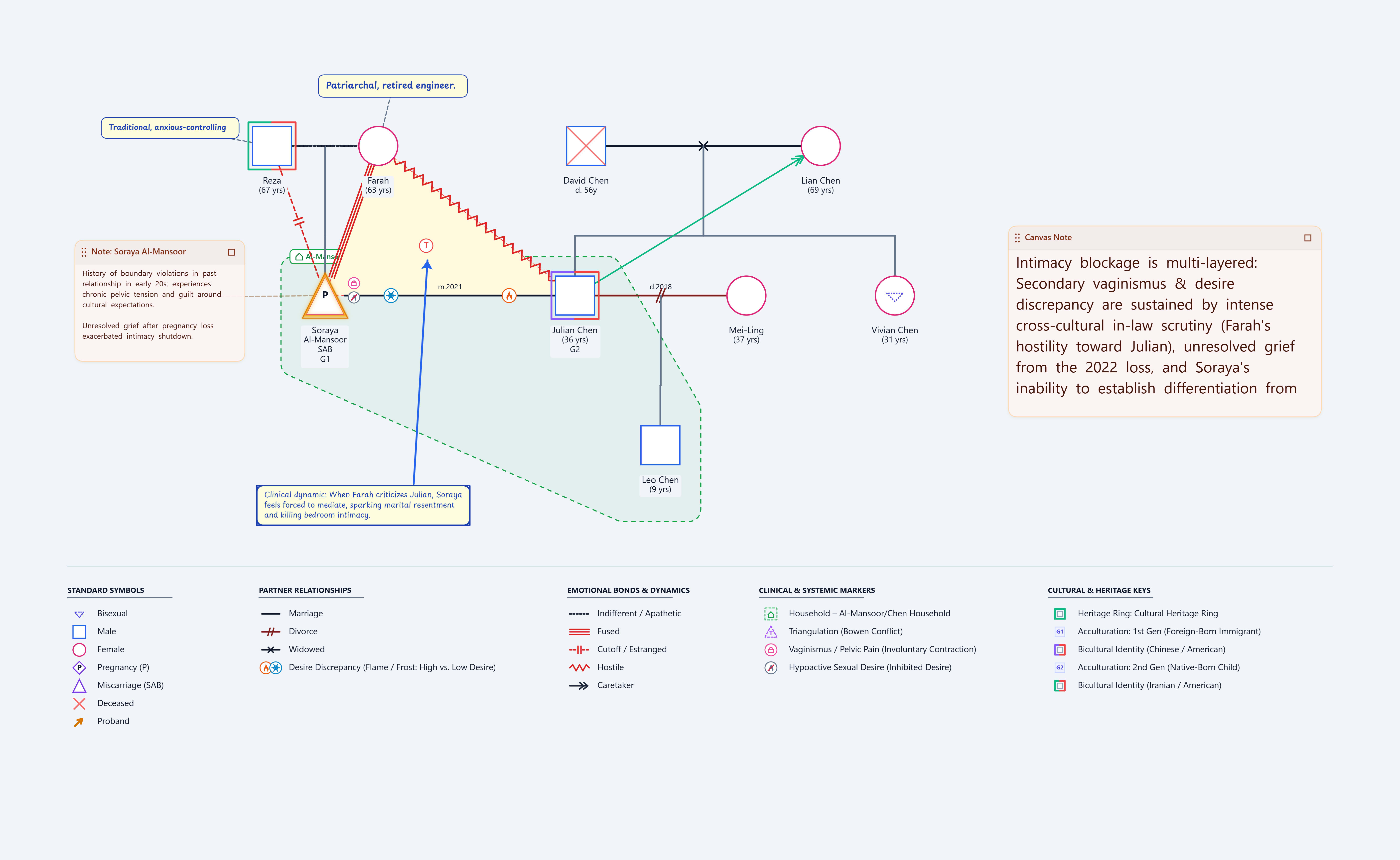
Couples Background: Soraya Al-Mansoor (34, Architectural Designer, 1st-gen Iranian-American) and Julian Chen (36, Software Engineering Manager, 2nd-gen Chinese-American), married in 2021. They present for couples therapy experiencing intimacy shutdown, desire discrepancy, sexual pain (vaginismus), and acute marital strain rooted in in-law triangulation, cultural rupture, and blended family step-dynamics.
Genogram Mapping Method:
- Primary Dyad & Desire Discrepancy: Soraya (Index Client / Proband, double outline) and Julian (married 2021) share a Close & Conflicted emotional bond. The union line features an active Desire Discrepancy marker (Julian: High Desire partner; Soraya: Low Desire partner). Soraya's clinical record notes Vaginismus and Hypoactive Sexual Desire Disorder (HSDD) rooted in past boundary violations and cultural expectations.
- Blended Family & Pregnancy Loss: Julian's prior marriage to Mei-Ling (37) is coded with double divorce slashes (`//`, divorced 2018). Julian's biological son Leo (9) resides primarily in their home under a step-mother dynamic. Under Soraya and Julian's union line, a filled dot symbol (`•`) documents an unresolved miscarriage (2022) that compounded marital withdrawal.
- Soraya's Lineage (Cultural Rupture & Mother Enmeshment): Parents Farah (63) and Reza (67) are married with a distant/cold emotional bond. Farah has a Fused / Enmeshed connection with Soraya (calling 4 times daily and intruding into marital decisions), while Reza has a severed Emotional Cutoff (vertical double red bars) after Soraya married outside her cultural heritage. Farah maintains an actively Hostile bond (zigzag red line) toward Julian.
- Julian's Lineage (Widowed Mother & Ally Sibling): Deceased father David (d. 2019, age 65) and widowed mother Lian (69), who holds a Fused / Caretaking bond with Julian as eldest son. Julian's sister Vivian (31, Bisexual) shares a Close / Supportive bond with Soraya, serving as her primary ally and cultural confidante.
- Systemic Household & Triangulation Markers: A dashed Household Boundary defines the "Al-Mansoor/Chen Household" (Soraya, Julian, and Leo). A Bowenian Triangulation Marker connects Farah → Soraya → Julian, showing how maternal criticism forces Soraya into a high-anxiety mediator role that triggers marital resentment and shuts down sexual intimacy.
The Breakthrough: Visualizing the intersecting lines of in-law triangulation, cultural estrangement, blended family responsibilities, and perinatal grief de-pathologized the couple's intimacy crisis. Rather than interpreting low desire as personal rejection, Julian understood the systemic weight Soraya carried. The couple leveraged the genogram to establish firm dyadic boundaries with in-laws, protecting their household and restoring safety in the bedroom.
Why Traditional Genogram Tools Fail in Couples Counseling
Most diagram tools were designed 20 years ago for simple medical genealogy. Couples therapy demands deep relational nuance.
| Clinical Need in Couples Therapy | Legacy Tools (GenoPro, Lucidchart, Canva) | Genosm Couples Studio |
|---|---|---|
| Sexual Genogram Markers | Zero tools support Hof and Berman markers. Clinicians must draw confusing makeshift notes by hand. | Native sexual genogram overlay covering desire discrepancy, scripts, and intimacy history. |
| Blended Families & Remarriages | Lines cross awkwardly over children when someone has 2 or more prior partners. Diagrams look like spiderwebs. | Smart auto-routing keeps prior marriages and step-children organized with standard divorce slashes. |
| Comparing Both Partners Side-by-Side | Forces both families onto one giant cluttered tree or separate files that cannot be viewed together. | Split Workspace Compare Mode lets you examine Partner A's family of origin directly against Partner B's. |
| Emotional Relationship Notation | Usually limited to 3 basic lines (married, divorced, child). Cannot represent enmeshment or cutoffs. | 34+ clinical emotional lines including fusion, hostility, cutoffs, triangulation, and abuse markers. |
| Showing Progress Across Sessions | Static canvas. You must redraw the whole diagram from scratch to show a couple how their boundaries improved. | Version Timeline with visual diff. Compare intake baseline against session 12 to celebrate de-triangulation. |
| Client Confidentiality & Affairs | Stores sensitive infidelity notes on public servers vulnerable to data breaches or discovery. | Zero-cloud local-first encryption. Data lives in the clinician's browser. 1-click de-identification for records. |
How to Map In-Law Dynamics on a Genogram
In-law conflicts are rarely about the in-laws themselves. They are about unfinished differentiation in one partner's childhood family. Using bowen couples genogram triangulation techniques, you can map these lines accurately:
1. The Healthy Boundaried Line
A solid horizontal marriage line with clear vertical connections. Extended parents are respected, but decisions are made inside the couple perimeter.
2. The Fused/Enmeshed In-Law Line
Three parallel solid lines between partner and parent. Indicates regular over-involvement, emotional rescue habits, and lack of privacy from in-laws.
3. The Cutoff Line
A line interrupted by double perpendicular tick marks. Represents cold estrangement, refusal to attend family events, and silent resentment.
When one partner is fused with their parent, the other partner usually feels isolated and develops a conflictual line with that parent. The couple's marital friction is actually an in-law triangle in disguise.
Sexual Genogram for Couples Therapy
Sexual desire discrepancy is one of the most common reasons couples seek therapy, yet standard genograms do not have symbols for physical intimacy. A sexual genogram for couples therapy bridges this gap based on the Hof and Berman clinical framework:
What Questions Should a Therapist Ask During a Couples Genogram?
To keep couples engaged without triggering defensiveness, introduce questions in four gentle stages:
Stage 1: Factual Demographics (Safe Warm-Up)
- "Where do you fall in your sibling birth order, and what expectations came with that role?"
- "Did your parents stay together, divorce, or remarry? At what ages were you when those changes happened?"
Stage 2: Gottman Family of Origin Genogram Questions
- "When your parents disagreed, did they yell, use sarcasm, give the silent treatment, or talk calmly?"
- "Which of the Four Horsemen (criticism, defensiveness, contempt, stonewalling) was the loudest in your childhood kitchen?"
Stage 3: Bowen In-Law Triangulation Questions
- "When your parents had marital tension, were you pulled in to referee or comfort one of them?"
- "When we disagree as a couple today, do you feel an urge to vent to your mother, father, or sibling?"
Stage 4: Synthesis & New Rules
- "Which unwritten rule from your family do you want to retire from this marriage forever?"
- "What generational strength or resilience from your grandparents can you lean on right now?"
Tracking Dyadic Growth: Version Timeline with Visual Diff
Couples often ask: "Are we actually making progress?" Standard talk therapy notes struggle to demonstrate systemic shifts. With Genosm's visual versioning:
High-Conflict Triangulated System
Shows active in-law fusion, jagged conflict lines between partners, and stonewalling cutoffs.
Differentiated Dyad with Boundaries
In-law fusion is replaced by a healthy, boundaried connection. Marital line shifts from hostile to a secure double-solid bond.
Genosm highlights changes in color. Showing couples their before-and-after diagram reinforces their commitment and validates the work they have accomplished.
CPT 90847 Genogram Session Documentation
Couples therapy billing under CPT 90847 (family psychotherapy with client present, 50 minutes) requires proof of medical necessity and systemic formulation. Genosm's integrated Note Co-Pilot translates your visual genogram into audit-ready SOAP and DAP notes in seconds:
Assessment: Dyadic conflict exacerbated by unresolved family-of-origin loyalty binds and maternal triangulation.
Intervention: Executed multigenerational genogram review. Deconstructed pursuer-distancer loop. Established boundary agreement regarding extended family contact.
Plan: Practice 20-minute time-out de-escalation protocol. Next visit scheduled under CPT 90847.
Frequently Asked Questions About Couples Genograms
How do you use a genogram with couples?
A clinician maps both partners families three generations back onto a unified canvas. This helps the couple look at communication patterns, conflict habits, and in-law expectations as learned scripts rather than personal character flaws.
How do you map in-law interference on a genogram?
In-law interference is drawn using emotional lines. You draw a fused/enmeshed line (three solid lines) between one partner and their parent, and a jagged conflictual line between that parent and the spouse, forming a clear visual triangle.
How do you document infidelity or an affair on a clinical genogram?
Infidelity is documented using a dotted or dashed partnership link to the third party, accompanied by a mistrust or cutoff symbol between the spouses. Genosm protects this sensitive information using local-first browser storage with zero cloud exposure.
Can genograms help resolve pursuer distancer loops?
Yes. By tracing where each partner learned their conflict habits, the pursuing partner realizes the withdrawal is a self-protection habit learned in childhood, while the withdrawing partner learns that the pursuit is a cry for attachment security.
How do genograms handle complex blended families and multiple marriages?
Genosm uses automated multi-partner horizontal routing. Marriages and divorces are ordered chronologically from left to right with standard double hash marks, keeping child lines neat and avoiding crossed vectors.
Build Your First Couples Genogram Today
Join hundreds of LMFTs, psychologists, and couples counselors who use Genosm to clarify in-law dynamics, resolve dyadic loops, and export audit-ready clinical notes.
Start 7 Days Free Trial. 100% local-first HIPAA privacy guarantee.