Sexual Genogram: The Clinical Guide to Transgenerational Intimacy, Scripts, and Modern Families
Learn how systemic therapists assess sexual heritage, desire dynamics, gender affirmations, and
non-traditional family structures across three generations.
Clinical Practice Edition (2026)
Peer-Referenced Clinical ProtocolGenosm: Leading Sexual Genogram Maker
Key Takeaways for Mental Health
Practitioners
Core principles of modern clinical sexual
genograms
1
Multigenerational Sexual Transmission: Sexual attitudes, body shame, purity
mandates, and intimacy styles travel quietly across generations through family emotional
systems.
2
Gagnon & Simon's Three Script Levels: Sexual problems rarely start in
the bedroom. They live at the crossroads of cultural rules, partner interactions, and
individual beliefs.
3
Protecting Node Interiors: Standard medical genograms require clean node
interiors for disease quadrants and carrier dots. Modern sexual markers belong on the
outside of the shape.
4
Genosm as the Ultimate Tool: Genosm is the only clinical platform built to
natively render sexual orientation milestones, gender affirmation timelines, desire
discrepancy markers, and consensual non-monogamy with zero text clutter.
5
Beyond Pathology: Sexual genograms reframe intimacy struggles from personal
defects into systemic adaptations. This gives couples, queer clients, and polycules a
neutral visual language for healing.
The sexual genogram is not a simple family tree. It is a structured psychological blueprint of
human intimacy across generations. While medical genograms map biological illnesses and family
systems genograms track alliances, the sexual genogram uncovers how people learn to desire,
fear, touch, communicate, and love.
The tool was created in 1986 by family therapist Larry Hof and psychiatrist
Ellen M. Berman. In their landmark work, The Sexual Genogram,
published in the Journal of Marital and Family Therapy, Hof and Berman recognized a glaring
blind spot in clinical practice: therapists were treating sexual dysfunctions as isolated
physical problems or simple marital conflicts. They ignored the powerful multigenerational rules
that shaped how clients experienced their bodies.
Hof and Berman demonstrated that every family passes down unspoken rules about sexuality. These
rules dictate whether nudity is natural or sinful, whether physical touch signals love or
danger, and whether pleasure is celebrated or punished. By gathering data across at least three
generations, therapists can help clients realize that their sexual fears or blocks did not begin
with them.
1973 • Sociology
Gagnon & Simon
Introduced Sexual Scripting Theory, proving human sexuality is learned through cultural and
social scripts rather than pure instinct.
1986 • Origins
Hof & Berman
Published the foundational clinical framework for the sexual genogram in marital and sex
therapy.
2000s •
Integration
Weeks & Gambescia
Built Systemic Sex Therapy, integrating biological treatments with relational systems and
transgenerational legacies.
2012 • Modernity
Belous et al.
Expanded the sexual genogram to include gender identity diversity, queer lineages, and
consensual non-monogamy.
2. Gagnon & Simon's Sexual Scripting Theory
To understand why sexual conflicts happen, systemic clinicians rely on the pioneering framework
of sociologists William Simon and John Gagnon (1973). Gagnon and Simon proved
that human sexual behavior is not an automatic animal drive. It is a deeply rehearsed
psychological drama governed by three interconnected script levels.
Level 1: Cultural Scenarios
Macro Systemic Rules
These are the broad societal blueprints. They define what is acceptable, who may touch whom,
purity ideals, legal marriage models, and heteronormative pressures. When families live
under strict religious or cultural dogmas, these scenarios create deep conscious and
unconscious guilt.
Level 2: Interpersonal Scripts
Relational Dance
This is the shared choreography between partners. It dictates who initiates, how boundaries
are stated, how rejection is given or received, and how desire differences are negotiated.
Misunderstandings happen when partners bring clashing unwritten scripts into the bedroom.
Level 3: Intrapsychic Scripts
Internal Erotic Core
This is the individual mind: personal fantasies, bodily sensations, arousal triggers,
private shame, and self-worth. It represents what turns a person on or off, often running in
direct conflict with family rules learned in childhood.
Clinical Core Foundation
3. The Three Distinct Pillars: Biological Sex, Gender Identity, and Sexual Orientation
In sex therapy and family systems assessment, confusing these three dimensions is one of the
most common and damaging clinical mistakes. Each pillar represents a completely independent
layer of human experience. A person can have any combination across these three domains.
Older genogram software forced therapists to pick a single symbol that blurred body anatomy with
internal identity and romantic attraction. Genosm was built from the ground up to separate these
three dimensions into independent, first-class fields in the Basic Tab. This
gives clinicians the exact vocabulary needed to chart modern, diverse families with diagnostic
accuracy.
01
Pillar 1: Biological Sex (Assigned Sex at Birth)
Anatomy, Chromosomes & Reproductive Physiology
Biological sex refers to the physical anatomy, sex chromosomes, internal
reproductive organs, and hormonal baselines present at birth. In Genosm's Basic Tab,
this is recorded through four foundational categories:
Male (AMAB)
Assigned Male at Birth. Represented by the standard clinical square boundary.
Female (AFAB)
Assigned Female at Birth. Represented by the standard clinical circle boundary.
Intersex / DSD
Congenital variations in sexual anatomy or karyotypes (e.g., 46,XY, 47,XXY
Klinefelter, 45,X Turner).
Unknown / Undocumented
Unconfirmed or historical lineage records where birth sex is undocumented.
Why it matters in a sexual genogram: Biological sex is critical for
tracking hereditary health risks (such as BRCA breast cancer, hemophilia, or heart
disease) and understanding fertility or hormone baselines. However, it does not
determine who the person is inside or whom they love. Genosm keeps the node interior
100 percent reserved for medical conditions, never using body anatomy to limit
personal identity.
02
Pillar 2: Modern Inclusive Gender Identities
Internal Psychological Sense of Self & Lived Experience
Gender identity is a person's deeply felt, internal sense of being a man, a woman,
non-binary, or another gender entirely. Genosm provides the industry's most
comprehensive clinical dropdown, organized into five clear groups:
1. Cisgender
Male (Cisgender) • Female
(Cisgender)
When a person's internal sense of gender
completely matches their assigned birth sex.
2. Transgender
Trans Male (FTM) • Trans Female
(MTF)
When gender differs from birth sex. Visualized
using affirmed shapes and transition timeline arrows.
3. Non-Binary & Fluid
Non-Binary (Enby) • Gender-Fluid
• Agender
Identities existing outside the traditional
binary, captured via concentric diamonds and wave glyphs.
4. Cultural & Indigenous
Two-Spirit • Intersex
Self-Identified
Honors traditional Indigenous Native American
roles and intersex individuals claiming their own identity.
5. Exploratory & Fluid
Questioning • Self-Described •
Not Disclosed
Supports adolescents and clients actively
questioning their gender without forcing rigid clinical labels.
Timeline Milestone Badges
[Birth Sex] ──(Age/Year)──▶ [Affirmed]
Positions a clean milestone arrow above the
node, tracking social, hormonal, and surgical steps across time.
Why it matters in a sexual genogram: Gender dysphoria, gender
euphoria, and transition milestones deeply affect self-worth, body confidence, and
sexual satisfaction. When family members reject or affirm a client's gender, it
sends ripples across the entire emotional genogram.
03
Pillar 3: Sexual Orientation & The Attraction Spectrum
Patterns of Romantic, Erotic & Somatic Desire
Sexual orientation describes an enduring pattern of emotional, romantic, and
physical attraction. Genosm provides the clinical community with the complete modern
spectrum, arranged into six clinical categories:
Monosexual
Heterosexual • Gay • Lesbian
Attraction directed toward a single gender. Visualized
with open bisected or solid inverted triangles.
Multisexual &
Plurisexual
Bisexual • Pansexual •
Omnisexual • Polysexual
Attraction to more than one gender, or attraction
where gender is not a limiting factor.
Ace & Arospec
Spectrum
Asexual • Demisexual •
Aromantic • Graysexual
Crucial for distinguishing healthy asexuality from
medical hypoactive desire disorders.
Queer & Fluid
Queer • Questioning •
Two-Spirit
Honors non-binary attraction models and clients
navigating changing erotic boundaries.
Attraction Patterns
Androsexual • Gynesexual •
Skoliosexual
Attraction defined by the traits desired (masculinity,
femininity, non-binary partners) regardless of client gender.
Coming Out Milestones
[Prior Orientation] ──(Age)──▶ [Affirmed]
Tracks coming-out milestones later in life without
erasing earlier marriages or family chapters.
Why it matters in a sexual genogram: Sexual orientation operates
completely independently of gender identity. A trans woman can be a lesbian,
bisexual, or asexual. A cisgender man can be pansexual or demisexual. Conflating
orientation with gender creates dangerous assumptions that derail therapy.
!
Three Critical Diagnostic Traps When Genograms Conflate These Dimensions
Trap 1: Assuming Transition Changes
Attraction
Therapists often assume that if a client transitions from male to
female, their sexual attraction must naturally shift to men. In reality, gender
transition has zero necessary link to sexual orientation. A client may remain deeply
attracted to women before, during, and after transition.
Trap 2: Pathologizing Normal
Asexuality
When legacy software lacks Ace and Demisexual categories,
therapists frequently misdiagnose asexual clients with Hypoactive Sexual Desire Disorder
(HSDD) or childhood trauma. An asexual person does not have a medical defect; they have
a healthy, legitimate sexual orientation.
Trap 3: Erasing Past Life
Chapters
If a client comes out as gay at age 42 after twenty years of
heterosexual marriage and two children, overwriting their history with a simple gay
label erases two decades of lived reality. Genosm's milestone arrow keeps the historical
truth intact while honoring their affirmed identity.
Clinical Horizon • The Next Decade
The Future of Systemic Family Therapy: Multi-Layered Affirmative Charting
The modern clinical landscape is evolving faster than therapy textbooks. Younger generations
describe their gender and sexual attraction using nuanced, multi-dimensional models. Genogram
charting must reflect this reality or risk becoming obsolete.
Longitudinal Identity Tracking
Family therapy is shifting from static snapshots to dynamic timelines. Genosm allows
therapists to capture how clients understood themselves at age 16, age 25, and age 40,
illuminating how family acceptance shaped their journey.
Medical & Endocrine Precision
As gender-affirming healthcare and hormone replacement therapy expand, systemic therapists
must track medical interventions without cluttering emotional lines. External pill tags like
[HRT] and [GAS] keep charts legible and clinical.
De-Pathologized Relationship Diversity
Consensual non-monogamy, polyamorous Vees, and asexual-allosexual mixed unions are entering
mainstream therapy. Genosm's non-judgmental notation models provide the neutral visual
clarity required for modern systemic healing.
4. The Technical Shortcomings of Prior Genogram Tools
For over three decades, clinicians wanting to draw sexual genograms were trapped between two bad
options: hand-drawing on paper or forcing generic genogram software to do things it was never
built to do. Standard tools failed therapy practices in five critical areas:
Flaw 1: Destroying Node Interior
Clinical Shading
In medical genetics and psychiatric genograms, node interiors are strictly reserved.
Male squares and female circles must show four-quadrant diagnostic shading, carrier
dots, and mortality slashes. Old tools tried to represent homosexuality or gender
identity by filling the shape with polka dots or diagonal stripes. This made it
impossible to tell if a shaded square meant depression, carrier status, or sexual
orientation.
The Genosm Solution: 100 percent of the node interior is kept
clean for medical diagnostics. All orientation, gender affirmations, and sexual
health tags are rendered as elegant, external badges.
Flaw 2: The Erasure of Sexual and
Gender Transitions
Human lives evolve. A client may live as heterosexual for twenty years and then
embrace a lesbian identity at age 38. Another may transition from assigned female at
birth to a trans male identity at age 22. In old software, changing an identity
simply overwrote the past, erasing the client's lived history. Therapists were
forced to scribble messy text notes.
The Genosm Solution: Dedicated transition milestone badges
formatted as [From Symbol] ──(Age or Year)──▶ [To Symbol]
positioned right above the person node.
Flaw 3: Conflating Romantic Attachment
with Erotic Chemistry
Couples frequently love each other deeply while having zero sexual intimacy.
Conversely, other clients experience intense sexual attraction toward someone they
share no romantic bond with. Legacy tools only had emotional lines (close, fused,
distant), failing to capture erotic chemistry.
The Genosm Solution: A first-class Sexual Attraction
emotional edge rendered in crimson with a central vector flame, supporting both
unidirectional and mutual attraction arrows.
Flaw 4: Pathologizing Desire
Discrepancies
Almost every couple entering sex therapy presents with mismatched sexual desire. One
partner pursues; the other withdraws. Without visual mapping, therapists often label
the lower-desire partner as hypoactive and the higher-desire partner as needy.
The Genosm Solution: Hot & Cold relational markers on the
partnership line (Flame for higher-desire pursuer, Snowflake for lower-desire
withdrawer) mapping the relational polarity neutrally.
5. Genosm Inclusive Symbology Reference
To maintain clinical accuracy without visual noise, Genosm adheres to strict vector geometric
standards. Review the visual indicators below used across the canvas, interactive legend, and
vector export formats.
Vector Preview
Clinical Feature
Genosm Placement
Clinical Purpose & Interpretation
Biological Sex (Assigned at Birth)
Node Primary Boundary
Represents biological karyotype and anatomy assigned at birth (AMAB,
AFAB, Intersex / DSD). The interior stays 100 percent free for clinical medical
quadrant fills.
Gender Identity & Affirmation
Node Structure & Upper Badge
Charts internal gender identity (Cisgender, Transgender, Non-Binary,
Agender) and tracks social or medical transition milestones across time without
overwriting the client's past.
Sexual Orientation
Inverted Triangle System
Standard clinical inverted triangle symbology (Belous, McGoldrick)
mapping heterosexual, gay, lesbian, bisexual, pansexual, asexual, and demisexual
orientations independently of gender.
Orientation Transition
Above Person Node
Displays prior orientation and affirmed orientation connected by an
arrow with the milestone age or year. Keeps historical context alive without erasing
earlier life chapters.
Gender Affirmation
Above Person Node
Tracks social or medical gender transition timelines from sex
assigned at birth to affirmed gender identity. Preserves node interior integrity.
Sexual Attraction
Emotional Relationship Edge
Solid crimson line with central flame glyph and directional
arrowhead. Maps somatic, erotic attraction independently of cognitive limerence or
romantic attachment.
Desire Discrepancy
Partner Connection Line
Flame marker near the higher desire pursuer and Snowflake marker
near the lower desire withdrawer. Helps couples externalize the pursuer-distancer
dance without blaming either person.
Sexual Health & Meds
Upper-Right Flank of Node
External micro-glyphs representing erectile dysfunction, rapid
ejaculation, delayed ejaculation, vaginismus, and low desire, alongside
medication tags for HRT, GAS, and SSRIs. Keeps node interior 100 percent reserved
for medical conditions.
6. The 5-Phase Clinical Sexual Genogram Interview
Gathering sexual history requires exceptional safety and intentional pacing. Therapists should
introduce the sexual genogram only after establishing rapport, framing it as an investigation
into family messages rather than a personal interrogation. Use this five-phase inquiry protocol
during assessment:
1
Phase 1: Multigenerational Sexual Script
Heritage
Goal: Uncover rules about bodies, modesty,
and pleasure learned in childhood.
How was physical affection demonstrated between your parents or caregivers?
What explicit or unspoken messages did your family give you about nudity, privacy, and
your body?
How did your family react when you reached puberty, menstruation, or bodily changes?
Was masturbation discussed openly, treated as forbidden, or completely silenced?
What religious, cultural, or purity rules governed how your family viewed premarital
intimacy?
Goal: Unpack past boundary violations,
secret keeping, and pleasure reclamation.
Are there unaddressed secrets, affairs, or boundary violations in earlier family
generations?
Did you experience sexual boundary violations or unwanted contact that continues to
trigger defensive reactions?
What practices help you reclaim pleasure, sovereignty, and joy in your body today?
Clinical Tool
Sexual Genogram Interview Quick-Reference
Prompts
Core inquiry prompts formatted for intake
sessions and case supervision
Purity & Generational
Transmission:
• "What did your childhood family system teach you
about physical affection, body modesty, and sexual desire?"
• "Was sexuality addressed with clinical warmth, moral
shame, or absolute silence?"
Desire Polarity & Somatics:
• "When desire discrepancies emerge, who pursues for
reassurance and who withdraws for autonomy?"
• "Does your body experience pelvic guarding or
performance anxiety when intimacy becomes goal-oriented?"
7. Five Clinical Case Formulations with Visual Diagrams
Examine five real-world clinical case formulations demonstrating how the sexual genogram
resolves complex relationship blocks. Each case includes systemic background, multigenerational
script analysis, and diagram visualization.
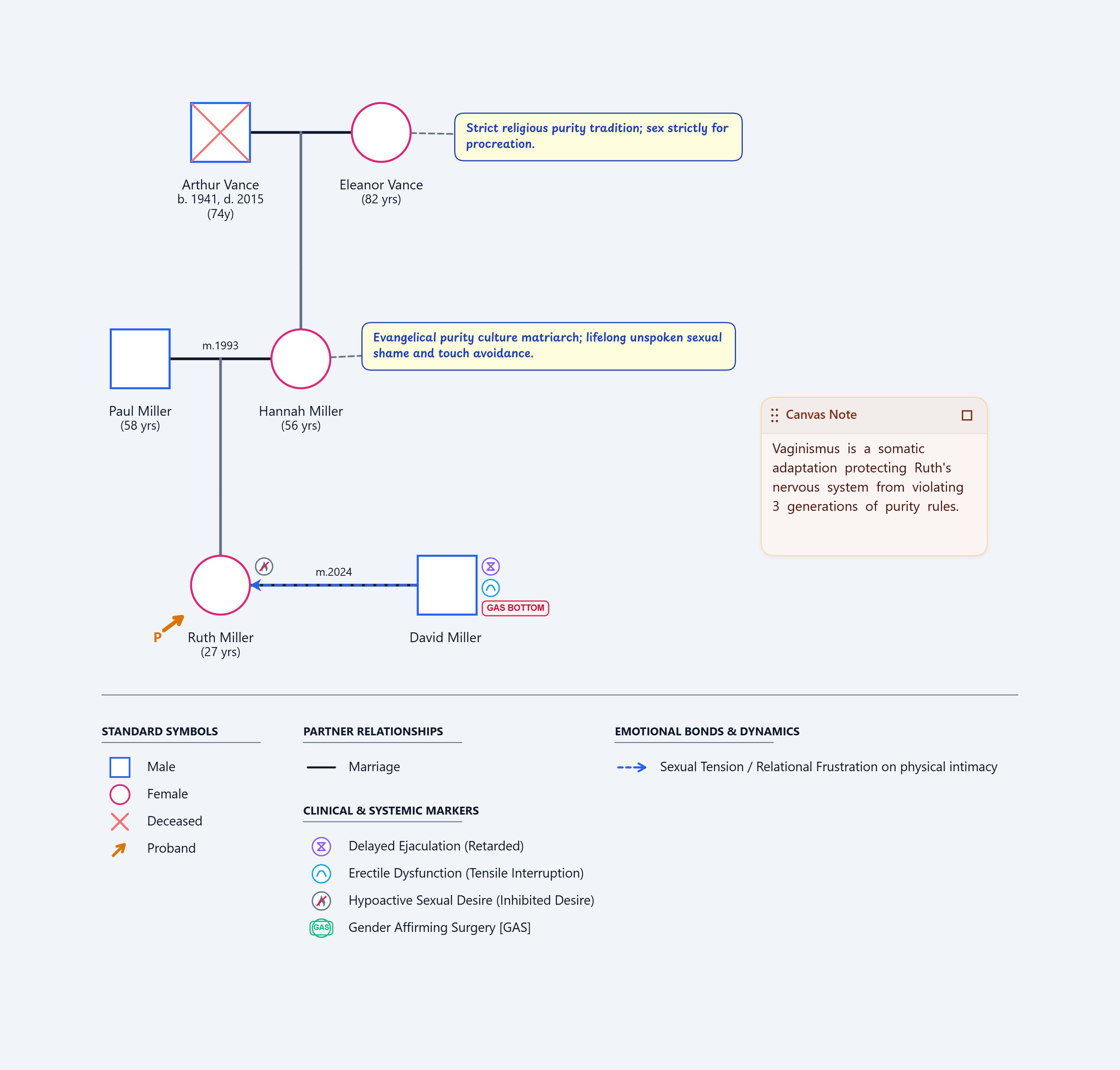
Transgenerational Purity Culture, Shame Deconstruction, and Vaginismus
Ruth (27) and David (29) sought sex therapy after two years of unconsummated marriage due to
severe involuntary pelvic pain and penetration resistance (vaginismus). Medical exams showed
no structural abnormality. Mapping Ruth's three-generation maternal lineage revealed a
strict evangelical purity culture legacy where female sexuality was framed as dangerous and
corrupting until marriage. Ruth was taught that good women do not feel sexual lust. While
she logically wanted intimacy with David, her nervous system had learned that penetration
equaled moral danger.
Enlarge Diagram
Figure 1: Ruth & David 3-generation sexual genogram mapping purity culture
transmission, somatic vaginismus freeze, and relational cutoff.
Clone in Studio
Systemic Formulation:
Vaginismus was not an individual muscular defect. It was a functional somatic defense
mechanism protecting Ruth from violating three generations of internalized family purity
rules.
Clinical Intervention:
Deconstructed maternal purity scripts, reframed David's touch, introduced Sensate Focus
I without penetration pressure, and validated bodily sovereignty.
Case
2 • Midlife Orientation TransitionIndividual & Family Systems • Age
44
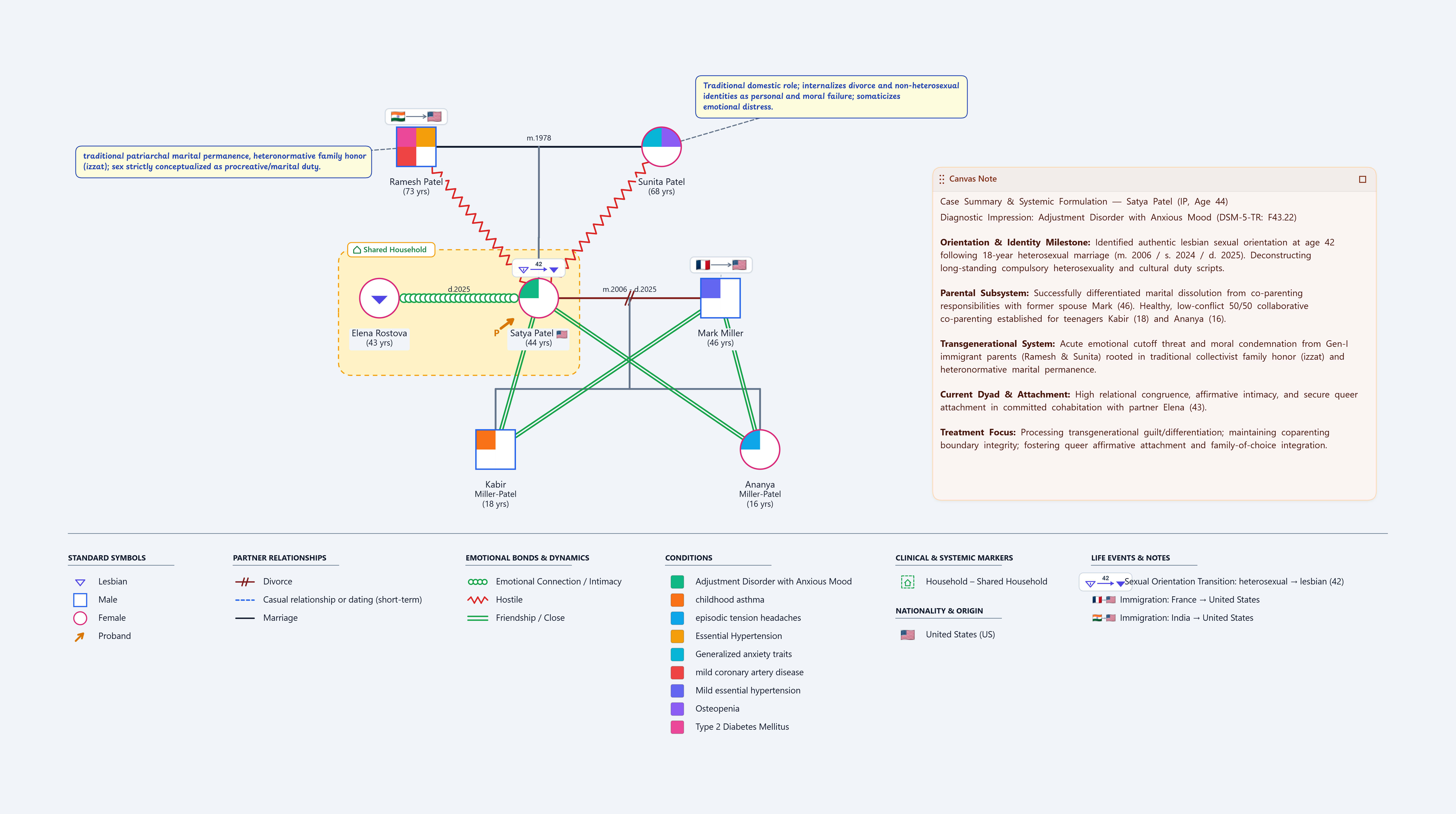
Late-in-Life Sexual Orientation Transition, Co-Parenting, and Family Integration
Satya (44) was married for 18 years in a heterosexual partnership with Mark (46), raising
two teenagers. At age 42, Satya recognized and accepted her authentic sexual orientation as
a lesbian. The couple separated amicably but faced intense judgment from Satya's
conservative immigrant parents, who viewed the divorce as a moral failure. Genosm's
orientation transition badge captured Satya's journey from heterosexual to lesbian at age 42
without erasing her 18-year marriage or her continued parental bond with Mark.
Enlarge Diagram
Figure 2: Satya & Elena sexual genogram depicting midlife orientation transition
badge, amicable co-parenting dynamic, and queer partnership.
Clone in Studio
Systemic Formulation:
Differentiated Satya's marital transition from parental responsibility. Reframed the
divorce from a family breakdown into a conscious restructuring of authentic attachment.
Clinical Intervention:
Mediated co-parenting boundaries with Mark, processed transgenerational immigrant shame
with Satya's parents, and supported healthy queer attachment with her partner Elena.
Case
3 • Intimacy Discrepancy & AnxietyCouples Sex Therapy • 7-Year
Union
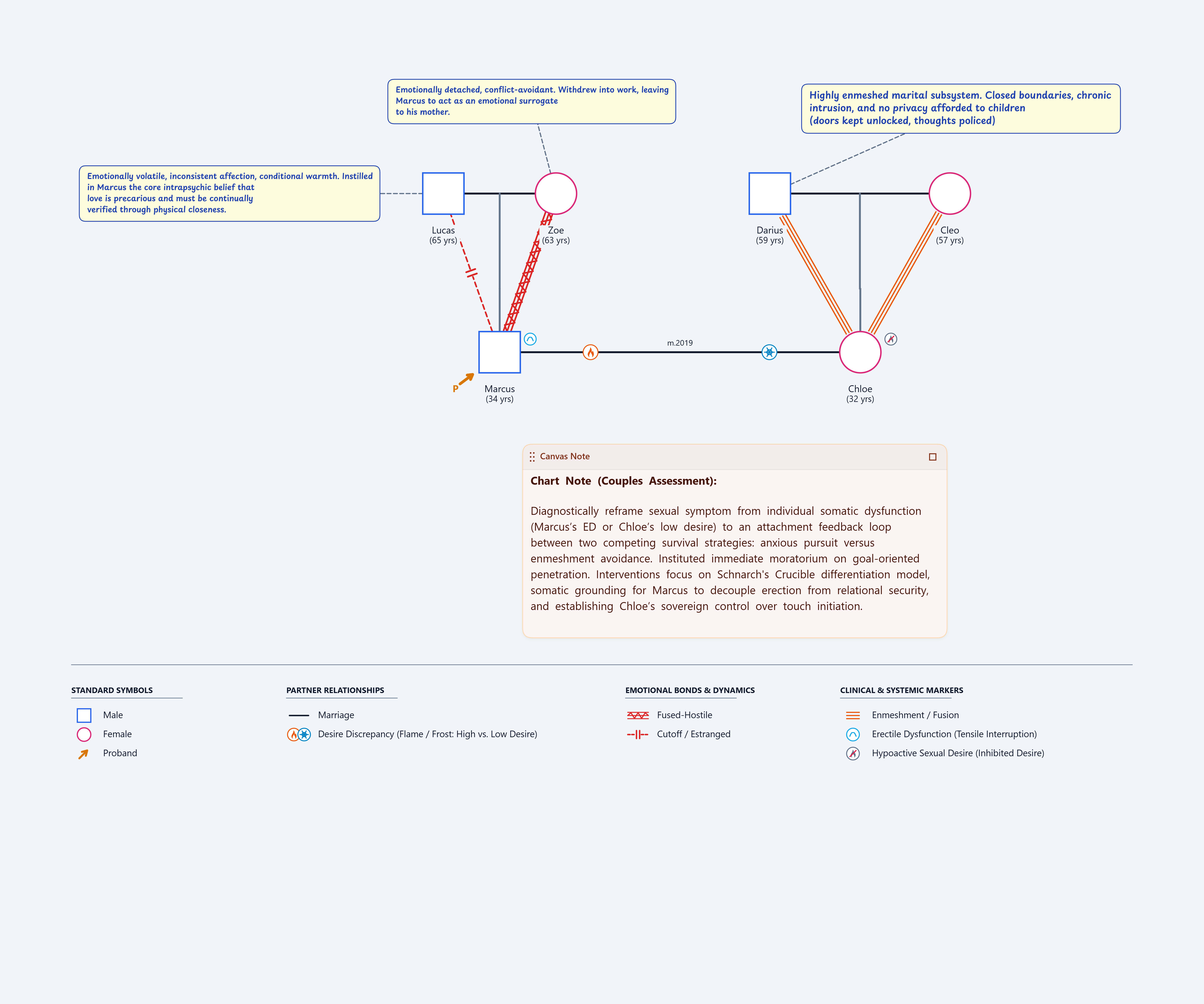
The Flame and Frost Desire Discrepancy, Pursuer-Distancer Cycle, and Performance Anxiety
Marcus (34) and Chloe (32) entered therapy reporting near-total sexual cutoff. Marcus wanted
intimacy four times a week; Chloe preferred once a month. As Marcus pursued more urgently,
Chloe experienced his touch as demanding and retreated further. Under pressure, Marcus
developed psychogenic erectile dysfunction, reinforcing his belief that he was undesirable.
Mapping their genogram revealed Marcus had anxious attachment from an emotionally
unpredictable mother, using sex to verify he was loved. Chloe came from an enmeshed family
where privacy was denied, making sexual withdrawal her only way to preserve autonomy.
Enlarge Diagram
Figure 3: Marcus & Chloe relational genogram illustrating pursuer-distancer
conflict
line, attachment history, and psychogenic performance anxiety markers.
Clone in Studio
Systemic Formulation:
Desire discrepancy was a secondary symptom of an attachment feedback loop. Marcus used
sex for emotional security; Chloe used abstinence to protect self-boundary.
Clinical Intervention:
Stopped all goal-oriented intercourse, instituted Schnarch's Crucible differentiation
model, taught Marcus self-soothing, and gave Chloe full control over sexual initiation.
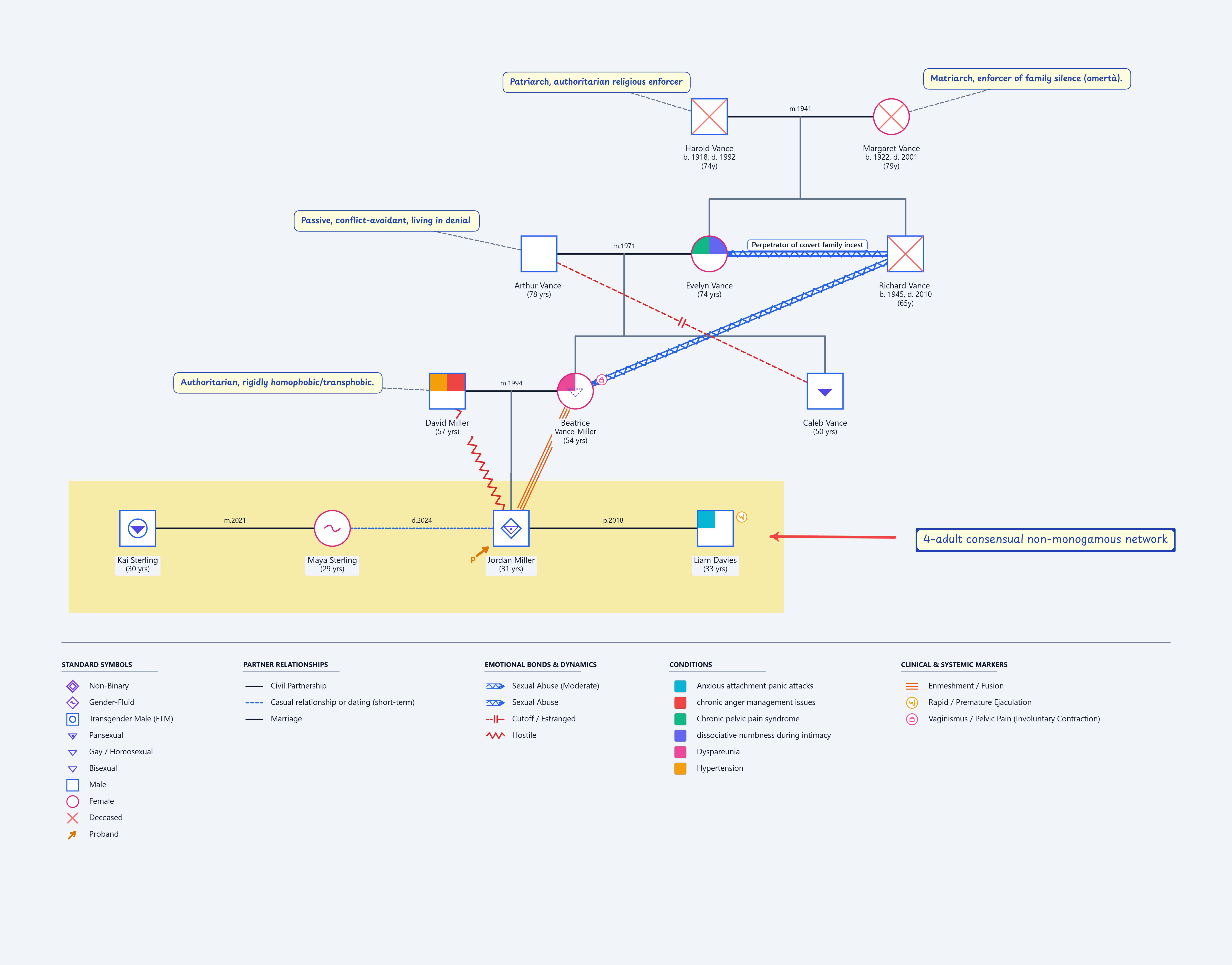
Jordan (31, they/them, non-binary, pansexual) and their anchor
nesting partner Liam (33, cis male, heterosexual) entered sex
therapy due to Jordan's severe sexual aversion, involuntary pelvic floor freeze, and
dissociative shutdown whenever intimacy escalated toward penetrative intercourse.
Jordan simultaneously maintained a romantic, non-cohabiting partnership with
Maya (29, queer female, she/they), who was legally married to
Kai (30, trans male, gay/queer).
Constructing a 4-generation sexual genogram exposed the deep transgenerational roots
of Jordan's somatic freeze. In Generation II, an unspoken family
secret emerged: great-uncle Richard had perpetrated covert sibling and niece incest
against Jordan's grandmother Evelyn and mother Beatrice (54,
bisexual). The family enforced an authoritarian code of silence
(omertà) to safeguard social standing. Beatrice somaticized this violation
as lifelong chronic vaginismus and dyspareunia in her high-conflict, emotionally
severed marriage to David (57, cis-hetero, rigidly homophobic).
When Beatrice's younger brother Caleb (50, cis gay male) came out
at age 19, he was excommunicated and cut off by patriarch Harold and grandfather
Arthur, creating an ancestral pattern of queer exile.
In Generation IV, Jordan's gender transition and non-monogamy
provoked overt, hostile rage from father David, who declared Jordan "morally sick,"
triangulating Beatrice into intense loyalty binds. In bed with Liam, Jordan's body
unconsciously equated male sexual expectation with the ancestral incest violations
endured by Beatrice and Evelyn, triggering somatic immobilization. Meanwhile,
metamour tensions flared as Liam experienced anxious attachment panic over Jordan's
weekends with Maya, while Kai navigated post-mastectomy chest dysphoria that
disrupted his and Maya's erotic intimacy.
Enlarge Diagram
Figure 4: 4-generation trauma and polycule matrix detailing ancestral incest
violations,
filial queer excommunication, non-binary gender nodes, and consensual non-monogamy
ties.
Clone in Studio
Systemic Formulation:
Jordan's sexual aversion was not a localized dysfunction, but a
multigenerational somatic defense. The pelvic holding mechanism protected Jordan
against what ancestral memory coded as dangerous male penetration, magnified by
father David's queer hostility and Liam's inadvertent attachment pressure.
Clinical Intervention:
Convened a systemic boundary session where Beatrice explicitly broke the
multigenerational silence of Uncle Richard's abuse, relieving Jordan of carrying
ancestral secrets. Instituted non-demand somatic touch, differentiated Liam's
attachment reassurance from sexual access, and facilitated respectful metamour
agreements between Liam, Maya, and Kai.
This 16-individual dynastic formulation maps how first-cousin consanguineous
boundary opacity and covert paternal incest intersect with late-in-life transgender
affirmation and acute genital somatic paralysis.
Morgan (32, trans woman, she/her, lesbian) and her spouse
Tara (31, cis female, queer/demisexual) sought treatment following
an escalating intimacy crisis. Morgan, assigned male at birth, had endured lifelong
gender dysphoria and chronic erectile performance anxiety before initiating gender
affirmation at age 29. While Tara loved Morgan deeply, their bedroom collapsed into
complete sexual cutoff (14 months with zero intimacy), complicated by Morgan's acute
genital dysphoria and panic when touched.
Mapping Morgan's family across four generations illuminated an entrenched systemic
web. In Generation I, great-grandparents Elias and Martha were
first cousins whose consanguineous union established an isolated, insular family
dynasty with rigid external boundaries and blurred internal boundaries. In
Generation II, patriarch Donald (1938–2018), a revered community
leader, subjected his adolescent daughter Clara (60, cis female) to
repeated incestuous sexual abuse. The family maintained absolute denial, leaving
Clara with lifelong Hypoactive Sexual Desire Disorder (HSDD) and chronic dyspareunia
in a 28-year sexless marriage to Robert (63, closeted bisexual
male), who compensated with hyper-masculine hostility while secretly
meeting men.
To survive, Clara had formed an intense, parentified enmeshment with Morgan,
treating Morgan as an emotional surrogate spouse. When Morgan came out as a trans
woman, father Robert erupted in violent rejection and emotional cutoff, while mother
Clara experienced severe emotional decompensation, projecting onto Morgan that
"all men in this family are predatory monsters, and transitioning is just your
way of running away." Morgan had internalized Clara's trauma
message—believing that having a penis inherently made her a sexual predator like
Grandfather Donald—leading to somatic revulsion toward her own body and complete
erotic paralysis with Tara. Concurrently, Morgan's closeted gay brother
Jesse (27) lived in substance-fueled estrangement.
Systemic Formulation:
Morgan's sexual shutdown fused physical gender dysphoria with Clara's
transgenerational incest legacy. Morgan unconsciously equated male arousal with
Donald's predatory abuse, believing her authentic sexual expression would
destroy Tara just as Donald destroyed Clara.
Clinical Intervention:
Utilized the 4-generation genogram to disentangle Donald's incestuous guilt from
Morgan's authentic womanhood, severing Clara's parentified triangulation.
Designed gender-affirming erotic mapping for Morgan and Tara (erogenous zones
excluding natal genitals, non-penetrative orgasmic scripting) to re-establish
erotic trust and mutual pleasure.
8. Genogram Models Compared: Medical, Emotional, and Sexual
Clinicians must select the right assessment model for their treatment goals. Review how the
sexual genogram compares to traditional medical and Bowenian systems tools:
Triangulation, differentiation, emotional cutoffs, family alliances
Transgenerational sexual scripts, intimacy styles, desire dynamics
Generational Scope
3 to 4 biological generations
3 to 4 generations including legal marriages
3 generations including chosen family, metamours, and partners
Node Interior Use
Disease shading, 4-quadrant carrier dots
Deceased slashes, primary patient proband arrow
100 percent reserved for medical quadrants and carrier dots
Gender & Orientation
Binary biological sex only (XY / XX)
Often limited to historical binary indicators
Full spectrum: non-binary, trans timelines, and orientation badges
Intimacy Dynamics
Not assessed
Emotional closeness, fusion, conflict, cutoff
Somatic attraction, desire discrepancy (Flame/Frost), health glyphs
9. Frequently Asked Questions (FAQ)
Clinical answers to common questions about constructing and interpreting sexual genograms in
psychotherapy practice.
When in therapy should a clinician introduce
the sexual genogram?
A sexual genogram should rarely be administered during the first session unless the
presenting crisis is acute sexual distress. Best clinical practice is to map a standard
family genogram in session two or three, and then expand into sexual scripts once the
therapeutic bond is secure.
How does Genosm safeguard sensitive sexual
health data?
Genosm uses a zero-knowledge local-first architecture. All client records, relationship
lines, and sexual health markers are stored securely in the clinician's browser database
(IndexedDB/RxDB) or encrypted workspace. Data is never sold, analyzed, or sent to
third-party advertisers.
How does the sexual genogram handle clients
with sexual trauma?
The genogram allows trauma survivors to map boundary violations without re-living traumatic
details. Using neutral boundary symbols and timeline notes, clients can visually locate
where violations happened in the family tree, recognizing how their current protective
reflexes kept them safe.
Can a sexual genogram be exported for
clinical case conferences?
Yes. Genosm exports ultra-high-resolution SVGs, publication-grade PNGs, and encrypted JSON
files. All symbols, legend keys, and timeline badges export with complete visual fidelity,
ready for clinical supervision and grand rounds presentations.
Professional
Software for Systemic Clinicians
Build Clean, Inclusive Sexual Genograms in Minutes
Experience the only genogram studio designed for modern family therapy. Map orientation
transitions, gender affirmation timelines, desire discrepancy, and diverse relationship
structures with clinical precision.