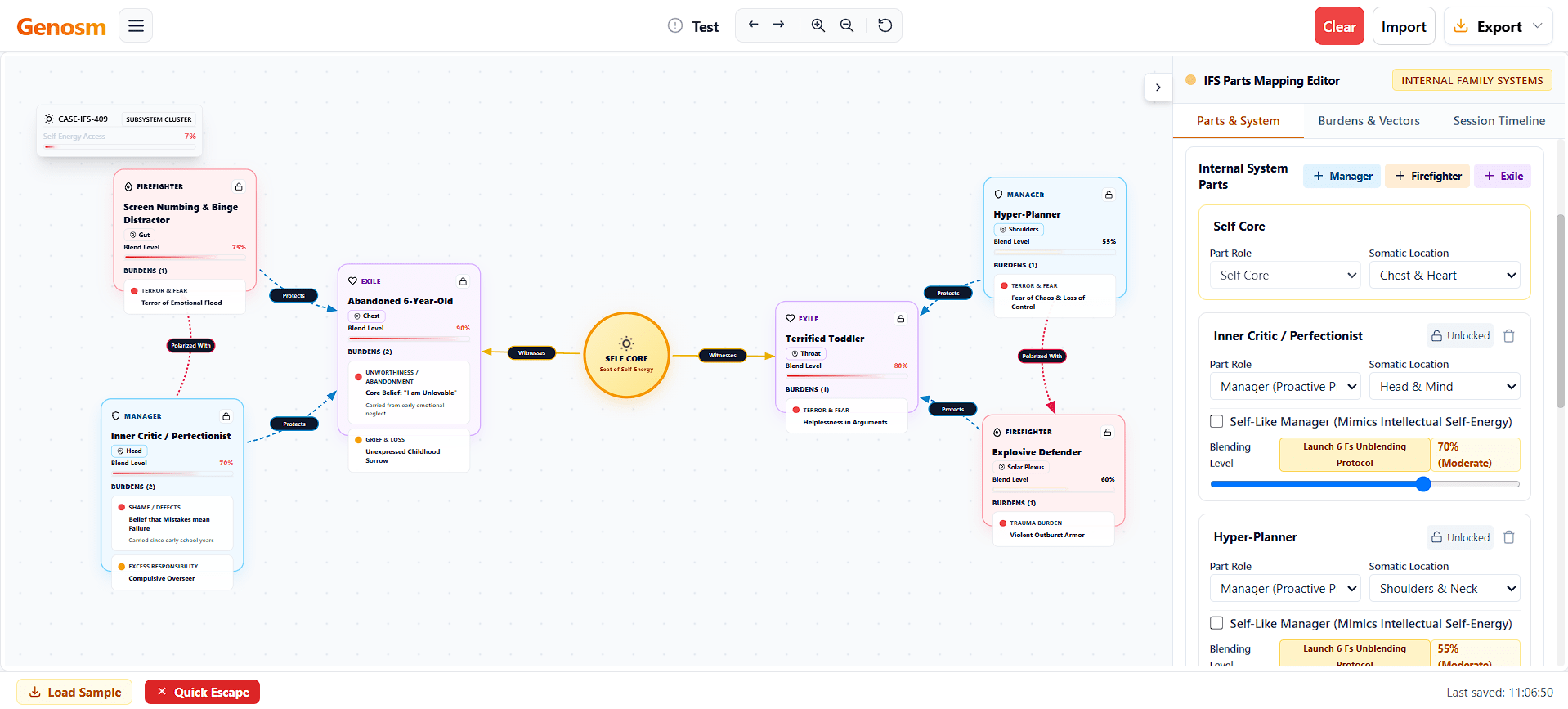
Clinical Origins: Dr. Richard C. Schwartz & Multiplicity of Mind
Developed in the early 1980s by family therapist Dr. Richard C. Schwartz, Internal Family Systems (IFS) represents an evidence-based synthesis of systemic family systems theory and the natural multiplicity of the human mind. While treating clients experiencing severe eating disorders, self-harm, and complex developmental trauma, Schwartz observed that individuals naturally spoke of their internal experience as a collection of distinct persona states with specialized protective roles.
Rather than viewing these sub-personalities as pathological fragments, Schwartz made a radical clinical breakthrough: every part possesses a positive protective intention. No part is inherently bad. Parts take on extreme, destructive, or rigid roles only because they carry historical emotional burdens of fear, shame, abandonment, or grief resulting from overwhelming life events.
By visually mapping these sub-personalities on a structured canvas, clinicians help clients externalize internal conflict, disarm protective defensiveness, cultivate compassionate curiosity, and restore internal Self-leadership.
The 4 Sub-Personality Archetypes in Clinical Detail
An accurate IFS formulation differentiates between four primary structural elements within the internal family:
1. Self Core (The Spiritual Center & Healer)
Intact / Undamaged NucleusThe undamaged, compassionate spiritual core present in every human being. The Self never carries burdens, cannot be broken, and acts as the internal attachment figure that heals wounded parts. When unblended, the Self leads the system with the 8 Cs.
2. Managers (Proactive Protectors)
Proactive Control & ShieldingProtectors that operate preemptively to keep daily life orderly and prevent painful memories from surfacing. Common manager archetypes include the Inner Critic, Perfectionist, Taskmaster, Caretaker, Planner, and Intellectualizer.
3. Firefighters (Reactive Emergency Protectors)
Emergency ExtinguishersReactive protectors that step in abruptly when an exile's emotional pain escapes manager barriers. They will do anything to extinguish the emotional fire, using tactics like substance use, bingeing, dissociation, rage, or self-harm.
4. Exiles (Wounded & Isolated Child Parts)
Trauma CarriersYoung, vulnerable parts frozen in historical moments of trauma, terror, abandonment, or shame. Locked away in isolation by protectors to prevent the conscious system from being overwhelmed by their emotional agony.
A Self-Like Manager is an intellectualizing or analytical protector that mimics Self qualities. It talks smoothly about psychological concepts, analyzes emotions, and acts calm, yet lacks genuine somatic warmth, open-hearted curiosity, and compassion. Genosm includes a dedicated Self-Like Manager toggle to help therapists distinguish cognitive analysis from true Self-presence.
The 8 Cs of Self-Leadership & 5 Ps of Self-Presence
When clients unblend from protective parts, their natural Self-Energy manifests through universal qualities described by Schwartz as the 8 Cs and 5 Ps:
The 8 Cs of Self-Leadership
The 5 Ps of Self-Presence
The Interactive 6 Fs Unblending Protocol Wizard
When a client is overwhelmed or blended with a part, they cannot access Self-Energy. Genosm includes an interactive, step-by-step 6 Fs Unblending Protocol Engine that guides clinicians through the canonical stages of unblending:
"Where in or around your body do you feel this part right now?" (Links to 9 somatic loci).
"Turn your attention inward and focus gently on this somatic sensation."
"What image, age, color, shape, or sensation represents this part in your mind?"
"How do you feel TOWARD this part?" (If judging, irritated, or fearing, another protector is blended!).
"Ask the part what its positive intention is and what job it has been tirelessly doing for you."
"Ask the part: What are you afraid would happen if you stepped back even 10%?"
Somatic Body Residency Across 9 Anatomical Loci
Parts are not abstract cognitive concepts; they maintain tangible neuromuscular, visceral, and fascial residency in the client physical body. Genosm maps every node to 9 anatomical loci:
Overthinking managers, analytical inner critics, tension headaches.
Silenced exiles, constricted speech, swallowing difficulties.
Grief exiles, heart heaviness, caretaker managers, racing palpitations.
Panic firefighters, bracing anxiety, control taskmasters.
Visceral dread, disgust exiles, nausea, bingeing firefighters.
Responsibility managers carrying excessive systemic burdens.
Fight response limbs, restless legs, flight impulses, trembling.
Vigilance protectors bracing against back attacks or betrayal.
Dissociative fog, dorsal freeze shutdown, generalized numbness.
Burden Categories & The Unburdening Lifecycle
In IFS therapy, parts are distinct from the burdens they carry. Burdens are toxic beliefs or emotional residues absorbed from childhood trauma, family rules, or cultural oppression. Genosm organizes burdens into 6 clinical categories:
3-Stage Burden Status Tracking & Invited Gifts
Clinicians track burdens from Burdened (Active) through In Unburdening Process (witnessing past scenes, retrieving exiles) to Unburdened & Healed. When a burden is unburdened, the software prompts the clinician to document the Invited Positive Quality / Gift (e.g., Inherent Worth, Playfulness, Joy, Spontaneity, Peace).
5 Inter-Part Relationship Vectors & Polarizations
The Genosm engine calculates directed relationship vectors between nodes, visualizing the internal systemic alliances and high-tension conflicts:
Self-Energy Analytics & Acute Flooding Detection
Genosm analyzes the blend levels of all parts in the system and computes an aggregate Self-Energy Level (0.10 to 1.0):
If any single protector or exile reaches 85% or higher blend, the system triggers an immediate Flooding Alert and clamps overall Self-Energy to 10% or below, alerting the clinician to pause exile retrieval and focus immediately on protector unblending.
How to Build an IFS Parts Map in 5 Clinical Steps
Follow this structured clinical protocol during IFS assessment, trauma processing, or ongoing case formulation:
Establish Grounding in the Self Core
Verify somatic grounding and the presence of Self qualities (Curiosity, Calm, Compassion). The non-deletable Self Core sits at the center of the diagram as the therapeutic anchor.
Map Protective Managers & Firefighters
Add proactive Managers (critics, perfectionists) and reactive Firefighters (numbing habits, bingeing). Record their somatic locations, initial blend percentages, and protective intentions.
Execute 6 Fs Unblending with Protectors
Launch the interactive 6 Fs wizard on blended protectors. Guide the client through Find, Focus, Flesh Out, Feel Toward, Befriend, and Fear. Reduce protector blending to secure their permission before approaching exiles.
Witness Exiles & Track Burden Lifecycles
Carefully introduce vulnerable Exiles holding shame, abandonment, or terror. Document their burdens, witness their historical memories, and update burden status to Unburdened as healing takes place.
Save Session Snapshot & Export Vector Records
Capture a dated session snapshot to preserve progress in the client timeline. Export high-resolution 300 DPI vector PDFs or SVGs with complete de-identification for clinical case files and supervision.
Clinical Practice Domains for IFS Parts Mapping
The IFS Parts Mapping engine adapts across multiple therapeutic specializations:
Complex PTSD & Attachment Trauma
Safely map severe protective systems without triggering premature exile flooding. Visualize dissociative firefighter defenses and facilitate gradual protector unblending.
Couples & Relational Therapy (IFIO)
Map how Partner A manager triggers Partner B firefighter. Visualize the U-Turn where partners take care of their own activated exiles rather than blaming each other.
Addiction & Eating Disorder Recovery
Demystify relapse behaviors by framing bingeing, purging, or substance use as well-intentioned firefighter parts attempting to extinguish unbearable emotional despair.
Clinical Supervision & IFS Training
Use Teach Mode to broadcast live parts mapping to clinical supervisees. Review therapist parts that become blended during challenging client encounters.
Pairing IFS Parts Maps with Other Genosm Diagram Tools
Genosm provides a comprehensive suite of 11 clinical diagramming tools. Clinicians frequently combine IFS Parts Mapping with these companion formulations:
Window of Tolerance Chart Maker
Autonomic TimelineCorrelate manager and firefighter activations with sympathetic hyperarousal spikes, and link exile pain to dorsal hypoarousal collapse along a clinical timeline.
Polyvagal Ladder & Hierarchy Chart
Autonomic StatesMap Self-Energy to Ventral Vagal social engagement, protectors to Sympathetic mobilization, and exiled trauma states to Dorsal Vagal freeze.
Transactional Analysis (PAC) Tool
Ego StatesBridge Berne Parent-Adult-Child ego states with IFS Manager-Self-Exile sub-personalities for multi-generational ego state mapping.
100% Local-First Data Privacy & HIPAA Compliance
IFS parts mapping explores the most sensitive trauma histories and protective defenses of your clients. Generic cloud diagramming platforms store user data on remote databases, creating data exposure risks.
Genosm uses a zero-storage, local-first architecture:
- All parts map calculations and vector renderings occur entirely in your local browser memory.
- Client names, exile trauma memories, burden notes, and part details are never uploaded to remote servers.
- Files are stored directly on your local device or encrypted browser database (IndexedDB).
- Total HIPAA and GDPR compliance with zero server PHI retention.
Why Genosm Outperforms Generic Whiteboards for IFS Parts Work
| Clinical Feature | Genosm IFS Tool | Generic Whiteboards (Miro/Canva) | Paper Worksheets |
|---|---|---|---|
| IFS Role Taxonomy | Native (Self, Manager, Firefighter, Exile) | Generic shapes without clinical rules | Static drawn boxes |
| Interactive 6 Fs Wizard | Built-in step-by-step unblending protocol | None (Manual text boxes) | Static printed text |
| Burden Lifecycle Tracking | Track from burdened to unburdened with gifts | None | Manual erasure / re-writing |
| Self-Energy & Flooding Alerts | Automated 0.10-1.0 score + flooding clamp | None | None |
| Somatic Body Loci Mapping | 9 anatomical loci with position offsets | None | Static drawn outlines |
| Session Timeline Snapshots | Dated restorable longitudinal snapshots | Scattered canvas clutter | Separate physical folders |
| Patient Data Privacy (HIPAA) | 100% Local-First (Zero Server PHI) | Third-party cloud storage risk | Physical paper loss risk |
| All-in-One Clinical Suite | All 11 diagram types in $9.99 plan | Expensive generic tiers | Disorganized loose handouts |
IFS Parts Mapping Tool FAQ
What is an IFS Parts Map and how does Internal Family Systems work?
An IFS Parts Map is an evidence-based visual formulation of a client's internal psychological system developed by Dr. Richard C. Schwartz. It conceptualizes the mind not as a single monologue, but as a dynamic family of distinct sub-personalities (Parts) organized around an intact, compassionate Self Core. Parts are divided into three primary categories: Managers (proactive protectors), Firefighters (reactive protectors), and Exiles (young wounded parts holding trauma burdens).
What are the 6 Fs of IFS Unblending supported in Genosm?
The 6 Fs protocol is a sequential clinical method to help a client unblend from an activated protector or exile and access Self-Energy: 1. Find (locate the part in or around the physical body), 2. Focus (turn internal attention inward toward the somatic sensation), 3. Flesh Out (discover the part's image, age, or felt shape), 4. Feel Toward (assess how the client feels toward the part to verify Self presence), 5. Befriend (learn the part's protective intention and job), and 6. Fear (inquire what the part fears would happen if it stepped back even 10%). Genosm provides an interactive step-by-step unblending wizard that recalculates blend levels in real time.
What are the 8 Cs of Self-Leadership and 5 Ps of Self-Presence?
In IFS therapy, when a client is unblended from protective parts, their natural Self-Energy emerges. The 8 Cs of Self-Leadership are: Curiosity, Compassion, Clarity, Connectedness, Confidence, Courage, Creativity, and Calm. The 5 Ps of Self-Presence are: Perspective, Patience, Persistence, Playfulness, and Presence. Genosm measures aggregate Self-Energy across the entire mapped system to indicate client grounding and therapeutic readiness.
What is a Self-Like Manager in IFS therapy?
A Self-Like Manager is an intellectualizing or analytical protector part that mimics Self-Energy by talking about therapy, analyzing emotions, and performing spiritual concepts without experiencing genuine somatic compassion, warmth, or curiosity. Genosm provides a dedicated Self-Like Manager toggle to help clinicians visually differentiate between intellectual cognitive analysis and authentic Self-leadership.
How does Genosm protect client health information on IFS parts maps?
Genosm operates on a strict 100% local-first browser architecture. All parts maps, sensitive trauma burden notes, client identifiers, and session timeline snapshots are rendered and stored locally in your browser's IndexedDB. Zero patient health information (PHI) is ever transmitted to or stored on Genosm cloud servers, fully satisfying HIPAA and GDPR requirements.
What export formats are supported for electronic health records (EHR)?
Genosm exports parts maps in high-resolution vector PDF (ideal for printing client psychoeducational handouts or attaching to EHR systems like SimplePractice, TherapyNotes, or Epic), crisp SVG vector graphics, transparent or white-background PNG images, and portable JSON backup files with one-click de-identification.
Is the IFS Parts Mapping tool included in the standard Genosm plan?
Yes. The IFS Parts Mapping tool is fully included in the $9.99 per month Genosm plan, which gives clinicians unlimited diagram creation across all clinical formats including Window of Tolerance, CBT Formulations, Polyvagal Ladders, Culturagrams, Johari Windows, and Genograms.