Clinical Origins: Dr. Lenore E. Walker & The Battered Woman Syndrome
Formulated in 1979 by psychologist Dr. Lenore E. Walker in her landmark clinical text The Battered Woman, the Cycle of Violence provided the mental health and legal professions with the first structured framework explaining why victims of intimate partner violence (IPV) remain in abusive relationships. Walker discovered that domestic violence is rarely constant or random; rather, it operates in a recurring, escalating four-stage cycle that exploits human attachment, hope, and intermittent conditioning.
Walker work demonstrated that the unpredictable alternation between explosive terror and tender, remorseful reconciliation creates severe psychological entrapment, cognitive dissonance, and conditioned helplessness. Genosm modernizes this foundational theory by integrating Evan Stark coercive control micro-regulations and Jacquelyn Campbell validated danger assessment metrics into a unified digital workspace.
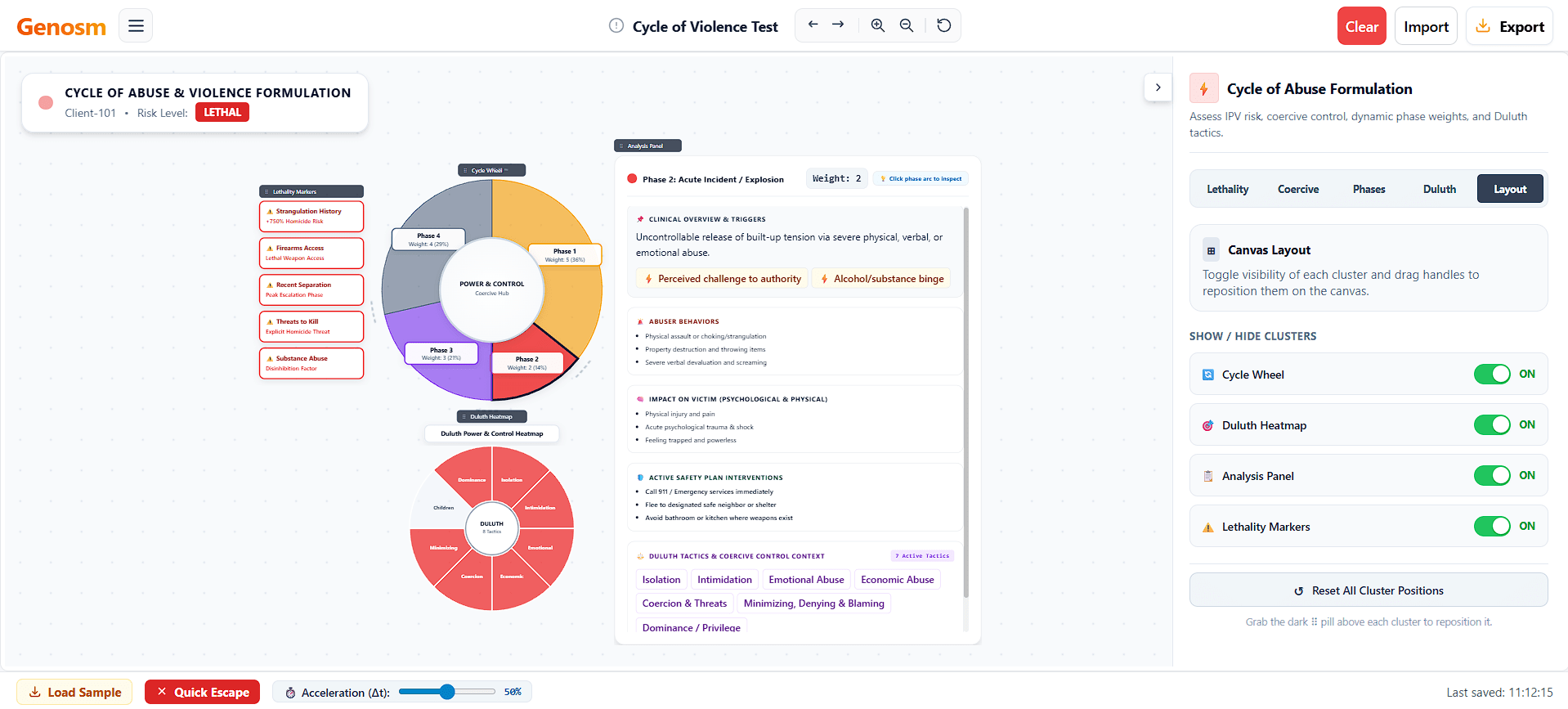
The 4 Phases of the Abuse Cycle in Forensic Detail
A comprehensive formulation documents abuser behaviors, victim reactions, somatic cues, and safety interventions across all four phases:
Phase 1: Tension Building
Walking on EggshellsStress, irritability, and passive hostility accumulate. The abuser displays mood swings, sarcastic insults, nitpicking, and non-verbal intimidation. The victim experiences intense hypervigilance, anxiety, headaches, and desperately attempts to soothe, appease, or anticipate the abuser's demands.
Phase 2: Acute Incident / Explosion
Peak Physical & Verbal ViolenceThe built-up tension discharges in an uncontrollable explosion of physical violence (striking, strangulation, throwing objects), extreme verbal devaluation, sexual assault, or destructive property damage. The victim suffers acute shock, terror, physical injury, and profound powerlessness.
Phase 3: Manipulative Honeymoon / Reconciliation
Trauma Bonding EngineFearing separation, arrest, or loss of control, the abuser displays profuse remorse, cries, begs forgiveness, buys gifts, declares passionate love, or promises to enter therapy or stop drinking. The victim experiences intense relief, cognitive dissonance, and renewed hope that the abuser has changed.
Phase 4: False Calm & Minimization
Denial & Boundary ErosionThe relationship enters a period of quiet denial. The abuse is minimized ("it wasn't that serious"), rewritten through gaslighting, or blamed on the victim provoking the outburst. The victim experiences emotional detachment, dissociation, and a false sense of temporary safety while tension secretly begins rebuilding.
Evan Stark Coercive Control & Ongoing Micro-Regulations
In his landmark 2007 work Coercive Control: How Men Entrap Women in Personal Life, sociologist Dr. Evan Stark argued that focusing exclusively on episodic physical violence misses the true mechanism of abuse: coercive control. Coercive control is an ongoing, 24/7 campaign of micro-regulations that robs the victim of autonomy, liberty, and personhood.
The 5 Central Micro-Regulation Categories
Monitoring call logs, reading text messages, demanding account passwords, inspecting social media.
Waking victim during the night for interrogations, preventing rest to induce cognitive exhaustion.
Confiscating wages, auditing grocery receipts down to the penny, prohibiting independent bank accounts.
Controlling clothing choices, makeup, hairstyles, and policing perceived modesty.
Installing covert vehicle AirTags, demanding live location sharing, systematically cutting off contact with parents, siblings, and friends.
Jacquelyn Campbell Danger Assessment & Lethality Predictors
Developed by Dr. Jacquelyn Campbell (1986) at Johns Hopkins University, the Danger Assessment (DA) is the gold-standard instrument for evaluating the risk of intimate partner homicide. Genosm implements an automated scoring engine based on 8 core empirical indicators:
The 8 Validated Lethality Indicators
5-Tier Risk ClassificationDuluth Power & Control Wheel 8-Tactic Interactive Heatmap
Created by the Domestic Abuse Intervention Project (DAIP) in Duluth, Minnesota, the Power & Control Wheel visualizes the non-physical tactics that enforce systemic dominance. Genosm provides an interactive heatmap allowing clinicians to log concrete real-world evidence across all 8 sectors:
Dynamic Phase Weights & Atypical Cycle Variations
No two domestic violence dynamics are identical. In early relational stages, the Honeymoon phase may last weeks. In severe, chronic IPV, the Honeymoon phase often disappears entirely, leaving the victim trapped in an uninterrupted cycle of tension, acute explosion, and cold minimization.
Genosm provides 1 to 10 duration weight sliders that dynamically scale the visual SVG arc lengths on the canvas, as well as Phase Omission Toggles to accurately represent atypical cycles missing specific phases.
Trauma Bonding, Intermittent Reinforcement & Attachment
Trauma bonding is not weakness; it is a biological survival adaptation to severe intermittent threat and relief. When an abuser alternates between terror (acute explosion) and comfort (reconciliation), the victim brain experiences a powerful neurochemical cocktail:
- Dopamine Surges: Intermittent reinforcement produces the highest levels of addiction in behavioral psychology.
- Oxytocin Attachment: Relief after terror floods the attachment system with bonding hormones.
- Cortisol & Adrenaline Flooding: Chronic autonomic dysregulation impairs prefrontal executive decision-making.
Phase-Specific Clinical Safety Planning
A safety plan cannot be generic; it must contain concrete action vectors tailored to the current phase of the abuse cycle:
Keep gas tank full, hide secondary prepaid burner phone, identify emergency safe houses.
Escape toward exit doors, avoid confined rooms, signal neighbors with pre-arranged distress signals.
Maintain legal documentation log, store court evidence in secure off-site lockers, do not cancel protective orders.
Establish financial independence, consult domestic violence legal advocates, strengthen external support network.
How to Build a Cycle of Abuse Chart in 5 Clinical Steps
Document Relationship Context
Enter anonymous client identifier, relationship duration, completed cycle count, and escalation trend.
Evaluate Campbell Lethality Indicators
Screen for strangulation history, gun access, and death threats to calculate the objective lethality risk tier.
Map Coercive Control Micro-Regulations
Log surveillance, sleep deprivation, financial control, and GPS tracking to establish systemic entrapment.
Calibrate Phase Duration Weights & Duluth Tactics
Adjust phase arc weights (1-10) and record concrete real-world evidence across active Duluth sectors.
Construct Safety Plan & Export Vector Records
Formulate actionable safety steps and export 300 DPI vector PDFs for clinical records or court documentation.
Practice Domains & Forensic Applications
Domestic Violence Shelters & Advocacy
Provide clear psychoeducation to victims, validate experiences of entrapment, and construct practical escape safety plans.
Family Court & Forensic Custody Evaluation
Document coercive control patterns, lethality flags, and child safety risks with objective forensic rigor.
Trauma Psychotherapy & C-PTSD Recovery
Unravel cognitive dissonance, resolve trauma bonding, and process somatic hypervigilance in individual therapy.
Clinical Supervision & Crisis Training
Train clinicians and social workers to spot subtle coercive control dynamics and high-risk strangulation histories.
Pairing Cycle of Abuse with Other Genosm Diagram Tools
Internal Family Systems (IFS) Parts Map
Parts WorkMap how trauma bonding creates appease managers and terrified exiles holding grief and terror.
Window of Tolerance Chart Maker
Autonomic TimelineTrack how tension building drives severe sympathetic hyperarousal while acute explosion drops the victim into dorsal freeze.
100% Local-First Data Privacy & HIPAA Compliance
Domestic violence casework involves life-or-death privacy considerations. Cloud diagramming tools that store data on remote databases create catastrophic subpoena and breach risks.
Genosm operates with a zero-storage, local-first architecture:
- All diagram calculations and vector renderings occur entirely inside your browser memory.
- Client names, lethality ratings, escape locations, and evidence logs are never transmitted to Genosm servers.
- Files are stored directly on your local device or encrypted browser database (IndexedDB).
- Total HIPAA and GDPR compliance with zero server PHI retention.
Why Genosm Outperforms Generic Drawing Software for IPV Formulation
| Clinical Feature | Genosm IPV Tool | Generic Whiteboards (Miro/Canva) | Paper Handouts |
|---|---|---|---|
| Walker 4-Phase Dynamic Wheel | Dynamic SVG arcs with 1-10 duration weights | Static geometric circles | Static printed drawings |
| Campbell Lethality Scoring | 8 validated risk markers + strangulation multiplier | None | Manual checklist |
| Evan Stark Coercive Control Hub | Dedicated ongoing micro-regulation tracking | None | Manual handwritten notes |
| Duluth Wheel Heatmap | 8 active tactic sectors with evidence logging | Unconnected text boxes | Static printed wheel |
| Phase Omission Toggles | Model atypical cycles missing honeymoon phase | Manual redrawing | Cannot adjust |
| Patient Data Privacy (HIPAA) | 100% Local-First (Zero Server PHI) | Cloud server data breach risk | Physical paper loss risk |
| Vector Court Export (PDF/SVG) | High-res 300 DPI vector PDF with de-identification | Low-res raster screenshots | Physical photocopies |
| All-in-One Clinical Suite | All 11 clinical diagram tools in $9.99 plan | Expensive generic tiers | Loose scattered papers |
Cycle of Abuse Chart Maker FAQ
What is the Cycle of Abuse and how does Lenore Walker model work?
The Cycle of Abuse (or Cycle of Violence) is a clinical formulation developed in 1979 by psychologist Dr. Lenore E. Walker. It conceptualizes intimate partner violence not as random chaotic events, but as a recurring cyclical pattern consisting of 4 distinct phases: 1. Tension Building (stress accumulation, walking on eggshells), 2. Acute Incident (uncontrollable explosion of physical, verbal, or emotional abuse), 3. Reconciliation or Honeymoon (manipulative remorse, gifts, promises to change), and 4. False Calm and Minimization (denial, treating the abuse as if it never occurred).
Why is the strangulation indicator weighted so heavily in Campbell Lethality Assessment?
In Dr. Jacquelyn Campbell Danger Assessment research, a history of manual strangulation (choking) is the single most powerful clinical predictor of future intimate partner homicide, representing a 750% (+7.5x) increase in lethal risk. Genosm automatically elevates the overall risk level to Severe or Lethal whenever strangulation history is selected.
What is Coercive Control in the Evan Stark framework?
Developed by Dr. Evan Stark (2007), Coercive Control shifts the clinical focus from discrete physical assaults to an ongoing, 24/7 condition of entrapment. It involves micro-regulations of the victim's daily life, including continuous phone surveillance, forced sleep deprivation, financial deprivation, strict dress codes, social isolation, and movement tracking. In Genosm, Coercive Control is visualized as an ever-present central background hub underlying all cycle phases.
What happens when the Honeymoon or Reconciliation phase is omitted?
As intimate partner violence relationships progress chronologically, the Reconciliation/Honeymoon phase often compresses or disappears entirely. In long-term or severe chronic abuse, the cycle frequently collapses into a rapid oscillation between Tension Building and Acute Explosions, followed immediately by cold minimization. Genosm includes phase omission toggles to accurately model these dangerous atypical cycles.
How does Genosm ensure client confidentiality and HIPAA compliance during domestic violence casework?
Due to the extreme safety risks involved in domestic violence cases, Genosm operates on a strict 100% local-first browser architecture. All cycle diagrams, lethality assessments, safety notes, and client identifiers are computed and stored exclusively in your local browser's IndexedDB. Zero Protected Health Information (PHI) is ever transmitted to or stored on Genosm remote servers.
What export formats are supported for forensic evaluation and EHR integration?
Genosm exports charts in high-resolution vector PDF (ideal for court reports, safety planning packets, or EHR attachments in SimplePractice, TherapyNotes, or Epic), crisp SVG vector graphics, transparent or white-background PNG images, and portable JSON backup files with one-click de-identification.
Is the Cycle of Abuse chart maker included in the standard Genosm subscription?
Yes. The Cycle of Abuse chart maker is fully included in the $9.99 per month Genosm plan, which provides clinicians with unlimited diagram creation across all 11 clinical formats including IFS Parts Mapping, Window of Tolerance, CBT Formulations, Polyvagal Ladders, and Genograms.