The Only AI Genogram Maker Built for Privacy.
Genosm utilizes secure graph modeling to convert unstructured clinical narratives into standardized genograms within a local-first architecture. This process ensures that patient identifiers remain on your device while the AI generates professional family assessments automatically.
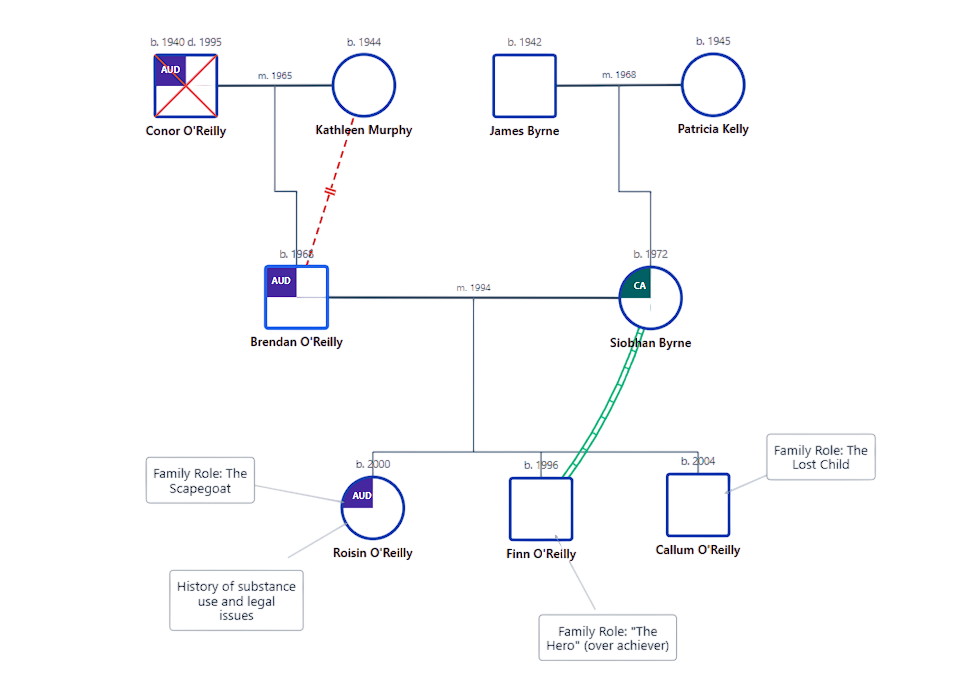
Examples of AI Genograms
Explore clinical cases where AI has transformed complex family narratives into standardized diagrams instantly.
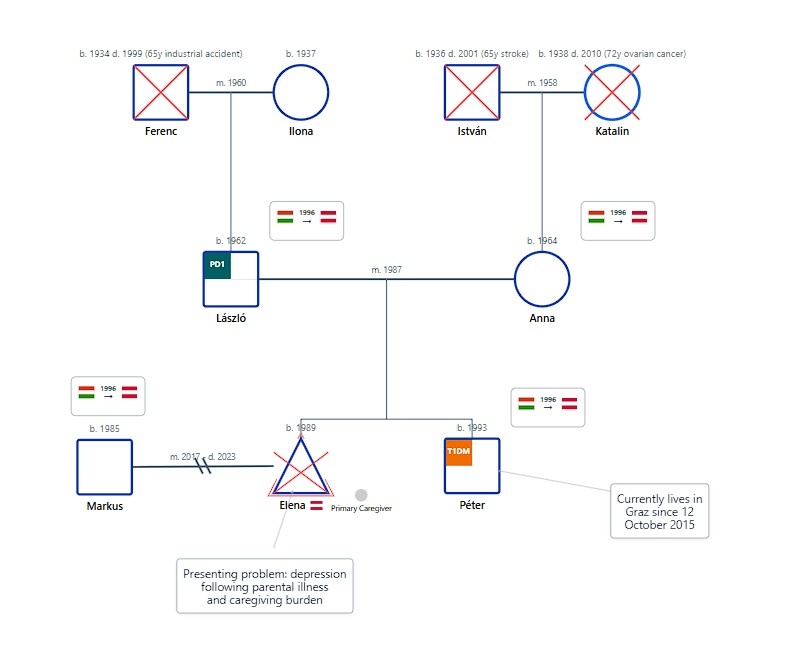
Case 1: Cross Border Clinical Assessment and Caregiving Burden
This clinical scenario tracks the family system of Elena Kovács, a 36 year old client in Vienna navigating depression and caregiving stress. The AI analyzed a three generation narrative including a 1996 relocation from Hungary to Austria, a father's Parkinson's diagnosis in 2021, and the client's own finalized divorce in 2025. The system automatically identified the intergenerational health patterns and correctly mapped the primary caregiver link between the client and her father with clinical precision.
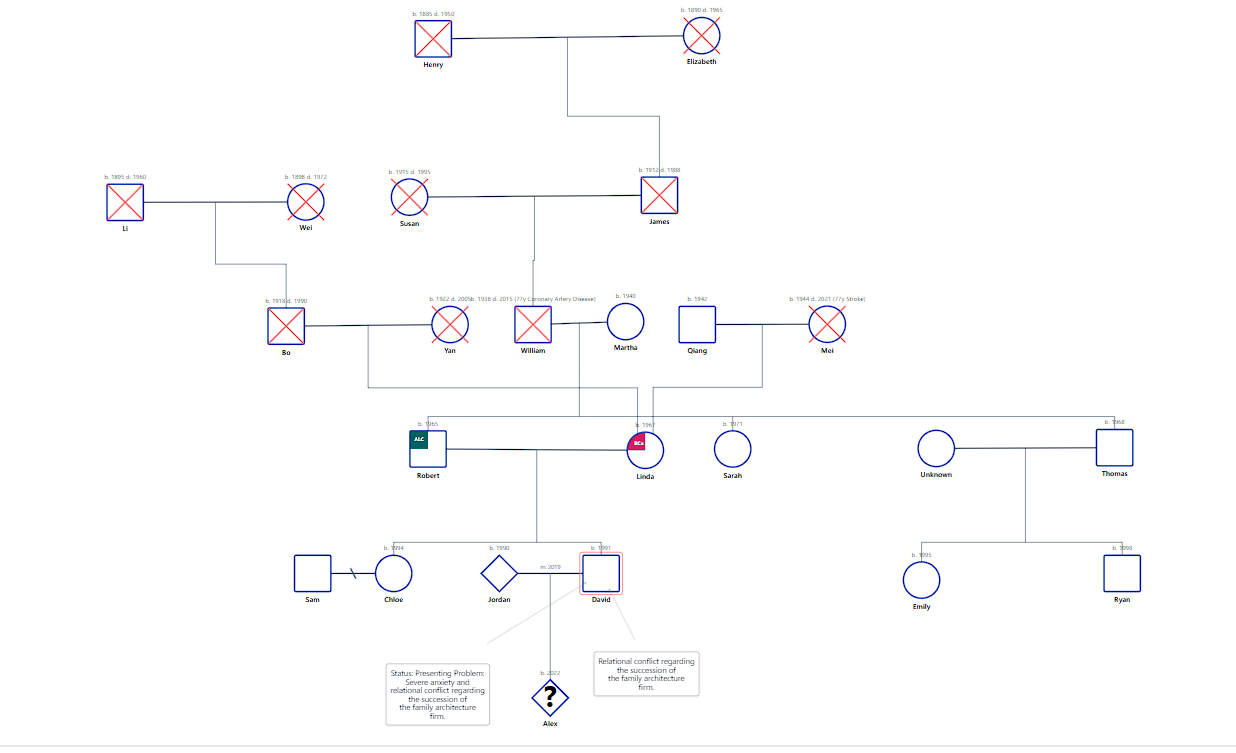
Case 2: Complex Kinship and Foster Parent Integration
This five generation assessment of the Miller-Chen family demonstrates the ability of Genosm to handle complex kinship networks. The AI successfully mapped two parental sets for the mother, Linda, identifying Bo and Yan as the long term foster parents alongside the biological lineage of Qiang and Mei. This visualization allows clinicians to track both biological heritage and foster care stability within a single unified clinical diagram.
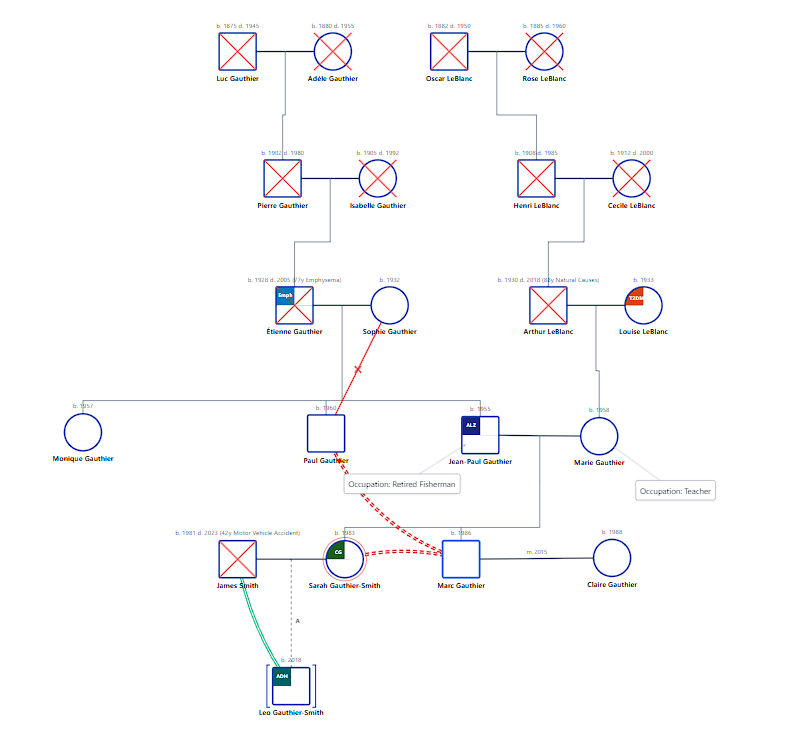
Case 3: Intergenerational Trauma and Displacement (Canada)
Sarah Gauthier-Smith, a 42 year old client in Nova Scotia, presents with complicated grief and parenting challenges. This case highlights how AI can map five generations of history, including the intergenerational impact of Acadian displacement and neurodegenerative health patterns such as Alzheimer's disease. The system clarifies the legal and emotional connections within her blended family, including her adopted child, Leo, and the support network required for his ADHD management.
What is an AI Genogram Maker?
An AI Genogram Maker is a specialized clinical tool that utilizes artificial intelligence to automatically transform narrative family data into standardized relationship diagrams. Unlike basic family tree builders that focus on genealogy and simple lineage, a professional AI genogram generator understands the complex emotional and behavioral dynamics required for clinical assessment.
These modern tools bridge the gap between traditional manual software and modern automation. While manual genogram programs require therapists to draw every line and symbol by hand, an AI powered system can parse unstructured text from intake forms or session notes to infer relationships, detect multi partner families, and apply McGoldrick standards without manual friction.
Beyond Family Trees
AI genogram tools differ from consumer family tree apps by focusing on clinical depth. They incorporate specialized symbols for mental health conditions, substance use patterns, and specific emotional relationship types like fused, conflicted, or enmeshed dynamics.
The Clinical Role
In professional settings such as therapy, social work, and medical research, these tools serve as a decision hub. They allow clinicians to visualize intergenerational trauma and health risks instantly, moving the focus from drawing diagrams to analyzing patient patterns.
Who Uses AI Genogram Tools?
Modern family mapping technology is essential across multiple clinical and educational disciplines.
Mental Health Professionals
Therapists and psychologists use AI genograms to map intergenerational trauma patterns and attachment structures during the intake process. The automation allows for rapid visualization of family secrets, triangles, and fused relationships that impact current psychological wellbeing.
Medical Practitioners
Doctors and genetic specialists rely on AI powered pedigrees to visualize risk inheritance for conditions such as cardiac disease or diabetes. Automated mapping ensures that family medical history is documented with clinical precision for early intervention and screening.
Social Workers
Caseworkers utilize these tools to document household structures, guardianship changes, and multi home upbringing. AI helps in organizing complex kinship networks quickly, which is vital for child welfare assessments and family reunification plans.
Clinical Students
Students in social work and psychology programs use AI generators to complete clinical assignments with standardized notation. These tools help them learn the correct application of genogram symbols while focusing on the analytical components of family systems theory.
Academic Researchers
Researchers mapping large scale pedigree datasets or longitudinal family studies benefit from the structured export capabilities of AI tools. Converting qualitative narratives into quantitative relationship data allows for deeper statistical analysis of family patterns.
Forensic Specialists
In legal and forensic settings, family structures must be documented with absolute clarity. AI genogram makers provide an objective, standardized method for presenting lineage and household dynamics in official clinical reports and court documentation.
What Makes the Best AI Genogram Maker in 2026?
Selecting a professional genogram tool requires evaluating several critical intent layers. To rank as the premier solution for clinical workflows, a platform must satisfy rigorous standards in automation depth and data security. Genosm supports all of these professional requirements out of the box.
Automation Depth and Intelligence
A high quality AI generator should be capable of parsing both structured JSON data and unstructured narrative text. The best tools in 2026 do not just draw lines but instead actively infer missing relationship links and detect complex multigenerational patterns automatically. This reduces the administrative burden on clinicians during the intake process.
Comprehensive Clinical Symbol Support
Standardization is essential for professional medical and therapeutic communication. The leading platforms support the full range of McGoldrick notation, including specific markers for substance use, mental health conditions, and complex emotional dynamics such as hostility or enmeshment. This ensures that every diagram is ready for official clinical documentation.
Local First Privacy Architecture
Privacy is the primary differentiator for healthcare tools. The best AI genogram makers utilize a local first architecture where personally identifiable information is stripped and stored on the user device. This design prevents sensitive patient data from ever reaching cloud servers, maintaining compliance with HIPAA and other international data sovereignty regulations.
Complex Relationship Modeling
Modern family structures are often non traditional. A professional tool must handle adoption, divorce, half siblings, same sex parents, and multi partner families with clinical accuracy. The ability to model these relationships without visual clutter is a hallmark of a high performance mapping system.
Interoperability and Clinical Documentation
Data portability is vital for integration with modern Electronic Health Records through standardized formats such as FHIR and clinical JSON. Beyond relationship mapping, the platform automatically generates editable SOAP notes based on the family systems analysis. This allows clinicians to adjust and finalize professional documentation efficiently while maintaining absolute precision in their clinical reporting.
How to Create a Genogram with AI
Follow this simple four step process to transform clinical narratives into professional assessments.
Input Narrative
Paste your unstructured clinical notes or intake forms directly into the interface. Our system accepts raw text, markdown, or structured JSON data without requiring any specific formatting from the user.
AI Analysis
The AI layout engine identifies family members, detects relationship types, and maps generational links. It automatically applies standardized clinical symbols based on the clinical context found within your notes.
Refine Details
Utilize the interactive editor to adjust node positions or modify relationship dynamics. You have full control to override AI suggestions to match your professional judgment and specific clinical insights.
Export & Notes
Generate your finalized genogram in multiple formats including PDF and SVG. Simultaneously review the AI generated SOAP notes for your records, ensuring a complete and accurate documentation package.
Clinical AI Genogram Examples
Explore how clinical specialists utilize AI generated family maps across different professional contexts.
Therapy Intake
A family therapist parses a 2000 word intake narrative to instantly visualize trauma patterns across three generations. The AI identifies fused emotional relationships between the primary client and their maternal grandmother while highlighting a history of substance use in the paternal lineage.
- Intergenerational trauma links
- Attachment style mapping
- Behavioral pattern detection
Medical Pedigree
A genetic counselor converts medical history forms into a standardized pedigree to assess cardiac risk. The system automatically applies symbols for heart disease and diabetes across the family tree, allowing the clinician to calculate the probability of hereditary transmission for the proband.
- Hereditary risk visualization
- Standardized medical notation
- Proband health analysis
Social Work Case
A caseworker documents a complex guardianship situation involving blended families and multiple households. The AI genogram maker clarifies the legal and emotional connections between foster parents, biological siblings, and extended kinship networks for a court submission.
- Guardianship link tracking
- Kinship network visualization
- Household structure clarity
AI Features to Expect in 2026
The next generation of clinical mapping software is defined by deep semantic understanding and predictive analysis.
Automatic Relationship Inference
Advanced semantic models will go beyond explicit statements to infer missing links in family structures. By analyzing birth dates and household dynamics, the AI can suggest likely sibling connections or marital histories that may have been omitted from raw notes.
Structural Error Detection
Intelligent validation engines will automatically flag biological or chronological impossibilities in family diagrams. This ensures that clinical documentation remains accurate and forensic grade by preventing date mismatches or incorrect generational mapping.
Symbol Correction Suggestions
As clinical standards evolve, the AI will provide real time suggestions for more precise notation. If a narrative describes a specific attachment style, the system will offer to update the relationship symbol to match the latest McGoldrick clinical guidelines.
Narrative to Diagram Conversion
Future systems will support seamless conversion between qualitative session transcripts and quantitative relationship graphs. This bidirectional flow allows clinicians to move from a spoken narrative to a structured clinical diagram with a single command.
The PHI/PII Strip Guard Technology
Standard AI tools are a liability in clinical settings. Genosm is the only platform that ensures patient data is anonymized locally before any processing occurs.
Local Identification
Our algorithm scans your notes for names, dates, and locations entirely on your device.
Identity Swapping
Real identities are swapped with fictional "P1", "P2" labels. The AI only knows the "what", never the "who".
Secure Restoration
Once the AI generates the structure, Genosm restores the real names locally on your screen.
// RAW INPUT (STAYS ON DEVICE)
Patient John Doe (42) reports history of heart disease in his father Robert...
// AI PROMPT (SENT TO CLOUD)
Patient P1 (42) reports history of heart disease in his father P2...
// FINAL RENDER (RESTORED LOCALLY)
Genogram generated for John Doe...
Privacy and Security Standards for Clinical Workflows
In the healthcare sector, data security is not just a feature but a mandatory requirement. Genosm is engineered to exceed global privacy standards for sensitive family systems documentation.
Zero Knowledge Local Storage
Unlike traditional cloud based genogram software, Genosm utilizes a zero knowledge local storage model. Your patient records and family diagrams are stored exclusively on your device. This architecture ensures that even in the event of a platform wide security incident, your patient data remains inaccessible to any external party.
HIPAA Ready Architecture
The platform is built to align with HIPAA Administrative Simplification rules. By automating the stripping of Protected Health Information locally, we provide a workflow that allows clinicians to utilize advanced AI mapping without compromising their legal obligations to patient confidentiality and data protection.
Data Retention Policies
We maintain a strict no retention policy for any data processed through our AI engines. Once the local Strip Guard anonymizes the input, the temporary tokens are processed and immediately discarded by the secure generation layer. Your primary mapping key never leaves your browser session.
Offline Capability
The core editing and visualization components of Genosm operate entirely offline. While AI generation requires a secure connection, all subsequent manual refinements and clinical analysis take place on your local machine, further reducing the attack surface for sensitive family data.
Why Traditional Genogram Software Fails Modern Clinicians
Manual family mapping tools have remained largely unchanged for decades. For high volume clinical environments, these legacy systems create significant operational friction that impacts patient care.
Manual Drawing Friction
Legacy software requires clinicians to manually drag every line and position every symbol. This process is time consuming and often leads to inconsistent diagrams that are difficult to update as family dynamics evolve.
No Automated Inference
Traditional tools lack the intelligence to understand the data you enter. They cannot detect intergenerational patterns or suggest relationship types based on your clinical notes, forcing you to do all the analytical heavy lifting yourself.
Rigid Export Options
Most older programs offer poor export support, making it nearly impossible to integrate your genograms with modern Electronic Health Records or clinical report builders. This creates silos where sensitive data is trapped in obsolete file formats.
Symbol Complexity Overload
Managing a vast library of clinical symbols manually is overwhelming. Without AI assistance to categorize and suggest the correct notation, clinicians often resort to simplified, non standard diagrams that lose essential clinical depth.
Professional Genogram Templates
Start your assessment with clinically validated templates designed for various professional requirements.
3 Generation Standard
The baseline for most clinical assessments, covering grandparents, parents, and children with full relationship mapping.
Medical Pedigree
Optimized for genetic counseling with markers for hereditary conditions, biological links, and health status indicators.
Therapy Intake
Focused on emotional dynamics, identifying triangles, enmeshment, and fused relationships across family systems.
Social Work Case
Designed for documenting complex household structures, guardianship, and kinship networks in welfare assessments.
Top AI Genogram Makers in 2026
Evaluate the leading family mapping platforms based on clinical precision, privacy architecture, and automation depth.
| Feature Capability | Genosm (Leader) | Templates.Net | GenogramAI |
|---|---|---|---|
| Privacy Architecture | Local PHI stripping and full data sovereignty | Standard cloud storage with no clinical anonymization | Cloud processing with raw data exposure risks |
| AI Automation | Deep semantic inference and auto layout | Static drag and drop template system | Basic text to node generation only |
| Clinical Documentation | Automated editable SOAP notes and analysis | Generic placeholder text for simple trees | No documentation or SOAP note support |
| Interoperability | Full FHIR and clinical JSON integration | Limited to standard image and PDF files | Basic SVG and PDF export capabilities |
| Ecomap & Pedigree Support | Native support for all family system charts | Limited to basic family tree structures | Strictly limited to genogram diagrams |
| Custom Node Creation | Create custom clinical symbols and notation | Fixed library of non clinical shapes | No custom symbol or node support |
| Standardization | Native McGoldrick and NSGC clinical notation | Basic shapes and generic vector icons | Limited clinical symbol support available |
One Tool. Four Clinical Verticals.
Genosm is the only platform that integrates all family mapping standards with native AI assistance.
Genograms
Full McGoldrick standards with emotional relationship mapping.
Pedigrees
NSGC-compliant symbols for genetic counselors and medical history.
Ecomaps
Social system assessments for social workers and family therapists.
Family Trees
Detailed lineage tracking for genealogy and heritage research.
Pro Tips for Your AI Genogram
Include Full Names & Links
Mention full names and clear relationship links (e.g., "Liam is the son of Patrick") for perfect mapping.
Specify Dates for Timelines
Include birth, marriage, and death years. The AI uses these for accurate generational spacing.
Mention Clinical Conditions
List conditions like "Type 2 Diabetes" or "MDD" for each person to automatically trigger clinical symbols.
Be Specific with Relationships
Use clinical terms like "Enmeshed," "Hostile-Fused," or "Distant." Our AI understands 34+ relationship types.
List Siblings Together
Even if parents are unknown, list siblings together in your notes to maintain structural integrity.
Paste Unstructured Notes
Don't worry about formatting. Our AI is trained on raw intake forms and clinical session narratives.
Leverage Local Stripping
Use real names; our Strip Guard technology will swap them for fictional IDs before any cloud processing.
Review Before Finalizing
Always review the generated structure. You can drag, drop, and edit any node to match your professional judgment.
Common Questions about the Best AI Genogram Maker in 2026
Genosm stands out due to its "Clinical Intelligence" combined with medical-grade privacy. Unlike generic tools, it understands complex family systems, adheres to McGoldrick standards, and uses local PHI/PII stripping to ensure data sovereignty.
The system uses advanced Natural Language Processing (NLP) to identify family members, generational links, health conditions, and emotional dynamics from unstructured text like session notes or intake forms.
Yes. Genosm is designed for HIPAA-regulated environments. By stripping patient identifiers locally and never storing sensitive PHI on our servers, we provide a secure solution for healthcare professionals.
Absolutely. Genosm is a 4-in-1 platform. You can generate and edit Genograms, Pedigrees, Ecomaps, and Family Trees within the same unified clinical interface.
Yes, you can export high-resolution PDFs, PNGs, and SVGs for your records. We also support clinical JSON exports for integration with modern EHR/EMR systems.
Yes. Our AI is trained to be inclusive, supporting LGBTQIA+ families, polyamorous relationships, blended families, and complex adoption histories with appropriate clinical symbols.
A standard 3-generation genogram can be generated from text in under 2 minutes, including the time for the local PHI/PII Strip Guard to process the names.
Yes. After mapping the family, our AI can analyze the structure to generate professional SOAP notes (Subjective, Objective, Assessment, Plan) based on detected multigenerational patterns.