Direct Comparison: At a Glance
Who is the winner for clinical professionals?
Genosm is the superior choice for clinical professionals due to its local-first data sovereignty, integrated ICD-11/DSM-5 nomenclature, and automated SOAP/DAP documentation. While GenogramAI offers a basic canvas for drawing, it fails clinical security standards by transmitting raw patient PII to cloud engines.
- Best for Privacy: Genosm
- Best for Coding: Genosm
- Best for Automation: Genosm
- Best for Students: Tie / GenogramAI
The 2026 Clinical Takeaway
The fundamental divide between Genosm and GenogramAI is the distinction between a Comprehensive 22-Modality Clinical Suite and a Single-Purpose Consumer Canvas. While GenogramAI charges nearly double the subscription price for basic visual tree building, its cloud architecture forces a legal paradox: their own Terms of Service explicitly forbid entering real Protected Health Information (PHI). For licensed professionals, paying a premium for cloud software restricted to fictitious or classroom data is an unsustainable liability.
Beyond privacy, the gap lies in Multi-Systemic Clinical Utility vs. Isolated Diagrams. Real therapy workflows demand more than just a family tree: they require integrated Polyvagal Ladders, Window of Tolerance charts, Somatic Body Maps, IFS Parts systems, ACT Matrices, and DBT Chain analyses. Genosm delivers all 22 clinical formulation modalities in a single local-first workspace for $9.99/month flat, complete with ICD-11 coding, automated SOAP/DAP notes, and zero server-side PHI exposure.
Genosm's Text-to-Genogram Capabilities
Some comparison articles suggest that Genosm requires manual creation of all nodes and lacks automated AI generation. To clarify how our platform works, we have provided a video demonstration of Genosm's Text-to-Genogram AI in action below.
GenogramAI Claimed Position
"Genosm markets itself as 'AI-powered' but does not generate genograms from text descriptions or images... the shipping product still requires you to drag and drop every person."
Genosm Actual Features
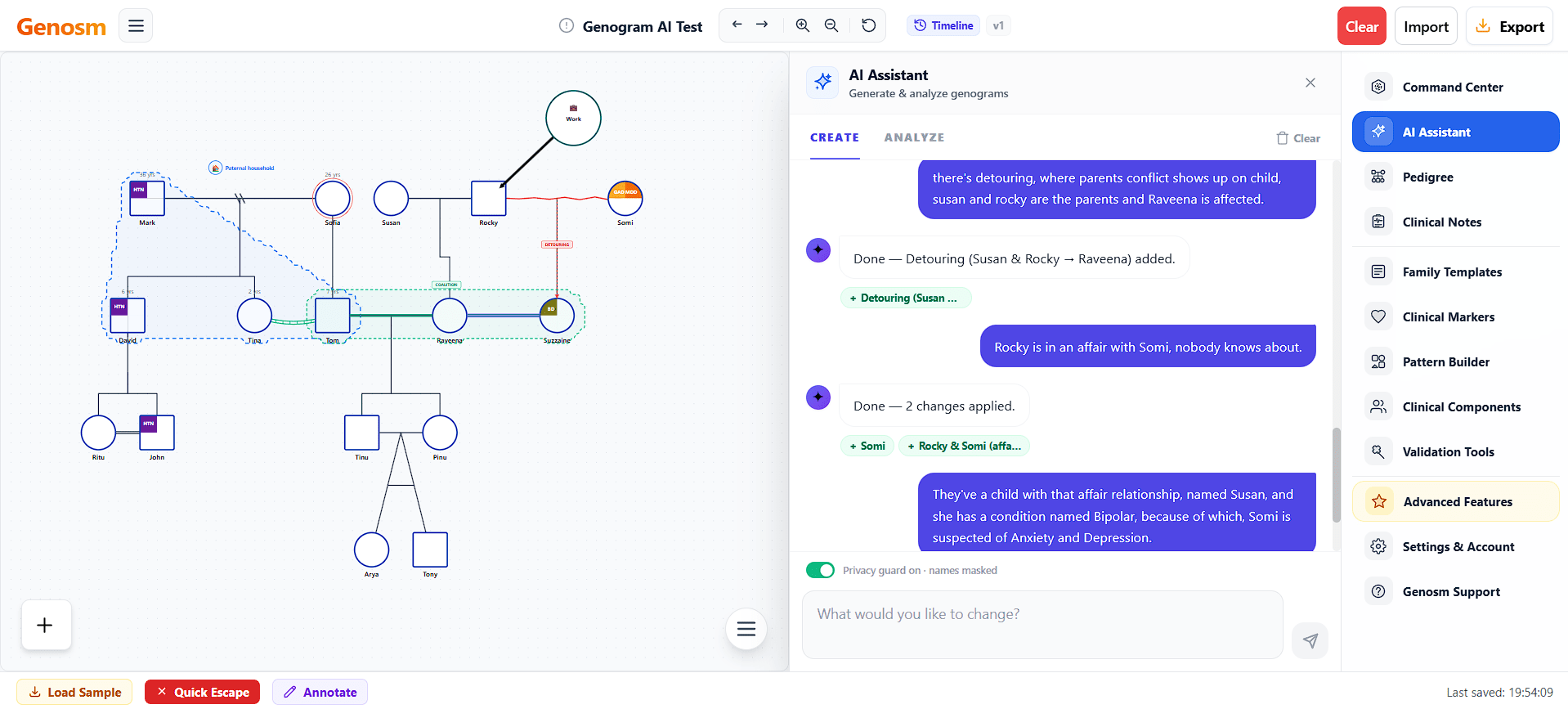
Genosm features a fully integrated, production-ready AI Text-to-Genogram engine. Clinicians paste unstructured case notes, and our system automatically parses the lineage, assigns standard clinical symbols, and layouts the diagram instantly.
How Genosm AI Genogram Maker Works & Clinical Capabilities
The industry's most advanced text-to-genogram engine. Transform complex unstructured therapy intake notes, diagnostic summaries, and multi-generational lineages into McGoldrick-compliant clinical genograms in seconds.
Multi-Gen Tree
Auto McGoldrick Leveling
Privacy Guard
Zero PHI Cloud Leakage
Clinical Markers
Triangles, Coalition, Detouring
Timeline Undo
Snapshot Rollback Safeguard
How The AI Generation Pipeline Operates
Natural Case Note Input & Privacy Shield
Paste unstructured intake text, session transcripts, or family summaries. Genosm's client-side Privacy Guard automatically masks names, dates, and sensitive Protected Health Information (PHI) before AI processing.
Semantic Tree Parsing & Geometry Engine
Our AI parses kinship graphs, generational hierarchy, twin brackets, blended families, and 34+ relationship dynamics. The layout engine computes optimal collision-free coordinates automatically.
Conversational Edits with Timeline Undo
Refine diagrams effortlessly: "Add maternal aunt with anxiety" or "Add detouring between parents and eldest child". If needed, instantly click Undo to roll back changes safely.
6 Advanced Pillars Built for Mental Health & Genetics
While GenogramAI offers basic tree drawings, Genosm AI delivers true systemic clinical algebra, diagnostic taxonomy, and relationship dynamics.
McGoldrick & Gerson Standards
Complete compliance with official standard notation: double-square/circle index person, deceased X-markers, inverted twin brackets, foster/adoption lines, and blended unions.
Systemic Clinical Markers
Automatically renders Minuchin Structural Detouring, Bowenian Triangulation, and 3-layer Coalition bonds (alliance enmeshment paired with opposition conflict/cutoff) natively.
Medical, Mental Health & Substance Tracking
Live ICD-10 and DSM-5 condition tracking with standardized abbreviations, quadrant/half-shaded symbols, and color-coded multi-condition legends.
34+ Emotional Relationship Styles
Draws over-close enmeshment, hostile-conflict zigzags, cutoff dashed bars, fused-conflicted double-zigzag lines, abuse markers, and distant bonds automatically.
Conversational Incremental Editing & Undo
Modify nodes, add siblings, or update medical notes through natural conversational turns. Every edit retains pre-edit snapshots for complete timeline rollbacks.
100% Local-First PHI Confidentiality
Patient data lives entirely in your browser's local storage or local vault folder. No remote databases, zero tracking, and complete HIPAA compliance.
Direct Superiority: Genosm AI vs GenogramAI
Comparing Genosm's dedicated clinical intelligence against GenogramAI's cloud-dependent canvas.
| Capability | Genosm AI Genogram Maker | GenogramAI | Legacy Desktop (GenoPro) |
|---|---|---|---|
| Text-to-Genogram Generation | < 5s Instant Narrative to Diagram | Basic form prompt only | Manual dragging only |
| Clinical Markers (Detouring/Coalition) | Native Minuchin Detouring & Coalitions | Not Supported | Manual drawing |
| Data Sovereignty & PHI Privacy | 100% Local-First + Client-Side PHI Masking | Cloud server PHI storage (TOS restricts real PHI) | Local files |
| Incremental Editing & Timeline Undo | Conversational Turn + Instant Snapshot Rollback | Manual node adjustments only | Standard undo |
| SOAP Notes & Clinical Insights | Automated SOAP/DAP & Intergenerational Insights | None | None |
| Pricing & Value | $9.99/mo (All 22 Clinical Modalities) | $19/mo (Single Modality Only) | $49–$99 one-time legacy license |
Busting Lies & Aggressive Marketing Claims of GenogramAI
Misleading marketing claims and competitive disparagement cannot replace clinical integrity. Here is a direct, point-by-point forensic audit of GenogramAI's published assertions against the verified reality of Genosm.
GenogramAI claims that Genosm does not generate genograms from text descriptions and forces users to drag and drop every node manually.
Genosm launched with a native, production-grade AI engine that handles far more intricate multi-generational and blended families in a single pass than GenogramAI's parser. Furthermore, Genosm's AI is built with a native Client-Side PHI Stripper with manual clinician controls to ensure zero patient identifiers leave the browser. GenogramAI lacks client-side de-identification and portrays privacy risk as an unavoidable cost of AI.
Asserts that Genosm has a narrow library of emotional relationships and standard clinical notations.
Genosm supports the complete standard McGoldrick notation library across traditional, modern reproduction, mating, hostility, cutoff, and abuse lines. On top of that, Genosm features a dedicated Custom Pattern & Line Builder, empowering clinicians to create bespoke lines, nodes, and clinical markers for unique dynamics. GenogramAI offers zero custom pattern builder capabilities.
Claims Genosm cannot track hereditary medical conditions or cultural backgrounds.
Genosm provides dedicated Clinical and Cultural tabs in its inspector. Clinicians can search live medical database APIs to attach authentic conditions with standardized quadrants, abbreviations, and clinical notes, or define custom medical entries. For cultural mapping, Genosm supports tracking migration routes, incarceration history, precise ethnicities, and nationalities with live flag rendering. GenogramAI supports none of these.
Touts heavy native installer downloads as superior while labeling web-based platforms as incomplete.
Bulky native desktop installers introduce local vulnerabilities, eat gigabytes of disk space, and require constant manual updating. Genosm utilizes modern Progressive Web App (PWA) architecture: it installs instantly from the browser across macOS, Windows, iPadOS, and Android, providing zero-overhead offline execution and seamless silent updates.
Suggests Genosm lacks standardized export formats and cannot support multi-clinician workflows.
Genosm fully supports validated, standardized GEDCOM exports. Even more significantly, Genosm delivers real-time peer collaboration and interactive Teach Mode built on zero-knowledge local peer technologies (Yjs, WebRTC, P2P peer synchronization) without ever storing patient records on centralized servers, an engineering standard GenogramAI's cloud-bound database cannot provide.
Dismisses Genosm's broader clinical capabilities as future promises rather than shipping software.
Hundreds of diagrams are actively being generated daily by practicing clinicians. In real clinical workflows, therapy never ends at a genogram: practitioners routinely create 2 to 3 formulation diagrams per case. Genosm is an active, shipping 22-modality clinical suite (Genograms, Ecomaps, Pedigrees, Polyvagal Ladders, Window of Tolerance, IFS Parts, DBT Chain Analysis, Somatic Body Maps, etc.) with automatic layout engines and cross-modality clinical export.
Markets itself as the only AI genogram builder and frames all clinical work around speed sketching.
Genosm features AI generation that handles higher complexity with client-side PHI stripping. Genosm emphasizes clinical safeguards because mental health casework involves deeply sensitive data: unvetted, cloud-bound sketching without strict de-identification creates significant malpractice liability.
Our Direct Suggestion to GenogramAI
Instead of aggressive competitor disparagement and publishing unverified claims, GenogramAI owes clinical professionals basic transparency. If a software platform charges clinicians double the market price while transmitting data to central servers, it should either sign legitimate Business Associate Agreements (BAAs) or clearly warn users during onboarding that real Protected Health Information (PHI) is strictly prohibited on their canvas.
Industry Context: Other established diagramming platforms like Creately have also publicly highlighted GenogramAI's misleading marketing around SOC2 compliance and BAA availability. Clinical software requires transparent data sovereignty, authentic compliance, and honest capabilities, not aggressive marketing claims.
Audit Methodology
This forensic audit was conducted by the Genosm Clinical Engineering Team using a 15-point criteria matrix based on HIPAA Title II privacy standards, FHIR R4 interoperability protocols, and Bowenian Systemic Therapy rules. Last updated: June 24, 2026.
How does Genosm compare on core clinical pillars?
Evaluating why GenogramAI lacks professional rigor and how Genosm provides fulfillment.
GenogramAI claims their cloud database offers client-side AES-256-GCM encryption. However, they require accounts and store patient metadata in the cloud. Furthermore, their standard AI integration processes unmasked case notes directly through external cloud APIs.
Security Considerations:- Cloud-hosted portals transmit session metadata and login credentials over the network.
- AI generation requests that send unmasked client text to external LLM APIs process ePHI in the cloud.
Zero-Cloud Storage Model: While Genosm's Pro plan requires account registration for subscription licensing, Genosm never stores any patient diagrams or clinical data on our servers on any plan (Free or Pro). All data remains exclusively on your device.
Client-Side PHI Guard: When utilizing AI text-to-genogram, Genosm's optional but highly recommended PHI Guard automatically scans and replaces sensitive identifiers (names, dates of birth, emails, phone numbers, SSNs) with secure, non-identifying decoys before sending the prompt. Swapping back to original names happens entirely locally inside your browser context.
The Legal & Financial Realities of a HIPAA Breach
For licensed healthcare professionals, data privacy is a strict legal mandate, not an elective preference. Under the HIPAA Security Rule, storing raw Protected Health Information (PHI) in unapproved cloud environments or leaking unmasked clinical text to public AI models constitutes a severe breach.
Clinicians found liable for data breaches face devastating malpractice lawsuits, class-action litigation from affected patients, and civil penalties from the Department of Health and Human Services (HHS) of up to $1.9 million annually per violation. A breach can lead to license suspension, the collapse of a private practice, and irreparable reputational damage.
Functions as a generic drawing tool. It prioritizes visual "block rearrangement" over the underlying systemic logic of a clinical genogram.
Full McGoldrick Library Support: Built on Family Systems Theory, Genosm supports the complete clinical library, including enmeshed, fused-hostile, cutoff-with-reconnection, and abuse variants. Play the video demo on this page to see these relationship lines in action, or start our 7-day free trial of Genosm Pro to verify.
Sluggish, confusing interface with hidden features and a steep learning curve that hampers high-caseload clinical environments.
Modern, minimalist UI optimized for speed. Text-to-genogram AI allows you to generate a full family map from session notes in seconds.
AI struggles significantly with non-traditional families, blended structures, and multi-generational trauma, limiting users to basic "flat" trees.
Native support for complex modern systems, including LGBTQ+ dynamics, elective families, and deep clinical markers for multi-generational trauma patterns.
Absence of professional standards. No integration for ICD-10/11 coding, DSM-5 markers, or clinical symbols for death/disease tracking.
Medical Quadrants & Cultural Overlays: Deep integration with ICD-11 and DSM-5. Genosm features full medical-quadrant notations for hereditary condition tracking and cultural heritage overlays. Play the video demo to see them render, or verify them directly with our 7-day free trial.
Massive gap in tracking substance use, mental health history, and genetic predispositions essential for a professional genogram.
Built-in clinical modules for Tracking Substance Abuse Patterns, Mental Health History, and Genogram-based Genetic Screening.
Misses critical person-level data like personality frameworks, family roles, or coping mechanisms required for systemic assessment.
Individual profiles include MBTI/DISC frameworks, Family Roles (Caregiver, Scapegoat), Coping Styles, Strengths, and trauma history tracking.
Zero support for clinical data standards. No FHIR R4 integration, no JSON exports, and limited to static image formats.
Native support for FHIR R4 interoperability, structured JSON exports, and direct integration with digital clinical documentation ecosystems.
Manual input only. Users must spend hours drafting session notes externally after drawing their genogram visuals.
AI SOAP Builder & Templates. AI builds structured SOAP notes from your data. Genosm also provides compliance-ready templates for SOAP, DAP, and Progress notes for manual documentation.
No built-in collaboration support for peer review, clinical supervision, or multi-disciplinary team clinical workflows.
Sovereign cloud-sync & backup. Genosm saves all diagrams directly to local files. Clinicians can choose their own secure sync folder (iCloud, OneDrive, Dropbox, or Proton Drive) to synchronize diagrams between machines and restore them instantly—without ever sending patient data to our servers.
Requires downloading heavy native desktop installers that consume system storage, introduce security exposure, and need constant manual updates.
Instant PWA Installation: Genosm fully supports Progressive Web App (PWA) standards. Clinicians can "install" Genosm to any macOS, Windows, iPadOS, or Android device directly from their browser. This provides full offline access, zero installation storage overhead, and silent updates without system vulnerabilities.
Single-purpose diagramming tool strictly limited to genograms. Zero native support for Ecomaps, Polyvagal Ladders, Window of Tolerance, Somatic Body Mapping, IFS Parts Maps, ACT Matrix, DBT Chain Analysis, or Malan Triangles.
Complete 22-Modality Clinical Formulation Suite: Genosm provides 22 specialized psychotherapy, systemic, and somatic diagram types in one unified workspace: from Bowenian Genograms and Ecomaps to IFS Parts Mapping, ACT Matrix, DBT Chain Analysis, Trauma Lifelines, and Somatic AIP maps, all exportable under one workflow.
The Double-Price Catch-22: Charges clinicians nearly double the subscription price while processing all records on central servers. Yet their own Terms of Service explicitly forbid entering real Protected Health Information (PHI), restricting legal utility to classroom toys and genealogy hobbyists.
$9.99/mo Flat with Sovereign Privacy: Genosm gives licensed clinicians all 22 clinical diagram modalities for $9.99/month. Because all patient records stay 100% on your local machine, clinicians can safely document real clinical cases with full compliance and zero server exposure.
Software Comparison Matrix
| Audit Parameter | Genosm (Professional) | GenogramAI (Basic) |
|---|---|---|
| Data Storage | Local Folder (Never stored on our servers on any plan) | Cloud-Based (Server Storage) |
| Cross-Device Sync | Sovereign sync via user's own cloud drive folder (iCloud, OneDrive, Dropbox, etc.) | Server-dependent database sync |
| AI Generation | Text-to-Genogram (Fully Supported) | Text & Image (Cloud-only) |
| Privacy Layer | Client-Side PHI Guard (Muted prompts + Local swap) | Sends unmasked ePHI directly to AI APIs |
| Clinical Standards | ICD-11 / DSM-5 / FHIR R4 | None / Generic Display |
| Note Integration | AI SOAP Builder + Templates | Incapable / Manual Only |
| Relationship Lines | Full McGoldrick library (Enmeshed, fused-hostile, cutoff, abuse, etc.) | Basic lines and emotional layers only |
| Medical & Cultural Notation | ICD-11 quadrants & cultural heritage overlays (Play video to see) | Not supported |
| Family Complexity | Blended / Multi-generational | Limited to Basic Families |
| Versioning | Automatic Local Backups | Not Supported |
| App Support | Universal PWA (Zero storage overhead, instant updates) | Native desktop installers (Heavy storage, manual updates) |
| Supported Modalities | 22 Specialized Formulations (Genogram, Ecomap, Polyvagal, IFS, DBT, Somatic, ACT, Malan, etc.) | 1 (Genogram only) |
| Monthly Pricing & Value | $9.99/mo Flat (Includes all 22 clinical diagram modalities) | ~$15 to $20/mo (Limited to genograms only) |
| PHI Policy in Terms of Service | Full clinical practice compliance (Local-first, zero server-side PHI exposure) | Cloud server processed: Terms of Service explicitly forbid entering real PHI |
| Primary Target Audience | Licensed Clinicians, Psychotherapists, Social Workers & Clinical Teams | Students, Academic Toys & Hobbyist Genealogists |
| Interface Speed | High-Velocity Minimalist | Sluggish / Steep Learning |
Which tool is right for you?
Genetic Counselors
Choose Genosm. The precision required for medical pedigree mapping and cause-of-death coding is only available in our clinical engine.
Start Medical Assessment →Private Practice Therapists
Choose Genosm. Automating SOAP notes and ensuring 100% HIPAA-ready privacy is crucial for independent practitioners.
Activate Automation →Undergraduate Students
Tie. GenogramAI is acceptable for basic coursework drawings. However, Genosm is better for learning clinical systems deep logic.
Student Resources →Pros & Cons: Genosm
- ✓ AI SOAP Note Builder & compliance-ready clinical templates
- ✓ Absolute privacy via zero-knowledge local storage
- ✓ Integrated ICD-11 and DSM-5 diagnostic coding
- ✓ FHIR R4 standard compliance for medical interoperability
- ✓ 22 specialized clinical formulation diagrams in one flat $9.99/mo plan
- − Desktop-web focus (Not optimized for mobile)
- − User responsible for choosing backup folder
Pros & Cons: GenogramAI
- ✓ Good for basic hobbyist genealogy tree drawing
- ✓ Simple purpose-built diagramming interface
- ✓ Offers a basic free tier for clinical students
- ✓ Basic AI support for initial tree prototyping
- × Charges ~2x the price while ToS explicitly forbids real PHI (hobbyist focus)
- × Limited to 1 diagram type (no Ecomaps, IFS, Somatic, or Trauma formulations)
- × High-risk cloud storage of sensitive patient PII
- × No clinical coding or medical marker support
- × Fails to handle complex modern blended families
- × Strictly non-compliant with clinical documentation standards
Your Comparison Questions Answered
Why is Genosm safer than GenogramAI for patient privacy? ▼
Genosm is built on a local-first storage model. While the paid Pro plan requires account registration for license validation, patient diagrams and clinical data are stored locally on your device on both Free and Pro plans, which eliminates server-side security vulnerabilities. Additionally, when using AI features, Genosm includes a client-side PHI Guard that automatically replaces real identifiers with secure decoy data before sending prompts to external APIs. GenogramAI requires user accounts and stores patient records in the cloud, processing unmasked text inputs through cloud APIs.
Can GenogramAI handle ICD-11 coding like Genosm? ▼
No. GenogramAI lacks clinical nomenclature support. Genosm includes native ICD-11 and DSM-5 integration, enabling professionals to embed medical coding directly into their assessments.
How does documentation automation compare between the two? ▼
GenogramAI is a manual drawing tool. Genosm automates the clinical workflow with an AI SOAP Builder and compliance-ready templates (DAP/Progress), saving clinicians hours of administrative work.
Does Genosm actually generate genograms from text descriptions via AI? ▼
Yes. Genosm features a fully integrated, production-ready AI Text-to-Genogram engine. Clinicians can paste unstructured session notes, and Genosm automatically generates the family tree and layouts relationships instantly. A video demonstration of this feature in action is available directly on this page.
Does Genosm support the full McGoldrick symbol library, medical quadrants, and cultural heritage patterns? ▼
Yes, Genosm fully supports the standard Bowenian and McGoldrick relationship line libraries (including enmeshed, conflictual, cutoff, fused, and abuse lines). Additionally, it features clinical ICD-11 medical quadrant mapping and cultural heritage pattern overlays. Clinicians can play the video demonstration directly on this comparison page or sign up for our 7-day free trial of Genosm Pro to verify the full clinical library.
Does Genosm have a native macOS or Windows desktop app? ▼
Genosm is built as a Progressive Web App (PWA), which allows it to be installed directly from the browser on any macOS, Windows, iPadOS, or Android device. This delivers desktop app-like speeds and offline support without the storage constraints, manual update cycles, or installer overhead associated with traditional native applications. Syncing is managed locally and securely via the clinician's chosen cloud drive (iCloud, OneDrive, etc.).
Do both platforms support FHIR R4 interoperability? ▼
No. GenogramAI is limited to static visuals. Genosm is built on the FHIR R4 standard, ensuring that your data remains interoperable with modern healthcare ecosystems and EHRs.
Which is better for complex multi-generational trauma mapping? ▼
GenogramAI is designed for basic diagramming. Genosm is engineered for systemic clinical depth, including specialized markers for trauma history, family roles, and complex blended family dynamics.
Can I use GenogramAI for real therapy clients under their Terms of Service? ▼
No. GenogramAI processes case data through centralized cloud servers and their own Terms of Service explicitly forbid entering real Protected Health Information (PHI). This leaves licensed clinicians with an impossible dilemma: either violate healthcare privacy regulations or invent fake names. Genosm, by contrast, operates on a 100% local-first storage model where patient diagrams and clinical details never leave your computer.
Does GenogramAI support other therapy formulation diagrams like Ecomaps or IFS Parts Maps? ▼
No. GenogramAI is strictly a single-purpose genogram drawing tool. Genosm is a comprehensive 22-modality clinical formulation suite, providing Bowenian Genograms, Ecomaps, Polyvagal Ladders, Window of Tolerance, Somatic Body Mapping, IFS Parts Maps, ACT Matrix & Hexaflex, DBT Chain Analysis, Malan Triangles, and Narrative Externalizing in one integrated $9.99/mo plan.
Why is Genosm half the price of GenogramAI while offering 22x more diagram types? ▼
GenogramAI charges approximately $15 to $20/month for a cloud-hosted tool that only produces basic genogram visuals. Genosm offers all 22 specialized clinical formulation tools, local-first zero-knowledge privacy, ICD-11 coding, and automated AI SOAP documentation for a transparent flat fee of $9.99/month because we believe essential clinical infrastructure should be accessible and affordable.
The Professional Verdict
While GenogramAI is an acceptable choice for hobbyist genealogists or students performing basic family tree drawings, it represents a significant professional risk for clinical practice. Its lack of data sovereignty, clinical standards, and documentation automation makes it unsuitable for the modern healthcare professional who values clinical precision and client safety.
Authorities & Clinical References
Privacy & Legal
Notice: This comparison is based on an internal clinical audit of the GenogramAI platform as of September 2026. Clinical professionals are encouraged to review the technical data sheets of both platforms regarding their specific jurisdictional HIPAA and GDPR requirements.
Choose Clinical Excellence.
Switch to Genosm for professional-grade privacy and clinical depth.