Genosm is the only clinical intelligence platform that unifies intergenerational family history and ecological context into a single, professional systemic map in under 120 seconds. Beyond visualization, the platform automatically generates diagnostic insights and structured SOAP notes, allowing practitioners to export standardized documentation in FHIR, PDF, PNG, and SVG formats for immediate integration into any Electronic Health Record.
See how professionals utilize integrated genograms and ecomaps to achieve diagnostic clarity in complex caseloads.
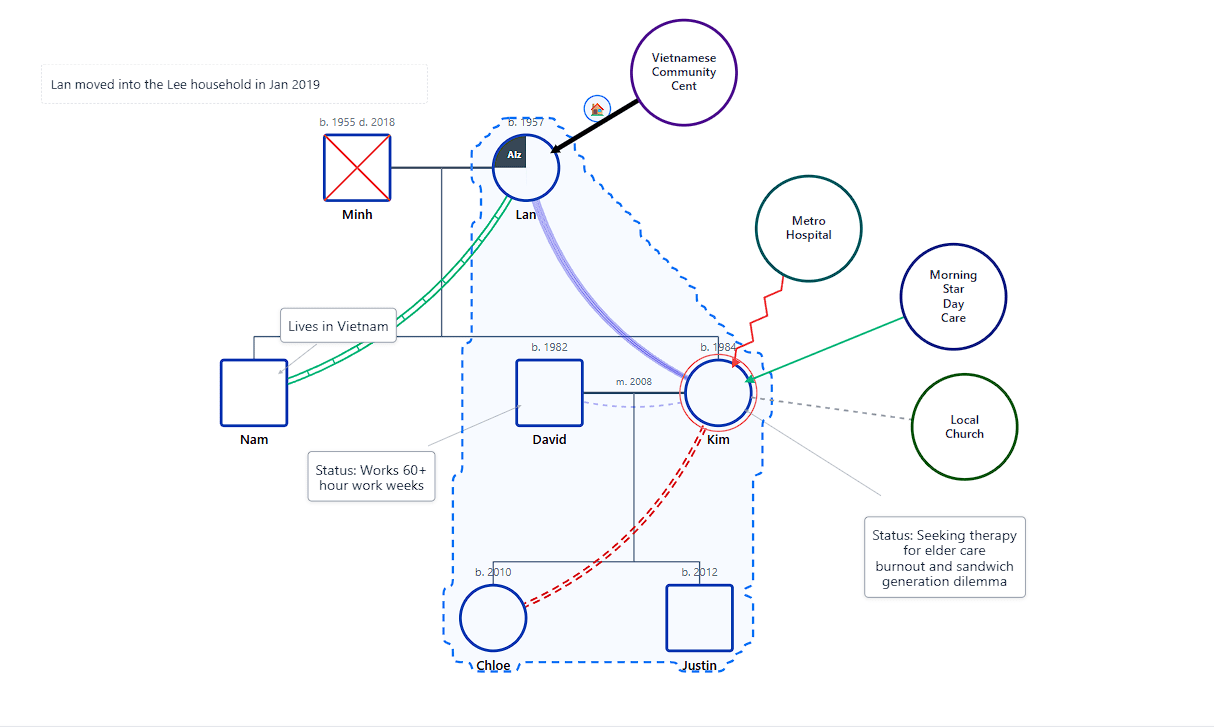
Sarah Miller (32) is navigating recovery from substance use while managing a CPS safety plan. The genogram layer reveals intergenerational trauma, including the overdose of her brother and the incarceration of her husband.
By layering the ecomap, the social worker identifies a vital "Resilience Node" through a local community church that provides childcare support. This integrated view prioritizes kinship stabilization over foster placement, ensuring the children remain within a supportive ecological network.
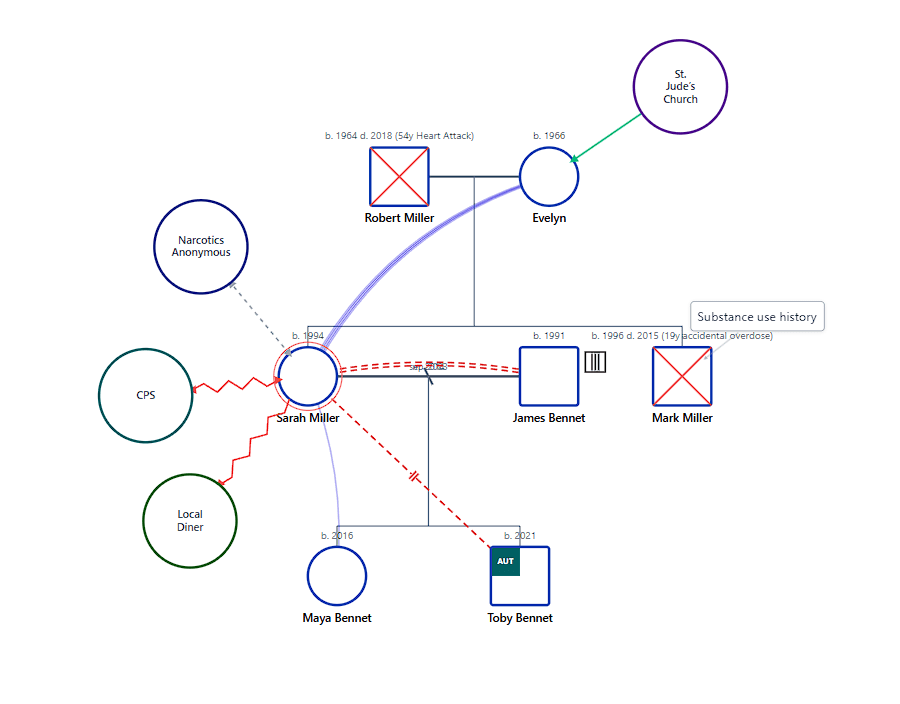
Kim Lee (42) manages the intensive care needs of her mother, Lan, who is living with Alzheimer's. The mapping visualizes the "Sandwich Generation" struggle: Kim is physically stretched between her nursing career, parenting, and complex elder care.
The ecomap identifies "Stress" markers at Kim's workplace but highlights a critical cultural resilience hub—a community center that provides Lan with social anchoring. The visualization allows the social worker to advocate for targeted respite services, shifting the energy flow from systemic fatigue toward sustainable care.
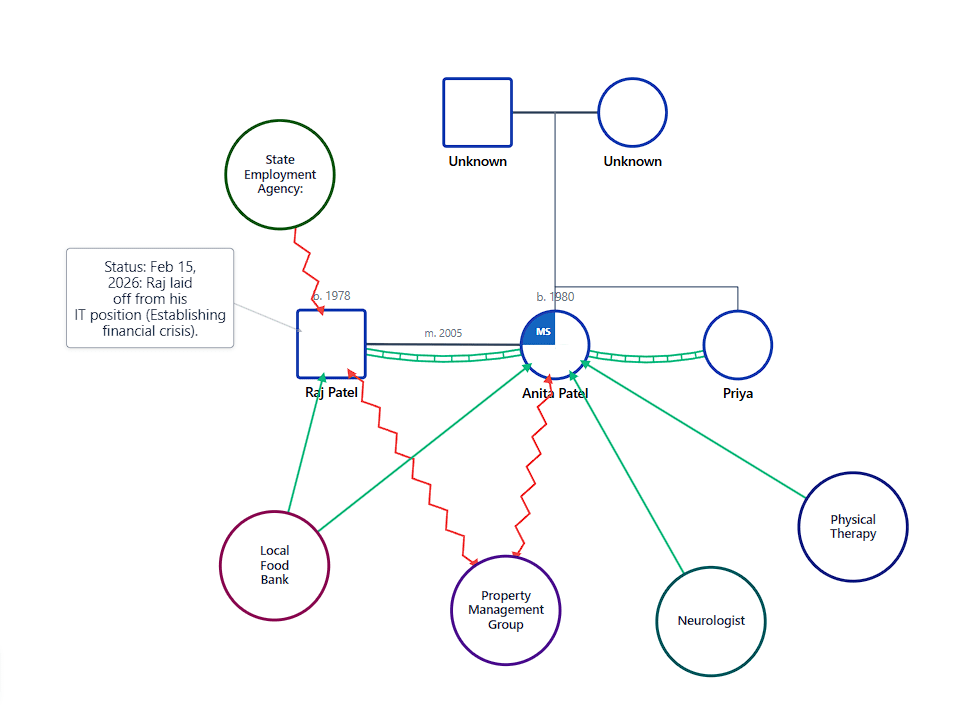
Anita Patel (46) is living with Multiple Sclerosis while her husband Raj faces sudden unemployment. The mapping illustrates the "Systemic Overload" that occurs when health crises intersect with economic instability and pending eviction.
By visualizing the 'spaghetti' of stressors, the social worker identifies "Hostile" energy flows toward property management but "Healing" nodes through Anita’s medical team. The ecomap facilitates immediate housing advocacy while leveraging family support to maintain clinical continuity for Anita’s treatment.
In systemic therapy and social work, family history (Genogram) and environmental context (Ecomap) are two sides of the same coin. Segregating them creates a clinical blind spot. Genosm bridges this gap, allowing practitioners to visualize how intergenerational trauma interacts with current ecological stressors and protective factors.
The Genogram tracks vertical patterns through time: health history, relationship cutoffs, and behavioral repetitions across three or more generations. The Genosm AI generates this structure instantly from narrative notes.
The Ecomap tracks horizontal connections in current space: relationships with work, school, healthcare, and community. Rapidly add these systems manually using the rule-baked interface.
Understanding when to use each systemic visualization tool.
| Feature | Genogram (Internal) | Ecomap (External) |
|---|---|---|
| Primary Focus | Biological lineage and family relationship dynamics. | Relationship between family and environmental systems. |
| Dimension | Temporal (Vertical/History). | Ecological (Horizontal/Context). |
| Key Data Points | DOB/DOD, medical history, emotional bonds, sibling order. | Work, school, healthcare providers, community resources. |
| Clinical Goal | To identify intergenerational patterns and repetitions. | To assess resource adequacy, isolation, and environmental stress. |
| Symbology Basis | McGoldrick clinical notation. | Hartman ecological mapping. |
Genosm eliminates the friction of manual drawing. Our hybrid workflow leverages AI for the complex structural generation of family trees while providing a streamlined, rule-based interface for ecological context.
Paste your intake notes. The Genosm AI engine instantly extracts family members, dates, and emotional relationships to build the Genogram base.
Click to add external systems (Health, Legal, Spiritual). No need to remember symbols; the tool enforces Hartman rules automatically.
Download a single high-fidelity PDF containing both maps, ready for your EHR system or court report.
Clinicians often avoid ecomaps because of the specific symbology requirements. Genosm bakes the rules into the interface. When a "Conflicted" relationship is selected, the zigzag line is generated with the correct clinical weight automatically. The practitioner focuses on the client; the platform focuses on the standards.
Genosm implements standardized Hartman clinical notation to ensure your ecological assessments are universally legible and professional.
Represents a robust and highly reliable resource flow.
Identifies fragile, inconsistent, or unreliable connections.
Visualizes significant tension, friction, or energy drain.
Identifies active protective factors and positive buffers.
The external system is actively supporting the family unit.
The family unit is expending significant energy on the system.
Indicates a healthy, two-way flow of support and resources.
Hand-drawn maps are often rejected in legal settings or institutional reviews due to lack of standardization and legibility. Genosm provides high-resolution, vector-grade exports that adhere strictly to professional clinical notation. Whether for a court-ordered family assessment or a hospital multidisciplinary team review, your documentation will command authority.
Genosm does more than draw lines. It identifies the invisible dynamics that define systemic health.
The Genosm AI analyzes relationship weights to identify potential triangles where a third party is pulled in to stabilize a conflicted dyad.
Visualizing boundary diffusion by identifying clusters of over-involved emotional relationships that may hinder individual autonomy.
Cross-referencing Ecomap voids with Genogram cutoffs to highlight clients at high risk due to a lack of systemic support.
Systemic mapping is a universal clinical language. Genosm adapts to your specific field of practice.
Track reunification paths and kinship placements while mapping educational and legal advocacy systems.
Map primary caregivers and medical specialists alongside family health history and inheritance dynamics.
Generate standardized assessments for court testimony, emphasizing behavioral patterns and institutional connections.
Coordinate complex discharge planning by mapping family support capacity against healthcare resource availability.
For decades, systemic mapping remained trapped in a "drafting" phase—valuable for sessions but difficult to digitize, standardize, or analyze. Genosm moves mapping from a static drawing to a dynamic data layer. By digitizing Hartman and McGoldrick standards, we allow the system itself to provide insights that the human eye might miss on a messy paper sketch.
Experience the Future of MappingGenosm bridges the gap between seeing the system and treating it.
Genosm analyzes your final dual-map and generates draft SOAP note sections. It highlights systemic observations and protective factors, ready to be pasted into your EHR for immediate documentation compliance.
Identify "lever points" in the system. Should the focus be on strengthening a tenuous school connection (Ecomap) or addressing a generational cutoff (Genogram)? Genosm provides the data to justify your clinical direction.
Sensitive clinical data requires absolute sovereignty. Genosm utilizes a local-first, zero-knowledge architecture. All relationship data is stored in the browser's secure enclave. When using AI features, the proprietary "PHI Strip Guard" sanitizes all personal identifiers (names, specific dates, addresses) before anonymized relationship tokens are processed. Client data remains private.
Common questions regarding systemic mapping and Genosm.
Genosm is the definitive clinical tool for creating a genogram and ecomap within a single, unified workspace. It eliminates the need for fragmented documentation by allowing you to layer ecological systems directly onto your AI-generated family tree, providing a holistic "Person-in-Environment" assessment.
Creating a genogram and ecomap together ensures that neither historical patterns nor current environmental stressors are missed. The genogram provides the temporal depth (intergenerational history), while the ecomap provides the spatial context (external systems), leading to more rigorous diagnostics and effective treatment planning.
Genosm utilizes a hybrid workflow: our specialized AI engine parses clinical notes to instantly render a complex genogram, while a rule-based interface allows you to rapidly add ecomap systems (like schools, work, or healthcare) with standardized clinical precision.
While both are systemic, genogram symbols represent internal family structures and emotional relationship qualities, whereas ecomap symbols (such as energy flows and stress lines) represent the transactions between the family unit and external ecological systems.
Yes. Both your genogram data and ecomap visuals are protected by our local-first architecture. Sensitive clinical data never persists on our servers, and our PHI Strip Guard anonymizes all identifiers before any AI-augmented mapping occurs.
Integrating the genogram and ecomap allows social workers to identify all biological relatives while simultaneously assessing their social support capacity. This dual view is essential for identifying stable, supported kinship placements in child welfare cases.
Absolutely. You can export your combined genogram and ecomap as a high-resolution PDF or PNG. These standardized reports are designed for immediate attachment to Electronic Health Records (EHR) like Epic, Cerner, or Jane.
No. Genosm consolidates both into one professional workspace. You no longer need separate apps or paper sketches for your genogram and ecomap; the entire systemic ecosystem is managed within a single clinical platform.
The Person-in-Environment (PIE) perspective requires a simultaneous focus on history and context. The genogram provides the historical/internal lens, while the ecomap provides the environmental/external lens, together forming the gold standard for PIE diagnostics.
Clinicians typically map at least three generations on a genogram to provide sufficient historical depth, even when layering it with a current ecomap. This ensures that the ecological assessment is informed by intergenerational patterns.