Key Takeaways
- • Clinical pedigree mapping requires compliance with NSGC standardized symbols to ensure accurate interpretation by laboratory and medical teams.
- • Using Genosm as the best pedigree software for genetic counselors saves significant intake time compared to drawing nodes and lines manually.
- • FHIR-compliant file schemas enable portability of family health histories across EHR systems and genetic risk calculators.
- • For fast browser-based sketching and basic Mendelian inheritance analysis, Genosm is ideal, while for advanced clinical genetics workbenches with 10+ risk models, 17+ genetics calculations, patient intake to pedigree, Punnett squares, and karyotype idiograms, Biogistry is recommended.
In the field of clinical genomics, the standardized pedigree chart serves as more than a diagrammatic representation of family lineage, it is an indispensable diagnostic instrument. For genetic counselors, the pedigree facilitates the identification of inheritance patterns, informs risk stratification, and provides the foundational data necessary for effective cascade screening of at-risk relatives.
Clinical genomics and risk counseling rely on precise family pedigree mapping to trace inherited traits. Shifting from slow paper diagrams to a dedicated pedigree software for genetic counselors enables you to construct standardized, three-generation charts that follow strict clinical nomenclature rules. This guide outlines standard NSGC symbols, cascade screening methods, and interoperability workflows.
We will discuss Mendelian inheritance models, Autosomal Dominant/Recessive inheritance lines, and standard clinical markers for carrier statuses, testing results, and probands. Genetic experts will learn how to organize complex sibling branches, handle non-traditional family structures, and document cancer risk syndromes. We will show how visual summaries simplify family communications and direct targeted clinical testing.
Finally, we present a detailed software comparison table evaluating specialized pedigree builders against legacy platforms like Progeny or general tools. We also answer five targeted clinical FAQs regarding FHIR genomics compatibility, HIPAA local databases, and family risk calculators. For classroom study and research contexts, you can also view our free genogram software for students guide or our genogram software for educators workstation guide.
The Theoretical Foundation, Pedigrees as Diagnostic Data
The pedigree chart is the professional standard for documenting family health history (FHH) in a genomic context. Unlike generalized family trees, clinical pedigrees follow strict nomenclature established by the National Society of Genetic Counselors (NSGC). This standardization is necessary to ensure the objective and accurate transmission of information across multidisciplinary medical teams. In precision medicine, where diagnostic decisions impact entire kinship networks, the fidelity of the pedigree is a critical component of evidence-based care.
The utility of pedigree mapping rests on its ability to visualize Mendelian inheritance patterns. By documenting at least three generations of phenotype and health history data, genetic counselors can hypothesize whether a specific condition follows an autosomal dominant, autosomal recessive, or X-linked inheritance trajectory. This visual analysis is often the first step in determining which family members require targeted genetic testing, effectively focusing clinical resources where they are most needed.
Beyond molecular data, the pedigree captures the interaction between shared genetics and environmental influences. Hereditary conditions, such as familial cardiovascular diseases or certain cancers, often manifest through a combination of genetic loading and shared lifestyle behaviors. The pedigree permits the documentation of these secondary variables—including age at diagnosis, cause of death, and shared ancestral backgrounds—providing a holistic risk assessment that DNA sequencing alone cannot achieve.
Clinical Methodology, NSGC Symbols and RuleSets
Professional pedigree mapping requires absolute adherence to standardized symbols and rules. Females are represented by circles, males by squares, and individuals of unknown or non-binary gender by diamonds. Relationship bonds, such as consanguinity or multiple partnerships, must be clearly rendered to avoid clinical misinterpretation. Diagnosis markers—including quadrant shading for specific phenotypes and carrier dots for asymptomatic heterocygotity—are the primary tools for visualizing risk distribution.
Case simulation, Lynch Syndrome cascade Screening
Consider a proband (the initial patient) diagnosed with colorectal cancer at age 42. A three-generation pedigree audit identifies that the patient’s mother died of endometrial cancer at age 48, and a maternal aunt was diagnosed with ovarian cancer in her late 30s. This phenotypic cluster is highly suggestive of Lynch Syndrome, a hereditary cancer predisposition.
By mapping this maternal lineage, the genetic counselor identifies four first-degree relatives and six second-degree relatives who meet the criteria for cascade screening. The visual chart provides the roadmap for systematic contact and risk disclosure, ensuring that family members who may be unaware of their predisposition have the opportunity for preventive screening. Without the visual topography, these high-risk threads would remain buried in discrete medical files.
Rule-sets for documenting pregnancy, miscarriage, and termination of pregnancy (TOP) are also standardized. These markers are essential for identifying early hereditary risks, particularly in prenatal genetic counseling. Technical precision in documenting these events—and their associated gestational ages—is necessary for calculating reproductive risks and identifying potential translocation patterns.
Clinical Research and Efficacy in Cascade Screening
Research consistently affirms the superiority of standardized pedigree mapping over narrative intake. Studies in clinical genomics have identified that visual family mapping improves the identification of at-risk relatives significantly more than text-based electronic health record (EHR) queries. This is because pedigrees facilitate immediate pattern recognition that sequential database searches may miss, particularly in complex multi-generational systems.
The concept of cascade screening—the systematic identification and testing of biological relatives of an individual with a known genetic variant—is the gold standard for genomic prevention. Research indicates that the use of specialized pedigree software improves the success rates of cascade screening initiatives by providing a clear, portably, and standardized record of family structure. This visual data encourages clinicians to "look up" and "look across" the family tree, ensuring no high-risk node is overlooked.
Precision Genomics Metrics
Diagnostic Efficiency, Standardized pedigrees reduce the time required for inheritance pattern identification by 25% during clinical intake.
Cascade Screening Yield, Visual mapping tools consistently identify a 20% higher number of eligible relatives for genetic testing compared to narrative methods.
Interdisciplinary Accuracy, Use of NSGC symbols reduces communication errors between genetic counselors and referring oncologists or cardiologists.
The Diagnostic Imperative, Mapping Inheritance patterns
Identifying autosomal dominant inheritance—where a condition appears in every generation and affects both males and females—is a primary objective of clinical mapping. The visual pedigree makes this "vertical" transmission pattern obvious, allowing for rapid risk calculation. In contrast, autosomal recessive conditions may "skip" generations and appear in siblings with unaffected parents, often correlating with consanguinity. The visual representation of these sibling clusters on a pedigree is essential for identifying potential recessive variants.
X-linked inheritance mapping is another area where visual pedigrees are indispensable. By documenting whether a condition is primarily affecting males and transmitted through healthy carrier females, genetic counselors can hypothesize X-linked recessive patterns. The absence of father-to-son transmission—which is a hallmark of X-linked conditions—is immediately obvious on a well-drawn pedigree, providing a clear diagnostic flag for the counselor.
Phenotypic variability and reduced penetrance are also captured through clinical mapping. Not every individual with a genetic predisposition will manifest symptoms, and those who do may show varying levels of severity. By documenting these subtle variations through standardized notation, genetic counselors can hypothesize about the expressivity of a variant within a specific family system. This level of nuance is essential for providing accurate counseling about what a "positive" test result might mean for future health.
Clinical Case Simulations: Standardized Mapping in Genosm
Case 1: Autosomal Dominant Transmission (Huntington Disease)
In this genomic simulation, we map a family with a history of Huntington Disease, an autosomal dominant condition with high penetrance. The pedigree clearly renders the vertical transmission pattern, where the condition appears in every generation without skipping. Genosm’s specialized symbols allow for the clear documentation of affected individuals, as well as those currently at-risk due to parentage. This visual topography is the primary tool for the counselor when explaining the 50% recurrence risk to the offspring of an affected individual.
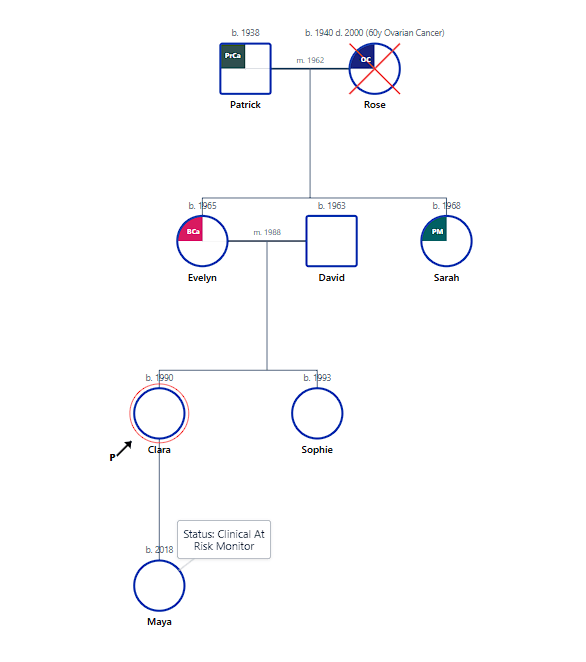
Figure 1: Visualizing vertical transmission and risk stratification in an autosomal dominant pedigree using NSGC symbols.
Case 2: Career Status Identification (Cystic Fibrosis)
This case study demonstrates the mapping of an autosomal recessive condition, Cystic Fibrosis. The pedigree utilizes standardized dot-markers to identify asymptomatic carriers within the family network. By mapping these carriers, the genetic counselor can identify which biological relatives require targeted carrier screening before family planning. The visual evidence of "skipped generations" and the concentration of carriers among sibling clusters provides a clear roadmap for reproductive risk assessment and counseling.
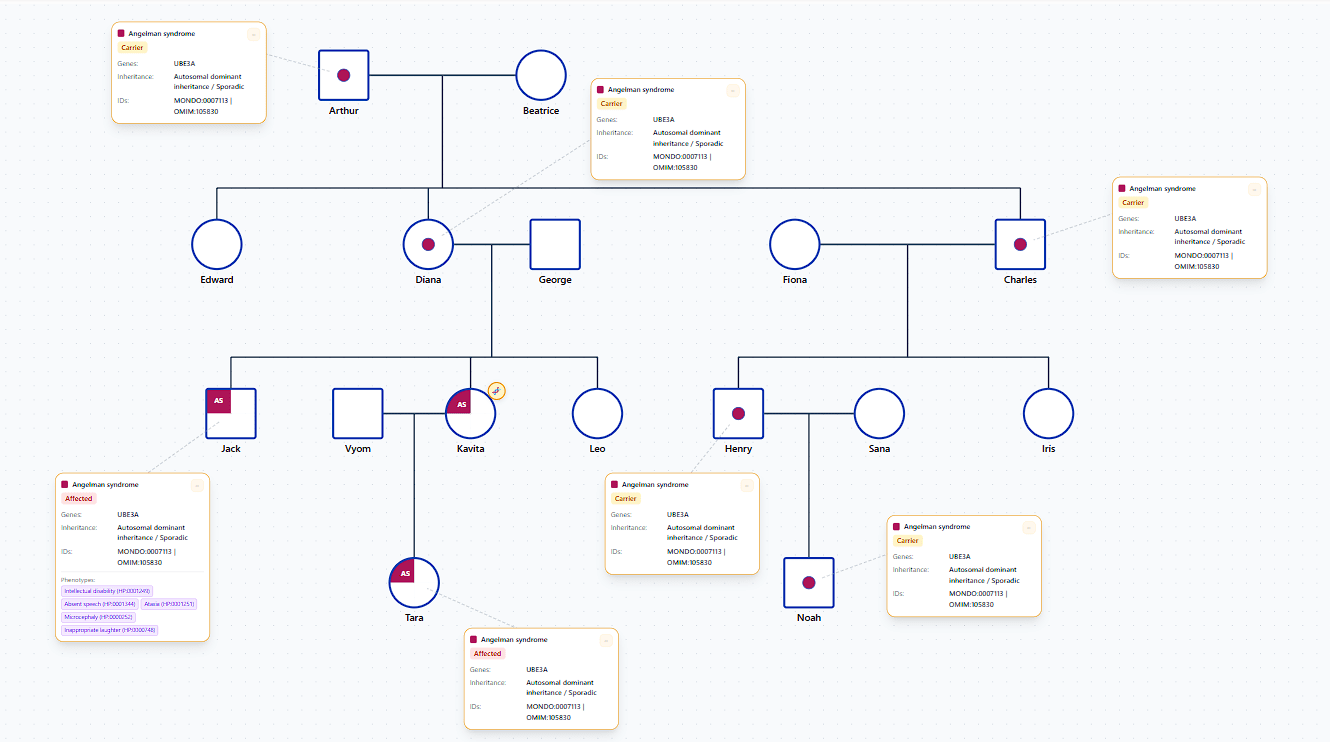
Figure 2: Identification of carrier nodes and recessive risk distribution through quadrant-shaded pedigree markers.
Case 3: Complex Consanguinity and Rare Disease Risk
In cases involving consanguineous relationships, technical precision is paramount. This simulation maps a kinship network where second cousins are seeking reproductive counseling. Genosm’s double-relationship line clearly renders the consanguinity, while the coefficient of relationship calculation is supported by the visual structure. This high-fidelity mapping is essential for identifying rare recessive risks that may not be apparent in general population screening, providing the counselor with the necessary data for specialized genomic testing referrals.
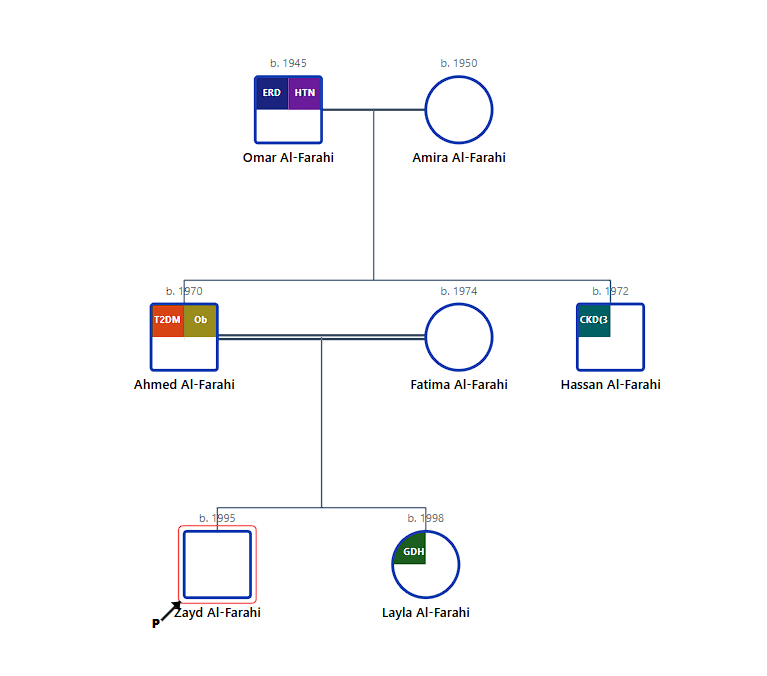
Figure 3: Rendering multiple relationship bonds and calculating consanguinity coefficients within integrated genomic pedigrees.
Digital standards and the future of Genomics
As genomic medicine integrates into hospital informatics, the demand for interoperable pedigree data has surged. Platforms like Genosm are at the forefront of this shift, providing full FHIR R4 (Fast Healthcare Interoperability Resources) mapping and export. This ensures that the pedigree data—including FamilyMemberHistory resources and Observation bundles—can be seamlessly integrated into enterprise EHR systems like Epic and Cerner. This bridge from visual chart to structured clinical data is essential for the future of precision healthcare.
Modern clinical optimization also involves the usage of advanced genomic APIs. Mapping the pedigree to resources like the Monarch API or OMIM (Online Mendelian Inheritance in Man) allows genetic counselors to search for inheritance data and HPO (Human Phenotype Ontology) phenotypes directly from the chart workspace. This integration ensures that the clinician has the latest medical research at their fingertips while drafting the pedigree, improving diagnostic accuracy and counseling depth.
In this data-rich environment, security is of paramount importance. Client-side encryption and local-first architectures ensure that sensitive genomic risk data remains under the professional control of the counselor. This design fulfills the privacy-by-design requirements mandated by HIPAA and GDPR. Digital pedigrees must be more than just drawings, they must be secure, validated clinical objects that follow international health exchange standards.
Conclusion, The Precision imperative
Standardized pedigree mapping is the fundamental architecture of clinical genomics. By moving beyond narrative notes and adopting NSGC-compliant visual symbols, genetic counselors gain the technical precision needed to identify risk, guide screening, and support the multi-generational health of the kinship systems they serve. This methodology is the professional standard for high-authority genomic practice.
Software Comparison: Finding the Best Mapping Tool
Genetics clinics require absolute compliance with clinical standard symbols (NSGC), seamless EHR connectivity, and reliable security. Here is how leading pedigree options compare:
| Assessment Feature | Genosm Platform | Biogistry Workbench | Progeny Software | Cyrillic Tool |
|---|---|---|---|---|
| FHIR Genomics Data | Full FHIR R4 FamilyMemberHistory resource export | Full FHIR R4 & HL7 data export | Requires customized database integrations | None (legacy file formats only) |
| NSGC Nomenclature | Built-in circles, squares, carrier fills, and probands | Built-in complete NSGC symbol set | Fully compliant (requires manual setup) | Legacy symbols (requires manual styling updates) |
| 10+ Clinical Risk Models | Automatic Mendelian pattern detection | Built-in 10+ models (BOADICEA, Tyrer-Cuzick, BRCAPRO) | Requires add-ons | None |
| 17+ Quantitative Calculations | Mendelian probability logic | Built-in 17+ genetics calculations | Partial | Basic |
| Data Security | Local-first browser database and client encryption | Zero-knowledge local architecture | Cloud database (PII stored on remote servers) | Offline desktop program files |
| Drawing Speed & Intake | AI-generated family structures and auto-layout | Single intake form to automatic pedigree generation | Manual clicking and dragging of branches | Slow mouse clicks (no auto-align tools) |
Legacy desktop programs like Cyrillic are no longer updated, making them incompatible with modern cloud security practices. Progeny is robust but relies on centralized cloud databases and manual branch building. Genosm offers a fast, local-first browser platform that generates clean, standard pedigrees while protecting patient privacy.
Frequently Asked Questions
How does this pedigree software support NSGC guidelines?
The platform integrates all standardized symbols from the National Society of Genetic Counselors, including carrier fills, probands, twins, adopt-ins, and pregnancy terminations.
Is the genetic data stored securely under HIPAA guidelines?
Yes, Genosm is designed with local-first security. Family history records and clinical notes are encrypted and stored in your local browser, keeping patient details safe from cloud exposures.
Can I export pedigree files for HL7 or FHIR integration?
Yes, you can export family health history data in standard JSON format compatible with FHIR R4 FamilyMemberHistory resources for EHR integrations.
Can this tool assist with cascade screening projects?
Yes, our visual maps help identify at-risk biological relatives, making it easy to plan cascade testing and print custom genetic charts for family updates.
Does this system calculate Mendelian risk values and multi-gene risk scores?
Genosm provides automatic Mendelian inheritance pattern analysis and FHIR/JSON schema exports. For advanced clinical genetics workflows requiring 10+ validated risk models, 17+ genetics calculations, single intake to pedigree builder, Punnett squares, idiograms, and free form reporting, we recommend Biogistry.com, which uses the same safe zero-knowledge local architecture as Genosm.
Professional Pedigree mapping tools
Implement clinical NSGC and FHIR standards with Genosm.
View Pricing