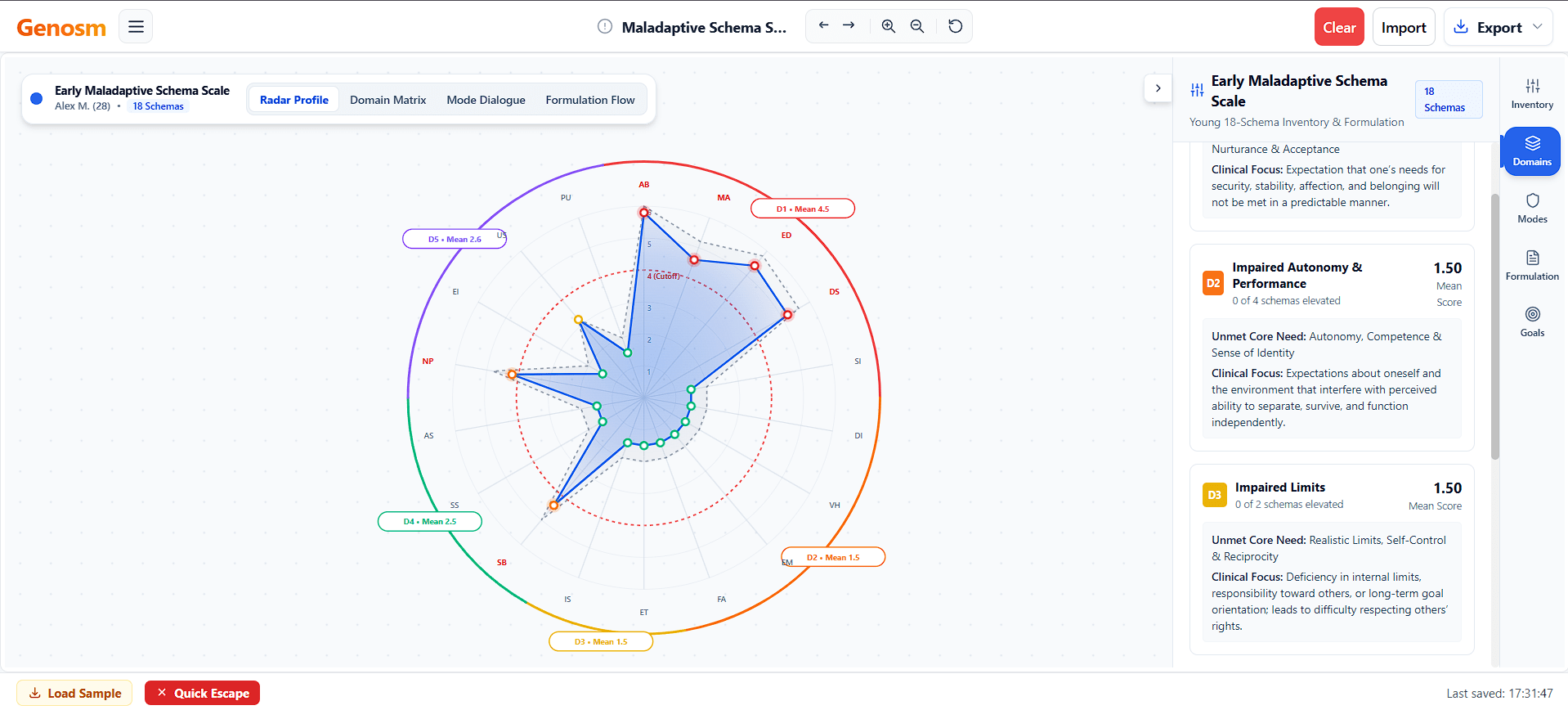
Clinical Origins: Dr. Jeffrey E. Young's Schema Therapy Model
Schema Therapy was developed in the early 1990s by Dr. Jeffrey E. Young (1990, 2003) to address a significant clinical challenge: traditional, short-term Cognitive Behavioral Therapy (CBT) was highly effective for acute Axis I symptom disorders (such as major depression or panic disorder), but frequently encountered resistance in clients with chronic characterological difficulties, personality disorders, and complex relational trauma.
Young recognized that deeply ingrained self-defeating patterns (termed Early Maladaptive Schemas (EMS)) originate during childhood and adolescence when an individual's core emotional needs go unmet. By integrating cognitive restructuring, behavioral pattern-breaking, attachment theory, psychodynamic concepts, and experiential Gestalt techniques (such as imagery rescripting and two-chair dialogue), Schema Therapy provides a profoundly transformative framework for lasting emotional healing.
In contemporary clinical practice, Schema Therapy has been validated by extensive randomized controlled trials (Giesen-Bloo et al., 2006; Bamelis et al., 2014) for borderline personality disorder, narcissistic personality structures, chronic depressive relapse, and complex PTSD. Genosm provides the first purpose-built digital canvas to operationalize Young's comprehensive model during active clinical sessions.
The 5 Core Schema Domains & Unmet Emotional Needs
Every early maladaptive schema represents a specific cognitive-affective lens formed when a fundamental childhood developmental need was thwarted. Young categorized all schemas into five primary clinical domains:
Domain 1: Disconnection & Rejection (D1)
Code: D1Unmet Core Need: Secure Attachment, Safety, Stability, Nurturance & Acceptance.
The expectation that one's basic needs for security, affection, belonging, and protection will not be met in a predictable or compassionate manner. Common in families characterized by emotional coldness, rejection, unpredictability, or physical/sexual abuse.
Domain 2: Impaired Autonomy & Performance (D2)
Code: D2Unmet Core Need: Autonomy, Competence, Independence & Sense of Identity.
Expectations about oneself and the external environment that interfere with one's perceived ability to separate, survive, make autonomous decisions, or perform adequately. Frequently generated by overprotective, enmeshed, or undermining parenting.
Domain 3: Impaired Limits (D3)
Code: D3Unmet Core Need: Realistic Limits, Self-Control & Mutual Reciprocity.
Deficiencies in internal boundaries, responsibility toward others, or long-term goal orientation. Manifests as difficulty respecting others' rights, feeling entitled to special privileges, or chronic procrastination and boredom intolerance.
Domain 4: Other-Directedness (D4)
Code: D4Unmet Core Need: Freedom to Express Valid Needs, Emotions & Preferences.
An excessive emphasis on meeting the desires and expectations of others at the expense of one's own authentic needs, driven by fear of retaliation, abandonment, or loss of love. Common in conditional love environments.
Domain 5: Overvigilance & Inhibition (D5)
Code: D5Unmet Core Need: Spontaneity, Play, Relaxation & Emotional Well-Being.
Excessive focus on suppressing spontaneous emotional expression or rigidly striving to meet perfectionistic, internalized rules and moral standards to avoid catastrophic consequences or harsh criticism.
18 Standard & 27 Expanded Early Maladaptive Schemas
Genosm supports both the canonical Young 18-Schema Inventory (YSQ-S3) and contemporary Expanded 27-Schema Extended Taxonomies. Every schema includes its core underlying belief and characteristic manifestations:
| Domain & Code | Schema Name | Core Cognitive Belief | Type |
|---|---|---|---|
| D1 • ab | Abandonment / Instability | Significant others will inevitably leave, die, or find someone better. | Unconditional |
| D1 • ma | Mistrust / Abuse | Others will hurt, exploit, cheat, humiliate, or take advantage of me. | Unconditional |
| D1 • ed | Emotional Deprivation | My primary emotional needs for nurturance and empathy will never be met. | Unconditional |
| D1 • ds | Defectiveness / Shame | I am inwardly flawed, bad, or unlovable; if truly known, I will be rejected. | Unconditional |
| D1 • si | Social Isolation | I am fundamentally different from others and do not belong to any group. | Unconditional |
| D2 • di | Dependence / Incompetence | I am unable to handle everyday responsibilities competently without significant help. | Unconditional |
| D2 • vh | Vulnerability to Harm | Catastrophe is imminent (medical, financial, emotional, or external disaster). | Unconditional |
| D2 • em | Enmeshment / Undeveloped Self | I have no distinct identity without my partner/parent; we cannot exist separately. | Unconditional |
| D2 • fa | Failure to Achieve | I am inherently inept, stupid, or less successful than my peers. | Unconditional |
| D3 • et | Entitlement / Grandiosity | I am special and entitled to special privileges without regard for common rules. | Unconditional |
| D3 • is | Insufficient Self-Control | I cannot tolerate boredom, frustration, or discomfort to achieve long-term goals. | Unconditional |
| D4 • sb | Subjugation | I must surrender control to others to avoid anger, retaliation, or abandonment. | Conditional |
| D4 • ss | Self-Sacrifice | I must voluntarily meet others' needs at the expense of my own gratification. | Conditional |
| D4 • as | Approval Seeking | My self-worth depends entirely on gaining praise, attention, and external status. | Conditional |
| D5 • np | Negativity / Pessimism | Life will inevitably go wrong; positive events are fleeting or deceptive. | Unconditional |
| D5 • ei | Emotional Inhibition | I must suppress spontaneous feelings and impulses to avoid shame or chaos. | Unconditional |
| D5 • us | Unrelenting Standards | I must meet extremely high perfectionistic standards to avoid criticism or shame. | Conditional |
| D5 • pu | Punitiveness | People (including myself) should be harshly punished for making mistakes. | Unconditional |
Schema Modes & The 3 Maladaptive Coping Styles
While an Early Maladaptive Schema represents a latent character trait, a Schema Mode represents the active, moment-to-moment emotional state and coping response. When a schema is triggered, individuals react using one of three evolutionary coping styles:
1. Surrender (Freeze / Submit)
The client yields completely to the schema, accepting its validity as absolute truth and acting out submissive behaviors (e.g. Compliant Surrenderer).
2. Avoidance (Flight / Numb)
The client emotionally disconnects, isolates, or engages in addictive self-soothing to avoid triggering schema pain (e.g. Detached Protector).
3. Overcompensation (Fight)
The client fights the schema aggressively by behaving in an exaggerated opposite manner, often becoming controlling or hostile (e.g. Self-Aggrandizer).
The 4 Primary Schema Mode Categories in Genosm
Vulnerable & Angry Child
Holds raw childhood emotional pain (loneliness, worthlessness, terror) or intense protest anger due to unmet needs.
Punitive & Demanding Parent
Internalized harsh, condemning, or perfectionistic voices that relentlessly berate the Vulnerable Child.
Protectors & Aggrandizers
Maladaptive survival defenses that numb emotion or dominate others, maintaining schema entrapment over time.
Healthy Adult & Happy Child
The compassionate reparenting executive that soothes the Vulnerable Child, silences the Punitive Parent, and fosters play.
4 Interactive Visual Formulation Modes
Genosm provides specialized tooling for Schema Therapy that replaces static paper questionnaires with dynamic clinical canvases:
1. 5-Domain Polar Radar Wheel
Renders 5-sector polar severity curves across all 18 or 27 schemas, displaying clinical cutoff thresholds (4.0+) and previous baseline shadow overlays.
2. Matrix Inventory Grid
Structured cards grouped by domain with rapid 6-point Likert segmented controls, conditional/unconditional badges, and severity indicators.
3. Case Formulation Activation Cycle
Maps linear schema trigger loops: Trigger Situation → Activated Schemas → Child Emotion → Parent Critic Voice → Coping Behavior → Reinforcement Loop.
4. Mode Dialogue & Chairwork Canvas
Interactive node map connecting internal parts with directional dialogue vectors for critical attacks, protective boundaries, and reparenting dialogues.
Two-Chair Dialogue & Mode Mapping Canvas
Chairwork represents one of the most powerful experiential interventions in Schema Therapy. Genosm visualizes internal multi-part dialogues on an interactive topological canvas:
How to Formulate a Schema Therapy Case in Genosm
Follow this five-step clinical procedure during intake assessment and ongoing formulation:
Select Schema Taxonomy & Threshold
Choose between the standard Young 18-schema inventory or expanded 27-schema taxonomy, and set your clinical cutoff threshold (3.5, 4.0, or 4.5).
Score Schemas across 5 Domains
Use the 1-click 6-point Likert segmented controls to rate schema severity from questionnaire results or clinical interview observations.
Identify Active Schema Modes & Coping Styles
Adjust mode intensity sliders (1-10) for Child, Parent, and Coping modes, activating idiosyncratic roles for chairwork.
Draft Schema Activation Cycle & Scripts
Map specific client trigger situations to activated schemas, child pain, coping behaviors, and the reparative Healthy Adult script.
Export Client Flashcards & Vector EHR Records
Download printable wallet-sized HTML/PDF coping flashcards for client homework and export 300 DPI vector PDFs for your clinical documentation.
Schema Interventions & Printable Coping Flashcards
Genosm provides dedicated tools to track evidence-based Schema Therapy interventions and produce practical psychoeducation materials:
Limited Reparenting
Therapist provides warmth, validation, and realistic boundaries within appropriate ethical boundaries to meet unmet childhood needs.
Imagery Rescripting
Revisiting traumatic childhood memories in imagination, allowing the Healthy Adult or therapist to enter the scene and protect the child.
Behavioral Pattern Breaking
Assigning behavioral experiments to replace avoidant or overcompensating habits with authentic, adaptive connection.
Printable Coping Flashcards
1-click generation of formatted pocket cards containing trigger identification, reality checks, and Healthy Adult action steps.
Pairing Schema Therapy with Other Genosm Diagrams
Genosm provides an integrated suite of 14 clinical diagramming tools. Clinicians frequently pair the Schema Therapy Scale with these related formulation tools:
IFS Parts Map & Internal Systems Canvas
Parts MappingCorrelate Schema Modes directly with Internal Family Systems (IFS) parts: Vulnerable Child with Exiles, Detached Protector with Managers, and Bully/Attack with Firefighters.
Window of Tolerance Chart Maker
Nervous SystemMap how Detached Protector modes trigger hypoarousal emotional numbing while Angry Child or Overcompensator modes drive autonomic hyperarousal flight/fight spikes.
ABC Chart & Functional Behavior Assessment
Behavioral LoopLink immediate ABC antecedents to underlying early maladaptive schemas, tracking how avoidant coping behaviors maintain operant negative reinforcement loops.
100% Local-First Data Privacy and HIPAA Alignment
Schema evaluations and chairwork formulations document intimate core wounds and vulnerability. Generic cloud whiteboards store client diagnostics on remote servers, creating HIPAA compliance risks.
Genosm uses a zero-storage, local-first architecture. When formulating a Schema Therapy case:
- All polar calculations, mode coordinates, and dialogue vectors render inside your local browser.
- Client names, childhood trauma notes, and chairwork transcripts are never stored on remote servers.
- Files save directly to your local workstation or encrypted browser storage (IndexedDB).
- Includes an instant Privacy Mode that masks client initials for clinical supervision.
Why Genosm Outperforms Generic Software
| Feature | Genosm | Generic Whiteboards (Miro/Lucid) | Paper Questionnaires |
|---|---|---|---|
| 5-Domain Polar Radar | Native automated 5-sector polar engine | Manual disjointed shapes | Requires manual graphing |
| Schema Taxonomies | Young 18 & Expanded 27 Schemas | None (manual typing) | Fixed printed booklet |
| Mode Dialogue Canvas | Interactive chairwork vector canvas | Static lines | Handwritten notes |
| Baseline Ghost Tracking | Automated intake baseline polygon overlay | None | Comparing separate papers |
| Printable Coping Cards | 1-click pocket HTML/PDF flashcards | None | Hand-written index cards |
| Patient Data Privacy (HIPAA) | 100% Local-First (Zero Server PHI) | Third-party cloud risk | Physical file risk |
Schema Therapy Diagram Maker FAQ
What is Schema Therapy and who developed it?
Schema Therapy is an integrative psychotherapy approach developed by Dr. Jeffrey E. Young in 1990 and 2003. It combines elements of Cognitive Behavioral Therapy (CBT), psychoanalysis, attachment theory, and Gestalt therapy to treat chronic psychological conditions, personality disorders, and deeply ingrained characterological patterns.
What are the 5 Schema Domains in Genosm?
The five core schema domains reflect specific unmet childhood emotional needs: 1. Disconnection and Rejection (unmet safety and attachment), 2. Impaired Autonomy and Performance (unmet competence and identity), 3. Impaired Limits (unmet realistic limits and self-control), 4. Other-Directedness (unmet freedom to express valid needs), and 5. Overvigilance and Inhibition (unmet spontaneity and emotional well-being).
What is the difference between an Early Maladaptive Schema and a Schema Mode?
An Early Maladaptive Schema (EMS) is a trait-level, long-term cognitive-affective pattern formed in childhood (such as Defectiveness or Abandonment). A Schema Mode is a state-level, moment-to-moment emotional and behavioral manifestation currently active in a client (such as the Vulnerable Child, Detached Protector, Punitive Parent, or Healthy Adult).
How does Genosm support baseline ghosting and longitudinal tracking?
Genosm includes a built-in baseline shadow tracking toggle. Clinicians can overlay a client's initial intake baseline polygon alongside current treatment scores on the 5-domain radar chart to visually prove therapeutic progress and schema reduction over time.
Can I generate printable client coping flashcards?
Yes. Genosm automatically compiles your active case formulation into a formatted, wallet-sized HTML/PDF "Healthy Adult Schema Coping Card". Clients can keep this card on their phone or in their wallet to access grounded validation, reality checks, and action steps during acute triggers.
Is client diagnostic data stored on remote Genosm servers?
No. Genosm is built on a 100% local-first, zero-PHI architecture. All diagram calculations, client scores, session notes, and chairwork formulations execute strictly inside your web browser. No client data is ever transmitted to or stored on remote cloud databases.