Clinical Origins: Dr. Eric Berne and Transactional Analysis
Transactional Analysis (TA) was developed in the late 1950s and formally published in 1961 by Canadian-born psychiatrist Dr. Eric Berne in his classic text Transactional Analysis in Psychotherapy and later popularized in Games People Play (1964). Trained in psychoanalysis, Berne sought a transparent, jargon-free methodology to make observable interpersonal behavior accessible and treatable in group therapy.
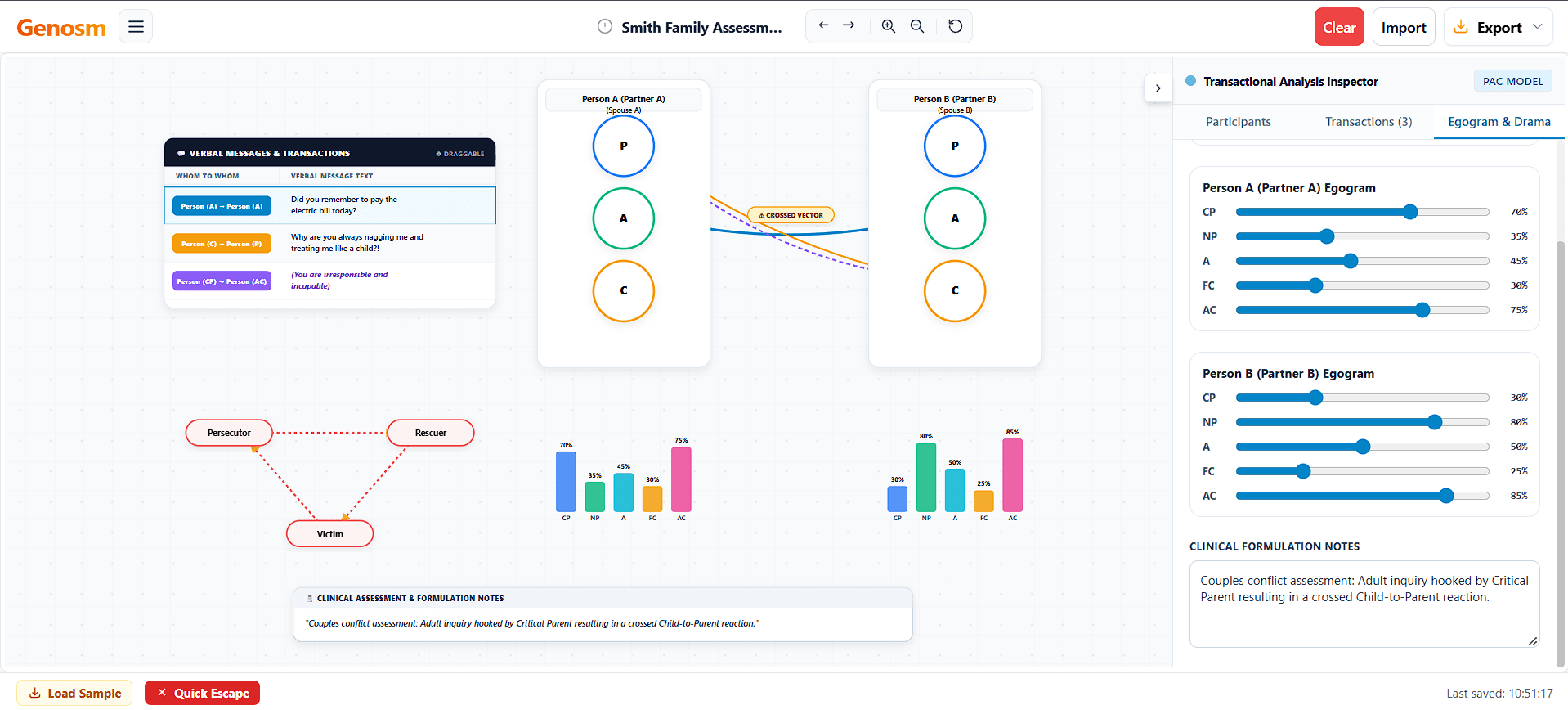
Berne observed that human personality is organized into three coherent systems of thoughts, feelings, and operational behaviors called Ego States: the Parent (P), the Adult (A), and the Child (C). A transaction is a unit of social interaction consisting of a transactional stimulus and a transactional response. By diagramming these transactions as directional vectors between stacked circles, clinicians identify repetitive psychological games, unconscious life scripts, and communication failures in real time.
Subsequent clinical developments by Dr. Stephen Karpman (1968) (The Drama Triangle) and Dr. Jack Dusay (1977) (The Egogram and Constancy Hypothesis) transformed Transactional Analysis into a powerful visual and quantitative diagnostic framework for couples therapy, family systems, and organizational consulting.
Structural & Functional Ego-State Models
Genosm provides full support for three levels of Transactional Analysis ego-state modeling:
1st-Order Structural
P - A - CThe classic 3-circle stack. Represents personality structure based on developmental origins: Parent (introjected authority), Adult (objective reality processor), Child (replayed childhood feelings and coping mechanisms).
Functional Sub-Division
5 FunctionsDivides Parent into Critical Parent (CP) and Nurturing Parent (NP), retains Adult (A), and divides Child into Free Child (FC) and Adapted Child (AC).
2nd-Order Structural
P2 - A2 - C2Micro-nested structural analysis exploring the internal Parent, Adult (the 'Little Professor'), and somatic Child components contained within the Child ego state.
The 5 Functional Ego States in Clinical Practice
The 3 Core Types of Transactions
Transactions occur when two ego-state stacks exchange verbal and non-verbal messages. Genosm renders three diagnostic vector types:
1. Complementary (Parallel) Transactions
Stable FlowThe vector stimulus from one ego state is met with an expected response from the targeted ego state (e.g. Adult to Adult: "What time is the meeting?" / "At 2 PM.", or Parent to Child: "Put your coat on." / "Okay, mom."). Berne's First Law of Communication: communication can continue indefinitely as long as transactions remain complementary.
2. Crossed Transactions
Communication RuptureOccurs when an unexpected ego state responds (e.g. an objective Adult question "Where are my keys?" is met by a Critical Parent attack "Why can't you keep track of your own things!"). Berne's Second Law of Communication: communication is immediately halted or turns into conflict when a crossed transaction occurs.
3. Ulterior (Duplex / Hidden) Transactions
Psychological GameOperates on two levels simultaneously: an overt Social Level message (drawn as a solid vector) and a covert Psychological Level hidden subtext (drawn as a dashed vector). Berne's Third Law of Communication: the behavioral outcome of an ulterior transaction is always determined by the psychological level, not the social words.
Jack Dusay Egograms & The Constancy Hypothesis
In 1977, psychiatrist Dr. Jack Dusay introduced the Egogram, a visual bar chart displaying how much psychic energy an individual invests across their five functional ego states (CP, NP, A, FC, AC):
Interactive 0-100% Sliders
Quantify individual ego-state energy profiles for each participant in couples counseling or individual therapy.
The Constancy Hypothesis
Dusay proved that total psychic energy is constant. To decrease an overactive state (e.g. Critical Parent or Rebellious Child), the client intentionally increases another state (e.g. Adult or Nurturing Parent).
Couples Egogram Comparison
Compare relationship partners side-by-side to expose interlocking patterns (such as high Critical Parent in one spouse locking the other into high Adapted Child).
Longitudinal Progress Tracking
Document shifts in Adult executive functioning and Free Child vitality over the course of psychotherapy sessions.
The Stephen Karpman Drama Triangle Overlay
Repetitive destructive relationship patterns ('Games') revolve around three shifting roles identified by Dr. Stephen Karpman (1968). Genosm provides an interactive Drama Triangle overlay:
1. Persecutor
Behavior: Blaming, criticizing, demanding.
Operates from an aggressive Critical Parent stance: "It is all your fault." Avoids personal vulnerability through righteous anger.
2. Rescuer
Behavior: Over-helping, enabling, saving.
Operates from a smothering Nurturing Parent stance: "Let me fix it for you." Gains self-worth by keeping the Victim dependent.
3. Victim
Behavior: Helpless, suffering, seeking rescue.
Operates from a helpless Adapted Child stance: "Poor me, I cannot cope." Avoids Adult responsibility by eliciting rescue.
How to Construct a Transactional Analysis Diagram in Genosm
Follow this five-step clinical procedure to model communication patterns in session:
Add Communicators & Select Ego-State Mode
Create participants (e.g. Client, Partner, Therapist) and choose 1st-Order Structural (P-A-C) or 5-part Functional circles.
Draw Stimulus & Response Transaction Vectors
Connect originating ego states to targeted ego states and enter the spoken dialogue message in the vector inspector.
Tag Crossed Breakdowns & Psychological Subtext
Designate crossed transaction lines or add ulterior psychological subtext messages with dashed covert vectors.
Adjust Jack Dusay Egograms
Calibrate CP, NP, A, FC, and AC energy distribution bar charts and toggle the Karpman Drama Triangle role overlay.
Add Case Formulation & Export Vector Records
Document therapeutic intervention notes and export 300 DPI vector PDFs or SVG diagrams directly to your local computer.
Couples, Family & Organizational Workflows
Transactional Analysis provides immediate visual clarity across diverse therapeutic modalities:
Couples Therapy
Disentangle recurring crossed arguments (e.g. Critical Parent attacking Rebellious Child) and teach partners Adult-to-Adult communication.
Individual Psychotherapy
Help clients recognize harsh internal Critical Parent dialogues, re-parent their hurt Adapted Child, and empower Adult decision-making.
Executive Coaching
Train managers to avoid Persecutor and Rescuer traps in leadership, fostering collaborative Adult communication in team settings.
Pairing Transactional Analysis with Other Genosm Diagrams
Genosm provides an integrated suite of 14 clinical diagramming tools. Clinicians frequently pair Transactional Analysis with these formulation tools:
Johari Window & Interpersonal Disclosure
Self-AwarenessPair TA crossed transactions with the Johari Blind Spot to show clients how unexamined Critical Parent tones trigger defensive reactions from partners.
Sociogram & Moreno Group Dynamics
Group RolesAnalyze mutual attraction and repulsion dyads on the Sociogram using TA ego-state transactions and Drama Triangle shifts between group members.
Schema Therapy Scales & Mode Formulation
Mode MappingMap TA Parent-Adult-Child states directly to Schema Therapy modes: Demanding/Punitive Parent to CP, Vulnerable Child to AC, and Healthy Adult to the TA Adult state.
100% Local-First Data Privacy and Zero-PHI Guarantee
Transactional Analysis diagrams capture verbatim verbal conflicts, marital disputes, and vulnerable psychological dialogues. Cloud-based diagram tools store these confidential dialogues on shared servers, creating compliance and privacy risks.
Genosm uses a zero-storage, local-first architecture. When creating a TA diagram:
- All ego-state stacks, transaction vectors, and egograms render locally in your browser.
- Client dialogue transcripts and therapist case notes never transmit to Genosm servers.
- Files save directly to your local computer or private browser IndexedDB database via the File System Access API.
- Export 300 DPI vector PDFs and SVG diagrams directly for placement in your EHR or client chart.
Why Genosm Outperforms Generic Software
| Feature | Genosm | Generic Whiteboards (Miro/Lucid) | Hand-Drawn Paper Circles |
|---|---|---|---|
| Ego-State Models | 1st Structural, Functional, and 2nd Structural | Manual disjointed circles | Hand-drawn static circles |
| Transaction Vector Engine | Complementary, Crossed & Ulterior (duplex) | Standard generic arrows | Hand-drawn pencil arrows |
| Jack Dusay Egograms | Interactive 0-100% energy sliders | None | Separate graph paper |
| Karpman Drama Triangle | 1-click role overlay with game tracking | None | Manual separate sketch |
| Vector PDF & SVG Exports | 300 DPI vector PDF and SVG graphics | Rasterized screenshot | Physical paper folder |
| Patient Data Privacy (HIPAA) | 100% Local-First (Zero Server PHI) | Third-party cloud risk | Physical storage risk |
Transactional Analysis Diagram Tool FAQ
What is Transactional Analysis (PAC) and who developed it?
Transactional Analysis (TA) is a psychoanalytic theory of personality and systematic method of psychotherapy created by Canadian psychiatrist Dr. Eric Berne in 1961 in his landmark book "Transactional Analysis in Psychotherapy". It analyzes social transactions between individuals using three core ego states: Parent, Adult, and Child (PAC).
What is the difference between Structural and Functional ego states?
Structural analysis examines what is inside each ego state (historical origin: Parent introjects parental figures, Adult tests current reality, Child replays childhood feelings). Functional analysis divides ego states into observed behavioral actions: Critical Parent (boundary-setting or criticizing), Nurturing Parent (caring and validating), Adult (objective data processing), Free Child (spontaneous creativity and joy), and Adapted Child (compliance, rebellion, or fear).
What are the 3 types of transactions in Transactional Analysis?
1. Complementary Transactions: Parallel vectors where the response comes from the ego state addressed (e.g. Adult to Adult, or Parent to Child with Child answering Parent). 2. Crossed Transactions: Vectors cross unexpectedly (e.g. an Adult question meets a Critical Parent accusation or Rebellious Child defiance), halting constructive dialogue. 3. Ulterior Transactions: Two levels of communication occur simultaneously: an overt social level message (solid line) and a hidden psychological subtext (dashed line), which determines the true emotional outcome.
What is an Egogram and the Dusay Constancy Hypothesis?
Created by Dr. Jack Dusay in 1977, an Egogram is a bar graph displaying the relative amount of psychological energy a person distributes across five functional ego states: CP, NP, A, FC, and AC. According to Dusay's Constancy Hypothesis, total psychological energy is finite; when an individual consciously exercises and elevates one ego state (such as the Adult), energy in overactivated states (such as Critical Parent or Adapted Child) naturally decreases.
What is the Karpman Drama Triangle in TA?
Developed by Dr. Stephen Karpman in 1968, the Drama Triangle maps the three unconscious, shifting roles adopted during psychological games: Persecutor (blaming, attacking), Rescuer (saving others to avoid own vulnerability), and Victim (feeling helpless and mistreated). In therapy, clients learn to step off the triangle into Adult empowerment.
Is client psychological case data stored on remote servers?
No. Genosm operates on a strict 100% local-first, zero-storage model. Participant ego-state configurations, verbal transaction transcripts, egograms, and clinical case formulation notes are computed entirely within your local browser. No Protected Health Information (PHI) is ever transmitted to or stored on remote cloud databases.