Clinical Origins: B.F. Skinner, Albert Ellis, and Iwata
The Antecedent-Behavior-Consequence (ABC) Model represents one of the most enduring, empirically validated frameworks across behavioral analysis, clinical psychology, and special education. First formulated by B.F. Skinner (1953) as the 3-term operant contingency (SD → R → SR), the model demonstrates that human behavior does not occur in a vacuum: it is evoked by antecedent environmental stimuli (SD) and maintained by subsequent environmental consequences (SR).
In 1955, psychologist Albert Ellis expanded the ABC paradigm to cognitive psychotherapy through Rational Emotive Behavior Therapy (REBT). Ellis demonstrated that emotional and behavioral consequences ($C$) are not caused directly by activating events ($A$), but by an individual's rigid, irrational beliefs ($B$). Ellis later extended this to the A-B-C-D-E Model, incorporating Socratic disputation ($D$) to establish an effective new rational philosophy ($E$).
In the 1980s and 1990s, Brian Iwata et al. (1982/1994) and O'Neill et al. (1997) standardized the Functional Behavior Assessment (FBA) methodology. Iwata proved that treating surface topography without identifying the underlying environmental function inevitably fails. By isolating whether a behavior functions to escape demands, gain social attention, access tangible rewards, or satisfy sensory needs, clinicians can engineer Functionally Equivalent Replacement Behaviors (FERB) that resolve the underlying need adaptively.
The E.A.T.S. Function Matrix & Operant Contingencies
Every targeted behavior (whether classroom task refusal, interoceptive panic flight, or workplace procrastination) serves a specific biological or environmental function. Genosm categorizes behavioral functions into the standardized E.A.T.S. Matrix:
E • Escape / Avoidance (SR−)
Code: ERemoves, delays, or terminates an unpleasant task, academic demand, difficult social interaction, or internal emotional discomfort. Driven by negative reinforcement.
A • Attention / Social (SR+)
Code: AGains verbal, physical, or eye-contact reactions from peers, teachers, parents, or partners (even if the attention is reprimanding or negative). Driven by positive reinforcement.
T • Tangible / Activity (SR+)
Code: TGains physical access to preferred food, toys, digital screens, money, privileges, or specific activities. Driven by positive reinforcement.
S • Sensory / Automatic (SR±)
Code: SProvides internal bodily soothing, vestibular regulation, acoustic relief, or self-stimulatory feedback independent of the social environment.
The 4 Maintaining Operant Contingencies
REBT Cognitive Chain & Socratic Disputation (A-B-C-D-E)
For adult psychotherapy, anxiety disorders, perfectionism, and anger management, Genosm seamlessly transforms the 3-term operant model into Albert Ellis's REBT A-B-C-D-E Framework:
The objective situation, event, or internal sensation (for example, heart palpitations on a subway or receiving a complex assignment).
Rigid cognitive demands evaluated across 4 categories: Demandingness ("Musts/Shoulds"), Awfulizing ("100% terrible"), Low Frustration Tolerance ("I can't stand it"), and Global Depreciation ("I am a total failure").
Unhealthy emotions (rage, panic, shame) and maladaptive actions (subway elopement, procrastinating busywork, road rage blaring).
Challenging irrational beliefs across 4 Socratic vectors: Logical ("Does wanting something mean it must happen?"), Empirical ("Where is the evidence?"), Functional ("Where does believing this get you?"), and Philosophical ("Can you tolerate discomfort?").
Grounded rational alternatives promoting healthy concern, frustration tolerance, self-acceptance, and constructive action steps.
Built for Real-Time Clinical Session Formulations
Genosm provides specialized tooling for behavior analysis and cognitive restructuring that replaces static paper worksheets with dynamic digital canvases:
4 Interactive Visual View Modes
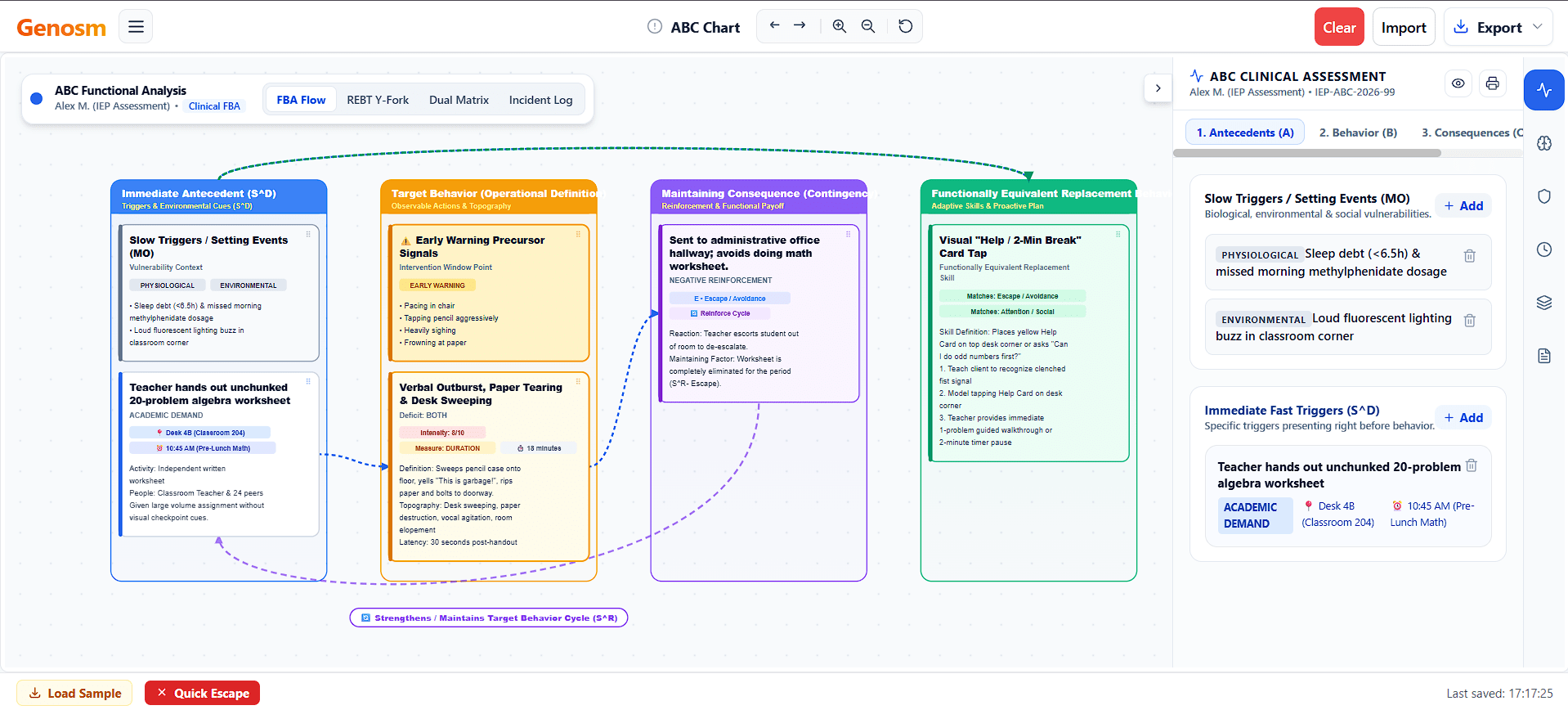
Switch instantly between FBA Flow (4-column operant layout), REBT Chain (A-B-C-D-E restructuring), Unified Dual-Level (behavioral and cognitive combined), and Incident Log tracking.
Animated Operant Feedback Loop Arcs
Renders animated mathematical curves connecting maintaining consequences back to antecedents to visually demonstrate operant reinforcement loops to clients and teams.
3 Audience Terminology Modes
Toggle language between Clinical BCBA (Motivating Operation, SD, FERB), Parent and School Friendly (Slow Triggers, Fast Triggers, Healthy Alternative Skill), and CBT/REBT.
Printable Client Coping Card Generator
Generate a formatted, wallet-sized HTML/PDF coping card with one click for clients to carry in their pocket or save to their mobile device.
How to Create an ABC Chart in Genosm
Follow this five-step clinical procedure during intake evaluations, IEP meetings, or cognitive restructuring sessions:
Set Audience Terminology & Visual Mode
Open the Inspector, select the appropriate terminology (Clinical, Parent/School, or CBT/REBT), and pick your visual mode (FBA Flow, REBT Chain, Unified, or Incident Log).
Document Setting Events & Immediate Antecedents (A)
Record slow vulnerability factors (sleep debt, sensory sensitivity, medication timing) and fast immediate antecedent triggers (SD) with location, time, and specific demand context.
Define Target Behavior & Precursor Warning Signals (B)
Input operational definitions, physical topography, intensity ratings (1-10), measurement types (duration, frequency, latency), and early warning precursor signals.
Analyze Maintaining Consequences & E.A.T.S. Functions (C)
Identify maintaining operant contingencies (Negative or Positive Reinforcement) and categorize the core behavioral function using the E.A.T.S. matrix.
Design FERB Replacement Skills & Export Clinical Reports
Formulate Functionally Equivalent Replacement Behaviors (FERB), Socratic disputations, and export print-ready vector PDFs, CSV incident logs, or automated SOAP reports.
6 Pre-Built Clinical Presets
Genosm includes six fully populated clinical case formulation presets for instant loading in-session:
Classroom Task Avoidance & Disruption
School FBA mapping multi-step math task refusal, paper tearing, and room elopement maintained by escape (SR−).
Panic Disorder & Interoceptive Avoidance
REBT cognitive restructuring of catastrophic health appraisals (A → B → C → D → E) in crowded transit.
Executive Perfectionism & Procrastination
Unified formulation linking rigid demandingness, fear of evaluation, and avoidant email inbox displacement busywork.
Interpersonal Anger & Road Rage
Disputing low frustration tolerance and global driver-depreciation triggered by commute conflicts.
Autism Sensory Transition Meltdown
Pediatric FBA mapping cafeteria acoustic overload, precursor signals, head-hitting, and noise-cancelling FERB protocols.
Chronic Lumbar Kinesiophobia
Fear-avoidance model distinguishing hurt from harm and replacing complete bed rest with paced spinal movement.
Pairing ABC Charts with Other Genosm Diagrams
Genosm provides an integrated suite of 14 clinical diagramming tools. Clinicians frequently pair the ABC Chart with these related formulation tools:
CBT 5-Areas Hot Cross Bun Formulation
Cognitive LoopWhile the ABC Chart maps environmental operant contingencies and REBT chains, the CBT 5-Areas formulation details real-time feedback loops between thoughts, emotions, body sensations, and behaviors.
Early Maladaptive Schema & Mode Scale
Longitudinal SchemaLink immediate ABC antecedent triggers to underlying core maladaptive schemas (for example, Abandonment or Defectiveness) and coping modes (Surrender, Avoidance, Overcompensation).
Polyvagal Ladder & Autonomic Mapping
Autonomic StateConnect ABC precursor signals (sighing, pacing) directly to sympathetic mobilization or dorsal vagal collapse zones on the Polyvagal Ladder.
100% Local-First Data Privacy and HIPAA Alignment
Behavioral assessments contain sensitive Protected Health Information (PHI). Generic cloud diagramming tools store client data on remote multi-tenant databases, creating security exposure risks.
Genosm uses a zero-storage, local-first architecture. When creating or editing an ABC Chart:
- All diagram calculations and graphical rendering execute directly inside your web browser.
- Client names, operational definitions, setting events, and incident logs are never sent to remote servers.
- Files are saved directly to your local device or encrypted browser database (IndexedDB).
- Includes a one-click Privacy Mode that masks client names and case identifiers for clinical supervision and case presentations.
Printable Coping Cards, CSV Incident Logs & SOAP Reports
Genosm provides comprehensive export capabilities tailored for clinical practice and electronic health records:
Vector PDF & SVG
300 DPI print-ready vector PDF exports for client psychoeducation handouts and EHR attachments (SimplePractice, TherapyNotes, Epic).
CSV Incident Log Export
Export structured CSV files containing timestamped incident logs, phase metrics (baseline vs. intervention), values, and E.A.T.S. functions.
Automated SOAP/FBA Report
Generates structured Markdown SOAP/FBA assessment reports with functional hypotheses and multi-tier intervention plans.
Why Genosm Outperforms Generic Software
| Feature | Genosm | Generic Whiteboards (Miro/Lucid) | Paper Worksheets |
|---|---|---|---|
| Operant Layout Engine | Native 4-column flow & REBT chains | Manual disjointed shapes | Static printed layout |
| E.A.T.S. Function Matrix | Built-in categorized function matrix | Manual text typing | Handwritten notes |
| Animated Feedback Arcs | Animated operant maintaining loops | Static straight arrows | Hand drawn lines |
| Audience Terminology Switcher | 3 modes (BCBA Clinical, Parent, CBT) | None | None |
| Patient Coping Card Generator | 1-click printable wallet card HTML/PDF | None | Requires manual writing |
| Longitudinal CSV Data Tracking | Baseline vs intervention incident logging | None | Separate paper binder |
| Patient Data Privacy (HIPAA) | 100% Local-First (Zero Server PHI) | Third-party cloud risk | Physical file risk |
ABC Chart Maker FAQ
What is an ABC Chart used for in therapy and behavior analysis?
An ABC Chart (Antecedent-Behavior-Consequence) is a foundational clinical tool used in Applied Behavior Analysis (ABA), Cognitive Behavioral Therapy (CBT), and Rational Emotive Behavior Therapy (REBT). It breaks down behavioral episodes into what happened immediately before (Antecedent), the observable action (Behavior), and what occurred immediately after (Consequence). Clinicians use it to identify environmental triggers, maintaining reinforcement loops, and the underlying function of behavior.
What are the 4 E.A.T.S. functions of behavior in Genosm?
The E.A.T.S. framework categorizes the four primary functions of behavior: Escape/Avoidance (removing an unpleasant demand or situation), Attention/Social (gaining peer or adult reaction), Tangibles/Activities (gaining access to preferred items or privileges), and Sensory/Automatic (achieving intrinsic bodily relief or stimulation).
What is the difference between FBA Flow Mode and REBT Chain Mode?
FBA Flow Mode focuses on operant conditioning (Setting Events, Antecedents, Precursors, Target Behavior, Consequences, and FERB skills). REBT Chain Mode focuses on cognitive restructuring based on Albert Ellis's A-B-C-D-E model (Activating Event, Irrational Beliefs like demandingness or awfulizing, Emotional/Behavioral Consequences, Socratic Disputation, and Effective New Philosophy).
How does Genosm generate printable patient coping cards?
With a single click, Genosm converts your active ABC formulation into a formatted, pocket-sized HTML/PDF coping card. Clients can print and keep this card in their wallet or phone to reference their specific trigger, old reactive thought, Socratic reality check, rational alternative, and concrete action step.
Is client data stored on Genosm servers?
No. Genosm operates on a 100% local-first, zero-storage architecture. All diagram calculations, client names, incident logs, and clinical notes execute locally in your web browser. No Protected Health Information (PHI) is ever transmitted to or logged on remote servers, making Genosm 100% HIPAA-ready right out of the box.
Can I export incident log data for statistical tracking?
Yes. Genosm allows clinicians to export longitudinal incident data as structured CSV files, clean SVG vector graphics, 300 DPI print-ready PDFs for EHR systems like SimplePractice and TherapyNotes, or automated Markdown SOAP and FBA assessment reports.