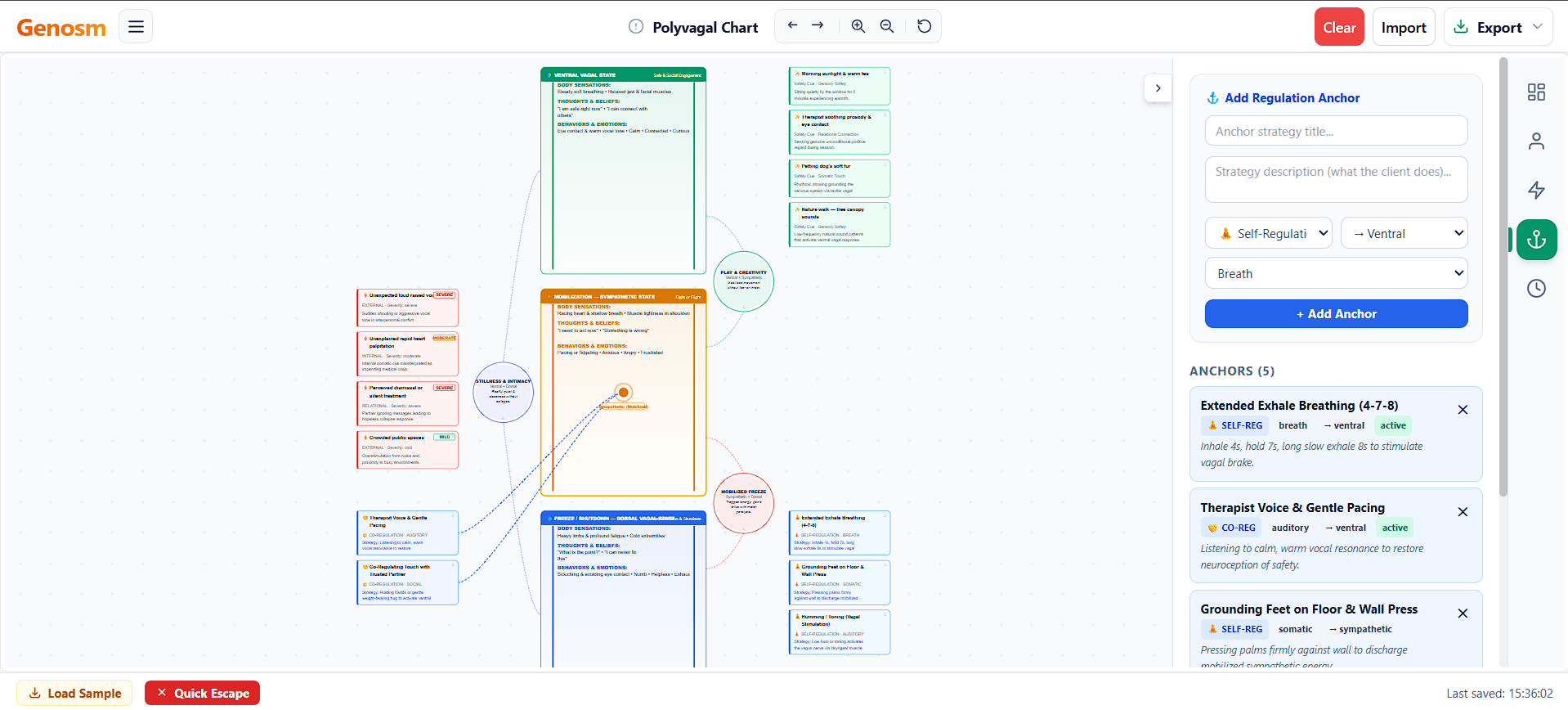
Clinical Origins: Dr. Stephen Porges and Deb Dana
Polyvagal Theory, introduced in 1994 by neuroscientist Dr. Stephen Porges, fundamentally reshaped our understanding of trauma, emotional regulation, and human social connection. Dr. Porges identified that the autonomic nervous system operates not as a simplistic two-part on/off switch (sympathetic versus parasympathetic), but as a sophisticated three-part evolutionary hierarchy governed by the tenth cranial nerve: the vagus nerve.
Clinical social worker and author Deb Dana subsequently translated Porges complex neurobiology into practical clinical frameworks, introducing the concept of the Polyvagal Ladder. In this visual model, the nervous system moves hierarchically up and down a ladder in response to neuroception: the subconscious neural surveillance of environmental, internal, and relational cues for safety or threat.
By mapping a client's unique polyvagal profile, clinicians help clients identify their personal cues of safety (glimmers) and cues of danger (triggers), fostering self-compassion and building reliable pathways back to autonomic safety.
The Three Autonomic States of the Polyvagal Ladder
The Polyvagal Ladder represents three distinct neurobiological states ordered by evolutionary development:
1. Ventral Vagal (Top of Ladder: Safety & Social Engagement)
Ventral Vagus Nerve (Myelinated)The newest branch evolutionarily. The ventral vagal complex originates in the nucleus ambiguus, innervating the heart, lungs, and facial muscles. When active, the client experiences visceral safety, calm presence, prosodic voice, easy eye contact, and emotional connection. The ventral vagus acts as a natural brake, slowing heart rate and supporting digestion, repair, and social engagement.
2. Sympathetic Nervous System (Middle of Ladder: Mobilization / Fight-Flight)
Spinal Sympathetic ChainWhen neuroception detects danger, the ventral vagal brake releases. The sympathetic nervous system floods the bloodstream with adrenaline and cortisol. Heart rate accelerates, respiration quickens, muscles tense for action, and sensory focus narrows to identify threats. The individual experiences anxiety, frustration, panic, or anger.
3. Dorsal Vagal (Bottom of Ladder: Immobilization / Shutdown)
Dorsal Motor Nucleus (Unmyelinated)The oldest evolutionary branch, shared with reptiles. When danger is perceived as inescapable or life-threatening, the dorsal motor nucleus initiates a systemic shutdown. Heart rate and blood pressure drop, metabolism slows, endorphins induce numbness, and the client experiences profound exhaustion, dissociation, flat affect, brain fog, or paralysis.
The Three Blended States: Hybrid Autonomic Combinations
In clinical reality, the nervous system does not always exist in pure single states. Genosm natively supports and renders the three primary Blended Autonomic States with interactive circular bridge nodes connected by Bézier curves:
Blended Play
High metabolic sympathetic mobilization anchored within ventral safety. Seen in sports, playful banter, joyful dancing, and creative flow where competition occurs without genuine hostility.
Blended Stillness
Dorsal stillness combined with ventral trust and connection. Present during deep meditation, quiet cuddling, restorative sleep, and peaceful contemplative silence without fear.
Mobilized Freeze / Fawn
High sympathetic alarm trapped beneath dorsal motor inhibition. The client feels intense internal panic while physically immobilized, playing dead, or fawning to appease a threat.
Neuroception in Practice: Triggers and Safety Glimmers
Neuroception continuously evaluates cues of safety and threat. Genosm provides structured categorization cards for both directions of neuroceptive movement:
Autonomic Triggers (Cues of Threat)
Events that move the client down the ladder into defensive states. Genosm logs:
- Trigger Type: Internal (intrusive thought), External (loud sound), or Relational (critical face).
- Target State: Moving toward Sympathetic fight-flight or Dorsal collapse.
- Severity Rating: Mild, Moderate, or Severe badges.
Safety Glimmers (Cues of Safety)
Micro-moments that activate the ventral vagal social engagement system. Genosm logs:
- Category: Sensory Safety, Nature Connection, Relational Warmth.
- Visceral Experience: Warm sunlight, warm cup of tea, a pet purring, a calm voice.
- Clinical Function: Serves as biological anchors to guide autonomic recovery.
Somatic Anchors, 7 Sensory Channels, and Co-Regulation Pathways
Autonomic regulation requires tailored intervention pathways. Genosm structures Somatic Anchors across two essential mechanisms:
Self-Regulation vs. Relational Co-Regulation
Animated Co-Reg VectorsSelf-regulation tools allow the client to modulate their own physiology. Co-regulation recognizes that mammalian nervous systems are biologically wired to coregulate through attuned connection with a calm other (therapist, supportive partner, trusted friend). In Genosm, selecting Co-Regulation draws an animated dashed connection link directly to the Ventral Vagal zone.
7 Sensory Channels for Regulation Anchors
Built for Real-Time Clinical Session Charting
Genosm provides specialized tooling for polyvagal mapping that eliminates messy whiteboard diagrams:
Quick Somatic Pill Injector
Inject 14+ standardized somatic symptom pills (racing heart, shallow breath, foggy brain, tight chest, lump in throat, relaxed jaw, warm chest) into Sensations, Thoughts, or Behaviors with a single click.
Real-Time Session Timeline Logs
Clicking on any state on the canvas instantly logs a timestamped transition event (e.g. Dorsal to Sympathetic to Ventral) with clinical session notes for objective progress tracking.
Directional Neuroception Arrows
Toggle animated upward safety arrows (cues of connection) and downward threat arrows (cues of danger) alongside the ladder rails to visually teach the directional movement of nervous system regulation.
Draggable Freedom & Persisted Offsets
Drag and reposition trigger cards, glimmers, anchors, and bridge circles anywhere on the infinite canvas. All drag offsets are saved and retained in JSON exports.
How to Create a Polyvagal Chart in Genosm
Follow this five-step clinical procedure during intake evaluations, psychoeducation segments, or post-session clinical documentation:
Set Client Profile and Active State
Open the Polyvagal Inspector, record client information and clinical case notes, and designate the client's current starting state on the ladder.
Populate 4-Quadrant State Profiles
Map characteristic body sensations, thoughts, behaviors, and emotions across Ventral Vagal, Sympathetic, and Dorsal Vagal states using the Quick Injector or manual input.
Document Autonomic Triggers and Safety Glimmers
Categorize triggers by type (internal, external, relational) and severity, and document client-specific glimmers that cue neuroceptive safety.
Map Somatic Anchors and Co-Regulation Pathways
Add self-regulation and relational co-regulation strategies across 7 sensory channels (breath, movement, tactile, auditory, visual, social, somatic).
Track Session Transitions and Export Clinical Records
Log real-time state shifts on the session timeline, adjust card positions on canvas, and export high-resolution vector PDF, SVG, or PNG records for EHR documentation.
Pairing Polyvagal Charts with Other Genosm Diagrams
Genosm provides a comprehensive suite of 14 clinical diagramming tools. Clinicians frequently combine the Polyvagal Ladder with these related formulation tools:
Window of Tolerance Chart Maker
Arousal TimelineWhile the Polyvagal Ladder maps hierarchical neurobiological states, the Window of Tolerance tracks continuous physiological arousal across session minutes. Pairing them provides complete neurobiological psychoeducation.
Internal Family Systems (IFS) Parts Map
Parts MappingCorrelate manager and firefighter protector parts with sympathetic mobilization, and connect exiled parts with dorsal vagal collapse and shame.
CBT 5-Areas Hot Cross Bun Formulation
Cognitive FormulationLink autonomic ladder states directly to automatic thoughts, cognitive appraisals, and behavioral maintaining loops.
100% Local-First Data Privacy and HIPAA Alignment
Clinical case formulations and autonomic profiles contain sensitive Protected Health Information (PHI). Generic cloud diagramming platforms store user data on remote multi-tenant databases, creating data exposure risks.
Genosm uses a zero-storage, local-first architecture. When you create or edit a Polyvagal chart:
- All diagram calculations and graphical rendering occur directly inside your browser.
- Client names, session notes, triggers, and anchor details are never transmitted to Genosm servers.
- Files are stored directly on your local device or encrypted browser database (IndexedDB).
- You maintain complete data ownership, ensuring compliance with HIPAA, GDPR, and clinical confidentiality ethics.
Why Genosm Outperforms Generic Drawing Software
| Feature | Genosm | Generic Whiteboards (Miro/Lucid) | Paper Worksheets |
|---|---|---|---|
| Autonomic Ladder Architecture | Native 3-tier hierarchy & blended bridges | Manual disjointed rectangles | Static printed layout |
| Triggers & Glimmers Tagging | Built-in categorized card libraries | Generic sticky notes | Manual handwritten lists |
| Quick Somatic Pill Injector | 14+ standardized somatic symptom pills | Manual typing required | Manual handwriting |
| Co-Regulation Vector Pathways | Animated relational pathway links | Manual generic arrows | Hand drawn lines |
| Session State Transition Logs | Real-time timestamped event logging | None | Separate note binder |
| Patient Data Privacy (HIPAA) | 100% Local-First (Zero Server PHI) | Third-party cloud storage | Physical file risk |
| EHR Vector Export (PDF/SVG) | High-res 300 DPI vector export | Low-res raster images | Requires document scanning |
| All-in-One Clinical Suite | 14 clinical diagram types in $9.99 plan | Expensive generic tiers | Disorganized paper sheets |
Polyvagal Chart Maker FAQ
What is the Polyvagal Ladder used for in clinical therapy?
The Polyvagal Ladder, developed from Dr. Stephen Porges Polyvagal Theory and popularized by Deb Dana, is a visual clinical mapping tool that organizes human nervous system functioning into an evolutionary hierarchy. It helps clients identify whether they are operating from Ventral Vagal safety and social connection (top of ladder), Sympathetic mobilization and fight/flight (middle of ladder), or Dorsal Vagal immobilization and shutdown (bottom of ladder). Therapists use it to build autonomic awareness, demystify trauma responses, and systematically restore regulation.
What are blended states on the Polyvagal Chart?
Blended states represent complex physiological combinations where two autonomic branches operate simultaneously. In Genosm, blended states are visualized with interactive circular bridge nodes connected by Bézier pathways: Blended Play (Ventral safety combined with Sympathetic high energy), Blended Stillness (Ventral safety combined with Dorsal quiet surrender, as in meditation), and Mobilized Freeze or Fawn (Sympathetic alarm trapped beneath Dorsal immobilization).
What is the difference between Triggers and Glimmers in Polyvagal mapping?
Triggers are internal, external, or relational cues that neuroception interprets as danger, driving the nervous system downward into sympathetic agitation or dorsal collapse. Glimmers are micro-moments of safety, connection, and peace that signal neuroceptive safety, inviting the system back upward into the ventral vagal social engagement zone.
How does Genosm maintain patient privacy and HIPAA compliance?
Genosm is built with a zero-storage, local-first architecture. All diagram rendering, client profiles, session notes, and timeline logs execute locally in your web browser. No Protected Health Information (PHI) is ever transmitted to, logged on, or stored in remote Genosm databases.
Can I reposition cards and nodes freely on the canvas?
Yes. Genosm combines structured auto-layout with complete manual drag-and-drop freedom. You can drag trigger cards, glimmer badges, anchor cards, and blended bridge nodes to custom positions. All spatial offsets are automatically saved and persisted across exports.
What export formats are supported for clinical records and EHR systems?
Genosm exports charts in 300 DPI print-ready vector PDF (ideal for client psychoeducation handouts and electronic health records like SimplePractice, TherapyNotes, or Epic), crisp SVG vector graphics, transparent or white-background PNG images, and portable JSON backup files.