Clinical Origins: Dr. Aaron T. Beck and Case Formulation
Cognitive Behavioral Therapy (CBT) was founded in the 1960s and 1970s by psychiatrist Dr. Aaron T. Beck (1976) at the University of Pennsylvania in his seminal text Cognitive Therapy and the Emotional Disorders. Beck demonstrated that emotional distress is not caused directly by external events, but by the cognitive appraisal and automatic thoughts individuals generate in response to those events.
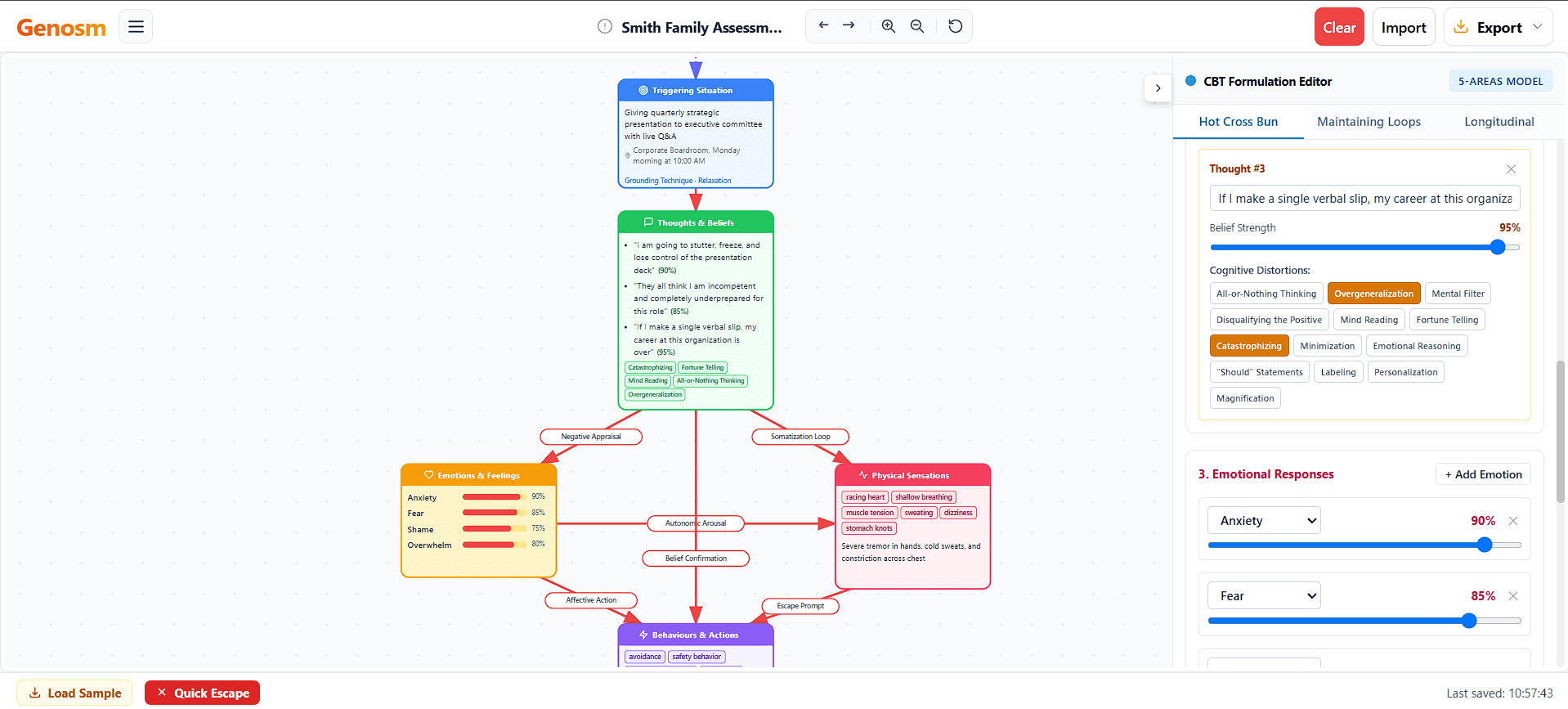
In subsequent clinical practice, Dr. Christine A. Padesky and Dr. Dennis Greenberger (1995) in Mind Over Mood popularized the 5-aspect formulation, affectionately known as the Hot Cross Bun Model. By organizing human experience into five interconnected domains (Environment/Situation, Automatic Thoughts, Moods/Emotions, Physical Reactions, and Behaviors), clinicians and clients collaboratively visualize how negative thoughts trigger physiological arousal and avoidant behaviors, which in turn validate the original distorted thought.
Formally extended into everyday clinical practice by Chris Williams and Anne Garland (2002) as the 5-Areas Assessment Model and enriched by Judith S. Beck (1995, 2020) with longitudinal case conceptualizations, CBT diagramming remains the global gold standard for evidence-based psychotherapy formulation.
The 5 Areas (Hot Cross Bun) Formulation Anatomy
Genosm models the complete Padesky 5-aspect architecture across five specialized clinical nodes:
1. Triggering Situation / Context (Top Node)
Context TriggerClinical Focus: Objective external event, time, place, interpersonal context, or memory that initiated the acute distress episode.
2. Automatic Thoughts (NATs)
Top-Left AreaClinical Focus: Spontaneous appraisals, self-talk, cognitive distortion tagging, and belief conviction ratings (0-100%).
3. Emotional Responses / Moods
Top-Right AreaClinical Focus: Primary affective states (Anxiety, Sadness, Anger, Guilt, Shame, Fear) with 0-100% subjective intensity scores.
4. Physical Bodily Sensations
Bottom-Left AreaClinical Focus: Autonomic arousal: racing heart, shallow breathing, muscle tension, sweating, nausea, dizziness, and stomach knots.
5. Behavior & Coping Actions
Bottom-Right AreaClinical Focus: Overt actions: situational avoidance, safety behaviors, reassurance seeking, social withdrawal, rumination, or aggression.
The 13 Evidence-Based Cognitive Distortions
Genosm includes the complete Beck and Burns taxonomy of cognitive thinking errors. Clinicians can tag automatic thoughts with one or multiple distortion badges:
Viewing situations in black-and-white extremes without middle ground.
Viewing a single negative event as a never-ending pattern of defeat.
Dwelling exclusively on a single negative detail, ignoring all positives.
Rejecting positive experiences by insisting they do not count.
Assuming you know others are judging or looking down on you.
Predicting that things will turn out badly as an established fact.
Anticipating the absolute worst possible catastrophe.
Inappropriately shrinking personal strengths or achievements.
Assuming that negative feelings reflect objective reality ('I feel it, so it is true').
Motivating oneself with strict shoulds, musts, and oughts, generating guilt.
Attaching a global negative label to oneself ('I am a failure') instead of an error.
Holding yourself responsible for events not entirely under your control.
Exaggerating the importance of minor flaws, mistakes, or external threats.
The 6 Vicious Maintaining Feedback Loops
CBT formulation is defined by its bidirectional maintenance vectors. Rather than a linear sequence, psychological symptoms trap clients in mutually reinforcing vicious cycles:
Thoughts ↔ Emotions Loop
Catastrophic thoughts trigger acute anxiety, which reinforces the conviction that a genuine threat exists.
Emotions ↔ Sensations Loop
Panic surges sympathetic adrenaline, accelerating heart rate and hyperventilation, which escalates terror.
Sensations ↔ Behaviors Loop
Chest tightness and dizziness prompt immediate situational escape or safety posture behaviors.
Behaviors ↔ Thoughts Loop
Avoidance prevents disconfirmation, maintaining the catastrophic belief ('If I had stayed, I would have collapsed').
Thoughts ↔ Sensations Loop
Hypervigilant somatic monitoring amplifies normal bodily sensations into perceived medical emergencies.
Emotions ↔ Behaviors Loop
Depressed mood drives behavioral withdrawal and inactivity, which eliminates positive reinforcement and deepens depression.
Beck Longitudinal Formulation Extension
While the Hot Cross Bun captures the present 'here-and-now' cross-sectional episode, comprehensive therapy requires understanding developmental origins. Genosm includes an integrated Longitudinal Case Conceptualization Layer:
1. Relevant Early Experiences
Childhood developmental events, parental criticism, trauma, peer bullying, or academic expectations that shaped initial self-concept.
2. Core Beliefs / Deep Schemas
Fundamental, absolute beliefs about the Self, Others, and the World (e.g. 'I am inadequate / flawed', 'People cannot be trusted') with 0-100% conviction scoring.
3. Conditional Rules & Intermediate Assumptions
If/Then rules and attitudes developed to cope with the core belief (e.g. 'If I perform flawlessly at all times, then no one will see my flaws').
4. Compensatory Coping Strategies
Long-term behavioral strategies used to prevent core belief activation (e.g. chronic perfectionism, over-preparation, emotional detachment).
Tagging CBT Interventions & Behavioral Experiments
A formulation must guide clinical intervention. In Genosm, therapists can attach standardized technique tags directly to specific nodes and maintenance loops:
How to Create a CBT Formulation in Genosm
Follow this five-step clinical procedure during intake or session formulation:
Define Triggering Event & Context
Enter the specific situational context, time, and location in the top situation node.
Elicit Automatic Thoughts & Distortions
Record negative automatic thoughts, set belief strength (0-100%), and tag cognitive distortion badges.
Record Emotions & Somatic Sensations
Input emotional mood ratings (0-100%) and select autonomic bodily sensations from the checklist.
Map Behaviors & Activate Vicious Cycles
Document avoidance actions and toggle active maintaining feedback loops with mechanism vector labels.
Layer Longitudinal Schemas & Export
Toggle the Beck longitudinal layer, add session intervention notes, and export 300 DPI vector PDFs for your EHR records.
Depression, Panic & OCD Clinical Workflows
CBT formulation provides rapid psychoeducation and treatment planning across diverse clinical presentations:
Major Depression
Break the inactivity-hopelessness loop using Behavioral Activation and Thought Records to challenge all-or-nothing thinking.
Panic Disorder & Agoraphobia
Map catastrophic misinterpretations of normal autonomic arousal and conduct interoceptive exposure experiments.
Social Anxiety & OCD
Expose safety behaviors and mental rituals that maintain fear, setting up gradual in vivo exposure hierarchies.
Pairing CBT Formulations with Other Genosm Diagrams
Genosm provides an integrated suite of 14 clinical diagramming tools. Clinicians frequently pair CBT formulation with these sister tools:
ABC Chart Maker & Functional Analysis
Behavioral TrackingTrack concrete Antecedent-Behavior-Consequence data in daily symptom monitoring logs, then synthesize weekly findings into a comprehensive CBT 5-Areas Hot Cross Bun.
Schema Therapy Scale & Early Maladaptive Schemas
Schema DepthConnect the core beliefs identified in the Beck Longitudinal Layer directly to Early Maladaptive Schemas (e.g. Defectiveness, Failure, Unrelenting Standards) on 5-domain radar charts.
Window of Tolerance & Trauma Regulation
Autonomic RegulationConnect somatic sensation nodes from the Hot Cross Bun directly to autonomic hyperarousal and hypoarousal states, integrating somatic grounding prior to cognitive restructuring.
100% Local-First Data Privacy and Zero-PHI Guarantee
CBT case formulations contain intimate core beliefs, trauma memories, and vulnerability data. Generic online whiteboards save client clinical notes to third-party cloud servers, posing severe HIPAA and privacy risks.
Genosm operates on a zero-storage, local-first architecture. When creating a CBT formulation:
- All 5 Hot Cross Bun nodes, distortion tags, and longitudinal layers compute locally in your browser.
- Client automatic thoughts and therapist formulation notes are never sent to remote Genosm servers.
- Files save directly to your local computer or private browser IndexedDB database via the File System Access API.
- Export 300 DPI vector PDFs and SVG diagrams directly for placement in your EHR or client chart.
Why Genosm Outperforms Generic Tools
| Feature | Genosm | Generic Whiteboards (Miro/Lucid) | Paper Worksheets |
|---|---|---|---|
| 5-Areas Hot Cross Bun Model | Standardized clinical layout with presets | Manual shapes and text boxes | Static paper worksheet |
| Cognitive Distortion Tagging | 1-click 13-distortion evidence badges | None | Manual handwriting |
| Maintaining Feedback Vectors | 6 active vicious cycle toggles with labels | Static lines | Hand-drawn arrows |
| Beck Longitudinal Extension | Toggleable early experience & schema layer | Manual redraw required | Separate clinical sheet |
| Vector PDF & SVG Exports | 300 DPI vector PDF and SVG graphics | Rasterized screenshot | Physical paper folder |
| Patient Data Privacy (HIPAA) | 100% Local-First (Zero Server PHI) | Third-party cloud risk | Physical storage risk |
CBT Formulation Software FAQ
What is a CBT Formulation and the 5-Areas Hot Cross Bun Model?
A CBT Formulation (or case conceptualization) is an individualized map linking a client's triggering situation to four interconnected response domains: Automatic Thoughts, Emotions, Physical Sensations, and Behaviors. Popularized by Christine Padesky (1995) as the "Hot Cross Bun" model and Chris Williams & Anne Garland (2002) as the "5-Areas Model", it visualizes how thoughts, feelings, bodily reactions, and actions continuously reinforce one another in vicious maintaining cycles.
What are the 13 Cognitive Distortions supported in Genosm CBT Software?
Genosm supports evidence-based cognitive distortion categories based on Aaron Beck and David Burns: 1. All-or-Nothing Thinking, 2. Overgeneralization, 3. Mental Filter, 4. Disqualifying the Positive, 5. Mind Reading, 6. Fortune Telling, 7. Catastrophizing, 8. Minimization, 9. Emotional Reasoning, 10. "Should" Statements, 11. Labeling, 12. Personalization, and 13. Magnification.
What are the 6 Maintaining Vicious Cycle Loops?
The 6 bidirectional feedback vectors in the Hot Cross Bun model are: 1. Thoughts ↔ Emotions, 2. Emotions ↔ Physical Sensations, 3. Physical Sensations ↔ Behaviors, 4. Behaviors ↔ Thoughts, 5. Thoughts ↔ Physical Sensations, and 6. Emotions ↔ Behaviors. Clinicians can toggle active maintenance loops and render custom mechanism labels on vector arrows (e.g. "Avoidance maintains anxiety").
What is the Beck Longitudinal Formulation Extension in Genosm?
The longitudinal layer extends cross-sectional 5-Areas diagrams with developmental case conceptualization: 1. Relevant Early Experiences (childhood conditioning, family rules), 2. Core Beliefs / Deep Schemas (e.g. "I am defective" with 0-100% conviction ratings), 3. Conditional Rules & Intermediate Assumptions (e.g. "If I perform flawlessly, then no one will notice my flaws"), and 4. Compensatory Coping Strategies.
Can therapists tag specific CBT interventions to nodes and loops?
Yes. Clinicians can tag evidence-based CBT interventions directly to any formulation node or feedback loop, including Thought Records, Behavioral Experiments, In Vivo Exposure, Activity Scheduling, Grounding Techniques, Relaxation, Problem Solving, Cognitive Restructuring, Acceptance, and Mindfulness.
Is client psychological case data stored on remote cloud servers?
No. Genosm operates on a strict 100% local-first, zero-storage model. All CBT formulation data, automatic thought entries, belief ratings, and clinical notes are computed entirely in your local web browser. No Protected Health Information (PHI) is ever transmitted to or stored on remote servers.