Clinical Origins: Joseph Luft, Harrington Ingham & Group Dynamics
The Johari Window was developed in 1955 by American psychologists Dr. Joseph Luft and Dr. Harrington Ingham during their work on group dynamics at the University of California, Los Angeles (UCLA) Western Training Laboratory. The tool was created to provide participants in experiential T-groups and psychotherapy cohorts with a visual, cognitive framework to understand how personal information is disclosed, concealed, and perceived by others.
Luft and Ingham recognized that interpersonal effectiveness depends on the dynamic balance between two core behaviors: Self-Disclosure (sharing thoughts, feelings, and personal history) and Feedback Solicitation (actively listening to how one is experienced by peers). When individuals enter a new group, their Open Arena is small. Through sustained interpersonal interaction, mutual trust, and reciprocal feedback, the Open Arena expands, reducing anxiety, defensiveness, and interpersonal friction.
Today, the Johari Window is widely utilized across individual psychotherapy, couples counseling, group therapy process debriefs, and executive leadership coaching to facilitate deep self-reflection without shame or confrontation.
The 4 Informational Quadrants of Self-Awareness
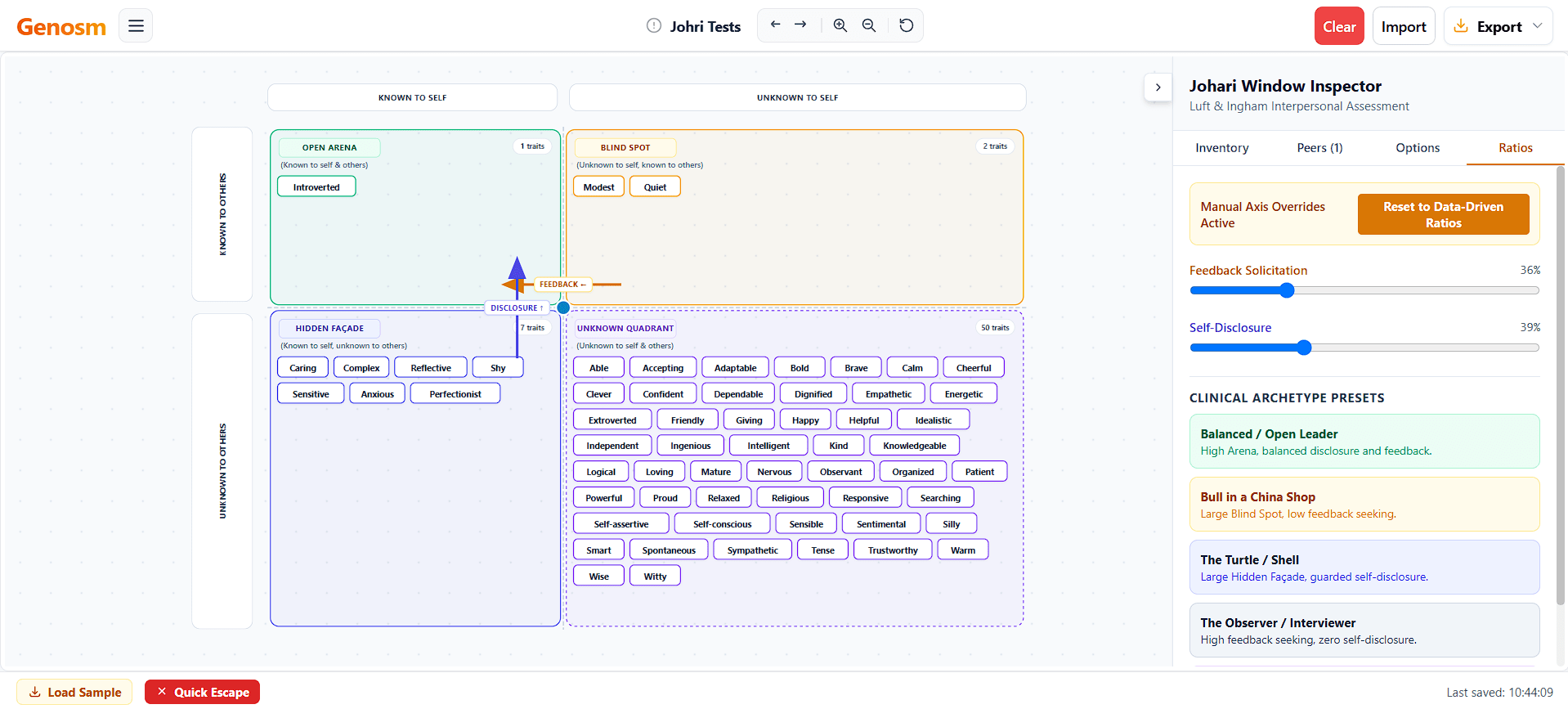
The Johari matrix is structured across two axes: Information Known or Unknown to Self (Horizontal Axis), and Information Known or Unknown to Others (Vertical Axis):
1. Open Arena (Quadrant 1)
Self ∩ PeerInformational State: Known to Self AND Known to Others.
The public self. Contains behaviors, values, traits, and skills acknowledged by both the client and group observers. Characterized by high trust, open communication, and psychological safety.
2. Blind Spot (Quadrant 2)
Peer \ SelfInformational State: Unknown to Self BUT Known to Others.
Aspects of behavior, tone of voice, defensive body language, or emotional reactions that others perceive clearly, but the client remains unaware of. Shrunk through non-defensive feedback solicitation.
3. Hidden / Façade (Quadrant 3)
Self \ PeerInformational State: Known to Self BUT Unknown to Others.
The private self. Private vulnerabilities, personal doubts, hidden fears, and past histories deliberately concealed from others. Shrunk through gradual, safe self-disclosure.
4. Unknown / Unconscious (Quadrant 4)
((Self ∪ Peer)&supc;)Informational State: Unknown to Self AND Unknown to Others.
Unconscious dynamics, latent potential, repressed memories, and undiscovered coping resources. Discovered through deep psychotherapy, clinical hypnosis, or experiential group challenges.
The 56 Canonical Johari Adjectives & Custom Traits
Genosm includes the complete, canonical 56-adjective inventory established in standard Luft & Ingham literature, organized for rapid one-click selection alongside custom clinical trait creation:
The 56 Canonical Adjectives
Standard Psychometric ListMulti-Peer Evaluation & Consensus Aggregation
A single observer's perspective can introduce individual bias. Genosm supports multi-observer evaluations with advanced consensus aggregation:
Unlimited Peer Evaluators
Add multiple raters (such as Spouse, Therapist, Peer, Manager) and track their independent observations separately in the inspector.
Union Aggregation Mode
Maps any adjective selected by at least one peer observer into the peer rating pool for comprehensive exploratory discussions.
Consensus Threshold Engine
Filters peer observations by statistical consensus (e.g. requiring 50% or 75% of observers to select a trait before placing it in Open or Blind quadrants).
Manual Quadrant Overrides
Allows clinicians to assign individual traits directly to specific quadrants or toggle classical unselected adjective mapping into the Unknown area.
Dynamic Feedback & Self-Disclosure Vector Sliders
The visual geometry of the Johari Window reflects relational style. In Genosm, quadrant sizes shift dynamically through two vector mechanisms:
Vertical Axis: Feedback Solicitation
Shrinks Blind SpotMoving the feedback slider increases the client's willingness to listen to external perspectives, pulling the horizontal divider downward and converting Blind Spot traits into Open Arena knowledge.
Horizontal Axis: Self-Disclosure
Shrinks Hidden FaçadeMoving the disclosure slider reflects the client's openness in sharing personal feelings and experiences, pulling the vertical divider rightward and converting Hidden Façade traits into shared Open Arena clarity.
The 5 Classical Interpersonal Archetype Presets
Genosm provides 5 pre-configured clinical archetypes to accelerate psychoeducation and interpersonal diagnostic formulation:
1. The Balanced / Open Communicator
Visual Profile: Large Open Arena, balanced disclosure and feedback solicitation.
The goal of interpersonal therapy. High trust, minimal defensiveness, healthy boundaries, and effective mutual communication.
2. The Bull in a China Shop
Visual Profile: Massive Blind Spot, low feedback seeking, high self-disclosure.
Dominates discussions, expresses personal views aggressively, but remains unaware of how their behavior alienates group peers.
3. The Turtle / Shell (Façade)
Visual Profile: Massive Hidden Area, highly guarded, minimal self-disclosure.
Maintains a polite public mask while concealing true thoughts, anxieties, and past histories due to fear of rejection or vulnerability.
4. The Observer / Interviewer
Visual Profile: High feedback seeking, zero personal self-disclosure.
Constantly asks questions and solicits feedback from others while withholding their own personal stance, maintaining an emotional distance.
5. The Novice / Unconscious
Visual Profile: Dominant Unknown quadrant, unmapped potential.
Common in new group members, adolescents, or clients beginning their first therapeutic journey with significant unexplored potential.
How to Create a Johari Window in Genosm
Follow this five-step clinical procedure to create, customize, and export an interpersonal Johari assessment:
Set Target Client & Complete Self-Rating
Enter client name and check the traits they identify with across the 56-adjective table or add custom descriptors.
Add Observers & Record Peer Ratings
Add peer raters (spouse, group member, colleague, counselor) and check the adjectives observed by peers.
Configure Peer Aggregation Mode
Select Union Mode for exploratory discussions or Consensus Threshold Mode to filter traits by peer agreement.
Adjust Vector Sliders & Archetypes
Fine-tune feedback and disclosure vector sliders or compare against clinical archetype presets.
Export 300 DPI Vector Reports
Export vector PDFs, SVGs, or raw JSON data files directly for EHR documentation or client handouts.
Therapy, Coaching & Group Workflows
The Johari Window is a versatile clinical tool used across diverse therapeutic settings:
Group Psychotherapy
Facilitate structured feedback debriefs, shrink blind spots, and build interpersonal trust in process therapy cohorts.
Couples Counseling
Explore unexpressed emotions in the Hidden Façade and resolve unconscious defensive triggers between partners.
Executive Coaching
Help leaders discover blind spots in their communication style and expand their authentic Open Arena with direct reports.
Pairing Johari Windows with Other Genosm Diagrams
Genosm provides an integrated suite of 14 clinical diagramming tools. Clinicians frequently pair the Johari Window with these related formulation tools:
Sociogram Chart Maker & Moreno Target Rings
Group DynamicsPair peer nominations from a Moreno Sociogram with the Johari Window to help sociometric Isolates and Controversial group members understand how their hidden façade or blind spots impact peer acceptance.
Schema Therapy Scale & Mode Mapping
Schema ModesExamine how maladaptive schemas (Defectiveness, Social Isolation, Emotional Deprivation) maintain a guarded Hidden Façade, and map Healthy Adult mode to an expanded Open Arena.
Polyvagal Ladder & Autonomic Safety
Autonomic StateConnect sympathetic fight-flight reactions to the Bull in a China Shop archetype, dorsal vagal shutdown to the Turtle Façade, and ventral vagal safety to the Open Arena.
100% Local-First Data Privacy and Zero-PHI Guarantee
Personal disclosures and peer behavioral evaluations represent sensitive psychological data. Generic online whiteboards save client evaluations to remote cloud servers, creating ethical and privacy risks.
Genosm operates on a zero-storage, local-first architecture. When building a Johari Window:
- All 56 adjective classifications, peer matrices, and vector sliders render locally in your browser.
- Client names, evaluator notes, and trait selections are never stored on remote servers.
- Files save directly to your local computer or private browser IndexedDB database via the File System Access API.
- Export 300 DPI vector PDFs and SVG diagrams directly for placement in your EHR or client chart.
Why Genosm Outperforms Generic Software
| Feature | Genosm | Generic Whiteboards (Miro/Lucid) | Paper Handouts |
|---|---|---|---|
| 56 Canonical Adjectives | Built-in 1-click checklist with custom traits | Manual text boxes | Static paper list |
| Multi-Peer Rating Engine | Union & Consensus threshold modes | None | Manual hand tallying |
| Dynamic Vector Geometry | Interactive sliders for feedback & disclosure | Manual static boxes | Fixed static grid |
| Clinical Archetype Presets | 5 diagnostic presets (Balanced, Turtle, etc.) | None | None |
| Vector PDF & SVG Exports | 300 DPI vector PDF and SVG graphics | Rasterized screenshot | Physical paper folder |
| Patient Data Privacy (HIPAA) | 100% Local-First (Zero Server PHI) | Third-party cloud risk | Physical storage risk |
Johari Window Tool FAQ
What is the Johari Window and who created it?
The Johari Window is an interpersonal communication and self-awareness model created in 1955 by psychologists Joseph Luft and Harrington Ingham at the University of California Western Training Laboratory. The name "Johari" is a combination of their first names: Joe and Harry.
What are the 4 quadrants of the Johari Window?
The 4 quadrants are: 1. Open Arena (Quadrant 1: Known to Self and Known to Others), 2. Blind Spot (Quadrant 2: Not Known to Self but Known to Others), 3. Hidden / Façade (Quadrant 3: Known to Self but Not Known to Others), and 4. Unknown (Quadrant 4: Not Known to Self and Not Known to Others).
What are the 56 standard Johari adjectives?
The 56 canonical adjectives established by Luft and Ingham include traits such as Able, Accepting, Adaptable, Bold, Brave, Calm, Caring, Cheerful, Clever, Complex, Confident, Dependable, Dignified, Empathetic, Energetic, Extroverted, Friendly, Giving, Happy, Helpful, Idealistic, Independent, Ingenious, Intelligent, Introverted, Kind, Knowledgeable, Logical, Loving, Mature, Modest, Nervous, Observant, Organized, Patient, Powerful, Proud, Quiet, Reflective, Relaxed, Religious, Responsive, Searching, Self-assertive, Self-conscious, Sensible, Sentimental, Shy, Silly, Smart, Spontaneous, Sympathetic, Tense, Trustworthy, Warm, Wise, and Witty.
How do Feedback and Self-Disclosure vectors change the Johari Window?
In group therapy and interpersonal training, giving and receiving feedback shrinks the Blind Spot and expands the Open Arena vertically. Self-disclosure shrinks the Hidden Façade and expands the Open Arena horizontally. Through mutual trust and psychotherapy, the Unknown quadrant shrinks as unconscious material is integrated.
What are the 5 clinical archetype presets in Genosm Johari Tool?
Genosm provides 5 preset interpersonal archetypes: 1. Balanced / Open Leader (large Open Arena with balanced disclosure and feedback), 2. Bull in a China Shop (large Blind Spot, low feedback seeking), 3. The Turtle / Shell (large Hidden Façade, guarded self-disclosure), 4. The Observer / Interviewer (high feedback solicitation with minimal self-disclosure), and 5. The Novice / Unconscious (dominant Unknown area, unmapped potential).
Is client evaluation data stored on remote cloud databases?
No. Genosm operates on a strict 100% local-first, zero-storage model. Client trait selections, peer ratings, and case notes are processed entirely in your web browser. No Protected Health Information (PHI) is ever transmitted to or stored on remote cloud servers.