Clinical Origins: Dr. Dan Siegel and Dr. Pat Ogden
The Window of Tolerance is one of the most widely utilized clinical models in contemporary psychotherapy, trauma recovery, and somatic psychology. Originally conceptualized in 1999 by psychiatrist Dr. Dan Siegel in his seminal text The Developing Mind, the framework describes the optimal zone of nervous system arousal in which an individual can effectively function, process emotions, integrate new information, and engage with others.
The model was subsequently expanded by Dr. Pat Ogden, founder of Sensorimotor Psychotherapy, and somatic trauma pioneers such as Dr. Bessel van der Kolk and Dr. Stephen Porges. In clinical practice, psychological trauma, chronic developmental stress, and neurodivergent sensory overload frequently compress the window, causing individuals to swing rapidly between severe emotional agitation and sudden somatic collapse.
By externalizing internal autonomic states onto a visual timeline, therapists help clients move away from self-blame and pathologizing language. Rather than viewing themselves as broken, clients learn to recognize their physiological reactions as predictable autonomic survival responses that can be systematically tracked, grounded, and regulated.
The Three Autonomic Arousal Zones in Clinical Detail
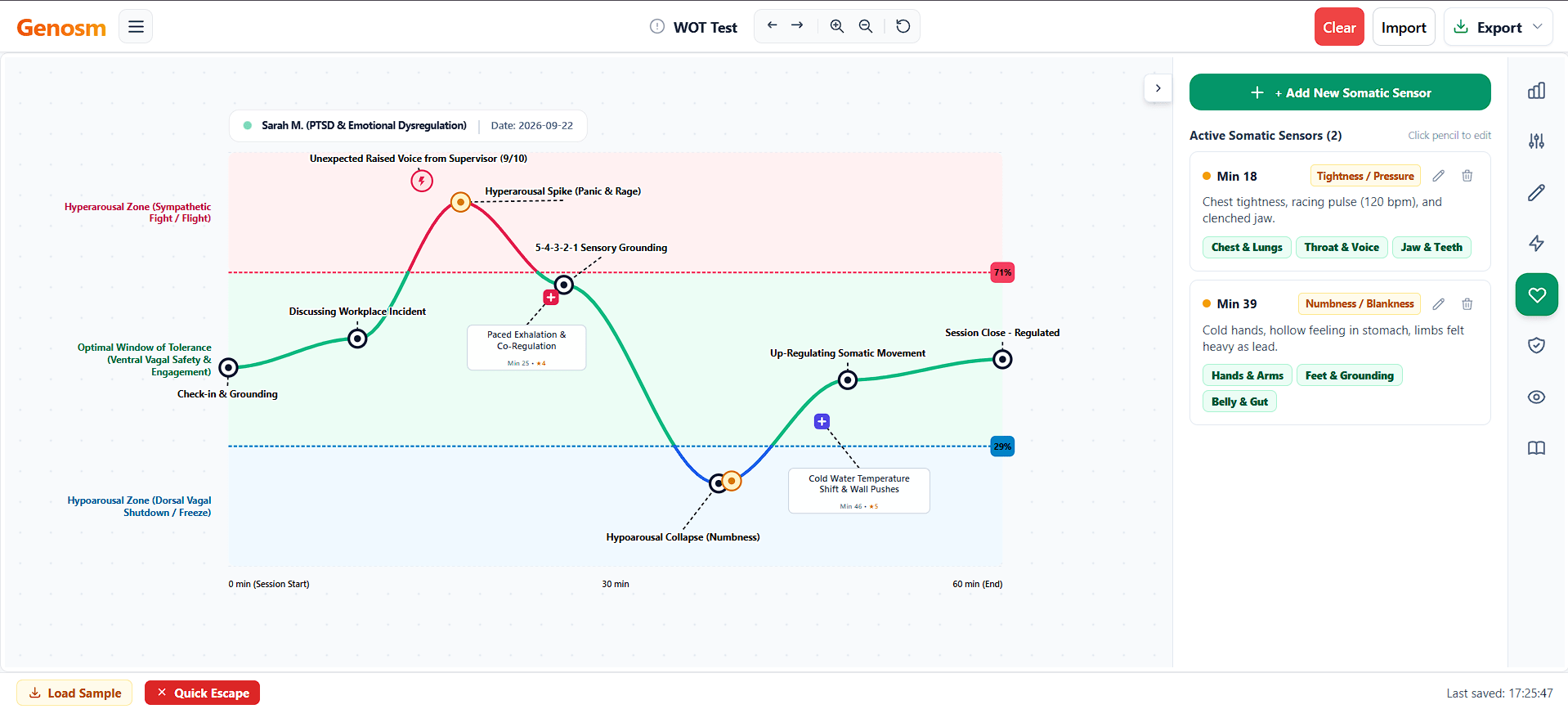
A clinically robust Window of Tolerance diagram requires precise differentiation between the three primary branches of autonomic activation:
1. Hyperarousal Zone (Sympathetic Mobilization)
Fight / Flight / PanicWhen arousal surges above the upper threshold, the sympathetic nervous system takes complete control. The client experiences rapid heart rate, muscle tightness, shallow thoracic breathing, hypervigilance, emotional flooding, racing thoughts, anger outbursts, or intense panic. Executive functioning and cognitive reflection become temporarily inaccessible.
2. The Optimal Window of Tolerance (Ventral Vagal Social Engagement)
Regulated / Present / SafeWithin this zone, the client feels safe, grounded, and emotionally balanced. They can experience positive and challenging feelings without feeling overwhelmed or numb. Prefrontal cortex connectivity remains intact, enabling cognitive flexibility, self-reflection, empathy, and collaborative therapeutic problem solving.
3. Hypoarousal Zone (Dorsal Vagal Immobilization)
Freeze / Collapse / DissociationWhen stimulation becomes completely overwhelming, the dorsal vagal system triggers an emergency conservation reflex. The client drops below the lower threshold into numbness, depersonalization, profound exhaustion, flat emotional affect, brain fog, mutism, or physiological collapse.
Interactive Somatic Homunculus Body Mapping with Live Hover Preview
A key differentiator in Genosm is its native Somatic Sensor Homunculus System. Trauma lives in the body before it presents as a conscious cognitive thought. Traditional worksheets force clinicians to write generic text notes like "feels anxious," which fails to capture the precise visceral somatic cues preceding autonomic dysregulation.
Live Hover Popover Demo on the Canvas
In Genosm, every somatic marker placed along the timeline is an active interactive node. When you or your client hover your cursor over any somatic sensor node on the canvas:
- An anatomical body map popover (homunculus) instantly appears beside the cursor.
- The exact pinned body regions illuminate in bold color (such as throat constriction, chest tightness, solar plexus clenching, cold hands, or leg shaking).
- The card displays the specific sensation quality (Heat/Flushing, Cold/Chills, Tightness/Pressure, Numbness/Blankness, Tingling/Buzzing, Sharp Pain, or Hollow Void).
- The exact minute offset and clinical intensity rating (1 to 10 scale) are shown in real time.
10 Pinned Anatomical Regions
- 1. Head & Brain
- 2. Eyes & Vision
- 3. Jaw & Teeth
- 4. Throat & Voice
- 5. Chest & Lungs
- 6. Solar Plexus
- 7. Belly & Gut
- 8. Hands & Arms
- 9. Legs & Thighs
- 10. Feet & Grounding
7 Clinical Sensation Categories
- Heat / Flushing: Sympathetic vascular dilation
- Cold / Chills: Peripheral vasoconstriction
- Tightness / Pressure: Muscle bracing
- Numbness / Blankness: Dorsal dissociation
- Tingling / Buzzing: Hyperventilation sensation
- Sharp Pain / Ache: Somatic tension
- Hollow / Void: Depersonalization feeling
Engineered for Clinical Speed, Flexibility, and Precision
Genosm provides an intelligent, specialized canvas that understands clinical timelines and neurobiological parameters:
Continuous Spline Arousal Curve
Plot arousal points at specific minute intervals. Genosm automatically computes smooth mathematical curves with configurable smoothing factors, eliminating jagged lines and creating clear visual representations.
Direct Draggable Threshold Handles
Grab and slide the upper and lower threshold dotted boundaries directly on the canvas with pointer capture, or fine-tune them using sliders in the inspector (40% to 95% upper, 5% to 60% lower).
Freehand Sketch Drawing Mode
Draw continuous arousal lines directly on the canvas using a stylus, mouse, or touchpad. Genosm automatically simplifies your freehand strokes into editable keyframe nodes while preserving the original shape.
Multi-Category Trigger Markers
Categorize clinical triggers into Interpersonal Conflict, Sensory Overload, Trauma Memory/Flashback, Cognitive Worry, or Unsafe Environment, each with a 1 to 10 intensity slider.
4-Category Coping Interventions
Log Down-Regulating (Calming), Up-Regulating (Activating), 5-Sense Grounding, or Co-Regulation interventions with 1 to 5 star effectiveness ratings to identify what strategies work best.
Dynamic Layer Visibility Toggles
Customize presentation clarity by toggling Keyframes, Triggers, Somatic Sensors, Interventions, or Text Labels on and off. Ideal for simplifying diagrams during client discussions.
Therapeutic Analytics Dashboard and Automated Clinical Progress Narrative
Documenting emotional regulation in Electronic Health Records (EHR) often requires extensive manual charting. Genosm includes an automated clinical analytics engine that analyzes every curve and calculates key metrics in real time:
Calculated Clinical Metrics
"Client maintained physiological regulation within the optimal window for 62% of the 60-minute session. Sympathetic hyperarousal peaked at minute 12 (arousal 82%) following an interpersonal trigger, accompanied by reported somatic throat and chest tightness. Implementation of 4-7-8 diaphragmatic down-regulation successfully restored baseline within 13 minutes. A brief hypoarousal drop to 22% was observed at minute 40, resolved through sensory up-regulation."
How to Build a Window of Tolerance Chart in Genosm
Follow this five-step clinical procedure during intake evaluations, psychoeducation segments, or post-session clinical documentation:
Set Time Range and Initial Thresholds
Choose your timeline duration in the Inspector panel. Select a 60-minute therapy session, a 4-hour triggering event, or a 24-hour day log. Adjust the upper threshold (e.g., 70%) and lower threshold (e.g., 30%) by dragging handles on the canvas or using sliders.
Plot Keyframe Moments of Arousal
Add keyframe points along the time axis. Assign an arousal score between 0 (complete dissociation) and 100 (extreme panic). Drag keyframe positions or text labels directly on canvas to prevent visual overlap.
Attach Somatic Sensations and Trauma Triggers
Use the Somatic Cue builder to record specific physiological sensations across the 10 body regions. Add trigger markers categorized by interpersonal conflict, sensory overload, or memory flashbacks with 1 to 10 intensity ratings.
Map Regulating Coping Interventions & Baseline Progress
Add coping interventions applied during or between sessions. Choose from down-regulating calming exercises, up-regulating activation tools, 5-sense grounding, or co-regulation. Enable the Past Baseline Ghost Overlay to showcase treatment progress.
Export Clinical Handouts and EHR Records
Export crystal-clear vector PDF files for printing client handouts or attaching directly to progress notes in SimplePractice, TherapyNotes, or Epic. Download PNG images or raw JSON files for local record keeping.
Therapeutic Modalities and Clinical Populations
The Window of Tolerance diagram adapts seamlessly across numerous therapeutic modalities:
EMDR and Trauma Processing
Ensure clients remain within their window during bilateral stimulation. Use the chart to identify early signs of emotional flooding or dissociation before processing traumatic memories.
Dialectical Behavior Therapy (DBT)
Track emotional vulnerability factors and distress tolerance skills (TIPP, STOP) to illustrate how physical interventions lower emotional arousal.
Sensorimotor & Somatic Experiencing
Map titration and pendulation by guiding clients between mild activation and grounded somatic resources, tracking bodily sensations throughout the process.
Couples and Family Therapy
Illustrate mutual dysregulation cycles where one partner's hyperarousal triggers the other partner's hypoarousal withdrawal, supporting systemic co-regulation.
Pairing Window of Tolerance with Other Genosm Diagrams
Genosm provides a comprehensive suite of 14 clinical diagramming tools. Clinicians frequently combine the Window of Tolerance with these related formulation tools:
Polyvagal Ladder and Hierarchy Chart
Autonomic AnatomyWhile the Window of Tolerance tracks arousal over a continuous timeline, the Polyvagal Ladder categorizes hierarchical states: Ventral Vagal (Safety), Sympathetic (Fight/Flight), and Dorsal Vagal (Freeze). Use both diagrams together for deep psychoeducation.
Internal Family Systems (IFS) Parts Map
Parts IntegrationMap protector parts (Managers and Firefighters) to sympathetic hyperarousal behaviors, and link exiled parts to dorsal hypoarousal emotional wounds.
CBT 5-Areas Hot Cross Bun Formulation
Cognitive FormulationConnect physiological arousal spikes directly to negative automatic thoughts, cognitive appraisals, and behavioral maintaining loops.
100% Local-First Data Privacy and HIPAA Alignment
Clinical case formulations and trauma histories contain sensitive Protected Health Information (PHI). Generic cloud diagramming platforms store user data on remote multi-tenant databases, creating data exposure risks.
Genosm uses a zero-storage, local-first architecture. When you create or edit a Window of Tolerance chart:
- All diagram calculations and graphical rendering occur directly inside your browser.
- Client names, session notes, somatic markers, and trigger details are never transmitted to Genosm servers.
- Files are stored directly on your local device or encrypted browser database (IndexedDB).
- You maintain complete data ownership, ensuring compliance with HIPAA, GDPR, and clinical confidentiality ethics.
Why Genosm Outperforms Generic Drawing Software
| Feature | Genosm | Generic Whiteboards (Miro/Lucid) | Paper Worksheets |
|---|---|---|---|
| Spline Arousal Curves | Automated with manual control | Manual disjointed lines | Hand drawn only |
| Somatic Homunculus Hover | Native anatomical body popover | No somatic integration | Static body outlines |
| Automated Clinical Impression | Auto-generated narrative & metrics | Manual typing only | Manual handwritten text |
| Freehand Sketch Mode | Stylus sketch with auto-simplification | Clunky unsimplified drawing | Physical pen only |
| Longitudinal Baseline Overlay | Built-in historical comparison | Manual duplication required | Requires multiple sheets |
| Patient Data Privacy (HIPAA) | 100% Local-First (Zero Server PHI) | Third-party cloud storage | Physical file risk |
| EHR Vector Export (PDF/SVG) | High-res 300 DPI vector export | Low-res raster images | Requires document scanning |
| All-in-One Clinical Suite | 14 clinical diagram types in $9.99 plan | Expensive generic tiers | Disorganized printed sheets |
Window of Tolerance Chart Maker FAQ
What is the Window of Tolerance diagram used for in therapy?
The Window of Tolerance diagram is a visual psychoeducational and clinical tracking tool originally formulated by Dr. Dan Siegel. It maps three autonomic nervous system states: Hyperarousal (fight or flight, anxiety, panic), the Optimal Window of Tolerance (calm, grounded, socially engaged), and Hypoarousal (freeze, shutdown, numbness, dissociation). Clinicians use it to help clients recognize early somatic dysregulation, identify triggers, and apply targeted self-regulation interventions.
How does the interactive somatic homunculus hover preview work in Genosm?
When you hover your cursor over any somatic sensor marker on the canvas, Genosm instantly displays a floating anatomical body map popover. This graphic highlights the specific pinned anatomical regions (such as head, throat, chest, solar plexus, gut, or feet) and displays the associated sensation category and intensity score in real time.
What is the automated clinical narrative generator?
Genosm includes an integrated clinical analytics engine that calculates the exact percentage of time the client spent in the regulated window, hyperarousal, and hypoarousal. It synthesizes these metrics with logged triggers and intervention outcomes into an objective clinical progress paragraph suitable for inclusion in progress notes.
How does Genosm protect client health information on Window of Tolerance charts?
Genosm operates with a local-first architecture. All diagram data, client names, session dates, somatic descriptions, and clinical notes are computed and stored directly in your web browser. No Protected Health Information (PHI) is ever transmitted to, processed by, or stored on Genosm remote servers. This ensures complete HIPAA alignment and total data sovereignty.
Can I sketch the arousal curve freehand?
Yes. Genosm includes a dedicated Freehand Sketch Mode. Clinicians can draw continuous curves directly on the canvas using a stylus, touchpad, or mouse. The software automatically simplifies the raw sketch into clean, editable keyframe nodes while preserving the clinician's intended curve shape.
What export formats are supported for electronic health records (EHR)?
Genosm exports charts in high-resolution vector PDF (ideal for printing client handouts or attaching to EHR systems like SimplePractice, TherapyNotes, or Epic), crisp SVG vector graphics, transparent or white-background PNG images, and portable JSON backup files.
Is the Window of Tolerance tool included in the standard Genosm plan?
Yes. The Window of Tolerance chart maker is fully included in the $9.99 per month Genosm plan, which gives clinicians unlimited diagram creation across all 14 clinical formats including Genograms, CBT Formulations, Polyvagal Ladders, IFS Parts Maps, and Sociograms.