Clinical Origins: Dr. Elaine P. Congress and Culturagram Assessment
The Culturagram was created in 1994 by social work scholar Dr. Elaine P. Congress (expanded in 2005 and 2017) at Fordham University Graduate School of Social Service. Developed as a culturally competent family assessment instrument, the Culturagram was designed to move clinical practice beyond generalized racial or ethnic stereotypes. It treats every immigrant, refugee, or cross-cultural family as a unique cultural system with its own distinct migration journey, acculturation pace, and value hierarchy.
While traditional family tools like Genograms capture biological lineages and Ecomaps map external institutional connections, the Culturagram maps internal cultural meaning. It systematically explores how relocation history, documentation status, spiritual coping, experiences with bias, and family power balances influence emotional wellness and clinical presentation.
Subsequent clinical frameworks, including the Transnational Culturagram (Congress, 2017; Furman et al.) and the Intergenerational Acculturation Gap Model (Congress & Kung, 2013), established that family members who migrate together often adapt at vastly different speeds. Children in school adopt host culture norms rapidly, while parents and grandparents retain traditional heritage values, creating acute intergenerational tension that standard assessments overlook.
The 10 Core Cultural Assessment Domains
Genosm organizes the Elaine Congress formulation into ten standardized, customizable domain cards positioned around the central client:
1. Reasons for Relocation
PerceptionsClinical Focus: Voluntary versus forced migration context, economic pull factors, political asylum, and desire or ability to return to the home country.
2. Legal Status & Documentation
DemographicsClinical Focus: Current visa standing, citizenship, permanent residency, fear of deportation, and access to healthcare or public benefits.
3. Time in Community & Acculturation
DemographicsClinical Focus: Duration of residence in current community, age at migration, generational cohort (1st vs 2nd Gen), and residential stability.
4. Language Spoken at Home & Work
SkillsClinical Focus: Primary home language, English proficiency, literacy, and presence of child language brokering for adult family members.
5. Health & Medical Beliefs
PerceptionsClinical Focus: Folk healers, herbal remedies, Western medical trust, mental health stigma, somatic illness expression, and wellness rituals.
6. Impact of Trauma & Crisis Events
TransitionsClinical Focus: Pre-migration war or violence, perilous border transit, prolonged family separation, and post-arrival discrimination crises.
7. Cultural & Religious Institutions
SkillsClinical Focus: Faith community involvement, spiritual support, observance of religious holidays, traditional food, and ethnic social clubs.
8. Oppression, Bias & Discrimination
DemographicsClinical Focus: Systemic racism, workplace exploitation, neighborhood hostility, school microaggressions, and institutional distrust.
9. Values about Education & Work
PerceptionsClinical Focus: Academic achievement expectations for children, career sacrifice, credential devaluation, and survival job stress.
10. Values about Family & Hierarchy
PerceptionsClinical Focus: Collectivism versus individualism, filial piety, parental authority, gender role flexibility, and extended family obligations.
3 Layout Variants: Standard, Transnational & Generational
Different case configurations require tailored visual layouts. Genosm supports three specialized Culturagram layout variants:
1. Standard Congress 10-Domain Model (Default)
Standard ModelDistributes the 10 classic Congress domain cards in a balanced radial arrangement around the primary focus subject node. Each card connects via connecting vectors with customizable drag offsets for clear, presentation-ready clinical case reports.
2. Transnational Culturagram (4-Sector Hub & Spoke)
Cross-Border FamiliesOrganizes assessment cards into four distinct macro-sectors: Skills & Activities (Top), Perceptions & Values (Right), Life Transitions & Rituals (Bottom), and Demographic Factors (Left). Built specifically for transnational families who maintain active economic, social, and emotional ties across international borders.
3. Multi-Generational Family Culturagram
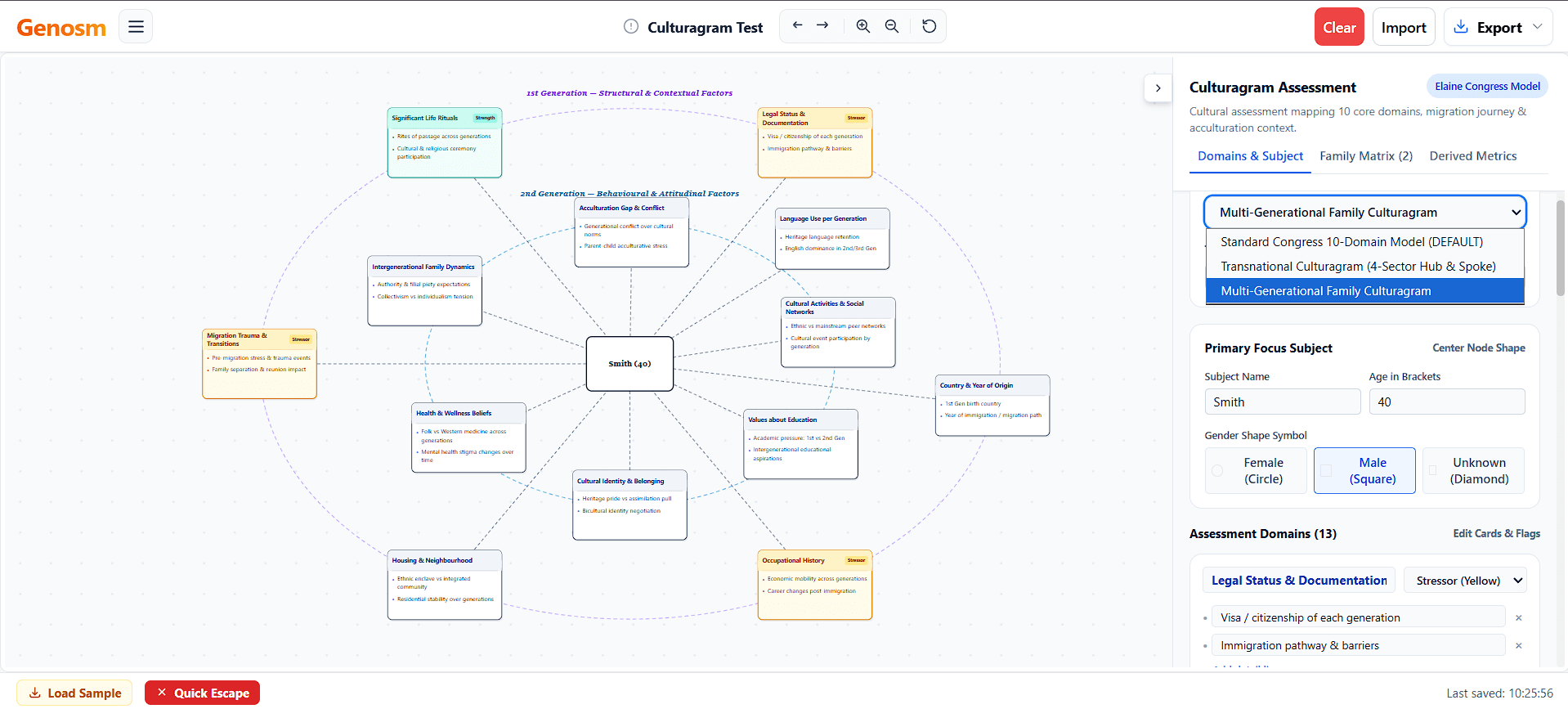
Acculturation RingsArranges domain cards into 3 concentric generational tiers: 1st Gen outer ring (demographic origin and migration barriers), 2nd Gen middle ring (language use, peer networks, bicultural identity), and 3rd+ Gen inner ring (intergenerational family dynamics and acculturation gaps).
Family Acculturation Matrix & Intergenerational Disparity
Clinical conflict in immigrant households frequently stems from divergent rates of acculturation among family members. Genosm includes an interactive Family Acculturation Matrix:
4-Tier Generation Status Tracking
Categorize each member by migration cohort: 1st Generation (immigrant parents), 1.5 Generation (arrived during childhood/adolescence), 2nd Generation (born in host country), or 3rd+ Generation.
5-Point Acculturation Scale
Assign individual acculturation scores from Level 1 (Traditional heritage orientation) to Level 3 (Bicultural integration) up to Level 5 (Full assimilation into host culture).
Parent-Child Acculturation Gap
Identifies the mathematical variance between parental heritage expectations and adolescent host culture integration to locate points of systemic family friction.
Language Brokering Burden
Highlight when children assume adult translation duties for legal, medical, or school meetings, altering traditional parent-child authority boundaries.
Derived Metrics: CSS, ASI & IADI Scorecards
Genosm provides digital decision-support metrics calculated from domain flags and the family matrix. These indices provide rapid visual summaries during clinical supervision and treatment planning:
The indices below are software-calculated auxiliary metrics derived from domain tags and matrix levels. They serve as clinical decision-support aids and are not original mandates from Dr. Elaine Congress.
Quantifies protective factors, cultural institutions, and positive family assets supporting psychological resilience (0-100%).
Weighted index assessing legal vulnerabilities, migration trauma events, and discrimination barriers (0-100 score).
Measures cultural orientation distance between 1st Gen parents and 2nd Gen children to flag family discord risk.
Temporal Time-Lapse Phases & Clinical Flags
Cultural formulation is not static; it evolves as families move through migration and integration milestones. Genosm supports longitudinal tracking through:
Captures initial survival needs, acute language barriers, visa insecurity, and transit trauma immediately following relocation.
Assesses present cultural institutions, schooling adjustment, acculturation gaps, and healthcare access in the current community.
Establishes therapeutic targets: legal stability, bicultural identity reconciliation, career mobility, and family harmony.
Color-Coded Clinical Domain Flagging
Clinicians can tag individual assessment cards with standardized diagnostic flags to create instant visual heatmaps of client vulnerability and strength:
How to Create a Culturagram in Genosm
Follow this five-step clinical procedure to create, customize, and export a professional cultural assessment:
Select Variant and Time-Lapse Phase
Choose between the Standard Congress 10-Domain model, Transnational 4-Sector layout, or Multi-Generational ring format, and designate the assessment phase.
Configure Primary Subject Details
Input the focus client name, age in brackets, country of origin, primary language, arrival year, and select the central shape symbol (Circle, Square, Diamond).
Populate 10 Assessment Domains
Enter interview findings, clinical observations, and bullet details across all 10 domain cards, assigning Strength, Stressor, or Trauma flags.
Complete the Family Acculturation Matrix
Add household members, designate their generational cohort (1st Gen to 3rd+ Gen), and set individual acculturation sliders (1 to 5).
Review Derived Metrics and Export
Review CSS, ASI, and IADI decision support metrics, add clinical formulation notes, and export high-resolution vector PDFs or SVG charts for EHR records.
Social Work, Therapy & Healthcare Workflows
Culturagram assessments provide essential diagnostic context across diverse health and human service settings:
Social Work & Case Management
Document immigrant family strengths, identify community connections, and evaluate access to legal aid, food security, and bilingual social safety nets.
Family Systems Therapy
Resolve intergenerational parent-child conflict by visualizing differing acculturation paces, authority boundaries, and bicultural identity challenges.
Medical & Hospital Social Work
Evaluate health beliefs, traditional healing practices, language interpretation needs, and institutional trust barriers in oncology, pediatrics, and discharge planning.
Pairing Culturagrams with Other Genosm Diagrams
Genosm provides an integrated suite of 14 clinical formulation diagrams. Clinicians frequently combine the Culturagram with these complementary tools:
3-Generation Genograms & Ecomaps
Family Systems SuiteCombine the Culturagram with a 3-generation Genogram and institutional Ecomap for the definitive gold-standard social work intake assessment, mapping heritage lineage, community energy flows, and cultural values simultaneously.
Window of Tolerance & Migration Trauma
Trauma RegulationLink migration trauma events and discrimination triggers recorded in Culturagram Domain 6 and Domain 8 directly to hyperarousal panic or hypoarousal dissociation states on the Window of Tolerance.
Schema Therapy Scales & Early Maladaptive Schemas
Core BeliefsExplore how collective family cultural values and migration sacrifices intersect with Early Maladaptive Schemas such as Unrelenting Standards, Self-Sacrifice, or Social Isolation across 1st and 2nd generation clients.
100% Local-First Data Privacy and Zero-PHI Guarantee
Culturagrams contain deeply sensitive information, including immigration documentation status, trauma narratives, religious affiliations, and family conflicts. Storing this information on shared third-party cloud servers poses grave ethical, legal, and privacy risks for clients.
Genosm operates on a zero-storage, local-first architecture. When creating a Culturagram:
- All 10 domain cards, family matrix scores, and derived metrics render locally in your web browser.
- Client names, immigration details, and clinical case notes are never transmitted to Genosm servers.
- Files save directly to your local computer or private browser IndexedDB database via the File System Access API.
- Export 300 DPI vector PDFs and SVG diagrams directly for placement in your EHR or client chart.
Why Genosm Outperforms Generic Tools
| Feature | Genosm | Generic Whiteboards (Miro/Lucid) | Paper Assessment Handouts |
|---|---|---|---|
| Elaine Congress 10 Domains | Standardized radial layout with presets | Manual shapes and text boxes | Static paper worksheet |
| Layout Variants | Standard, Transnational & Generational | Manual redraw required | Single rigid paper format |
| Family Acculturation Matrix | Interactive generational sliders (1-5) | None | Separate manual notes |
| Derived Decision Metrics | Automated CSS, ASI, and IADI scores | None | None |
| Temporal Phase Tracking | Arrival, Current, and Future Goal phases | Manual separate boards | Requires filing multiple sheets |
| Vector PDF & SVG Exports | 300 DPI vector PDF and SVG graphics | Rasterized screenshot | Physical paper folder |
| Client Data Privacy (HIPAA) | 100% Local-First (Zero Server PHI) | Third-party cloud risk | Physical storage risk |
Culturagram Assessment Tool FAQ
What is a Culturagram and who developed this assessment model?
A Culturagram is a family assessment diagram developed by Dr. Elaine P. Congress in 1994 (expanded in 2005 and 2017) to help social workers and mental health practitioners understand the cultural background, migration journey, and unique cultural context of immigrant and refugee families.
What are the 10 core domains in the Elaine Congress Culturagram?
The 10 standard domains are: 1. Reasons for Relocation, 2. Legal Status & Documentation, 3. Time in Community & Acculturation, 4. Language Spoken at Home & Work, 5. Health & Medical Beliefs, 6. Impact of Trauma & Crisis Events, 7. Cultural & Religious Institutions, 8. Oppression, Bias & Discrimination, 9. Values about Education & Work, and 10. Values about Family & Hierarchy.
What is the difference between Standard, Transnational, and Multigenerational Culturagrams?
The Standard Congress model arranges the 10 domains radially around the client. The Transnational model groups domains into four macro-sectors (Skills/Activities, Perceptions/Values, Life Transitions/Rituals, and Demographics) for cross-border families. The Multigenerational model organizes assessment cards across three concentric generational rings (1st Gen, 2nd Gen, and 3rd+ Gen) to highlight generational acculturation differences.
What are the Derived Metrics in Genosm Culturagram?
Genosm calculates three digital clinical decision-support metrics: 1. Cultural Strengths Score (CSS, measuring proportion of protective factors and cultural institutions), 2. Acculturative Stress Index (ASI, a weighted score of legal vulnerabilities, trauma, and discrimination), and 3. Intergenerational Disparity Index (IADI, measuring acculturation level variance between 1st Gen parents and 2nd Gen children). These metrics are clearly labeled as software-calculated decision aids.
How does Temporal Time-Lapse Phase tracking work in Culturagram?
Genosm allows clinicians to document cultural adjustment over time by selecting between Phase 1 (Initial Arrival Assessment), Phase 2 (Current Assessment), and Phase 3 (Future Goal / Follow-up). This tracks shifts in legal security, language acquisition, and family adaptation longitudinally.
Is client cultural assessment data stored on remote servers?
No. Genosm operates on a strict 100% local-first, zero-storage model. Client demographic details, migration narratives, legal documentation notes, and cultural assessments are processed entirely inside your local web browser. No Protected Health Information (PHI) is ever transmitted to or stored on remote cloud servers.