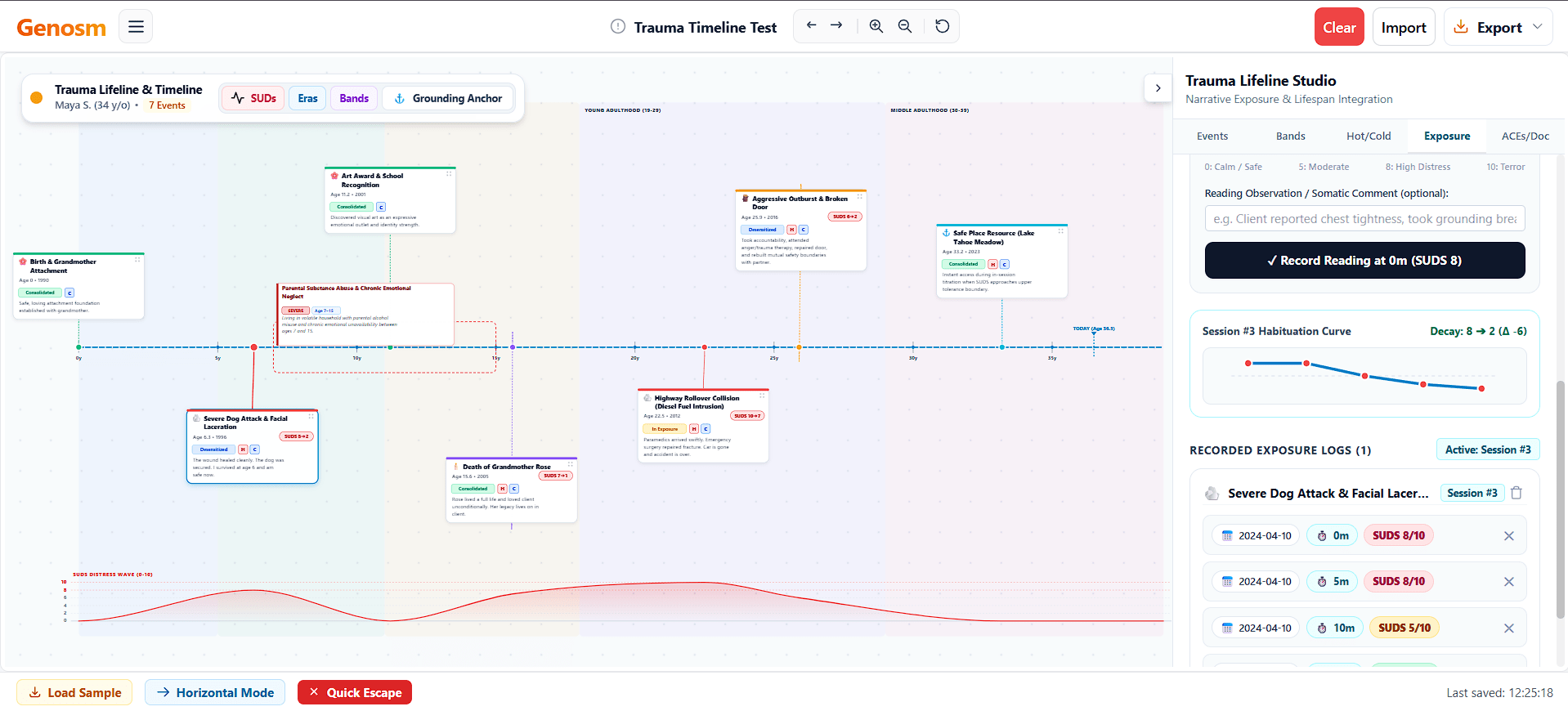
Clinical Foundations: Narrative Exposure Therapy & Dual Memory Theory
Traumatic experiences impair how the brain processes and stores autobiographical memory. During extreme terror, overwhelming physiological arousal shuts down hippocampal contextualization. As described by Dr. Chris Brewin in the Dual Representation Theory of PTSD, traumatic memories become trapped as fragmented, non-verbal Sensation-Representation System (Hot Memories) rather than integrated into the declarative Verbally Accessible System (Cold Memories).
To resolve this fragmentation, Dr. Maggie Schauer, Dr. Frank Neuner, and Dr. Thomas Elbert developed Narrative Exposure Therapy (NET) and Forensic NET (FORNET). In NET, the client and clinician lay out a physical cord or braided rope representing the lifespan from birth to the present. Together, they place physical symbols along the rope to construct a coherent, chronological narrative of the client's life history.
By systematically anchoring isolated sensory fragments (flashbacks, hyperarousal triggers) into their precise chronological place along the lifespan, the brain recognizes that the traumatic event belongs to the past. Genosm digitizes this entire evidence-based protocol with interactive symbols, continuous adversity bands, live exposure timers, and diagnostic calculators.
The 5 Core Lifeline Symbols & Chronic Adversity Bands
A standardized clinical lifeline requires clear symbolic differentiation between distinct types of autobiographical events:
1. Flowers (Positive Milestones)
ResilienceRepresent experiences of joy, secure attachment, personal achievement, social support, and moments of safety. Flowers provide vital emotional scaffolding, reminding the client of internal resources during subsequent trauma processing.
2. Stones (Traumatic Incidents)
Acute ThreatMark discrete traumatic events, physical attacks, natural disasters, sexual violations, serious accidents, or life-threatening terror. Each stone logs peak SUDS distress and active reprocessing status.
3. Sticks (Moral Injury / Harm)
FORNET ProtocolStandardized in Forensic NET (FORNET) to document acts of aggression committed by the client, survivor guilt, or severe moral violations. Facilitates compassionate exploration of survival behaviors without judgment.
4. Candles (Bereavement & Loss)
Grief WorkMemorialize the loss of loved ones, ambiguous grief, forced displacement, or major life transitions. Enables structured mourning alongside trauma desensitization.
5. Anchors (Somatic Stabilization Resources)
Present-Day SafetyRepresent grounded present-moment safe places (such as a coastal cabin, a safe person, or deep diaphragmatic breathing). Clinicians can toggle Genosm Grounding HUD mode to instantly orient dysregulated clients back to their anchor.
Chronic Continuous Adversity Bands
Developmental SpansDiscrete stone nodes cannot fully capture chronic, continuous developmental stressors such as ongoing childhood emotional neglect, prolonged domestic violence, systemic racism, or generational poverty. Genosm allows clinicians to define multi-year Continuous Adversity Bands using 5 colorblind-safe SVG patterns (diagonal hatch, cross hatch, stippled dots, wave lines, dense stripes) mapped to specific age intervals.
Hot Memory vs. Cold Memory Dual Representation Studio
The primary mechanism of change in trauma processing is contextualizing raw perceptual fragments within a coherent autobiographical narrative. Genosm includes a dedicated Dual Memory Studio for every event node on the timeline:
Raw, non-verbal memory components that trigger automatic fight, flight, or freeze reactions during recall.
- Sensory Triggers: Sights, smells, diesel exhaust, screaming, sudden footsteps.
- Somatic Sensations: Throat constriction, chest tightness, cold shaking, visceral dread.
- Intrusive Cognitions: "I am going to die", "I am completely helpless".
- SUDS Scoring: Peak distress score (0-10) versus current recall distress.
Contextual, chronological facts that anchor the memory firmly in the past.
- Declarative Context: Who was present, exact location, time of day, chronological age.
- Resolution Statement: "The police arrived. The surgery healed. The event ended and I am safe today."
- Habituation Indicator: Confirms the memory has been integrated into autobiographical awareness.
In-Session Exposure Pacer & SUDS Habituation Monitor
During active narrative exposure or EMDR desensitization, clinicians must systematically pace the client's emotional distress. Genosm provides an interactive In-Session Exposure Monitor that locks onto the targeted memory:
How Clinicians Use the Exposure Monitor
Automated ACEs Scoring, LEC-5 Mapping & Testimony Generator
Genosm integrates standardized diagnostic tools directly into the formulation workflow:
CDC/Kaiser ACEs Calculator
Score: 0 to 10As clinicians tag stones and continuous adversity bands with categories like physical abuse, emotional neglect, or household substance abuse, Genosm automatically tallies the Adverse Childhood Experiences (ACEs) score.
DSM-5 LEC-5 Classification
Criterion AClassify individual traumatic events under all 17 Life Events Checklist categories (e.g., natural disaster, assault with weapon, combat, life-threatening illness) to support formal PTSD diagnostic evaluations.
Formal NET Autobiographical Testimony Document
NET Protocol DeliverableIn formal Narrative Exposure Therapy, the concluding phase involves producing a written biographical testimony of the client's life. Genosm compiles this complete narrative document with one click, including chronological event descriptions, hot/cold memory links, diagnostic summaries, and formal client and treating clinician signature blocks.
How to Build a Trauma Lifeline in Genosm
Follow this five-step clinical procedure during intake assessments, trauma sequencing, or active reprocessing sessions:
Set Date of Birth and Establish Stabilization Anchors
Enter the client date of birth in the Inspector. Genosm calculates all event ages with zero timezone drift. Before mapping traumatic memories, establish at least one safe anchor resource (such as a coastal cabin or grounding practice) to support in-session stabilization.
Chronologically Place Lifeline Symbols
Click symbols in the quick-add bar to place Flowers (positive milestones), Stones (traumatic events), Sticks (moral injuries), and Candles (grief). Adjust node positions directly on canvas to ensure clear presentation.
Map Continuous Adversity Bands & ACEs
Define multi-year adversity periods (such as childhood emotional neglect or domestic violence) with custom start/end ages and colorblind-safe patterns, linking them to CDC/Kaiser ACEs categories.
Differentiate Hot vs. Cold Memories
Use the Dual Memory Studio to record sensory triggers and somatic sensations in the Hot Memory panel, then pair them with objective facts and present-day safe resolution statements in the Cold Memory panel.
Track Habituation and Export Testimony
Run in-session imaginal exposure with the built-in timer, log SUDS distress decay curves across minute intervals, and export high-resolution vector PDF charts, formal testimony documents, or printable client worksheets.
Therapeutic Modalities & Clinical Populations
The Trauma Lifeline adapts flexibly across major evidence-based trauma modalities:
Narrative Exposure Therapy (NET / FORNET)
Directly implements the standardized NET protocol for refugees, combat veterans, complex trauma survivors, and individuals with multiple severe traumatic events.
EMDR Target Sequencing & Touchstone Mapping
Identify earliest touchstone memories, worst traumatic incidents, and current triggers to build a clear 8-phase EMDR target sequencing plan.
Lifespan Integration (LI)
Utilize the chronological event sequence to repeat visual memory timeline sweeps, clearing body memory and reinforcing neural integration of elapsed time.
Forensic & Asylum Psychological Evaluations
Compile objective chronological evidence, LEC-5 documentation, and signed biographical testimony for clinical court reports and asylum evaluations.
Pairing Trauma Lifelines with Other Genosm Diagrams
Genosm provides 14 integrated clinical diagramming tools. Clinicians frequently combine the Trauma Lifeline with these related formulation instruments:
Window of Tolerance Chart Maker
Arousal TrackingWhile the Trauma Lifeline maps events across the entire lifespan, the Window of Tolerance tracks real-time autonomic nervous system arousal during sessions, ensuring safe exposure titration.
Somatic Body Mapping Tool
InteroceptionDeep-dive into the visceral bodily sensations identified in the Hot Memory module, mapping somatic tension across 24 anatomical zones with dual-pole pendulation.
IFS Parts Mapping Tool
Parts IntegrationLink exiled parts to specific stone trauma nodes on the lifeline, and map protector manager/firefighter behaviors to corresponding life chapters.
100% Local-First Data Privacy and HIPAA Alignment
Trauma lifelines document sensitive disclosures, including abuse history, combat experiences, and diagnostic details. Generic cloud whiteboard platforms store user data on remote multi-tenant servers, creating substantial security and confidentiality risks.
Genosm employs a zero-storage, local-first architecture:
- All diagram calculations, memory profiles, and exposure logs run entirely inside your browser.
- Client names, birth dates, trauma narratives, and notes are never transmitted to Genosm servers.
- Data persists securely on your local computer or encrypted browser storage (IndexedDB).
- Ensures seamless compliance with HIPAA, GDPR, and clinical ethics confidentiality standards.
Why Genosm Outperforms Generic Timeline & Drawing Software
| Feature | Genosm | Generic Whiteboards (Miro/Lucid) | Physical Cord & Paper |
|---|---|---|---|
| NET Standard Symbols | Native flowers, stones, sticks, candles, anchors | Manual generic shapes | Physical stones/flowers on cord |
| Hot vs Cold Memory Studio | Integrated dual memory profiling & tag inputs | Generic sticky notes | Manual handwritten sheets |
| Exposure Timer & SUDS Curves | Built-in exposure pacer with live decay curves | External stopwatch required | Manual timer & paper graphing |
| Automated ACEs & LEC-5 | Automatic tallying & diagnostic coding | No clinical diagnostic tools | Separate clinical paper forms |
| Formal Testimony Export | 1-Click HTML/PDF testimony document with signatures | Not available | Manual word processor typing |
| Patient Data Privacy (HIPAA) | 100% Local-First (Zero Server PHI) | Third-party cloud server storage | Physical binder storage risk |
| All-in-One Clinical Suite | 14 clinical diagram types in $9.99/mo plan | Expensive generic enterprise tiers | Scattered physical paper copies |
Trauma Timeline & Lifeline Chart Maker FAQ
What is a Trauma Lifeline in clinical psychotherapy?
A Trauma Lifeline is a visual, chronological mapping method derived from Narrative Exposure Therapy (NET) developed by Dr. Maggie Schauer, Dr. Frank Neuner, and Dr. Thomas Elbert. It represents a client's entire lifespan along a central lifeline cord, using standardized symbolic objects: Flowers for positive attachment, Stones for traumatic terror, Sticks for acts of aggression or moral injury, Candles for bereavement, and Anchors for present-moment grounding. It helps transform fragmented traumatic hot memories into coherent, contextualized autobiographical cold memories.
How does Genosm support the Dual Representation Theory of PTSD?
Trauma memories are dual-encoded: Hot Memories consist of sensory triggers (sights, sounds, smells), visceral somatic reactions, and high emotional terror without time stamps, while Cold Memories hold declarative autobiographical context (who, where, time) and safe resolution facts. Genosm provides a dedicated Dual Memory Studio for every event node, enabling clinicians to systematically tag raw sensory fragments and link them directly to declarative safe narrative facts.
How does the In-Session Exposure & Habituation Monitor work?
During Narrative Exposure Therapy or EMDR target processing, clinicians can lock the inspector onto a specific trauma memory and activate the built-in exposure timer. Practitioners record Subjective Units of Distress (SUDS, 0-10 scale) at designated intervals (0m baseline, 5m, 10m, 15m, 20m, 30m). Genosm renders an immediate habituation curve illustrating emotional distress decay over the session, storing multi-session logs to track desensitization over time.
How are Adverse Childhood Experiences (ACEs) and LEC-5 calculated?
When clinicians tag trauma events or chronic adversity periods with specific categories (such as emotional abuse, physical neglect, household substance use, or intimate partner violence), Genosm automatically tallies the standard 10-item CDC/Kaiser ACEs score. It also supports DSM-5 Life Events Checklist (LEC-5) coding for standard diagnostic reporting.
Can I export formal NET Testimony documents and client homework worksheets?
Yes. Genosm generates formal Narrative Exposure Therapy Autobiographical Testimony documents complete with diagnostic headers and client/clinician signature lines. Clinicians can also generate printable blank homework worksheets with drawing tracks for client self-mapping or pre-filled summary worksheets for session review.
How does Genosm protect client privacy and comply with HIPAA guidelines?
Genosm operates with a strict local-first architecture. All lifeline calculations, client names, dates of birth, trauma details, and clinical notes are computed and stored directly inside your local web browser. No Protected Health Information (PHI) is ever transmitted to or stored on Genosm remote servers, ensuring complete client data sovereignty and HIPAA alignment.
Is the Trauma Lifeline tool included in the standard Genosm plan?
Yes. The Trauma Lifeline & Timeline tool is fully included in the $9.99 per month Genosm plan, which includes unlimited diagram creation and exports across all clinical diagram types including Window of Tolerance, CBT Formulation, Polyvagal Ladder, IFS Parts Map, and Genograms.