Clinical Origins: Somatosensory Interoception in Trauma Recovery
Traumatic memories are fundamentally encoded as raw, non-verbal somatic sensations, procedural motor impulses, and visceral activations before they are organized into conscious narrative thought. As highlighted by trauma researcher Dr. Bessel van der Kolk in The Body Keeps the Score, traditional top-down cognitive therapies often fail to reach the subcortical imprint of trauma stored in the autonomic nervous system.
Somatic Body Mapping integrates three foundational psychotherapy frameworks:
- Somatic Experiencing (Dr. Peter Levine): Focuses on tracking interoceptive sensory loops, facilitating titration (breaking trauma into small manageable pieces), establishing pendulation between distress and ventral safety, and supporting natural motor discharge (trembling, warmth, deep exhalation).
- Sensorimotor Psychotherapy (Dr. Pat Ogden): Directs client awareness to postural bracing, defensive motor impulses (pushing away, shielding), and physical movement patterns that maintain trauma fixations.
- Adaptive Information Processing (Dr. Francine Shapiro): Structures the 8 phases of EMDR therapy, connecting isolated past touchstone memories, present triggers, and future templates with associated bodily tension.
By externalizing physical symptoms onto an interactive visual silhouette, clinicians help clients develop interoceptive literacy. Clients learn to view physical reactions not as terrifying medical anomalies, but as predictable nervous system survival responses that can be safely regulated.
Dual-Silhouette System Across 24 Standardized Regions
Accurate somatic tracking requires precise anatomical orientation. Genosm provides dual gender-neutral silhouettes with 24 standardized anatomical landmarks spanning both Anterior (Front) and Posterior (Back) views:
Cranial, Torso & Visceral Regions
- • Cranial & Crown: Headaches, brain fog, crown dissociation
- • Facial & Jaw (Masseter): Clenching, temporomandibular tension
- • Throat & Larynx: Vocal constriction, swallowing difficulty, mutism
- • Thoracic Chest & Sternum: Shallow breathing, crushing weight
- • Pericardial / Cardiac Center: Rapid pulse, heart palpitations, heartbreak
- • Solar Plexus & Diaphragm: Breath catching, adrenaline flutters
- • Visceral Gut & Abdomen: Gastrointestinal knots, nausea, dread
- • Pelvis & Sacral Base: Shock anchoring, reproductive area tension
Spine & Extremity Anchors
- • Cervical Spine & Occiput: Neck rigidity, hypervigilant scanning
- • Upper Back & Scapulae: Protective shield bracing, frozen back
- • Lumbar Spine & Kidneys: Lower back ache, adrenal exhaustion
- • Bilateral Shoulders (Trapezius): Chronic burden bearing, elevating
- • Bilateral Arms & Hands: Fight motor impulses, white-knuckle tremors
- • Bilateral Thighs & Legs: Flight motor impulse, running urge, shaking
- • Bilateral Feet & Ground Anchors: Grounded earth connection, stability
SIBAM Phenomenological Framework & 15 Sensation Vectors
Every physical sensation is part of a complex psychobiological cascade. In Genosm, each pin captures the full SIBAM framework (Peter Levine):
Visceral interoception (knot, heat, cold, ache)
Visual memory fragment (shattered glass, dark room)
Defensive motor impulse (push away, curl, flee)
Core emotional state (terror, rage, grief, relief)
Cognitive belief ("I am unsafe", "I survived")
15 Clinically Calibrated Sensation Qualities
Dual-Pole Pendulation Arcs & Sensation Migration Tracking
Trauma resolution is not static; it is a dynamic physiological movement from constriction to expansion. Genosm incorporates two specialized vector mechanisms:
Dual-Pole Pendulation Arcs
Green SplineIn Somatic Experiencing, pendulation is the rhythmic movement of awareness between a traumatic constriction zone (e.g. diaphragmatic panic flutter) and an island of safety or somatic resource (e.g. grounded feet on the floor).
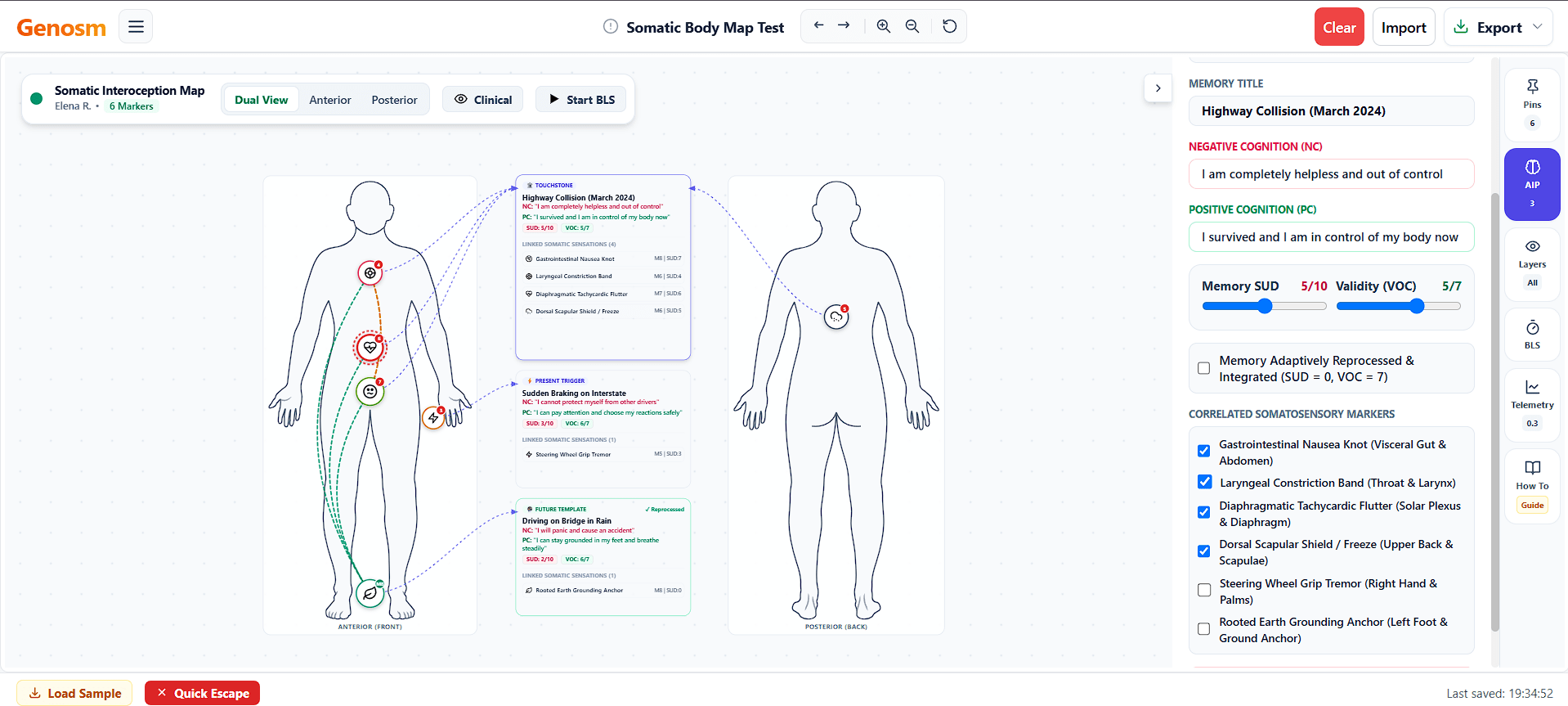
Genosm draws smooth green pendulation arcs between sympathetic/dorsal distress nodes and ventral resource anchors, helping clinicians visually guide titration and prevent nervous system flooding.
Sensation Migration Vectors
Gold Dashed ArrowAs trauma discharges, locked energy migrates across anatomical regions (e.g. an intense stomach knot dissolves and moves up to throat tension, before releasing through hand shaking and deep exhalation).
By selecting a "Previous Migrated Sensation," Genosm renders directional gold spline trajectories that map the exact pathway of somatic thawing across session stages.
Adaptive Information Processing (AIP) Memory Networks
In EMDR therapy, pathology is conceptualized as unprocessed, maladaptively stored memories. Genosm pairs the somatosensory body map with dedicated AIP Memory Target Cards:
3 Standardized AIP Memory Nodes
Foundational early life or acute traumatic incident establishing core negative belief.
Current daily stimuli triggering automatic somatic distress or hyperarousal spikes.
Anticipated future challenge formulated with adaptive positive cognition and grounded body state.
Interactive Node Dragging & Spline Connectivity
Clinicians can drag AIP target cards anywhere across the central formulation corridor. Adaptive mathematical splines link each memory card to its specific bodily markers. As reprocessing proceeds, clinicians adjust the SUD (0 to 10) and VOC (1 to 7) metrics, toggling the memory to "Reprocessed & Integrated" when complete.
Integrated Bilateral Stimulation (BLS) Visual & Audio Engine
Genosm provides a fully functional Bilateral Stimulation engine directly inside the diagram editor, eliminating the need for separate clicker or audio apps during remote or in-person sessions:
Fast Reprocessing Mode
Phase 4 DesensitizationRapid pacing (200 to 500 ms) designed for EMDR Phase 4 memory desensitization, dual attention stimulation, and associative somatic discharge.
Slow Installation Mode
Phase 5 AnchoringGentle, rhythmic pacing (1000 to 2000 ms) for positive cognition installation, somatic resource anchoring, and stabilization.
Stereo Web Audio API Integration
Clinicians can enable alternating Left / Right stereo audio chimes with customizable volume. Audio panning synchronizes in real time with the visual pacer dot rendered above the body silhouettes.
Real-Time Clinical Telemetry & Safety Safety Index
Genosm continuously calculates objective clinical metrics to monitor somatic activation and prevent emotional overwhelm:
Calculates aggregate distress weighted by physical magnitude and localized SUD.
Resource-to-Activation Ratio. Status flag alerts when ratio falls below 0.5x (Flooding Risk).
Synthesizes positive VOC increases, memory SUD reductions, and SDI normalization.
How to Build a Somatic Body Map in Genosm
Follow this five-step clinical procedure during intake evaluations, somatic tracking segments, or post-session documentation:
Pin Sensation Markers to Silhouette Landmarks
Click directly on the Anterior (Front) or Posterior (Back) silhouette. The pin automatically snaps to the closest anatomical region among the 24 standardized landmarks with precise coordinates.
Record SIBAM Channels & Intensity Scores
Select the sensation quality (e.g. Constriction, Thermal Heat, Tremor, Numbness). Record physical magnitude (1 to 10), distress SUD (0 to 10), tissue depth, motor urge, visual image fragment, affect, and cognitive belief.
Establish Ventral Resource Anchors & Pendulation Arcs
Identify a grounded ventral resource anchor (such as grounded feet or comforting warmth in hands). Connect distressed activation pins to this safe anchor using dual-pole pendulation arcs.
Link AIP Memory Targets & Trace Migration Trajectories
Create Touchstone Memories, Triggers, or Future Templates with Negative and Positive Cognitions. Link memory cards to their corresponding body pins, and trace sensation migration as tension discharges across sessions.
Export as SVG, JSON, Full Clinical Report, or Printable Manual Worksheet
After reviewing the calculated SDI and RAR metrics, choose the exact export format needed for your clinical workflow:
High-resolution vector graphic for EHR documentation, client portals, and multidisciplinary case presentations without quality loss.
Portable encrypted data file for local record archiving, longitudinal session comparison, and cross-device chart restoration.
Comprehensive formatted report compiling all 24 anatomical landmarks, SIBAM breakdowns, AIP target links, and objective telemetry for electronic health records.
Generate a clean, blank dual-silhouette somatic body map worksheet with sensation checkboxes for clients to draw, color-code, and fill out manually during in-person sessions.
Therapeutic Modalities & Clinical Populations
The Somatic Body Mapping tool adapts seamlessly across diverse clinical modalities and diagnostic presentations:
EMDR Therapy (Phases 3 to 8)
Identify somatic loci during Phase 3 assessment, run integrated bilateral stimulation during Phase 4 desensitization, and perform Phase 6 body scans to verify complete somatic clearance.
Somatic Experiencing & Sensorimotor
Guide titration and pendulation, track defensive motor impulses, and document involuntary nervous system discharge (tremors, thermal shifts, deep breathing).
Panic Disorder & Health Anxiety
Differentiate between physical magnitude (benign heart rate increase) and subjective distress (SUD panic), de-catastrophizing physiological symptoms through interoceptive exposure.
Complex Trauma & Dissociation
Help clients who struggle to verbalize emotions visually locate numbness, voids, and bracing, creating safety through grounded resource anchors before memory processing.
Pairing Somatic Body Maps with Sister Clinical Diagrams
Genosm provides a comprehensive suite of 14 clinical formulation tools. Clinicians frequently combine the Somatic Body Map with these related diagrams:
Window of Tolerance Chart Maker
Autonomic CurvesWhile Somatic Body Mapping captures the spatial anatomical location of sensations, the Window of Tolerance tracks arousal spikes over a continuous time axis. Pair both for comprehensive trauma tracking.
Polyvagal Ladder and Hierarchy Chart
Autonomic StatesConnect somatic pins directly to autonomic nervous system branches (Ventral Vagal safety, Sympathetic mobilization, or Dorsal Vagal shutdown).
Internal Family Systems (IFS) Parts Map
Parts LocalizationMap somatic body residency across protector parts (Managers, Firefighters) and exiled emotional burdens during the IFS 6 Fs unblending workflow.
100% Local-First Data Privacy and HIPAA Alignment
Somatosensory maps and trauma histories contain sensitive Protected Health Information (PHI). Generic cloud drawing tools store data on central databases where it is vulnerable to breaches and unauthorized analysis.
Genosm operates with a zero-storage, local-first architecture:
- All diagram calculations, sensation tracking, and SVG rendering occur directly inside your browser.
- Client names, trauma narratives, cognitive beliefs, and body markers are never sent to Genosm servers.
- Files are stored directly on your local device or encrypted browser storage (IndexedDB).
- Dedicated De-Identification toggle redacts names and identifiers for peer supervision and consultation.
Why Genosm Outperforms Generic Whiteboards & Paper
| Feature | Genosm | Generic Whiteboards (Miro/Lucid) | Paper Body Outlines |
|---|---|---|---|
| 24 Anatomical Regions | Dual Anterior & Posterior landmarks | Generic blank canvas | Static single sheet |
| SIBAM 5-Channel Tracking | Native SIBAM fields per pin | Manual unstructured sticky notes | Handwritten text margins |
| Pendulation & Migration Vectors | Automated dynamic splines | Manual disjointed arrows | Hand drawn lines |
| AIP Memory Target Cards | Integrated NC/PC, SUD, VOC nodes | No clinical memory structure | Separate clinical notes |
| Integrated BLS Engine | Fast/Slow presets + Web Audio chimes | No BLS integration | Physical tappers only |
| Real-Time Safety Telemetry | Automated SDI, RAR, and AIP-RM metrics | None | None |
| HIPAA & Zero PHI Retention | 100% Local-First (Zero Server PHI) | Third-party cloud storage risk | Physical paper loss risk |
| Exports, SVG, JSON & Worksheets | Export as SVG, JSON, print full clinical reports & blank worksheets to fill manually | Low-res PNG screenshots only | Requires manual scanning & filing |
Somatic Body Mapping Tool FAQ
What is Somatic Body Mapping in trauma therapy?
Somatic Body Mapping is a bottom-up clinical method used in Somatic Experiencing, Sensorimotor Psychotherapy, and EMDR. It helps clients locate, track, and externalize physical sensations (such as throat tightness, rapid cardiac flutter, or frozen numbness) on a human silhouette. This process builds interoceptive literacy and enables safe somatic titration during trauma reprocessing.
How does the SIBAM framework function in Genosm?
SIBAM stands for Sensation, Image, Behavior (Motor Impulse), Affect, and Meaning. Developed by Dr. Peter Levine, it represents the five holistic channels of human experience. In Genosm, each somatic pin records all five channels, helping clinicians track how visceral tension connects to visual memory fragments, defensive motor impulses, emotional affect, and cognitive core beliefs.
What are Dual-Pole Pendulation Arcs and Sensation Migration?
Pendulation is the clinical technique of guiding a client's attention between a point of traumatic distress and an established safe somatic resource anchor (such as grounded feet or gentle diaphragmatic warmth). Sensation migration traces how tension shifts and discharges across the nervous system as frozen trauma thaws during bottom-up processing.
How does Genosm integrate EMDR Adaptive Information Processing (AIP)?
Genosm allows clinicians to place unified AIP Memory Target cards (Touchstone Past Memories, Present Triggers, and Future Templates) on the canvas alongside the body silhouette. Therapists can document Negative Cognitions (NC), Positive Cognitions (PC), Subjective Units of Disturbance (SUD 0 to 10), and Validity of Cognition (VOC 1 to 7), with dynamic splines connecting memories directly to their somatosensory bodily markers.
What is the built-in Bilateral Stimulation (BLS) Engine?
Genosm features an integrated visual and audio Bilateral Stimulation engine with two clinical presets: Fast Reprocessing (200 to 500 ms for EMDR Phase 4 desensitization) and Slow Installation (1000 to 2000 ms for Phase 5 resource anchoring). It supports browser-based stereo audio chime panning (Left / Right) and a synchronized visual canvas pacer.
How does Genosm protect client health information on Somatic Body Maps?
Genosm is built on a 100% local-first, zero-storage architecture. All interoceptive pins, trauma narratives, client names, and memory cards are computed and stored directly inside your local web browser. No Protected Health Information (PHI) is ever transmitted to or stored on remote servers, providing complete HIPAA readiness.
What export formats are available for session notes and client handouts?
Genosm offers multiple flexible export options:
- Export as SVG: Scalable vector graphics suitable for embedding directly in electronic health records (EHRs) and clinical write-ups.
- Export as JSON: Complete client-side chart data file for local backups, data portability, and cross-device session tracking.
- Print Full Clinical Report: A structured clinical summary with patient identifiers, SIBAM channel breakdowns, and AIP memory targets ready for documentation.
- Print Blank Somatic Body Map Worksheet (Fill Manually): A standardized printable worksheet featuring front and back body outlines, sensation color legends, and SIBAM prompts for clients to draw and fill out manually during in-person intake and therapy sessions.