Clinical Origins: Functional Behavioral Analysis in Dialectical Behavior Therapy
Dialectical Behavior Therapy (DBT), developed by Dr. Marsha M. Linehan in 1993, is the gold-standard evidence-based psychotherapy for pervasive emotional dysregulation, Borderline Personality Disorder (BPD), chronic suicidality, and non-suicidal self-injury (NSSI). At the core of individual DBT psychotherapy is the Behavioral Chain Analysis, an intensive functional assessment protocol designed to uncover the precise psychobiological mechanism maintaining high-risk behaviors.
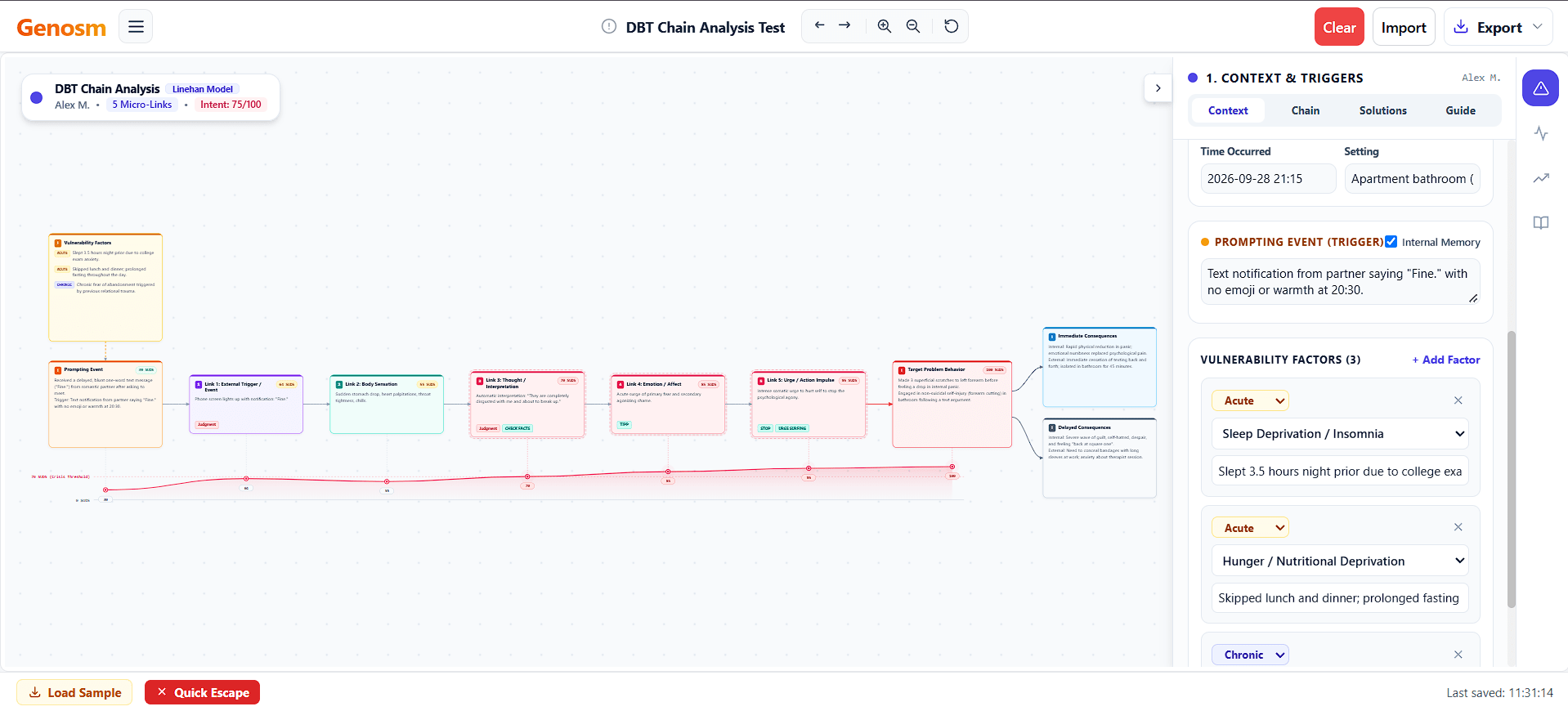
Rather than treating problem behaviors as unexplainable impulses, DBT chain analysis is grounded in behavioral psychology (Skinner's functional analysis and Kanfer & Saslow's S-O-R-C-K model). It operates on the clinical premise that every maladaptive action is part of a predictable cause-and-effect cascade:
- Vulnerability Factors: Biological, environmental, or interpersonal states that lower the threshold for emotional reactivity.
- Prompting Event: The specific environmental catalyst or internal memory that ignited the emotional surge.
- Micro-Chain Sequence: A fast-moving series of internal sensations, interpretations, affective surges, and behavioral urges.
- Target Problem Action: The maladaptive behavior executed to escape intolerable emotional tension.
- Functional Consequences: Immediate internal relief (negative reinforcement) that solidifies the behavior despite catastrophic delayed consequences.
By mapping this sequence visually, clinicians transform overwhelming crises into an orderly investigation. Clients develop non-judgmental awareness and recognize the exact moments where effective distress tolerance or emotion regulation skills could have altered the outcome.
Target Problem Behaviors & Prompting Events
In DBT individual sessions, clinicians follow a strict clinical priority hierarchy when selecting the target behavior for chain analysis. Genosm incorporates this exact hierarchy:
Priority 1: Life-Threatening Behaviors
- • Non-Suicidal Self-Injury (NSSI): Cutting, burning, hitting, or scratching
- • Suicidal Behavior / Crisis Action: Preparatory acts, means gathering, or gestures
- • Severe Acute Lethality Risk: Life-threatening crisis urges
Priority 2 & 3: Quality-of-Life Behaviors
- • Therapy-Interfering Behavior (TIB): Session avoidance, chronic lateness, silence
- • Substance Misuse / Relapse: Binge drinking, unauthorized medication use
- • Interpersonal Rage: Verbal attacks, property destruction
- • Eating Disordered Actions: Binging, purging, or severe restriction
- • Dissociative Shut Down: Prolonged non-responsive collapse
Deconstructing the Prompting Event (Trigger)
The prompting event is the catalyst that initiated the behavioral chain. In Genosm, clinicians record the exact objective occurrence and specify whether the trigger was an external environmental event (such as receiving a critical email or an interpersonal argument) or an internal intrusive memory (such as a trauma flashback or sudden autonomic panic).
Acute & Chronic Vulnerability Factor Profiling
A prompting event rarely causes a crisis in isolation; its impact is amplified by pre-existing vulnerability factors that deplete the client's emotion regulation capacity. Genosm provides standardized categorization across 8 major clinical domains:
The 6 Phenomenological Link Classifications
The heart of the chain is the second-by-second breakdown of internal experiences. In Genosm, every link is assigned a specific color-coded clinical category, short code, distress score, and optional judgment classification:
Body Sensation
Visceral physiological arousal, chest tightness, throat lump, nausea, hot flashes, or muscle rigidity.
Thought / Interpretation
Automatic internal dialogue, assumptions, catastrophic predictions, or cognitive rules.
Emotion / Affect
Subjective feeling state: shame, acute terror, grief, rage, emotional loneliness, or panic.
Urge / Action Impulse
Motivational urge to escape, self-harm, isolate, scream, run away, or use substances.
Overt Action / Step
Observable preparatory action: walking to bathroom, gathering materials, slamming doors.
External Event
Environmental shift or interpersonal statement occurring during the chain cascade.
Mindfulness Stance & Judgment Reframing
When a link represents a cognitive thought, therapists can toggle the Judgment checkbox and classify the cognition into one of four clinical stances: Judgmental Rule ("I am unlovable"), Unobserved Assumption ("They hate me"), Observable Fact ("They did not reply for 20 minutes"), or a Dialectical Reframe ("They are busy right now, and I am feeling anxious").
Integrated SUDS Distress Trajectory & The 70-SUDS Crisis Gate
A standout innovation in Genosm's DBT Chain Analysis module is the Integrated Clinical Distress Trajectory Monitor. As you assign Subjective Units of Distress (0 to 100 SUDS) to each link, Genosm dynamically renders a continuous linear distress curve directly beneath the chain cards:
In DBT theory, when emotional arousal exceeds 70 SUDS (The Crisis Gate), prefrontal cortical inhibition degrades rapidly. Complex verbal reasoning and interpersonal skills become inaccessible. Only rapid physiological distress tolerance skills (such as TIPP temperature shifts or STOP) can successfully interrupt the cascade.
Linehan DBT Skills Catalog & Inline Link Binding
Therapists can bind precise DBT coping skills directly to any link in the chain. Genosm embeds the complete 16-skill clinical catalog across all four DBT modules:
Distress Tolerance (Crisis Survival)
- • TIPP: Temperature (ice dive reflex), Intense exercise, Paced breathing, Paired muscle relaxation
- • STOP: Stop, Take a step back, Observe, Proceed mindfully
- • ACCEPTS: Wise Mind distraction (Activities, Contributing, Comparisons, Emotions, Pushing away, Thoughts, Sensations)
- • IMPROVE: Imagery, Meaning, Prayer, Relaxation, One thing, Vacation, Encouragement
- • Radical Acceptance: Turning suffering into ordinary pain without resistance
- • Pros & Cons: 4-quadrant balance sheet of tolerating vs acting on urges
Emotion Regulation & Mindfulness
- • Opposite Action: Deliberately execute the complete behavioral opposite of unjustified urges
- • Check the Facts: Separate objective reality from catastrophic interpretations
- • PLEASE Hygiene: Physical illness, Eating, Avoid drugs, Sleep, Exercise
- • DEAR MAN / FAST / GIVE: Assertive communication, self-respect, and relationship effectiveness
- • Wise Mind & Urge Surfing: Centered grounding and riding emotional waves to decay
Functional Consequences & Maintaining Reinforcers
A behavior cannot be extinguished without understanding the reinforcement function that maintains it. In DBT, self-harm and crisis behaviors are almost always maintained by negative reinforcement: the behavior produces an immediate, powerful drop in unbearable emotional pain, even while creating devastating long-term consequences.
Immediate Consequences (Short-Term)
Immediate Internal: Sudden emotional numbing, drop in panic, physical grounding, or release of tension (Negative Reinforcer).
Immediate External: Interpersonal conflict halted, partner stops demanding answers, retreat to private room.
Delayed Consequences (Long-Term Costs)
Delayed Internal: Severe rebound guilt, shame, self-loathing, demoralization, and reinforcement of helplessness.
Delayed External: Physical tissue injuries, medical visits, strained relational trust, hospitalizations.
Missing Link Diagnostic & The 4 Clinical Barrier Gates
When a client knows which DBT skill was needed but failed to use it, clinicians conduct a Missing Link Analysis. Genosm structures this assessment into four distinct barrier gates, each requiring a tailored clinical remedy:
Gate 1: Awareness Deficit (Did not know what skill to use)
Client lacked psychoeducation on which skill matched the specific link. Remedy: Direct skills training rehearsal in session.
Gate 2: Willingness Roadblock (Willfulness / Demoralization)
Client knew the skill but felt "Why should I bother?" or refused to engage. Remedy: Turning the Mind, Radical Acceptance, and Crisis Pros & Cons.
Gate 3: Prompting / Memory Failure (Skill did not cross mind)
Client was willing and capable, but the thought of using a skill never surfaced during the rapid emotional spike. Remedy: Visual lockscreen widgets, bathroom mirror reminder cues, or supportive peer check-ins.
Gate 4: Execution Barrier (Arousal > 80 SUDS)
Client attempted a cognitive skill (like Check the Facts) when emotional arousal was far too intense for verbal processing. Remedy: Mandatory physiological TIPP cold water dive reflex before any cognitive skill.
How to Construct a DBT Chain Analysis in Genosm
Follow this 5-step clinical workflow during individual DBT sessions:
Step 1: Define Target Behavior & Context
Open the Context tab. Select the behavior type from the priority hierarchy (NSSI, crisis action, substance misuse), set intent severity (0-100), log the exact observable action, and record session date and client initials.
Step 2: Log Prompting Event & Vulnerabilities
Record the exact triggering event or internal flashback memory. Click + Add Factor to document acute sleep deprivation, hunger, physical illness, or relational tensions present before the event.
Step 3: Build Sequential Micro-Links & SUDS Distress
Switch to the Chain tab. Add links sequentially. Classify each as Body Sensation (B), Thought (T), Emotion (E), Urge (U), Action (A), or External Event (X). Adjust the SUDS slider (0-100) on each card to generate the live distress curve.
Step 4: Bind DBT Coping Skills & Formulate Solutions
Select and bind skills from the dropdown (TIPP, STOP, Check the Facts) directly onto vulnerable link cards. In the Solutions tab, document the maintaining reinforcement type, Missing Link barrier gate, restitution repair plan, and PLEASE hygiene commitments.
Step 5: Export as SVG, JSON, EHR Note, or Print Worksheet
Export high-resolution vector SVG graphics, backup portable JSON files, copy auto-generated SOAP/BIRP/DAP narrative notes directly into your EHR, or generate a printable blank DBT chain worksheet for client homework.
Clinical Modalities & Targeted Populations
Comprehensive DBT Programs
Conduct weekly individual therapy chain analyses on diary card target behaviors, reviewing missing link barrier gates during supervision consultation teams.
Complex PTSD & Dissociation
Track somatic arousal spikes and dissociative freeze responses, connecting flashback triggers to physiological grounding and distress tolerance interventions.
Substance Use & Relapse Prevention
Deconstruct cravings and relapse episodes into environmental triggers, cognitive rationalizations, and physiological urges to build personalized urge-surfing plans.
Adolescent & Family DBT (DBT-A)
Engage adolescents and parents with visual, collaborative sequence cards that remove blame and highlight objective physiological and cognitive tipping points.
Pairing DBT Chain Analysis with Sister Clinical Diagrams
Genosm provides a comprehensive suite of 14 clinical formulation tools. Clinicians frequently combine the DBT Chain Analysis with these related diagrams:
Window of Tolerance Chart Maker
Autonomic ArousalWhile DBT Chain Analysis maps micro-link sequences and the 70-SUDS crisis gate, the Window of Tolerance tracks longitudinal autonomic arousal dysregulation across time.
Antecedent-Behavior-Consequence (ABC) Chart
Functional BehaviorUse ABC functional analysis for macro-level behavioral tracking and DBT Chain Analysis for deep micro-level crisis deconstruction.
Somatic Body Mapping Tool
Interoceptive SensationsLink DBT body sensation links (B) directly to anatomical body topography to deepen somatic interoception and TIPP effectiveness.
100% Local-First Data Privacy and HIPAA Alignment
DBT Chain Analyses document high-risk behaviors, self-harm incidents, and intimate emotional vulnerabilities. Storing this sensitive Protected Health Information (PHI) on third-party cloud servers introduces major legal and compliance risks.
Genosm operates with a zero-storage, local-first architecture:
- All chain sequencing, SUDS curve math, and SVG rendering occur entirely inside your web browser.
- Client initials, trauma narratives, and target behavior logs are never sent to Genosm servers.
- Charts are stored locally on your device or encrypted browser storage (IndexedDB).
- Built-in de-identification ensures safe presentation during clinical supervision and peer consultation teams.
Why Genosm Outperforms Generic Whiteboards & Paper
| Feature | Genosm | Generic Whiteboards (Miro/Lucid) | Paper Chain Worksheets |
|---|---|---|---|
| Sequential Micro-Chain Cards | Standardized 6 link types with reordering | Manual unstructured sticky notes | Handwritten text margins |
| SUDS Distress Trajectory Monitor | Live curve with 70-SUDS crisis pulsing pins | None | Static hand-drawn notes |
| Linehan DBT Skills Catalog | 16 standardized skills with 1-click binding | None | Requires manual lookup |
| Missing Link Diagnostic | 4-barrier gate diagnostic with remedies | None | Vague manual notes |
| Automated EHR Clinical Notes | 1-Click SOAP, BIRP, DAP generator | None | Requires manual re-typing |
| HIPAA & Zero PHI Retention | 100% Local-First (Zero Server PHI) | Cloud database security risk | Physical paper loss risk |
| Vector SVG, JSON & Printables | Export SVG, JSON, EHR reports & blank homework sheets | Low-res PNG screenshots only | Requires scanning & manual filing |
DBT Chain Analysis Tool FAQ
What is a DBT Chain Analysis in Dialectical Behavior Therapy?
A DBT Chain Analysis is a micro-level functional behavioral assessment developed by Dr. Marsha Linehan. It deconstructs a single episode of a target problem behavior (such as self-harm, emotional outbursts, or substance use) into a chronological second-by-second sequence of vulnerability factors, prompting events, bodily sensations, thoughts, emotions, and behavioral urges. This helps clients pinpoint the exact moments where effective coping skills could have broken the chain.
How does the Integrated SUDS Distress Trajectory Monitor work?
In Genosm, each link in the chain contains an interactive Subjective Units of Distress (SUDS) slider from 0 to 100. The editor automatically plots a continuous linear distress curve with shaded area under the curve, vertical anchor drop-lines, and glowing red pulse markers at or above 70 SUDS. This visually demonstrates the physiological tipping point where emotional arousal overwhelms cognitive reasoning and demands crisis survival skills.
What is the Missing Link Analysis diagnostic framework in Genosm?
Missing Link Analysis is a diagnostic tool used when a client knew a DBT skill was needed but failed to use it effectively. Genosm categorizes skill breakdown across four clinical barrier gates: 1) Awareness (did not know which skill applied), 2) Willingness (demoralization or willfulness), 3) Prompting/Memory (skill did not cross mind during crisis), or 4) Execution Barrier (emotional arousal exceeded 80 SUDS, blocking complex skills). The software helps clinicians assign specific remedies for each barrier.
Which DBT skills are included in the Genosm catalog?
Genosm includes full clinical descriptions for 16 core DBT skills spanning all four standard Linehan modules: Distress Tolerance (TIPP, STOP, ACCEPTS, IMPROVE, Radical Acceptance, Crisis Pros and Cons, 5-Sense Self-Soothing), Emotion Regulation (Opposite Action, Check the Facts, PLEASE Hygiene, Accumulating Positives), Interpersonal Effectiveness (DEAR MAN, GIVE, FAST), and Core Mindfulness (Wise Mind Grounding, Non-Judgmental Stance, Urge Surfing).
How does Genosm support EHR documentation and progress notes?
Genosm features an automated clinical note formatter that converts your visual chain analysis into structured SOAP, BIRP, or DAP progress notes with a single click. Clinicians can copy the synthesized note directly into their EHR (such as SimplePractice, TherapyNotes, or Epic) without manual re-typing.
How does Genosm protect client health information during chain analyses?
Genosm operates on a strict zero-storage, local-first architecture. All chain analysis calculations, client identifiers, trauma details, and session notes are processed entirely within your local browser. No Protected Health Information (PHI) is ever transmitted to or stored on remote servers, providing seamless HIPAA alignment.
What export formats are available for session handouts and EHR files?
Clinicians can export lossless vector SVG graphics for crisp documentation, download portable JSON files for local backup and reload, generate prefilled clinical formulation reports, and print standardized blank DBT chain analysis worksheets for clients to complete by hand during homework assignments.