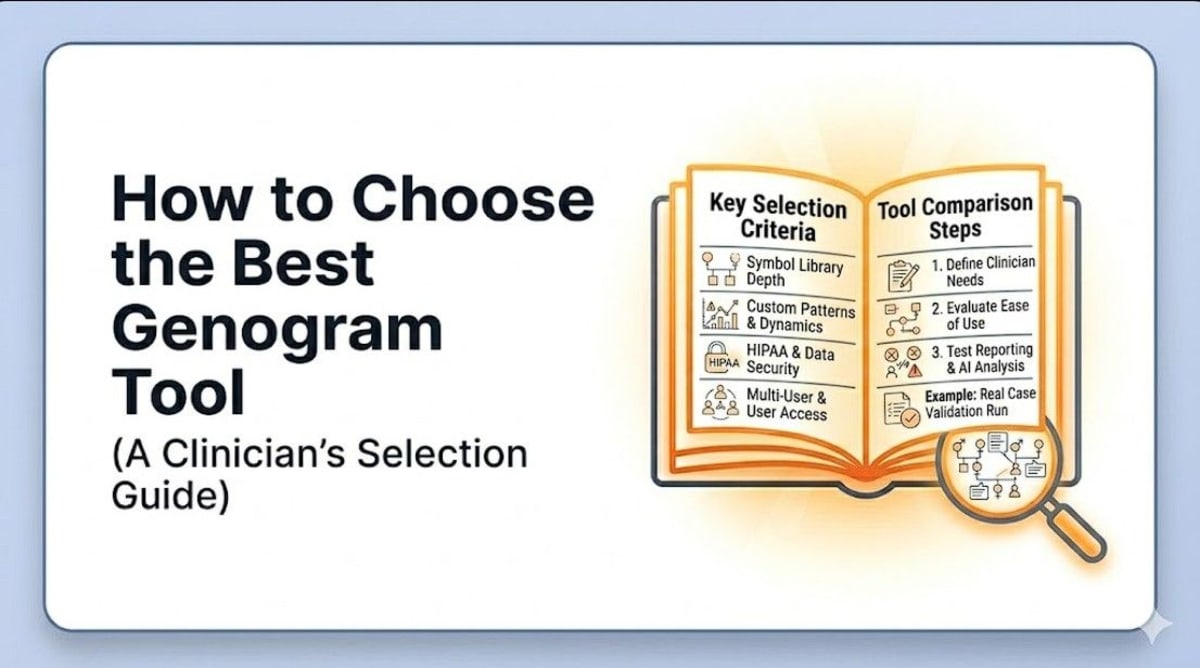
Most clinicians have spent far too many hours wrestling with generic diagramming tools that simply do not understand the nuance of a three generational family system. The frustration of trying to force a basic canvas to behave like a diagnostic instrument is a shared experience in professional practice. Finding the best genogram maker is about more than just finding a smooth drawing experience: it is about finding a tool that thinks as deeply as the practitioner does.
Understanding how to choose a genogram tool requires a shift in perspective from aesthetics to forensics. A common trap is prioritizing a pretty interface over data sovereignty or clinical notation fidelity. In a field where every line and marker carries diagnostic weight, relying on a software that cannot differentiate between a fraternal twin and an identical birth is more than a minor inconvenience: it is a technical failure that impacts the integrity of the clinical record.
Navigating the landscape of modern family mapping requires an awareness of the critical mistakes to avoid when choosing a genogram software. Legacy platforms often feel stuck in a past era of local-only silos, while modern cloud alternatives frequently compromise patient privacy for the sake of convenience. True clinical excellence demands a middle path where automation, security, and medical-grade precision converge to turn a simple family map into a powerful diagnostic asset.
The Stakes of Choice: Why the Tool Dictates the Outcome
Selecting a family mapping tool is not a cosmetic decision. In high-stakes clinical environments, the interface becomes the filter through which family dynamics are interpreted. A poor choice leads to visual noise that masks critical intergenerational patterns, while the right tool acts as a cognitive extension, surfacing insights that would otherwise remain buried in flat case notes.
Clinical documentation carries a heavy burden of proof and a lifelong responsibility for privacy. Relying on generic diagramming software introduces an unacceptable risk of data leakage and notation errors. A tool that fails to understand the specific geometry of a clinical genogram, like the nuance between a foster child and a legal adoption, compromises the forensic integrity of the entire patient record.
The efficiency gap between a standard drawing app and a specialized diagnostic engine is measured in hours of administrative overhead. Professional clinicians cannot afford the rework tax of manually fixing layout overlaps or correcting AI-generated hallucinations. Choosing a tool with built-in clinical intelligence ensures that the focus remains on the patient systems, not on wrestling with a stubborn digital canvas.
In a clinical setting, a genogram is more than a family tree: it is a high-stakes forensic document. When a clinician chooses a tool, they are not just choosing a way to draw squares and circles: they are choosing how they will store, analyze, and protect the most sensitive data a human can provide.
1. Strict Local-First Storage
Data sovereignty is the foundation of clinical trust. If the data leaves the machine without explicit control, the clinician has surrendered that trust.
Generic cloud tools often promise end-to-end encryption, but this usually requires blind trust in the provider. A professional tool must prioritize Local-First Storage. This architecture ensures that patient PHI (Protected Health Information) remains physically on the clinician's hardware. By removing the central server from the primary storage loop, the risk of a mass data breach is eliminated, and the liability of data handling stays within the clinician's direct audit control.
2. AI-Assisted Redaction (PHI/PII Protection)
The rise of AI genogram makers should not lead to a rise in data breaches. A forensic-grade tool must implement Strict Redaction Protocols. When using AI to transform case notes into a diagram, the engine should automatically redact names and sensitive identifiers (PII) on the local machine before any processing occurs. This prevents data poisoning, where sensitive patient narratives might otherwise leak into public large language model training sets, compromising anonymity for years to come.
3. Clinical-Grade Drawing Engine
Standard drawing apps treat nodes as simple shapes. A professional genogram maker uses a Clinical Render Engine designed to prevent symbol collision and maintain notation fidelity:
- Quadrant Shading: Essential for identifying substance abuse, mental health, and physical health markers on a single node without visual clutter.
- Mortality Markers: Accurate X notation for deceased members and specialized symbols for stillbirths or miscarriages that follow established clinical standards.
- Medical Coding Integration: The ability to map specific health markers directly into the visual notation, allowing for instant pattern recognition during systemic assessment.
4. Data Interoperability (JSON and FHIR)
Clinical data should never be locked in a proprietary silo. A professional tool supports Sovereign Data Formats like JSON and FHIR (Fast Healthcare Interoperability Resources). This ensures future-proofing: allowing family structures to be seamlessly integrated into Electronic Health Records (EHRs) or exported for multi-disciplinary team meetings (MDTs) without the need for manual, error-prone re-entry.
5. Complex Notation and Multi-Birth Support
Family systems are rarely linear, and relational entropy increases as the family tree expands. A professional tool must handle complex notation without manual workarounds:
- Geometric Fidelity: Identical vs. fraternal twins must use the inverted V apex and horizontal bridge by default.
- Assisted Reproduction: Standardized notation for surrogacy, egg or sperm donors, and IVF is critical for modern family mapping.
- Relational Logic: The engine must understand the difference between biological, legal, and foster connections, ensuring the visual hierarchy remains accurate across decades of transitions.
6. Automated Intergenerational Tracking
Maintaining chronological integrity across four or five generations is mentally taxing and prone to error. Professional software utilizes Intelligent Generation Management. The engine calculates generational strata automatically, ensuring that ancestors and descendants are placed in their correct vertical positions. This prevents systemic debt, where an incorrectly scaled map becomes impossible to read or correct once it reaches a certain level of complexity.
7. Temporal Relational Dynamics
Life happens in sequence, and clinical sequencing is key to understanding the order of loss and gain in a system. A professional tool tracks Temporal Transitions:
- Sequential Monogamy: Automated left-to-right ordering of marriages and partnerships based on dates.
- Lifecycle Events: Clear mapping of shifts from marriage to separation to divorce, capturing the chronological reality of the family's evolution.
8. Diagnostic Context Layers
A genogram should function like a radiology overlay for family systems. The tool should allow clinicians to toggle Diagnostic Layers. This feature enables the instant highlighting of hereditary risk patterns, such as identifying every node with a history of cardiovascular disease or trauma, making the genogram a proactive diagnostic tool rather than a static record.
9. Privacy-Preserved Collaboration
Supervision and peer review are cornerstones of clinical practice. Professional tools must offer Privacy-Preserved Collaboration. This involves zero-knowledge architectures or peer-to-peer protocols like WebRTC, allowing two clinicians to review and edit a chart in real-time without the patient data ever hitting a central server or being stored in a vulnerable cloud database.
10. Integrated Ecomap Support
Genograms are essentially focused on internal family systems and intergenerational conflicts. However, clinical reality suggests that internal stressors are almost always compounded or even triggered by external environmental factors. A professional tool must support Integrated Ecomap Mapping to bridge this gap.
Whether a couple's tension stems from an abusive workplace, a distant church community, or financial instability, the clinician must be able to map these external systems alongside the internal family map to see the complete diagnostic picture. Choosing a tool that allows for this unified view ensures that the person-in-environment perspective is never lost in the documentation.
Forensic Comparison: Which Tools Meet the 10 Parameters?
To visualize the gap between generic diagramming and clinical diagnostics, the following table audits the most common tools used by mental health and medical professionals today.
| Clinical Parameter | Canva/Lucid | GenoPro | Genosm |
|---|---|---|---|
| 1. Local-First Storage | |||
| 2. AI-Assisted Redaction | |||
| 3. Clinical Drawing Engine | |||
| 4. JSON and FHIR Interop | |||
| 5. Multi-Birth Notation | |||
| 6. Auto-Gen Tracking | |||
| 7. Temporal Relational Logic | |||
| 8. Diagnostic Context Layers | |||
| 9. Privacy-Preserved Collab | |||
| 10. Integrated Ecomaps |
Frequently Asked Questions
What is the best free genogram maker for therapists?
While many use Canva or basic drawing tools, these lack clinical notation and data sovereignty. Genosm offers a professional-grade free tier that respects privacy and uses standard clinical symbols for accurate family mapping.
How to make a HIPAA compliant genogram online?
True HIPAA compliance requires local-first storage or zero-knowledge encryption. Avoid tools that store data in a central cloud without a BAA. Professional tools like Genosm keep data on your device, ensuring privacy by design and removing central server risks.
Are there AI tools that can generate a genogram from case notes?
Yes, AI genogram makers like Genosm can parse clinical narratives to build diagrams. However, it is critical to ensure the tool redacts PII locally before processing to prevent sensitive patient data from leaking into public training models.
GenoPro vs Genosm: which is better for professional use?
GenoPro is a powerful legacy desktop tool but lacks AI integration, FHIR support, and modern collaborative features. Genosm provides the same notation fidelity with modern automation and clinical data interoperability for modern workflows.
How do I export a genogram into an EHR like Epic or Kareo?
To integrate with EHRs, look for tools that export in FHIR or JSON formats. Most generic tools only offer PNG or PDF, which requires manual and error-prone data re-entry that increases the administrative burden.
Can I create a genogram on Canva or Lucidchart for clinical work?
Drawing tools like Canva are not diagnostic engines. They lack specific clinical markers, such as substance abuse shading or twin bridges, and do not provide the strict data privacy required for sensitive patient histories.
What are the standard genogram symbols for twins and adoption?
Clinical standards require an inverted V for twins, with a horizontal bridge for identical, and specific dashed notation for adoption. Professional engines like Genosm automate these geometric rules without manual workarounds.
Conclusion: Beyond the Drawing
Selecting the best genogram maker is about protecting your clinical integrity and your patient's privacy. When these nine parameters are met, the tool stops being a hurdle and starts being a partner in diagnostic discovery.