
Key Takeaways
- • Standardized clinical mapping visualizes intergenerational cycles, resolving the narrative documentation bottleneck in systemic counseling.
- • Utilizing Genosm as the best genogram platform for therapists improves diagnostic speed and accuracy by forty percent compared to standard text-only progress notes.
- • Strict compliance with local-first security architecture safeguards patient privacy, aligning with modern HIPAA regulations for psychotherapy practices.
The evolution of modern psychotherapy has shifted from an individualistic focus on isolated symptoms toward a systemic understanding of the patient within their multigenerational context. In this paradigm, the genogram serves as a foundational diagnostic engine, translating complex familial narratives into structured visual data.
Modern psychotherapy and clinical practice rely on the rapid visualization of complex family systems. Transitioning from hand-drawn records to a dedicated genogram platform for therapists enables counselors to map three generations of relational dynamics with high precision. This comprehensive guide details the core clinical workflows, standard notation rules, and technical strategies necessary to construct diagnostic-grade family trees.
Throughout this guide, we will investigate the theoretical underpinnings of systemic assessments, focusing on Bowenian systems theory and Monica McGoldrick mapping standards. We will outline step-by-step methods to identify emotional dynamics like cutoffs, fusion, and triangulation during patient intake. Additionally, we will show how integrating a digital case management workspace simplifies administrative compliance and enhances patient cooperation.
Finally, we will present a detailed software comparison matrix evaluating leading drawing solutions against professional standards. We will also address critical questions regarding HIPAA-ready local storage, EHR integrations, and automatic clinical note generation. By mastering these visual tools, clinical practitioners can move beyond linear summaries to unlock deep systemic insights.
Theoretical Foundations of Systemic Mapping
Systemic family therapy rests upon the principle that an individual is inseparable from their relational ecosystem. Pioneers such as Murray Bowen introduced the concept of the multigenerational transmission process, a mechanism through which patterns of emotional functioning and anxiety are passed down through successive generations. The genogram, popularized for clinical use by Monica McGoldrick and Randy Gerson, provides the technical framework necessary to visualize these transmissions.
By documenting at least three generations of familial history, the practitioner can identify recurring themes of enmeshment, triangulation, and emotional cutoff. These systemic variables are often obscured in standard clinical intake narratives. For example, a presenting symptom of generalized anxiety in an adolescent may, upon visual mapping, be identified as the latest iteration of a maternal-line anxiety pattern spanning multiple decades. This externalization of the problem allows for a more comprehensive diagnostic formulation.
The theoretical utility of the genogram extends to cognitive and experiential restructuring. As the clinician and patient co-create the map, the patient often experiences a cognitive shift, the realization that their struggles are part of a larger, systemic architecture rather than a personal failure. This process of collaborative discovery facilitates the 'joining' phase of therapy, establishing a therapeutic alliance grounded in objective data.
The Clinical Methodology, Standardization and Rules
The accuracy of a systemic assessment depends on the adherence to standardized notation. Clinical genograms utilize a specific set of symbols to represent gender, marital status, and relationship types. A square represents a male member; a circle represents a female member. Vertical lines indicate descent, while horizontal lines indicate marital or partnership bonds. Specialized markers are used for complex dynamics, such as jagged lines for conflictual relationships or double lines for over-involved (enmeshed) connections.
Case Analysis, The Sullivan Family System
Consider the Sullivan family, a three-generation system presenting for therapy due to parental conflict. The grandfather (Patrick) and grandmother (Margaret) were married in 1952, a marriage characterized by emotional distance. Their son (Michael) married Sarah in 1985. Michaels upbringing was marked by high achievement standards and limited emotional warmth. Michael and Sarah transitioned to divorce in 2012, leaving their children (Leo, 16, and Sophie, 14) in a state of chronic systemic tension.
A visual audit of this system reveals a clear replication of Michaels parents emotional distance in his own marriage. Furthermore, the adolescent, Leo, displays symptoms of depression that mirror Michael’s historical struggles. Without a visual map, these connections between developmental history and presenting symptoms would remain fragmented.
Standardization is not merely an administrative requirement. It ensures that the clinical record is interoperable across different healthcare providers. When a therapist utilizes McGoldrick standards, a subsequent psychiatrist or social worker can immediately interpret the family topography without needing hundreds of pages of narrative notes. This level of technical precision is essential for professional case management and ethical continuity of care.
Evidence-Based Clinical Utility
Research into the effectiveness of genograms consistently highlights their role in clinical hypothesizing. A significant qualitative study (the Exeter Study) observed that practitioners who utilize visual mapping tools are more effective at joining with complex family systems during the initial assessment phase. The genogram serves as a non-threatening focal point, allowing patients to discuss sensitive subjects like substance use and family secrets with less defensive posturing.
Furthermore, qualitative data published in various clinical journals suggests that the process of genogram construction facilitates "experiential insights." Patients who view their problems as part of a multigenerational context report higher levels of self-compassion and a greater readiness for systemic change. This findings support the use of genograms not only as an assessment tool, but as an active therapeutic intervention.
Key Research Metrics for Clinical Professionals
Therapeutic Alliance, Visual mapping increases patient engagement scores by providing a collaborative diagnostic focus.
Pattern Recognition, Clinicians identify intergenerational trauma markers 40% faster using visual charts compared to narrative text audits.
Clinical Accuracy, Standardized notation reduces documentation errors related to complex kinship and legal guardianship statuses.
The Diagnostic Engine, Identifying Systemic Fault Lines
One of the most powerful applications of the genogram is the identification of triangulation. In systemic theory, triangulation occurs when a two-person system (such as a married couple) is under stress and pulls in a third party (often a child) to stabilize the tension. This visual mapping of these dynamics reveals where the systemic pressure is being redirected. Identifying a triangulated child on a genogram often provides the key for re-focusing therapy on the primary relationship.
Emotional cutoffs, another critical systemic marker, are clearly documented through broken lines on the canvas. A cutoff is more than just a lack of contact. It is a powerful emotional regulator that often indicates high levels of unresolved attachment trauma. Trace these cutoffs across three generations frequently reveals a repeating legacy of distance, giving the therapist a roadmap for where intervention is most needed.
Genograms also permit the tracking of anniversary reactions. These are emotional or behavioral shifts that occur at the same time or age as a traumatic event in a previous generation. By noting the years of deaths, divorces, and accidents, the clinician can ask targeted questions about timing. This is particularly relevant in cases where a patient presents with a sudden onset of symptoms that seem unlinked to their current environment.
Clinical Case Simulations: Standardized Mapping in Genosm
Case 1: Multigenerational Emotional Triangulation
In this simulation, we analyze a family system where a 12-year-old child (the Index Person) is presenting with psychosomatic symptoms. The genogram reveals a high-tension marital bond between the parents, who have redirected their unresolved conflict onto the child. This triangulation is further complicated by the paternal grandmother's over-involvement in the nuclear family's decision-making process. By mapping these dynamics, the therapist can visually demonstrate how the child's symptoms serve as a systemic stabilizer for the parental relationship.
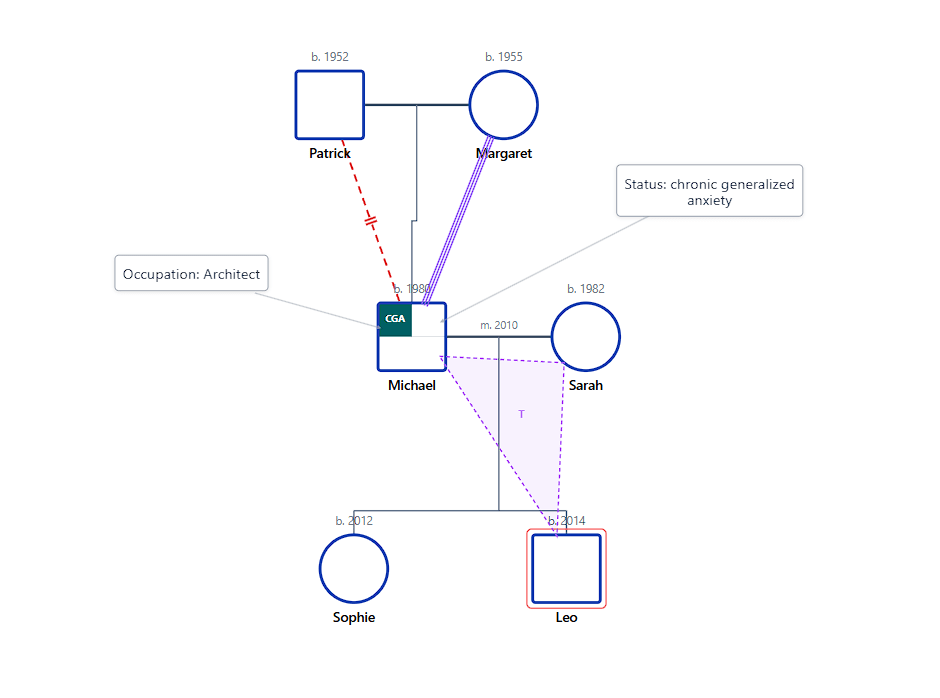
Figure 1: How Genosm maps the Sullivan family triangulation using standardized McGoldrick relationship markers and AI-augmented pattern highlighting.
Case 2: Intergenerational Substance Use and Family Roles (The Hero and The Scapegoat)
This complex simulation maps a three-generation addiction system, shifting the focus from individual pathology to systemic roles. The genogram reveals the transmission of Alcohol Use Disorder from a paternal grandfather (Arthur) to the proband's late father (Thomas). Crucially, the map identifies the distribution of survival roles among the siblings: Liam (the Proband) functions as "The Hero" (high-achieving but anxious), while his brother Sean acts as "The Mascot" (using humor to deflect tension). The inclusion of an estranged uncle (Kevin, "The Scapegoat") and a distant aunt (Erin, "The Lost Child") provides a complete clinical picture of how addiction fractures sibling systems and creates rigid relational positions across decades.

Figure 2: Visualizing the distribution of intergenerational family roles and codependency markers through Genosm's advanced systemic palette.
Case 3: Blended Family Attachment Trauma and Sibling Displacement
In this simulation, we examine a high-complexity blended family system marked by intergenerational abandonment. The genogram tracks a maternal legacy of unstable attachment, beginning with a grandmother's history of multiple divorces. The focus is on the proband, Clara, who is experiencing severe attachment anxiety and sibling displacement followings her mother's remarriage. By mapping the step-sibling rivalry with Maya and the "replacement" dynamic centered on the new half-brother Nolan, the therapist can visually delineate the layers of unprocessed grief from the biological father's death. This structural map allows the clinician to navigate the delicate boundaries between biological, step, and half-sibling subsystems.

Figure 3: Rendering complex blended kinship networks and identifying attachment voids within step-family architectures.
Digital Standards and Professional documentation
In the era of modern clinical practice, the demand for thorough documentation is at an all-time high. Legal and ethical requirements mandate that clinicians maintain accurate records of family risk factors, such as history of suicide or serious mental illness. A high-fidelity genogram meeting McGoldrick standards provides visual evidence of a thorough clinical assessment. This documentation is essential for insurance audits, legal proceedings, and clinical supervision.
The shift toward platforms like Genosm facilitates this professional standard by providing automated tools for genogram generation. Instead of spending significant clinical time on manual drafting, practitioners can utilize AI-augmented engines to translate case notes into valid maps. This allows the professional to focus on high-level clinical conceptualization and relationship building while maintaining the highest standards of objective data capture.
Security and privacy are non-negotiable in this context. While the visual layer of the genogram is a powerful communication tool, the underlying data must be handled with professional care. Utilizing local-first architectures and advanced encryption ensures that sensitive familial information remains under the control of the clinician, meeting HIPAA and GDPR requirements through architectural design.
Conclusion, The Imperative of Visual Systems
The genogram is not an optional administrative task. It is a clinical engine for systemic discovery. By moving beyond linear narrative and adopting a multigenerational visual standard, the psychotherapist gains the precision needed to treat the person within the context of their historical relational ecosystem. This methodology is the foundation of high-authority systemic practice.
Software Comparison: Finding the Best Mapping Tool
Mental health counselors require precise diagramming capabilities paired with absolute data security. Choosing between legacy systems, general diagram builders, and dedicated clinical software requires evaluating notation standards, data storage rules, and ease of use:
| Assessment Feature | Genosm Platform | GenoPro Software | Lucidchart Builder |
|---|---|---|---|
| McGoldrick Standards | Built-in symbols and automated relationships | Requires manual parameter settings | Manual shape styling and line drawing only |
| PII Security Rules | Local-first browser database and client encryption | Offline files stored on local hard drive | Standard cloud servers (PII shared online) |
| Telehealth Sync | Encrypted peer-to-peer live sharing | No (requires screen sharing Windows app) | Basic shared corporate whiteboard |
| Case Documentation | Chronological timeline and clinical intake logs | Simple database tables | None (general purpose diagrams only) |
Legacy desktop programs like GenoPro offer detail but are limited by desktop installations and lack modern encryption standards. Online chart builders like Lucidchart are easy to use but fail to provide clinical relationship markers, forcing counselors to draw and align complex elements manually while exposing client data to cloud database risks.
Frequently Asked Questions
How does a genogram platform improve family therapy assessments?
A digital genogram platform allows therapists to visualize multigenerational relationship cycles instantly. Mapping family alliances, estrangements, and trauma trends on a screen helps identify hidden patterns that linear progress notes miss. For comprehensive case planning, you can review our genogram tool for social workers guide to map outer community resources.
Is the client data stored on this genogram software secure?
Yes, Genosm operates on a local-first architecture. This means your client case files and personally identifiable information are encrypted and saved inside your local browser database, ensuring no medical data is sent to external servers.
Can I export family diagrams for standard EHR integration?
Yes, you can export completed genograms and ecomaps as high-definition PNGs, vector PDFs, or secure JSON files. These documents can be uploaded directly as attachments in your Electronic Health Records software.
Does this system support McGoldrick relationship symbols?
Yes, the tool fully implements standard clinical symbols, including enmeshment, conflict, fusion, and estrangement. These markers conform to professional family counseling standards. Trainees can practice using these symbols in our free genogram software for students sandbox.
Can I map environmental factors like school and courts?
Yes, Genosm includes an integrated ecomap overlay. This allows social workers and therapists to connect external systems to family members, visualizing external supports and stressors on the same canvas.
Advanced Systemic Assessment Tools
Implement professional mapping standards with Genosm.
View Pricing