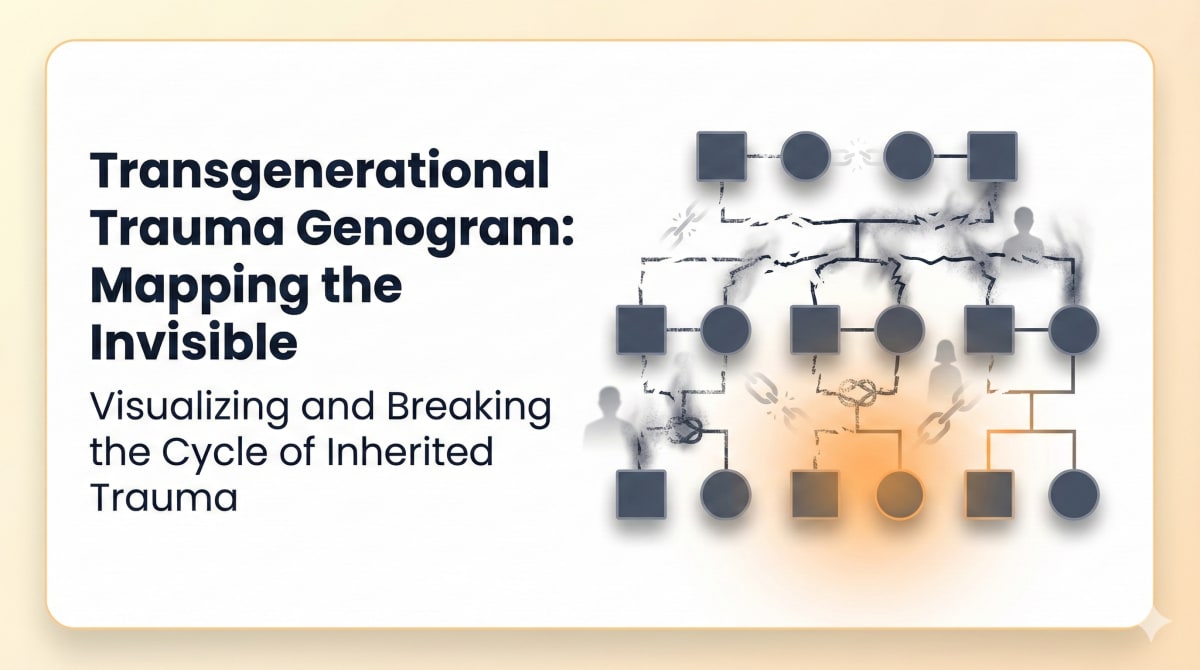
As a clinician, you’ve encountered it. A client presents with anxiety, depression, or relationship struggles that seem to defy traditional explanation. Their own life history doesn’t fully account for the depth of their pain. You sense the echoes of unspoken stories, of events that occurred long before they were born. This is the shadow of intergenerational trauma.
But how do you make these invisible wounds visible? How do you help a client see the patterns they are unknowingly living out? While narrative therapy is powerful, words alone can sometimes fail to capture the systemic nature of family trauma. You need a map.
This is where the clinical genogram transforms from a simple family tree into an essential tool for trauma therapy. A well-crafted trauma-informed genogram doesn’t just show who is related to whom; it reveals the emotional and psychological legacy passed down through generations. It makes the abstract concept of "family trauma" a concrete, visible artifact that you and your client can explore together.
In this guide, we will walk you through the step-by-step process of using genograms for trauma mapping. You will learn how to identify the signs of transgenerational trauma, what questions to ask, and how to use a tool like Genosm to create a clinical map that illuminates pathways to healing by following standard genogram rules.
Table of Contents
What is Transgenerational (or Intergenerational) Trauma?
Intergenerational trauma (also known as transgenerational trauma) is a psychological concept that suggests trauma can be transferred from one generation of survivors to the next. The descendants of people who have experienced profound trauma can exhibit symptoms and behaviors of trauma, even if they have not experienced the traumatic event themselves.
This isn't about memories being passed down, but about the transmission of unresolved emotional states, coping mechanisms, and relational patterns. Imagine a grandparent who survived a war but never spoke of it. Their resulting hypervigilance, emotional unavailability, or unresolved grief doesn't just disappear. It shapes their parenting style, which in turn shapes their children's development, and so on. The original trauma echoes through the family system.
How is Trauma Transmitted?
The transmission happens through a complex interplay of psychological, behavioral, and even biological mechanisms. Research in epigenetics, notably by experts like Dr. Rachel Yehuda at Mount Sinai, suggests that traumatic experiences can leave a chemical mark on a person's genes, which can then be passed down, potentially influencing their children's stress response.
Common sources of trauma that can become intergenerational include:
- Systemic oppression (e.g., racism, colonialism)
- War, genocide, or political violence
- Forced migration or displacement
- Childhood abuse (physical, emotional, or sexual) and neglect
- Sudden or traumatic loss of a family member
- Severe poverty or economic hardship
Understanding the answer to "what is intergenerational trauma" is the first step. The next is learning to recognize its subtle but powerful influence on the families you work with.
The Signs: How Intergenerational Trauma Manifests
The signs of transgenerational trauma are often subtle and can be mistaken for individual pathologies. A client may not have a narrative of trauma, but their body and their relationships tell a different story. As Bessel van der Kolk famously stated in "The Body Keeps the Score," the legacy of trauma is held in our physical and emotional being.
Here are common clinical indicators that may point to an underlying current of intergenerational trauma:
Dysfunctional Attachment Patterns
Clients may present with anxious or avoidant attachment styles that don't seem to originate from their direct relationship with their parents, pointing to a legacy of insecure attachment passed down from caregivers who were themselves affected by trauma.
Emotional Dysregulation
Heightened anxiety, a persistent sense of dread, or difficulty managing anger can be inherited coping mechanisms from a family system that lived in a constant state of threat.
Unexplained Physical Symptoms
Chronic pain, autoimmune disorders, or other somatic symptoms without a clear medical cause can be physical manifestations of inherited stress, a concept explored deeply in programs like the Sensorimotor Psychotherapy Institute.
A Sense of Foreshortened Future
A client may struggle to set long-term goals or imagine a future for themselves, reflecting a survivalist mindset inherited from ancestors whose futures were genuinely uncertain or perilous.
Mapping Trauma: A Clinician's Toolkit
Once you suspect the influence of intergenerational trauma, the next step is to make it visible. Trauma mapping is a process of externalizing the family's story into a tangible form. While several tools can aid in this process, they each offer a different lens.
Other Mapping Methods
- Timelines: Useful for tracking a sequence of events and their temporal relationship to symptoms, but can miss systemic patterns.
- Narrative Diagrams: Excellent for exploring a client's personal story and meaning-making, but less structured for family-wide analysis.
- Ecomaps: Powerful for showing external stressors and supports, but they don't map the internal family dynamics where trauma is often passed down.
Why the Genogram Excels
The genogram is uniquely suited for intergenerational trauma work because it was designed from the ground up to map family systems. Drawing from Murray Bowen's Family Systems Theory, it does what other tools cannot: it simultaneously displays structure, relationships, and behavioral patterns across generations.
A trauma-informed genogram allows you to layer clinical data over a family structure, revealing, for example, how a grandfather's wartime PTSD (a traumatic event) led to a "conflicted" relationship with his son (an emotional pattern), who then developed a substance abuse issue (a coping mechanism) and an "enmeshed" relationship with his own daughter, your client. This ability to visually link event, emotion, and behavior across time is what makes the genogram the gold standard for trauma mapping.
Why Genograms are Essential for Trauma Work
To effectively treat intergenerational trauma, you need a tool that thinks systemically. Trauma is not an isolated event; it's a disruption that ripples through a family's entire emotional and relational ecosystem. The genogram is purpose-built to map this ecosystem.
Unlike any other tool, a genogram allows you to layer multiple dimensions of data onto a single, coherent map. You can visualize:
- Family Structure: The basic biological and legal relationships.
- Emotional Relationships: The quality of the bonds—close, conflicted, distant, abusive—pioneered by Monica McGoldrick. Using standardized emotional connection lines is essential here.
- Behavioral Patterns: The recurrence of issues like substance abuse, domestic violence, or specific coping mechanisms.
- Significant Life Events: The historical context of migrations, sudden losses, and major traumatic incidents.
This multi-layered view is critical. It helps you and your client move from "What's wrong with me?" to "What happened to us?" This shift in perspective is often the first step toward healing, as it externalizes the problem and reduces individual shame.
Genosm: An Integrated Platform for Trauma-Informed Care
While a hand-drawn genogram is powerful, a digital tool designed for clinicians elevates the practice. Genosm isn't just a drawing tool; it's a clinical workspace for deep, long-term trauma work.
Integrated Genograms & Ecomaps
Seamlessly switch between the internal family system (genogram) and the external support system (ecomap) on one canvas to get a complete person-in-environment picture.
Structured Note-Taking
Link your visual map directly to clinical documentation. Genosm includes built-in templates for SOAP, DAP, and standard Progress Notes, keeping your insights organized and secure.
Case Versioning & Timelines
Trauma work is a long-term process. With the versioning feature, you can save snapshots of a genogram over time, creating a visual timeline of a family's healing journey and tracking progress for years.
Accurate Trauma Mapping
Utilize a comprehensive library of clinical markers and relationship types to accurately document the nuances of traumatic bonds and events with clinical precision.
Step-by-Step Guide: Mapping the Garcia Family's Legacy
Theory is best understood through practice. Let's build a trauma-informed genogram for the Garcia family, using the richer, more detailed case study below. We will construct their map layer by layer, demonstrating how each step reveals a deeper part of the story.
Case Study: The Garcia Family (Expanded)
Your new client is Maria Garcia (35), a talented graphic designer. She presents with generalized
anxiety, imposter syndrome at work, and a distressing pattern in her romantic relationships: an
intense start, followed by her feeling smothered and pushing her partner away.
Her mother, Elena (60), is a retired teacher who values order. Her love often manifests as sharp
criticism "for Maria's own good." She avoids "messy" emotional topics, especially concerning her
late husband, Javier (d. at 45). Javier was a charismatic but troubled man whose alcoholism
worsened in his late 30s, straining his marriage with cycles of bitter fights and remorseful
apologies. His suicide when Maria was 15 left a legacy of unspoken grief and shame.
Javier's mother, Isabela (95), is a stoic and resilient woman. She fled her home country during
a civil war in her early 20s, losing several family members. She never discusses the past,
believing that "what is done is done," encapsulating her trauma in silence.
Step 1: Lay the Foundation – The Family Structure
Why it's important: This first step creates the basic "map" of the system. It answers the fundamental question, "Who is in this family?" before you can explore "How do they relate?" It's the skeleton upon which you will layer the rich emotional and behavioral data.
How to do it: Start with the index person (Maria). Add her parents, Javier and Elena, and their parents. Use standard symbols for male, female, marriage, and children. Mark deceased members like Javier, Mateo, Ana, and Roberto with an 'X'. At this stage, you are simply documenting the facts of the family structure.

Image 1: The basic family structure of the Garcia family.
Step 2: Chart the Heart – The Emotional Relationships
Why it's important: This is where the genogram comes alive, transforming from a family tree into a dynamic clinical tool. This step maps the quality of the bonds, revealing the emotional currents, alliances, and fractures within the system.
How to do it: Apply specialized relationship lines. Based on the case study, you would draw a conflicted line between Elena and Javier. The bond between Maria and her mother Elena is distant and critical. In contrast, the relationship Maria had with her father Javier was close. Her current partnership with Leo is tumultuous and conflicted.

Image 2: Mapping the quality of emotional bonds.
Step 3: Layer the Context – Annotations & Clinical Markers
Why it's important: Trauma isn't just in the relationships; it's in the specific events and conditions that shape them. This step adds the critical "what happened" and "what is" to the map, providing context for the emotional dynamics you've just charted.
How to do it: Use annotations and clinical markers. Add a note for Isabela: "Refugee; fled civil war." For Javier, apply a clinical marker for "Alcoholism" and an annotation for "Died by suicide." For Maria, add a marker for "Generalized Anxiety" and a note about her "Imposter Syndrome."

Image 3: Layering contextual data with annotations and markers.
Step 4: Create the Key – The Legend
Why it's important: A map is useless without a legend. A clear, automatically generated legend ensures your genogram is a professional, shareable clinical document that any colleague can immediately understand. It is a core component of ethical and effective documentation.
How to do it: As you add symbols, lines, and markers in Genosm, a legend is automatically built in real-time. When your map is ready, don't forget to export as a high-quality PDF, PNG, or SVG in Genosm, which automatically attaches your legend to ensure your genogram is a complete, professional, and shareable clinical document.

Image 4: A legend is crucial for professional documentation.
Step 5: Deepen the Narrative – Clinical Documentation
Why it's important: The genogram is a catalyst for insight, not an end in itself. The final step is to link the visual data to your ongoing clinical narrative, creating a seamless connection between assessment and treatment.
How to do it: Use the completed genogram to inform your session notes. In Genosm, you can link the map directly to built-in SOAP or DAP note templates. For example, in your 'Assessment' section, you might write: "Client's presenting anxiety and relationship difficulties appear linked to a pattern of intergenerational trauma. The unresolved grief from her father's suicide, combined with a distant maternal relationship, likely stems from a family system shaped by encapsulated trauma (grandmother's refugee experience) and subsequent maladaptive coping (father's alcoholism). See genogram for visual representation."

Image 5: Integrating the visual map with clinical notes.
Using the Genogram for Healing: Insights from the Garcia Map
Creating the genogram is the assessment phase. Using it for healing is the therapeutic phase. The completed Garcia family map is not just a diagnostic tool; it's a dynamic roadmap for intervention.
Externalizing the Problem to Reduce Shame
By looking at the map, Maria can see her anxiety is not a random personal failing. It's a logical response to a system containing a grandmother with unspoken trauma, a father with untreated alcoholism, and a mother who coped through emotional distancing. This externalization, a concept borrowed from narrative therapy, shifts the focus from "What's wrong with me?" to "What happened to my family?"
Identifying Resilience and Strength
The map isn't only about trauma; it's also about survival. You can point to Isabela's immense strength in starting a new life. You can highlight the "very close" bond she had with her husband, Mateo, as an island of security. Even Maria's "close" bond with her father before his death is a resource—it shows she has the capacity for deep, positive attachment that can be accessed and nurtured in her present life.
Targeting Interventions and Breaking Cycles
The genogram clearly points to where the work needs to be done. The "distant and critical" relationship with Elena is a primary target for intervention, perhaps through family of origin work. Furthermore, by understanding that her pattern of "tumultuous" relationships is linked to this family system, Maria can begin to consciously choose different behaviors with her partner, Leo, effectively breaking the cycle in real-time.
Your Clinical Workflow, Perfected with Genosm
A trauma-informed genogram is a living document. Genosm is built to support this entire clinical workflow, from initial mapping to long-term case management.
-
1.
Map with Precision
Use a comprehensive library of clinical markers and relationship types to accurately capture the nuances of the Garcia family's story.
-
2.
Document with Clarity
As you uncover insights, link the genogram directly to integrated SOAP or DAP note templates. Your visual assessment and written documentation live together in one secure place.
-
3.
Analyze Over Time
Use the versioning feature to save snapshots of the genogram as Maria's relationships and understanding evolve, creating a powerful visual timeline of her healing journey.
-
4.
Export with Professionalism
When you need to share for supervision or archiving, export the genogram as a high-quality PDF, PNG, or SVG. Genosm automatically attaches the professional legend, ensuring your work is always clear and complete.
Recommended Reading
Frequently Asked Questions
What is the main difference between a trauma-informed genogram and a standard one?
A standard genogram maps family structure and relationships. A trauma-informed genogram goes deeper by specifically layering data about traumatic events, abuse, addiction, and dysfunctional relational patterns (like 'cutoff' or 'enmeshed' bonds) to see how the trauma has impacted the entire family system across generations.
How many generations should a trauma genogram cover?
Three to four generations is the clinical standard. This typically includes the client (and their children), their parents, and their grandparents. This scope is usually sufficient to identify significant recurring patterns without becoming overwhelmingly complex.
Is making a genogram a collaborative process with the client?
Absolutely. The process of co-creating the genogram is often as therapeutic as the final map itself. It's a collaborative exploration where the client is the expert on their family's story. The clinician guides the process, asks clarifying questions, and helps identify patterns the client may not have seen.
Make the Invisible Visible in Your Practice
Intergenerational trauma can feel like an invisible force, but with the right tools, it can be mapped, understood, and healed. The trauma-informed genogram is the key to unlocking these complex family stories.
Ready to bring this powerful methodology into your clinical workflow?