Coalitions in Family Therapy and Genograms: Identifying, Mapping, and Restructuring Broken Hierarchies
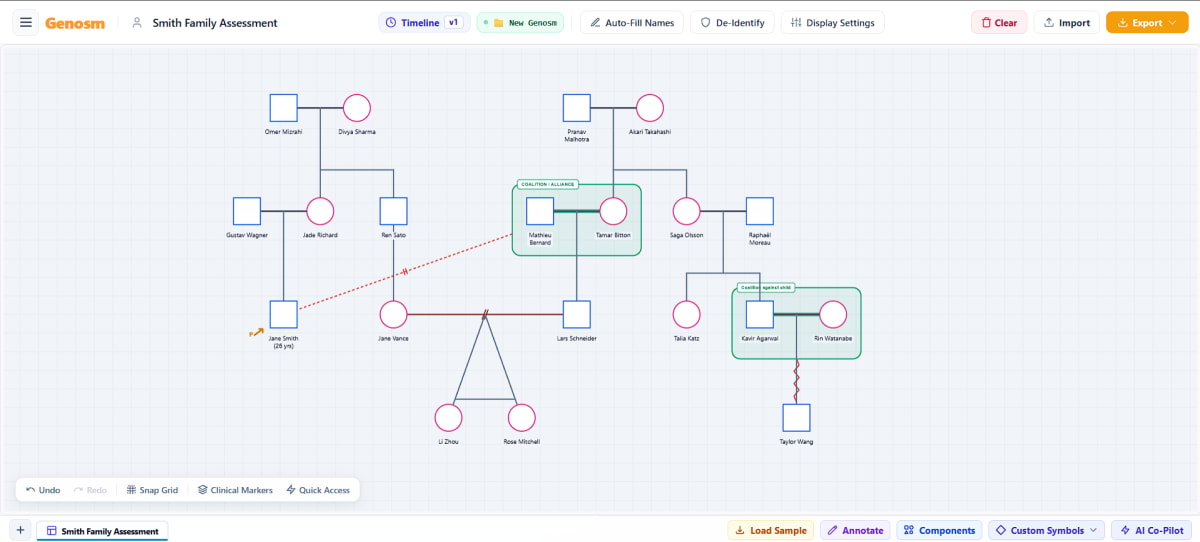
When two family members form a team against a third person, systemic balance collapses. In family therapy, this pattern is called a coalition. While cross-generational coalitions between a parent and child are famous in clinical literature, coalitions regularly form between siblings, extended relatives like aunts and nieces, or in-laws. Learn how therapists, counselors, and social workers identify diverse coalitions, map them on clinical genograms, and use structural interventions to restore healthy boundaries.
Clinical Key Takeaways: What Every Practitioner Must Know
-
1.
Coalitions are defined by opposition: Unlike a healthy alliance that supports family cooperation, a coalition is an alignment of two or more members formed specifically against an excluded third person.
-
2.
Coalitions span multiple family subsystems: Coalitions are not always between parents and children. They routinely form between siblings (two brothers allying against a sister), extended relatives (an aunt and niece allying against a mother), in-laws (mother-in-law and adult son allying against a wife), or across generations (parent and child allying against the other parent).
-
3.
Cross-generational coalitions invert family hierarchy: In Salvador Minuchin and Jay Haley's frameworks, parents must hold executive authority. When a parent recruits a child into an alliance against the other parent, the child is elevated into an adult peer position, which fuels anxiety, parentification, or behavioral symptoms.
-
4.
Genosm automates coalition markers without manual geometry: Clinicians do not have to drag multiple lines or draw manual boundary clouds. In Genosm, selecting Coalition under Clinical Markers and clicking the allies plus the opposed individual automatically generates an emerald hull envelope, internal double alliance lines, a dedicated label badge, and a boundary-anchored opposition line. Clinicians can also describe the alliance in everyday clinical language, and Genosm AI maps it automatically.
-
5.
Structural interventions restore healthy subsystem boundaries: Depending on whether the coalition is between siblings, in-laws, or across generations, clinicians use unbalancing, boundary-making, and enactments to dismantle the exclusionary bloc and help members resolve conflicts directly.
1. Coalitions in Clinical Practice: The Multi-Faceted "Two Against One" Pattern
In systemic clinical assessment, families frequently present with complaints about an unruly teenager, chronic sibling rivalry, or marital resentment. When clinicians look beneath individual symptoms to examine the interactional sequence, they often discover an active coalition.
Coalitions are not limited to one specific family relationship. They emerge across various subsystems whenever two or more individuals unite to marginalize someone else:
Presentation: Tension among adult siblings over family business decisions or shared responsibilities.
Systemic dynamic: Two brothers form a united voting bloc against their sister, ridiculing her suggestions and cutting her out of key family discussions.
Presentation: An overwhelmed mother complains that her 16-year-old daughter treats her with total disregard.
Systemic dynamic: A maternal aunt acts as the teen's confidante, secretly approving her defiance, lending her money, and criticizing the mother's rules behind her back.
Presentation: Couples therapy where the wife feels lonely, judged, and secondary in her marriage.
Systemic dynamic: The husband and his mother form a lifelong alliance, making financial and household choices together without consulting the wife.
Presentation: A father feels like a powerless outsider in his own home.
Systemic dynamic: The mother and teenage son form an emotional partnership against the father. When the father tries to discipline the son, the mother intervenes to protect him.
In all these cases, addressing the conflict as an individual issue fails because the allied members validate and reinforce each other's resistance. Mapping the system on a visual genogram exposes the coalition perimeter, helping everyone see the real emotional architecture of the family.
2. Alliance vs. Coalition vs. Triangulation: Key Clinical Differences
To choose the right therapeutic intervention, clinicians must differentiate healthy alliances from destructive coalitions and general anxiety triangulation.
| Diagnostic Marker | Theoretical Root | Core Function | Impact on Boundaries | Clinical Genogram Symbol |
|---|---|---|---|---|
| Healthy Alliance | Structural Therapy (Minuchin) | Cooperation, mutual support, task completion (e.g. parents uniting to support a child). | Respects generational boundaries; operates within appropriate subsystems. | Solid double parallel lines between individuals. |
| Family Coalition (General & Cross-Gen) | Structural & Strategic (Minuchin & Haley) | Oppositional alignment formed specifically against an excluded family member (sibling vs sibling, in-laws vs spouse, or parent-child vs parent). | Breaches boundary integrity; in cross-generational coalitions, inverts hierarchy; in sibling coalitions, isolates a peer. | Emerald boundary envelope enclosing allies with an anchored opposition line toward the target. |
| Bowenian Triangulation | Family Systems (Murray Bowen) | Spreading dyadic anxiety across three points to stabilize tension and avoid marital rupture. | Blurs emotional boundaries; child absorbs or carries the emotional weather of the parents. | Dashed purple boundary enclosing three individuals with a central T badge. |
1. Why an Alliance is Functional
Alliances are the building blocks of healthy family life. Two brothers sharing a bedroom, or two parents agreeing on curfew, is a functional alliance. It is defined by cooperation toward a shared goal, not by hostility toward someone else.
2. Why a Coalition is Pathological
A coalition is defined by exclusion and opposition. Two or more family members bond over their shared criticism, rejection, or control of a third person. This can occur horizontally between siblings (two brothers freezing out a sister), across collateral lines (an aunt and niece undermining a mother), between in-laws (mother-in-law and son shutting out a wife), or cross-generationally (parent and child teaming up against the other parent).
3. How Triangulation Differs from a Coalition
In Bowenian triangulation, the focus is on anxiety regulation. Two parents might detour their conflict by worrying about a sick child (Minuchin detouring-support) or scapegoating a child together. In a coalition, the parents are split: one parent and child gang up against the other parent.
3. Cross-Generational Coalition vs. Parental Alienation: Untangling the Clinical Confusion
In child custody disputes and high-conflict divorce cases, clinicians and forensic evaluators frequently encounter allegations of parental alienation. Understanding the relationship between a structural coalition and alienation is essential for accurate assessment.
The Structural Perspective
A cross-generational coalition is a broad structural family systems concept. It occurs regularly in never-divorced, intact families living under one roof. For example, a mother and daughter might routinely freeze out a disengaged father. The father remains in the home, but his executive authority is completely hollowed out.
The Forensic / Relational Perspective
Parental alienation is a specific, extreme relational outcome typically observed during or after high-conflict separation. It involves a systematic campaign where one parent manipulates a child into unjustifiably rejecting, fearing, or hating the other parent, resulting in the total rupture of the parent-child attachment bond.
4. How Genosm Draws Coalitions Under Clinical Markers (No Arrows Needed)
Drawing a coalition manually in standard diagram tools requires drawing separate boundary circles, connecting multiple double lines, and manually placing conflict arrows. When nodes move, the arrows detach and the chart becomes cluttered.
Genosm provides native, standardized clinical markers for coalitions and alliances:
1 Select Allies and the Opposed Target
In Genosm, open Clinical Markers and select Coalition. Click the allied family members (e.g. Mother and Daughter), and then click the excluded target (e.g. Father).
Genosm instantly generates an emerald hull envelope around the allies with a soft green tint, draws internal clinical double parallel alliance lines between them, and drops a standardized `COALITION / ALLIANCE` badge.
Boundary-Anchored Opposition Ray
Genosm automatically projects the opposition line (conflict zigzag or cutoff double crossbars) starting strictly from the outer boundary perimeter of the coalition envelope directed toward the target node.
Interactive Legend Synchronization
The coalition marker registers automatically in your interactive canvas legend. You can customize label text, stroke colors, and line dash styles for clinical presentations and legal reports.
Clinicians do not need to memorize marker names. You can paste raw narrative notes directly into Genosm AI:
"Elena and her 16-year-old daughter Maya have formed an alliance against David, shutting him out of disciplinary decisions and treating his rules with contempt."
Genosm's clinical AI parser analyzes the relational hierarchy, creates the allied subsystem around Elena and Maya, and projects the opposition vector toward David automatically.
5. How to Map Coalitions on Pen and Paper (Step-by-Step)
When drafting a family chart live during an in-person session, you can use standardized McGoldrick and Minuchin conventions:
Draw standard squares (males) and circles (females). Connect the parents with a marriage line and draw descent lines to the children.
Draw two parallel solid lines (close) or three parallel solid lines (enmeshed) between the allied members (e.g. mother and daughter).
Using a green pen, draw a solid continuous loop around the allied individuals. This visually establishes that they function as a unified subsystem.
Starting from the outer green perimeter of the coalition envelope, draw a red zigzag line (active conflict) or a line with double perpendicular slashes (cutoff) leading to the excluded individual.
6. Coalition in Genogram Examples: Four Clinical Case Formulations
These clinical genogram examples illustrate how coalitions manifest across diverse family structures, including extended family collateral ties, peer sibling alliances, in-laws, and cross-generational pairs.
The Mother-Son Coalition vs. Disengaged Father
Mother Karen feels lonely in her marriage to workaholic father Greg. Karen treats her 15-year-old son Tyler as her emotional confidante. Tyler develops panic attacks and refuses to obey his father, while Karen undermines Greg's discipline by calling it insensitive.
Maternal Aunt and Niece vs. Overwhelmed Mother
Maternal aunt Sarah forms a tight alliance with her 16-year-old niece Emma against Emma's mother Rachel. Sarah validates Emma's rebellion, buys her forbidden items, and tells her that her mother is unreasonable. Rachel feels completely disempowered, unable to enforce household limits.
The Sibling Bloc: Two Brothers vs. Sister in Estate Decisions
Adult brothers Daniel (28) and Alex (26) form an exclusive alliance against their sister Maya (22) regarding family property and estate management. Daniel and Alex make decisions privately and mock Maya's proposals, isolating her within her own sibling group.
The In-Law Vise: Mother-in-Law and Son vs. Wife
Mother Evelyn maintains an enmeshed emotional partnership with her adult son Marcus. Whenever Marcus's wife Sofia brings up financial or parenting boundaries, Marcus defends his mother and dismisses Sofia. Evelyn and Marcus manage domestic decisions together, leaving Sofia in an emotional freeze-out.
7. How to Spot Coalitions in Clinical Sessions
Experienced clinicians recognize that families exhibit boundary breaches in their micro-interactions. Look for these four reliable clinical markers during family intake:
Allies consistently refer to themselves as a single unit when discussing family matters: two brothers stating "We decided not to include our sister," or a mother and teen saying "We don't like how Dad manages money."
When the excluded individual speaks, the allied members exchange knowing smiles, eye rolls, or synchronized nods. One ally immediately jumps in to deflect or counter before the excluded person finishes speaking.
Normal subsystem boundaries dissolve: a child scolds a parent with impunity, or adult brothers cut off their sister as if she has no standing in her own family.
A client recites phrases and legal or financial grievances coached by an ally: a husband repeating his mother's exact complaints about his wife, or a niece reciting her aunt's harsh criticisms of maternal rules.
8. Diagnostic Questions to Ask to Uncover Hidden Coalitions
Use these targeted circular questions during assessment to reveal power imbalances and secret alliances:
"During disagreements or major decisions, who in this family feels like they are on the outside facing a closed front?"
What this reveals: Directly identifies the isolated target of the coalition across any subsystem.
"Among the siblings, do two of you confer and agree on a stance before presenting it to your brother or sister?"
What this reveals: Uncovers horizontal voting blocs and peer exclusion in sibling dynamics or estate disputes.
"Does an outside relative, like an aunt, uncle, or mother-in-law, weigh in on household rules or finances before the primary partners discuss it?"
What this reveals: Detects in-law and collateral alliances that weaken the primary household boundary.
"When one parent sets a boundary, does your child look to the other parent first before deciding whether to follow it?"
What this reveals: Tests whether parental authority has been split and co-opted through a cross-generational alliance.
9. Are Coalitions Ever Healthy?
In structural family therapy, the distinction between a temporary protective alliance and a chronic pathological coalition is crucial:
- Active abuse or domestic violence: A non-offending parent and child teaming up to protect themselves physically is adaptive and necessary.
- Severe untreated addiction: Family members aligning to stage an intervention or manage household safety.
- Crisis stabilization: The alignment exists strictly for survival and safety, not for emotional manipulation.
- Avoiding marital intimacy: A parent using a child as an emotional surrogate to avoid dealing with marital loneliness.
- Parental alienation: Poisoning a child's mind to win a divorce custody battle.
- Prolonged hierarchy inversion: The child remains in an adult role for years, sacrificing normal developmental milestones.
10. Structural Therapeutic Protocols: Dismantling the Coalition
Salvador Minuchin and Jay Haley developed specific clinical techniques to restructure families stuck in cross-generational coalitions:
The therapist temporarily sides with the isolated individual to shift systemic leverage. Whether supporting an excluded sibling facing two allied brothers, a wife facing an in-law alliance, or a sidelined parent, this intervention forces the coalition to break its rigid united front.
Physically change the seating arrangement in your therapy room. Place adult partners side by side while moving in-laws outside the primary circle. In sibling cases, separate allied brothers and seat the excluded sister between them for direct, balanced dialogue.
Instruct the two primary parties to negotiate directly without their usual ally intervening. If an ally attempts to interject, rescue, or speak for someone, intervene immediately: "Please pause. Let the two of them work through this disagreement directly."
Dismantle the exclusionary bond by fostering one-on-one relationships. Help allied siblings build direct individual connections with the excluded sibling, encourage spouses to prioritize their primary bond over extended in-laws, and return children to their developmental peer group.
📋 Clinical Scripts for In-Session Restructuring
"Tyler, I appreciate how much you care about this family. But this decision belongs to your parents. You are 15, and your only job tonight is to be a teenager. Let Mom and Dad figure this out."
"Marcus and Sofia, please speak directly to each other about your household finances. Evelyn, I will invite your perspective later, but right now this couple needs to reach an agreement as primary partners."
"Daniel and Alex, when you confer and decide family estate plans beforehand, Maya never gets an equal voice. Daniel, please step back and allow Alex and Maya to discuss this section one-on-one."
Map Coalitions and Boundary Violations in Seconds
Genosm empowers family therapists, counselors, and social workers with standardized clinical markers. Render emerald coalition envelopes, boundary-anchored opposition lines, and auto-syncing legends with zero manual geometry.
Frequently Asked Questions for Practitioners
1. What is a coalition in family therapy?
A coalition occurs when two or more family members form a rigid alignment specifically against a third person. Coalitions are not always between parents and children. They frequently appear between siblings (horizontal coalitions), extended relatives (such as an aunt and niece against a parent), in-laws (such as a mother-in-law and son against a spouse), as well as cross-generational parent-child pairs.
2. What is the difference between an alliance and a coalition?
An alliance is a cooperative, supportive bond between family members (such as two siblings sharing a hobby or co-parents collaborating) that does not target anyone. A coalition is an oppositional alignment formed specifically against an excluded person, designed to shift power or freeze someone out.
3. What is Jay Haley's perverse triangle?
Jay Haley coined the perverse triangle in Strategic Family Therapy. It refers to a covert coalition between two people from different generational levels (e.g. parent and child) against a peer on the higher level (the other parent), which is consistently denied by the allies while generating behavioral symptoms in the child.
4. How does Genosm automate coalition markers on genograms?
In Genosm, clinicians select Coalition under Clinical Markers, click the allied individuals, and click the opposed person. Genosm automatically renders an emerald boundary envelope, draws internal double alliance lines, drops a dedicated label badge, and draws a boundary-anchored opposition line directly toward the excluded individual. Clinicians can also describe the family conflict in natural text, and Genosm AI generates the coalition marker automatically.
5. How do family therapists dismantle a coalition?
Family therapists use unbalancing (temporarily supporting the isolated person to restore balance), boundary-making (blocking outside interference during private dyadic discussions), and enactments to guide family members to negotiate directly with each other without relying on a third ally.