Triangulation in Genograms and Psychology: A Clinical Practice Guide for Therapists and Counselors
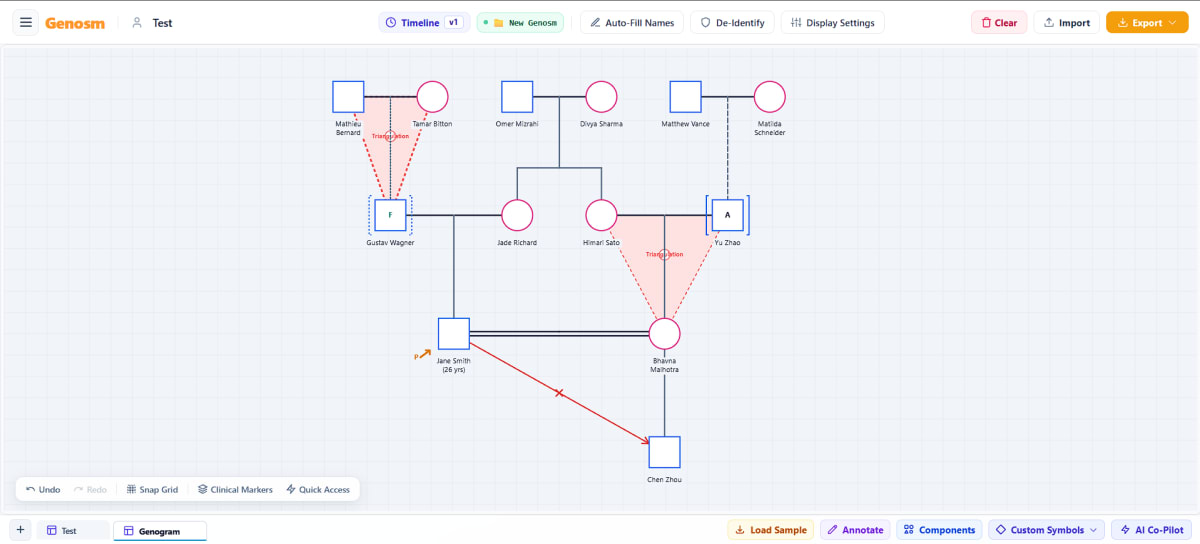
When families arrive in therapy, the presenting issue is rarely where the real conflict lives. Learn how marriage and family therapists, clinical social workers, and counselors use genograms to spot hidden triangles, differentiate detouring from cross-generational coalitions, and chart actionable detriangulation plans using standardized clinical templates.
Clinical Key Takeaways: What Every Practitioner Must Know
-
1.
Triangles are the emotional building blocks of living systems: In Bowen Family Systems Theory, a two-person dyad is inherently unstable under rising stress. When anxiety escalates, the system automatically pulls in a third party or symptom to stabilize tension and avoid marital rupture.
-
2.
Genograms cut through muddy client narratives: Clients frequently present with individual complaints about an unruly teen or an interfering mother-in-law. A clinical genogram maps these complaints as circular systemic feedback loops, revealing the underlying anxiety circuit in seconds.
-
3.
Triangulation, Detouring, and Coalitions are distinct diagnostic entities: Triangulation is the broad Bowenian process of anxiety offloading. Detouring is Minuchin's parental deflection onto a child (either via scapegoating or overprotection). A coalition is a cross-generational alliance where one parent and a child unite against the other parent.
-
4.
Genosm automates clinical markers without manual arrows: Clinicians do not have to waste session time drawing three disconnected arrows or tweaking angles. In Genosm, selecting Triangulation under Clinical Markers and clicking three family members automatically calculates the centroid, renders a dashed boundary envelope, and embeds a standardized T badge. Furthermore, clinicians can simply paste intake case summaries in everyday natural language, and Genosm AI identifies and maps the three-way dynamic automatically without needing clinical keywords.
-
5.
Detriangulation requires differentiation, not cutoff: Clinical intervention focuses on coaching clients to maintain a non-anxious presence, communicate using firm I-positions, seal parental boundaries, and transition from Karpman's Drama Triangle to the Winner's Triangle.
1. Triangulation in Clinical Intake: Beyond the Identified Patient
In family therapy and clinical counseling, families rarely arrive requesting help with a systemic triangle. Instead, they present with an Identified Patient (IP).
Parents schedule an intake because their 15-year-old son has failing grades, their 10-year-old daughter has severe stomach aches before school, or an adult daughter feels overwhelmed by marital fighting. When clinicians take a purely individual view, treatment often stalls. But when clinicians zoom out to the three-generation genogram, the symptom appears as a stabilizing mechanism for dyadic tension.
Intake presentation: High-conflict divorce where the parents cannot speak
directly without shouting.
Systemic dynamic: The child is placed in the middle to carry messages,
report on the other parent, and absorb adult conflict.
Intake presentation: Parents united in anger over their teenager's defiance
and poor habits.
Systemic dynamic: The child's behavioral crisis prevents the parents from
facing their emotionally barren marriage.
Intake presentation: An adult daughter suffering chronic generalized
anxiety and relationship difficulty.
Systemic dynamic: Mother treats the daughter as an emotional surrogate
spouse, confiding marital grievances and alienating the father.
Intake presentation: Couples therapy where one partner reports feeling like
a permanent outsider.
Systemic dynamic: Spouse remains emotionally fused to their family of
origin, prioritizing parental approval over marital solidarity.
For licensed clinicians, mapping these dynamics on a genogram is transformative. It allows clients to see that their anxiety is not an individual character flaw, but a predictable reaction to a structural family pattern.
2. Triangulation vs. Detouring vs. Coalition: Clarifying the Clinical Differences
Clinicians often hear these three terms used interchangeably in case conferences. However, in classic family systems theory, they represent three distinct organizational dynamics with different treatment implications.
| Diagnostic Marker | Theoretical Origin | Structural Dynamic | Clinical Genogram Representation |
|---|---|---|---|
| Triangulation | Murray Bowen (Family Systems Theory) | Anxiety in an unstable dyad spills onto a third person to relieve pressure and manage systemic tension. | A dashed purple boundary enclosing three individuals, labeled with a central T badge. |
| Detouring | Salvador Minuchin (Structural Therapy) | Parents avoid their direct marital conflict by uniting outward onto a child, either through attack (scapegoating) or support (infantilizing). | Parental dyad linked to child with directional deflection brackets and a designated detouring marker. |
| Cross-Generational Coalition | Salvador Minuchin (Structural Therapy) | One parent forms a rigid, covert alliance with a child against the other parent, breaching generational hierarchy. | Solid emerald perimeter around parent and child (alliance) paired with an opposition line toward the excluded parent. |
1. Triangulation (Bowen): The Universal Pressure Valve
Bowen focused on emotional reactivity and anxiety regulation. When two people reach an anxiety threshold, they cannot maintain stability. They recruit a third party to spread the anxiety across three points. The third person may be a confidante, a messenger, or a common focal point. The defining feature is anxiety diffusion.
2. Detouring (Minuchin): The False Harmony Mechanism
In Minuchin's Structural Family Therapy, detouring is a specific parental defense. The
parents maintain the illusion of marital harmony by focusing exclusively on a child's
problems:
• Detouring-Attack (Scapegoating): The parents agree that their marriage
would be fine if only their child stopped acting out. Both parents focus shared criticism on
the child.
• Detouring-Support: The parents unite around a child's illness or
fragility. In their classic study on psychosomatic families, Minuchin, Rosman, and Baker
showed how asthma flares, diabetic crises, and anorexia symptoms effectively halt parental
fights, drawing both parents into caretaking.
3. Cross-Generational Coalition (Minuchin): The Broken Hierarchy
Unlike detouring, where parents unite, a coalition splits the parents. One parent enlists a child to form an alliance against the other spouse. This breaches the generational boundary: the child is elevated to an adult partner role, while the other parent is stripped of authority and excluded.
3. How Genosm Draws Triangulation Under Clinical Markers (No Arrows Needed)
General purpose diagram tools were never built for clinical systemic assessment. Therapists are often forced to manually draw separate connectors, fiddle with arrowhead directions, and manually adjust angles whenever nodes move.
Genosm provides native support for Clinical Markers. It eliminates manual geometry and lets clinicians focus on systemic assessment:
1 Point and Click Three Family Members
In Genosm, open the Clinical Markers menu and select Triangulation. Then click the two parents and the child, or any three individuals in the family tree.
Genosm automatically computes the polygon centroid across all three coordinates, draws a clean dashed purple boundary envelope around the trio, and renders a centered, standardized T badge. When family nodes are moved or rearranged, the envelope dynamically tracks their positions.
Dedicated Markers for Detouring and Coalitions
Need to map Minuchin dynamics? Select Detouring to link parents and child with deflection lines, or Coalition to drop an emerald alliance boundary with opposition lines.
Clinical Customization & Legend Sync
Customize stroke colors, dash patterns (dashed, dotted, solid), and background tint opacity. Every marker automatically syncs to your chart legend for case consultations and court reports.
Clinicians do not need to enter structured codes or even type the word "triangulation." You can
paste raw clinical intake notes directly into Genosm AI:
"During marital arguments, Mark and Sarah stop speaking and funnel their complaints through
their 14-year-old son Leo, who has begun acting out at school."
Genosm's intelligent clinical parser analyzes the relational dynamics, establishes the
parent-child linkages, and renders the standardized purple triangulation marker with zero manual
drawing required.
4. How to Map Triangles on Pen and Paper (McGoldrick Standards)
When conducting live in-session assessments on a whiteboard or clinical intake notepad, following standardized notation keeps your chart clear and legally sound.
Draw squares for biological males, circles for females, and diamonds for non-binary or unstated gender. Connect the parental dyad with a horizontal relationship bar. Drop a vertical descent line down to the sibling subsystem.
Assess the emotional quality between the two adults. If they experience chronic conflict, draw a jagged zigzag line between them. If they are emotionally estranged, draw a solid line interrupted by two vertical cutoff bars.
Draw emotional lines from both adults to the triangulated party. If one parent is enmeshed with the child, use three solid parallel lines. If the other parent is hostile toward the child, use a zigzag line.
Using a colored pen (purple or red), draw a dashed triangular line that encloses all three individuals. In the center of the triangle, write a bold letter T. This flags the three-way systemic feedback loop for treatment planning.
Standard Clinical Relationship Lines
| Clinical Dynamic | McGoldrick Symbol | Clinical Indication |
|---|---|---|
| Enmeshed / Fused | 3 Solid Parallel Lines (≡) | Loss of ego boundaries, emotional over-involvement, parentification. |
| Conflictual / Hostile | Zigzag Line (∿∿∿) | Overt verbal combat, chronic hostility, unresolved emotional friction. |
| Fused & Conflictual | Zigzag over parallel lines | Volatile attachment; intense emotional closeness mixed with explosive arguments. |
| Emotional Cutoff | Line with double vertical tick (||) | Total withdrawal or estrangement used as a defense against overwhelming anxiety. |
| Triangulation Marker | Dashed purple boundary with central T | Anxiety deflected from a primary dyad into a three-way regulatory circuit. |
5. Triangulation in Genogram Examples: Four Clinical Case Archetypes
These clinical triangulation in genogram examples show how family triangles look across diverse case formulations.
The Adolescent Scapegoat as Systemic Glue
Parents Mark and Sarah present for therapy complaining about their 15-year-old son Leo's recent truancy and behavioral outbursts. Assessment reveals high covert marital hostility. When marital fights escalate, Leo acts out, shifting parental focus away from their failing marriage and onto disciplining Leo.
The Mother-Daughter Coalition vs. Excluded Father
Elena feels emotionally abandoned by her withdrawn husband David. Elena turns to 16-year-old Maya for emotional partnership, treating her as an adult confidante. Maya adopts an attitude of disdain toward her father, stripping David of parental authority while locking Maya into enmeshment.
The In-Law Triad and Boundary Permeability
Claire and Julian enter marital therapy. Julian reports feeling alienated in his own home due to constant interference from his mother-in-law, Evelyn. Claire exhibits low differentiation of self from her mother of origin, feeling acute guilt whenever she does not comply with Evelyn's directives.
The Golden Child vs. Scapegoat Polarized Sibling System
In high-conflict or narcissistic family systems, a parent often triangulates siblings against each other. Ben is idealized as the Golden Child, while Kyle is devalued as the Scapegoat. The parent compares them constantly, preventing the brothers from forming a supportive sibling alliance.
6. How to Spot Triangulation in Clinical Sessions
Experienced therapists know that triangles reveal themselves during the first fifteen minutes of family consultation. Clients do not need to explain their triangles in words; their relational posture and communication habits broadcast the pattern clearly.
Here are observable clinical cues to watch for during family intake:
When you ask one partner a direct question about their marriage, observe where their eyes travel first. If they glance at their child or mother before answering, they are checking for loyalty and approval.
Whenever parental dialogue becomes tense or quiet, the triangulated child suddenly acts out, drops an object, makes a joke, or asks to use the restroom. The child has learned to interrupt adult tension.
One parent speaks on behalf of the child or the other adult: "What my husband really meant to say was..." or "Sarah feels that her dad does not love her." This demonstrates boundary diffusion and enmeshment.
Look at seating choices. A mother sits on the couch holding hands with her teenage son, while the father sits isolated in an armchair across the room. Spatial distance mirrors emotional distance.
7. Diagnostic Questions to Ask to Uncover Triangulations
Direct questions like "Are you triangulating your son?" never work because triangles operate outside conscious awareness. Instead, clinicians use circular and behavioral tracking questions to reveal the emotional pathways:
"When you and your partner have an argument, who is the very first person you talk to afterward?"
What this reveals: Identifies the immediate confidante vertex (e.g. maternal grandmother, sister, or best friend) where marital tension is leaked.
"When voices get raised in the house, where is your child, and what do they usually do in that exact moment?"
What this reveals: Shows whether the child acts as a distress stabilizer, comforting one parent or drawing fire away by misbehaving.
"Is there anything one of you shares with your daughter that your spouse is not supposed to know about?"
What this reveals: Directly tests for cross-generational coalitions and boundary breaches that alienate one parent.
"When scheduling weekend plans or discussing money, do you talk directly with each other, or does someone pass the message?"
What this reveals: Highlights whether a child or third party is being used as a shield to bypass direct communication.
"If Leo's behavioral issues disappeared overnight, what would the two of you talk about over dinner?"
What this reveals: Exposes detouring. If the couple falls silent or feels anxious, the child's symptom is the only thing keeping them engaged.
8. Are Triangulations Always Unhealthy?
In popular social media psychology, the word "triangulation" is almost always treated as a synonym for toxic manipulation or narcissistic abuse. But in clinical systems theory, the answer is more nuanced: triangles are natural and universal, but chronic rigidity makes them destructive.
Murray Bowen emphasized that the triangle is simply the basic molecular unit of any emotional system. Every human being participates in triangles every single day:
- Temporary crisis buffer: A grandparent steps in to help care for children during a parent's medical emergency.
- Professional mediation: A couple hires a family therapist to provide a neutral, differentiated third presence.
- Constructive venting: A spouse talks to a personal counselor to process feelings before speaking calmly to their partner.
- Fluid roles: Once the acute stress passes, the third party steps back out and the original dyad resumes direct contact.
- Rigid and permanent: The third party is locked into the dynamic for years with no exit.
- Generational breach: A child is burdened with adult marital responsibilities or parentified.
- Symptom maintenance: A child's illness or failure is unconsciously needed to prevent parental divorce.
- Divide-and-conquer splitting: One party uses lies or comparisons to destroy bonds between other family members.
The clinical goal in therapy is not to eliminate all three-person interactions. Rather, it is to transform rigid, cross-generational traps into flexible, open relationships where adults communicate directly and children are free to be children.
9. Systemic Theory: Integrating Bowen, Minuchin, and Karpman
Mastery of triangulation requires understanding how structural systemic theory intersects with behavioral transactional psychology.
Murray Bowen: The Physics of Anxiety Regulation
Dr. Murray Bowen conceptualized the triangle as the fundamental molecule of emotional systems. In Bowenian formulation, the individual's level of differentiation of self determines their vulnerability to triangulation. Poorly differentiated family members cannot tolerate emotional separateness and reactively absorb anxiety, making them predictable lightning rods during family crises.
Salvador Minuchin: Structural Integrity and Subsystems
Minuchin emphasized the absolute necessity of generational boundaries. The executive parental subsystem must maintain clear, semi-permeable boundaries to resolve adult conflict privately. When boundaries become diffuse, children are parentified or scapegoated, leading to psychosomatic symptom formation to maintain family homeostasis.
Stephen Karpman: The Transactional Drama Triangle
While Bowen maps the generational structure, Stephen Karpman maps the psychological game
scripts:
• Persecutor: Rigid, blame-oriented ("It is your fault").
• Rescuer: Enables dependency and avoids personal vulnerability ("Let me
fix you").
• Victim: Avoids agency and seeks a savior ("Poor me").
During active conflict, family members cycle through all three roles rapidly. Clinicians use
Bowenian genograms to show the macro structure and Karpman psychoeducation to show micro
session behavior.
10. Clinical Detriangulation Protocols: Interventions That Work
In family systems practice, detriangulation is the gold standard intervention for restoring generational hierarchy and fostering client differentiation.
Therapists coach the triangulated client to remain emotionally connected while lowering physiological reactivity. When family members attempt to offload anxiety via gossip or complaints, the client learns to listen calmly without agreeing, defending, or counter-attacking.
Clients are trained to stop using reactive "You-statements" or collective "We-statements." Instead, they state personal boundaries cleanly: "I love you both, but I will not carry messages or discuss Dad's choices with you."
In structural family sessions, the therapist actively blocks cross-generational coalitions. When a child begins speaking on behalf of a parent, the clinician intervenes: "Let your mother speak for herself." The therapist redirects the parents to address their marital conflict directly.
Clinicians guide clients from dysfunctional drama roles into healthy functional
alternatives:
• Rescuer becomes the Coach (supportive listening without taking
responsibility).
• Persecutor becomes the Challenger (asserting clear, respectful boundaries
without blame).
• Victim becomes the Creator (taking active ownership of personal choices
and problem solving).
📋 Clinical Scripts for Client Psychoeducation
Therapists can role-play these boundary scripts with clients preparing for family encounters:
"Mom, I care about your happiness, but Dad is my father. I cannot be your sounding board for your marriage. That is a conversation to have directly with him or a couples counselor."
"I love you both, but I do not deliver messages between adults. If this is important, please contact them directly."
"I value my relationship with each of you too much to choose sides. I trust you two have the ability to talk through this directly."
Upgrade Your Systemic Family Assessments
Join hundreds of family therapists, social workers, and counselors who use Genosm. Map clinical triangulation markers in three clicks, or use our zero-storage, HIPAA-ready AI to transform raw intake notes into standardized genograms.
Frequently Asked Questions for Practitioners
1. What is the clinical definition of triangulation on a genogram?
In clinical family systems theory, triangulation is a three-person emotional process where anxiety between an unstable two-person dyad is shifted onto a third person or symptom. On a genogram, it is represented as a closed three-node circuit enclosed by a dashed line and labeled with a central T badge.
2. What is the difference between triangulation, detouring, and a coalition?
Triangulation is Murray Bowen's broad systemic mechanism where stress in a dyad pulls in a third party to reduce anxiety. Detouring is Salvador Minuchin's specific pattern where two parents mask marital strife by focusing united energy on a child, either by blaming them (detouring-attack) or overprotecting them (detouring-support). A coalition is a cross-generational alliance where one parent joins forces with a child against the other parent, breaching family hierarchy.
3. How does Genosm automate clinical markers for therapists?
Genosm eliminates manual line drawing. Clinicians simply select Clinical Markers, pick Triangulation, Detouring, or Coalition, and click the relevant family members. Genosm calculates geometric centroids, draws standard clinical boundaries, drops standardized badges, and auto-syncs the markers into the interactive canvas legend. Clinicians can also paste narrative intake notes, and Genosm AI identifies and maps the three-way dynamic automatically without needing clinical keywords.
4. How do clinicians use the Karpman Drama Triangle alongside Bowenian genograms?
Bowenian genograms map the structural flow of systemic anxiety across family generations, while Karpman's Drama Triangle maps the transactional roles (Victim, Rescuer, Persecutor) adopted during active conflict. Clinicians use Bowen genograms for systemic assessment and Karpman's model for psychoeducation during communication and boundary coaching.
5. What are primary therapeutic interventions for detriangulation?
Effective clinical interventions include coaching clients to maintain a non-anxious presence, training individuals to use calm I-positions instead of reactive accusations, sealing the parental subsystem boundary so parents resolve conflict directly, and helping clients shift from Karpman's Drama Triangle to the Winner's Triangle (Coach, Challenger, Creator).