Clinical Origins: Affect Labeling & Emotional Granularity
When clients enter clinical therapy in acute emotional distress, their internal state is frequently undifferentiated. Sentiments such as "I feel terrible," "I am broken," or "Everything is a disaster" represent globalized distress where high limbic arousal overwhelms cognitive discrimination. In clinical psychology, moving from global distress to granular emotional differentiation is known as affect labeling.
Genosm synthesizes three core scientific pillars into an interactive clinical workspace:
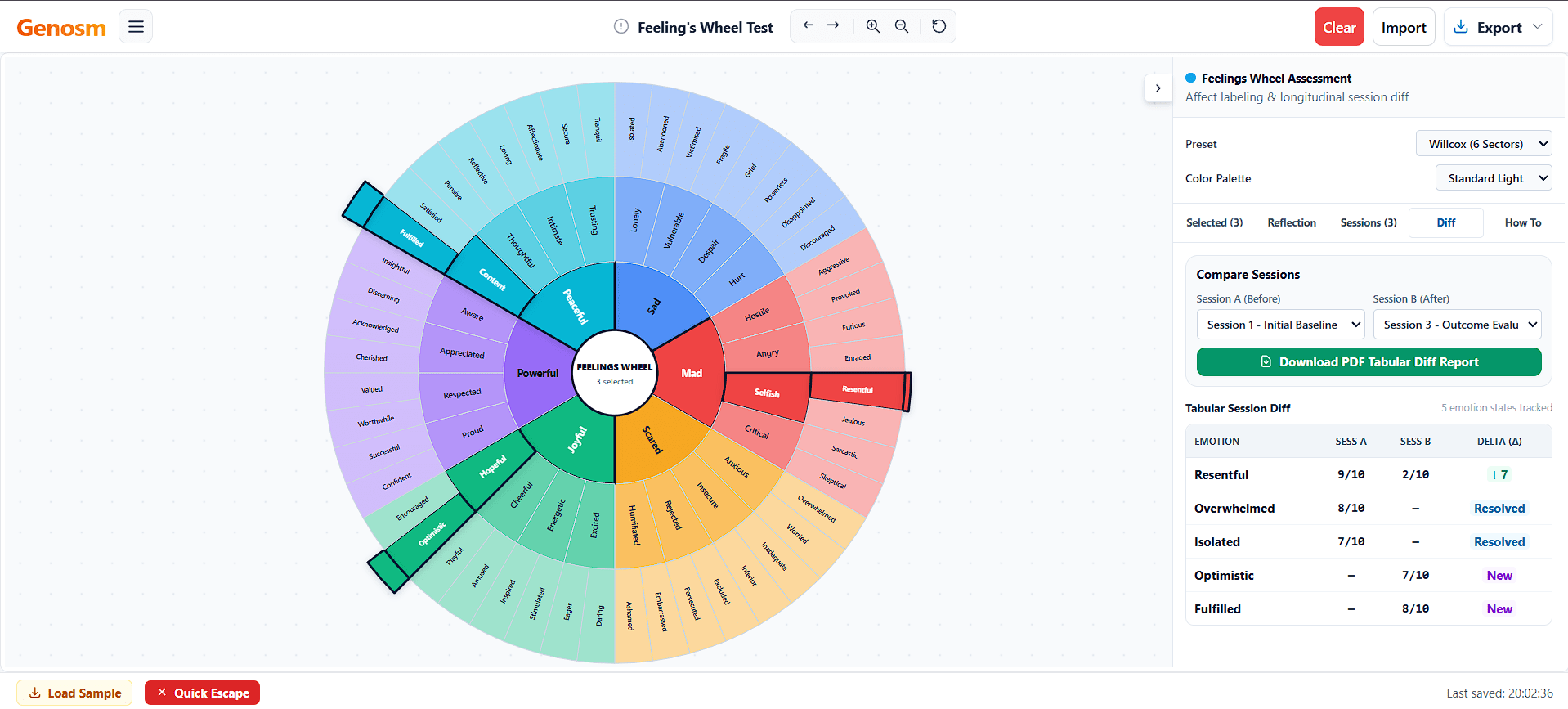
- Dr. Gloria Willcox (1982) Feeling Wheel: Designed within transactional analysis to expand emotional awareness and spontaneity. Organized into 6 core primary sectors (Sad, Mad, Scared, Joyful, Powerful, Peaceful) radiating outward into secondary contextual branches and tertiary granular expressions.
- Dr. Robert Plutchik (1980) Psychoevolutionary Model: Features 8 primary bipolar sectors (Joy vs. Sadness, Anger vs. Fear, Trust vs. Disgust, Surprise vs. Anticipation) arranged in complementary opposition with vertical intensity tiers and primary emotion blends (dyads).
- Matthew Lieberman et al. (2007) UCLA fMRI Research: Functional neuroimaging confirms that translating affective states into specific linguistic labels activates the right ventrolateral prefrontal cortex (rvlPFC), which exerts direct inhibitory down-regulation on the amygdala.
Concentric 3-Ring Architecture & SUDs Intensity Arc
The Genosm Feelings Wheel engine organizes emotional vocabulary into three concentric geometric rings with an optional outer intensity arc gauge:
Concentric Radial Rings
- • Ring 1 (Core Hub, r=50 to 130px): Primary survival affects (Sad, Mad, Scared, Joyful, Powerful, Peaceful).
- • Ring 2 (Secondary Ring, r=130 to 230px): Contextual subcategories (e.g. Mad branches into Hostile, Angry, Selfish, Critical).
- • Ring 3 (Tertiary Ring, r=230 to 340px): High-resolution granular affect leaves (e.g. Resentful, Jealous, Sarcastic, Skeptical).
- • Ring 4 (Intensity Arc, r=340 to 375px): Dynamic outer gauge reflecting 1 to 10 SUDs ratings.
Dual Clinical Presets
- • Willcox Standard (6 Sectors): Sad, Mad, Scared, Joyful, Powerful, Peaceful with 24 secondary branches and 48 tertiary leaves.
- • Plutchik Expanded (8 Sectors): Joy, Trust, Fear, Surprise, Sadness, Disgust, Anger, Anticipation with bipolar pairings.
- • Custom Tertiary Dictionaries: Clinicians can add customized client-specific descriptors into sector lists.
- • Real-Time Telemetry: Automatic calculation of selected emotion count and average SUDs intensity.
Dynamic Arc Geometry & Upright Radial Typography
Unlike static graphic templates where labels become upside down or distorted, Genosm employs a pure mathematical projection engine:
Dynamically computes sector angles for 6-sector (60 deg) and 8-sector (45 deg) models.
Normalizes text in the 90 to 270 degree hemisphere so all labels remain upright.
Calculates (delta > 180 ? 1 : 0) ensuring clean vector arc rendering across all viewports.
Clinicians can toggle between Standard Light Mode (with desaturated tints for secondary and tertiary rings), Deuteranopia (Colorblind Safe sky-blue and amber scales), and High Contrast (slate, black, and white) for maximum clinical accessibility.
Guided 4-Stage Affect Reflection Protocol
Identifying an emotion on the wheel is the diagnostic entry point. To convert insight into lasting behavioral change, Genosm embeds a structured 4-stage reflection worksheet directly into the side panel:
Initial Presentation: "I felt completely frozen and stressed out when my supervisor reassigned my project without consulting me."
Feelings Wheel Pinpoint: Mad → Selfish → Resentful (SUDs 8/10) and Scared → Insecure → Inadequate (SUDs 7/10).
Somatic Mapping: Tightness in upper chest, shallow breathing, clenched jaw.
Core Need Identified: Professional autonomy, respect, and psychological safety.
Therapeutic Outcome: After 4-7-8 breathing and framing an assertive clarification email, Sarah reported emotional intensity drop from 8/10 to 3/10.
Somatic Interoceptive Mapping (7 Body Regions)
Emotions are fundamentally embodied physiological experiences. In Genosm, every active feeling state can be assigned to standardized somatic body regions to bridge cognitive awareness with bottom-up interoception:
Multi-Session Tracking & Automated Diff Engine
Evaluating treatment progress requires longitudinal documentation. Genosm includes a built-in session management and diff comparison engine:
| Emotion State | Session 1 (Intake) | Session 6 (Review) | Delta (Δ) Shift | Clinical Interpretation |
|---|---|---|---|---|
| Resentful (Mad) | 8 / 10 | 2 / 10 | ↓ 6 pts | Significant downregulation |
| Overwhelmed (Scared) | 9 / 10 | 3 / 10 | ↓ 6 pts | Distress tolerance expanded |
| Isolated (Sad) | 7 / 10 | — | Resolved | Social connection activated |
| Confident (Powerful) | — | 7 / 10 | New | Self-efficacy emerging |
How to Construct a Feelings Wheel in Genosm
Follow this 5-step clinical workflow during collaborative in-session exploration or for rapid post-session documentation:
Choose Willcox 6-sector or Plutchik 8-sector presets in the toolbar, and select standard light, colorblind safe (deuteranopia), or high contrast display modes.
Click on any slice on the interactive wheel canvas to select primary sectors, secondary categories, and tertiary leaves.
Adjust the 1 to 10 intensity slider and document bodily locations such as chest tightness or jaw clenching.
Record situational triggers, somatic sensations, core underlying unmet needs, and adaptive coping responses.
Export lossless vector SVG graphics, portable JSON backups, generate clinical PDF summary reports, or print blank manual worksheets for clients to complete by hand.
Modalities & Specialized Populations
The Feelings Wheel adapts seamlessly across diverse psychotherapy paradigms:
Helps clients identify cognitive distortions linked to primary emotions and master opposite-action distress tolerance skills.
Connects fight, flight, and freeze autonomic activations with bodily sensations to support safe titration and discharge.
Distinguishes reactive secondary emotions (e.g. Hostility) from vulnerable primary emotions (e.g. Fear of abandonment) to de-escalate cycles.
Provides concrete visual scaffolding for autistic or ADHD clients who struggle to identify, differentiate, or describe internal states.
Multi-Diagram Cross-Modality Synergy
Combine the Feelings Wheel with sister formulation tools in Genosm for complete biopsychosocial assessment:
Transfer wheel affect labels directly onto 24 anatomical landmarks to map interoceptive tension and trauma hotspots.
ACT Matrix & Hexaflex Tool →Feed difficult tertiary emotions into the bottom-left unwanted inner experience quadrant to guide psychological flexibility.
Window of Tolerance Chart →Correlate wheel intensities with hyperarousal panic spikes or hypoarousal shutdown states along the autonomic spectrum.
CBT 5-Areas Formulation →Populate the emotional domain in hot cross bun formulations with granular feelings wheel taxonomy for cognitive restructuring.
Zero-Knowledge Privacy: Zero Server PHI Storage
Genosm is engineered from the ground up on a local-first architecture. All radial calculations, intensity scores, somatic markers, and clinical reflection notes execute entirely inside your local browser memory:
Clinical Comparison Matrix
See how Genosm compares against static PDF emotion wheels and generic drawing tools:
| Capability | Genosm Feelings Wheel | Static PDF Handouts | Generic Drawing Apps |
|---|---|---|---|
| Taxonomy Presets | Willcox 6 & Plutchik 8 | Fixed single chart | Manual drawing required |
| SUDs 1-10 Intensity Rings | Yes (Dynamic Arc Gauge) | No | No |
| Somatic Marker Integration | Yes (Location & Sensations) | Manual pen margins | No |
| Multi-Session Delta Diff | Yes (Auto Tabular Diff) | No | No |
| Vector SVG & JSON Export | Yes (Lossless + Backup) | No | Raster PNG only |
| Print Blank Manual Worksheet | Yes (Standard Outlines) | Yes | No |
| HIPAA Zero Server PHI | 100% Client-Side | Local Paper | Stored on Third-Party Cloud |
Clinical Exports & Printable Blank Worksheets
Genosm provides four comprehensive export channels to support digital documentation and in-person clinical sessions:
- 1. Export as SVG: High-resolution, lossless vector graphic suitable for EHR attachments, client takeaways, and clinical presentations without pixelation.
- 2. Export as JSON: Complete encrypted client-side session data file for local backup, data portability, and cross-device session continuation.
- 3. Print Full Clinical Report: A structured clinical formulation document with client identifiers, selected affect hierarchies, SUDs ratings, 4-stage reflections, and somatic notes ready for EHR charting.
- 4. Print Blank Feelings Wheel Worksheet (Fill Manually): A standardized printable worksheet featuring clean Willcox and Plutchik concentric blank wheel outlines, color guides, and guided reflection prompt lines for clients to draw on and fill out manually during in-person sessions or as take-home homework exercises.
Frequently Asked Questions
What is the clinical difference between the Willcox Feeling Wheel and Plutchik Wheel in Genosm?
The Gloria Willcox (1982) model is organized into 6 core primary affects (Sad, Mad, Scared, Joyful, Powerful, Peaceful) radiating outward into secondary and tertiary nuance for emotional literacy. The Robert Plutchik (1980) model uses 8 primary bipolar sectors (Joy vs. Sadness, Anger vs. Fear, Trust vs. Disgust, Surprise vs. Anticipation) arranged with radial intensity gradations. You can toggle between both presets instantly in the toolbar.
How does affect labeling on a feelings wheel reduce emotional distress?
Functional MRI neuroimaging studies (Lieberman et al., 2007) demonstrate that naming precise emotional states recruits the right ventrolateral prefrontal cortex (rvlPFC), which exerts an inhibitory downregulating effect on the amygdala. Shifting from vague distress to a granular tertiary label activates executive functioning and calms physiological arousal.
Can I print blank feelings wheel worksheets for in-session manual completion?
Yes. Genosm provides a direct print option for standardized, high-resolution blank feelings wheel worksheets. Clinicians can print empty concentric wheel outlines with fillable trigger, somatic sensation, and reflection prompt lines for clients to complete by hand during sessions or as take-home therapeutic exercises.
How does multi-session delta tracking work?
You can snapshot client emotion states across therapy appointments by clicking "Start New Session". The Diff tab automatically compares Session A against Session B, computing numerical delta shifts in SUDs ratings, highlighting resolved feelings, identifying newly emerged affects, and enabling download of a clean tabular PDF report for clinical records.
What is included in the Genosm $9.99/mo subscription?
The $9.99/month plan includes unlimited generation, editing, and vector export across all 14 clinical diagram tools, including Feelings Wheel, Somatic Body Mapping, ACT Matrix, Window of Tolerance, CBT 5-Areas, IFS Parts Mapping, and Polyvagal charts with zero watermarks and zero PHI cloud storage.