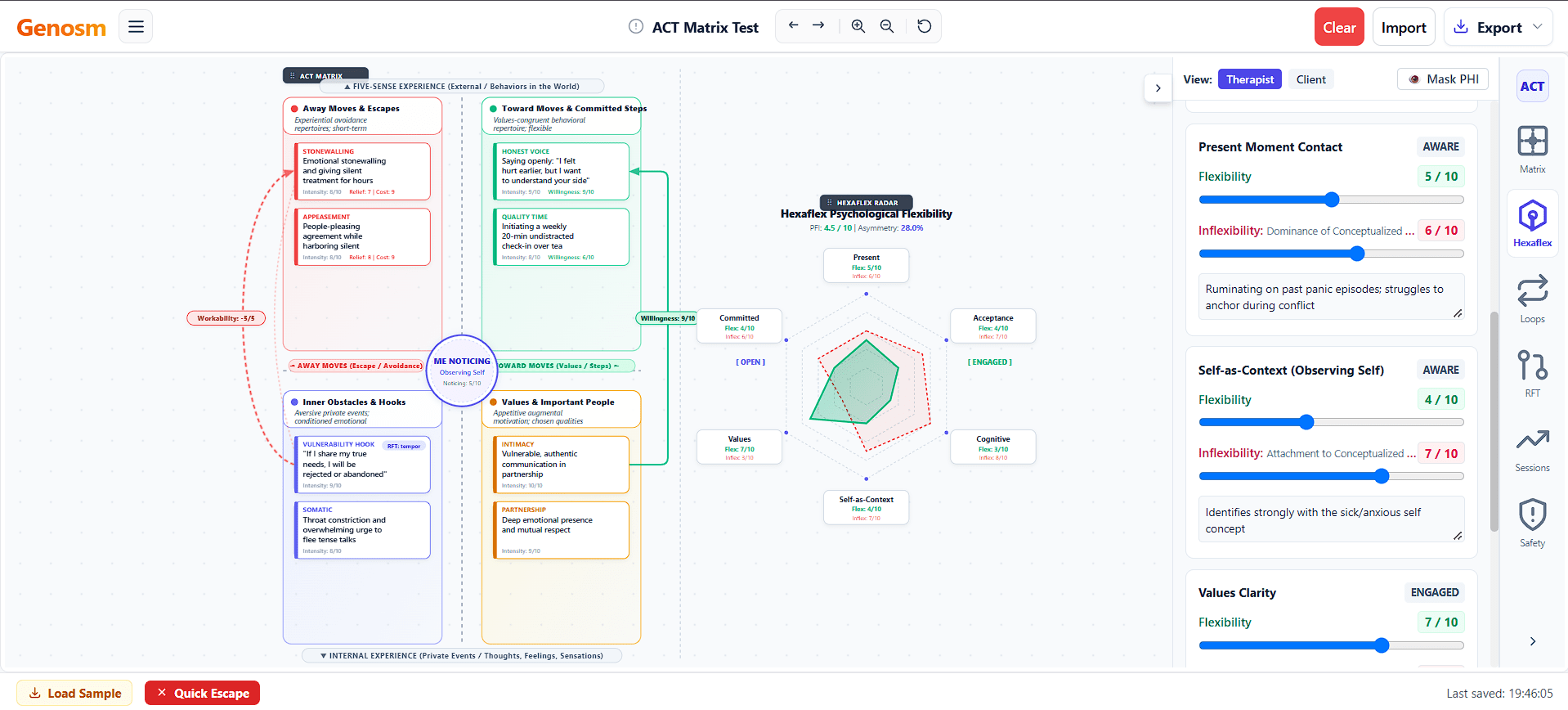
Clinical Origins: Contextual Behavioral Science & The ACT Matrix
Acceptance and Commitment Therapy (ACT), pioneered by Dr. Steven C. Hayes, Dr. Kirk D. Strosahl, and Dr. Kelly G. Wilson (1999), transformed modern psychotherapy by shifting the target of intervention from symptom reduction to psychological flexibility. Rooted in functional contextualism and Relational Frame Theory (RFT), ACT demonstrates that human suffering is primarily maintained by experiential avoidance and cognitive fusion rather than the presence of difficult emotions themselves.
To make the core principles of ACT immediately intuitive for clients, clinical psychologist Dr. Kevin L. Polk, along with colleagues Benjamin Schoendorff and Mark Webster (2014), created the ACT Matrix. The Matrix provides a clear, visual four-quadrant map that enables clients to track their behavior in real time, distinguish helpful actions from avoidant traps, and practice present-moment psychological noticing without getting caught in theoretical jargon.
The 4-Quadrant Sorting Grid & "Me Noticing" Center
The ACT Matrix is structured by two intersecting functional axes that divide human experience into four clear quadrants, anchored by an observing conscious center:
Quadrant 3: Away Moves & Escapes
Outer / AwayClient Prompt: "When heavy feelings bite, what do you do to numb, fight, or escape?"
Clinical Function: Experiential avoidance repertoires, substance use, procrastination, passive withdrawal, and short-term negative reinforcement loops that constrict life.
Quadrant 4: Toward Moves & Committed Steps
Outer / TowardClient Prompt: "What willing steps take you one inch closer to what matters?"
Clinical Function: Values-congruent behavioral patterns, observable habits of living, and flexible persistence in the presence of difficult private events.
Quadrant 2: Inner Obstacles & Hooks
Inner / AwayClient Prompt: "What heavy thoughts, fears, or body feelings show up inside?"
Clinical Function: Unwanted private events, conditioned emotional responses, somatic panic, traumatic memories, and fused cognitive rules.
Quadrant 1: Values & Important People
Inner / TowardClient Prompt: "Who and what is truly important to your heart here?"
Clinical Function: Freely chosen qualities of being, appetitive augmental motivation, meaningful relationships, and core life directions.
At the center of the crosshairs sits the observing self. The clinician invites the client to step into the perspective of the conscious witness: noticing the ongoing difference between inner experiencing (bottom) and outer actions (top), and between away moves (left) and toward moves (right).
The Hexaflex 6 Core Processes & Tri-Flex Pillars
Genosm links every card on the Matrix to the standardized six core processes of the ACT Hexaflex, grouped into the clinical Tri-Flex model:
1. Open Pillar
WillingnessMaking room for painful private feelings without struggle vs. Experiential Avoidance.
Stepping back from thoughts as ongoing mental events vs. Cognitive Fusion.
2. Aware Pillar
PresenceFlexible, voluntary attention to the here-and-now vs. Conceptualized Past/Future.
Transcendent observer self (the chessboard) vs. Conceptualized Self (the story of me).
3. Engaged Pillar
ActionFreely chosen qualities of purposeful living vs. Meaninglessness/Compliant rules.
Building effective, values-based behavioral patterns vs. Avoidant Inaction.
Stuck Loops & Behavioral Workability Tracking
One of the most potent clinical applications of the ACT Matrix is exposing the Stuck Loop: the vicious cycle where an internal obstacle triggers an away behavior, which provides temporary relief but ultimately worsens the original problem.
Workability Equation
Workability: -5 to +5In Genosm, clinicians link a Quadrant 2 obstacle (such as social anxiety) to a Quadrant 3 away move (such as cancelling plans). The software records the immediate short-term relief (numbs anxiety for 30 minutes) versus the long-term life constriction (deepens isolation and confirms the belief that one cannot handle socializing).
RFT Relational Frame Tagging & Precision Defusion
Underneath cognitive fusion lie specific verbal relations governed by Relational Frame Theory (RFT). Genosm provides a clinical RFT tagger to identify the exact verbal structure maintaining an obstacle and recommends precision defusion interventions:
The mind treats a thought as literally identical to reality (e.g. "I am broken").
Rigid judgment comparing the self to an idealized standard (e.g. "I am less worthy").
Conditioning valued life on the absence of distress (e.g. "I cannot date until panic is gone").
Viewing difficult thoughts as the total person rather than parts within a wider vessel.
Standardized CompACT-23 Assessment & Longitudinal Tracking
Genosm embeds the standardized 23-item CompACT measure (Francis, Dawson, & Golijani-Moghaddam, 2016) to evaluate psychological flexibility objectively across three validated subscales:
Acceptance & Defusion capacity
Present Moment & Self-as-Context
Values Clarity & Committed Action
Total CompACT score ranges from 0 to 138. Scores are logged in the session trajectory history to visualize progress across treatment phases.
7 Dedicated Life Domain Matrix Instances
A client might demonstrate strong values-congruent toward moves in their career while remaining paralyzed in an away loop regarding intimate relationships or chronic physical pain. Genosm allows clinicians to switch between seven specialized life domain matrices:
ACT-Informed Crisis Safety Planning Mode
Based on empirical crisis safety protocols by Bryan, Rudd, et al. (2018) and Ducasse et al. (2014), Genosm adapts the ACT Matrix into a life-preserving crisis plan during acute suicidal or severe risk episodes:
Maps high-risk warning signs and identifies impulsive self-harm actions as unworkable away moves that end all future values.
Anchors the client to their core values and defines concrete, life-preserving committed survival steps and lethal means safety protocols.
How to Construct an ACT Matrix in Genosm
Follow this five-step clinical procedure during intake evaluations, experiential exercises, or treatment reviews:
Anchor in "Me Noticing" at the Center
Introduce the vertical (Five-Sense vs. Mental) and horizontal (Away vs. Toward) axes. Establish the mindful observer stance at the center crosshairs.
Populate Values & Important People (Q1)
Ask the client: "Who and what matters to your heart in this area of life?" Add cards in Quadrant 1 defining chosen values and relationships.
Map Inner Obstacles & Relational Hooks (Q2)
Explore the inner barriers that show up when moving toward values: anxiety, self-doubt, somatic tension, and fused rules. Apply RFT relational frame tags.
Track Away Moves & Stuck Loops (Q3)
Identify overt behaviors used to escape internal discomfort. Draw stuck loop arcs and evaluate behavioral workability with the client.
Export as SVG, JSON, Full Clinical Report, or Printable Manual Worksheet
Define concrete committed toward steps in Quadrant 4. Choose your export format based on clinical needs:
High-resolution vector graphic for EHR documentation and digital presentations without quality loss.
Encrypted data backup for local record archiving and cross-device chart restoration.
Complete formatted report compiling 4-quadrant cards, Hexaflex process ratings, stuck loops, and CompACT-23 scores for electronic health records.
Generate a clean, blank 4-quadrant ACT Matrix worksheet with guided client prompts for clients to draw, write, and fill out manually during in-person sessions or as homework.
Therapeutic Modalities & Clinical Populations
The ACT Matrix adapts effectively across diverse clinical settings and diagnostic categories:
Anxiety & Panic Disorders
Helps clients see that trying to control panic (away move) increases autonomic arousal, shifting attention toward willing values-congruent actions.
Chronic Pain & Somatic Illness
Distinguishes unavoidable physical sensation (pain) from suffering caused by behavioral avoidance, fostering meaningful life engagement alongside pain.
Obsessive-Compulsive Disorder (OCD)
Clarifies how compulsions function as short-term escape maneuvers in Quadrant 3, strengthening willingness to carry intrusive thoughts without neutralizing.
Depression & Behavioral Inaction
Exposes how waiting to feel motivated before taking action keeps clients trapped in withdrawal loops, building small daily toward moves.
Pairing the ACT Matrix with Sister Clinical Diagrams
Genosm provides a comprehensive suite of 14 clinical diagramming tools. Clinicians frequently combine the ACT Matrix with these related formulations:
Window of Tolerance Chart Maker
Autonomic RegulationPair the ACT Matrix with autonomic tracking to observe how hyperarousal and hypoarousal spikes trigger impulsive Quadrant 3 away behaviors.
Somatic Body Mapping Tool
Interoceptive CuesConnect Quadrant 2 internal obstacles directly to localized bodily sensations across 24 anatomical regions with SIBAM sensory tracking.
IFS Parts Mapping Tool
Parts LocalizationConceptualize Quadrant 3 away moves as protector firefighter strategies shielding exiled emotional burdens in Quadrant 2.
100% Local-First Data Privacy and HIPAA Alignment
ACT case formulations, private hooks, and trauma notes contain sensitive Protected Health Information (PHI). Generic cloud whiteboard tools store client data on centralized servers where it is vulnerable to breaches.
Genosm operates with a zero-storage, local-first architecture:
- All diagram calculations, Hexaflex radar renderings, and psychometric scores occur locally in your web browser.
- Client names, values, trauma hooks, and case formulations are never transmitted to or stored on Genosm servers.
- Files are stored directly on your local device or encrypted browser storage (IndexedDB).
- Includes a dedicated 1-click De-Identification toggle that masks client names for clinical supervision and case consultations.
Why Genosm Outperforms Generic Whiteboards & Paper
| Feature | Genosm ACT Tool | Generic Whiteboards (Miro/Lucid) | Paper Worksheets |
|---|---|---|---|
| 4-Quadrant Sorting Grid | Native ACT quadrant cards & prompt guides | Generic blank sticky notes | Static single printed sheet |
| Hexaflex & Tri-Flex Sliders | Interactive 6-process ratings & radar | No clinical psychometrics | Requires manual graphing |
| CompACT-23 Psychometrics | Standardized subscale & total scoring | None | Manual arithmetic calculation |
| Stuck Loop & Workability Scoring | Automated dynamic loops (-5 to +5) | Manual lines with no scoring | Hand drawn loops |
| RFT Relational Frame Tagging | RFT frame tagger & precision defusion | None | None |
| Crisis Safety Planning Mode | Dedicated Bryan et al. (2018) protocol | None | Separate crisis template |
| HIPAA & Zero PHI Retention | 100% Local-First (Zero Server PHI) | Third-party cloud storage risk | Physical paper loss risk |
| Exports, SVG, JSON & Worksheets | Export as SVG, JSON, print full clinical reports & blank worksheets to fill manually | Low-res PNG screenshots only | Requires manual scanning & filing |
ACT Matrix & Hexaflex Tool FAQ
What is the ACT Matrix in clinical therapy?
The ACT Matrix is a visual functional analysis tool developed by Dr. Kevin Polk and colleagues. It organizes human experience across two primary axes: Five-Sense External Experiencing versus Mental Internal Experiencing (vertical axis), and Away Moves versus Toward Moves (horizontal axis). This creates four distinct quadrants for sorting values, obstacles, avoidance behaviors, and committed actions while fostering present-moment noticing.
How does Genosm integrate the Hexaflex and Tri-Flex models?
Genosm connects the four Matrix quadrants directly to the six core processes of the Hexaflex: Acceptance, Cognitive Defusion, Present Moment Contact, Self-as-Context, Values Clarity, and Committed Action. These six processes are categorized into the Tri-Flex pillars (Open, Aware, and Engaged) with live radar visualizations and flexibility asymmetry scoring.
What is the CompACT-23 assessment integration?
CompACT-23 is a validated 23-item psychometric measure developed by Francis, Dawson, and Golijani-Moghaddam (2016) to evaluate psychological flexibility. In Genosm, clinicians can record subscale scores for Openness to Experience (0-60), Behavioral Awareness (0-30), and Valued Action (0-48), generating a total score (0-138) to track longitudinal treatment outcomes.
How does Stuck Loop tracking evaluate behavioral workability?
A Stuck Loop connects a Quadrant 2 internal obstacle (such as panic or shame) to a Quadrant 3 away behavior (such as substance use or social withdrawal). Genosm allows clinicians to explicitly document the short-term function (immediate relief) and long-term cost (life narrowing), scoring overall behavioral workability on a scale from -5 (unworkable trap) to +5 (adaptive coping).
How does Relational Frame Theory (RFT) tagging work in the tool?
Clinicians can tag internal cognitive hooks with specific relational frame categories (such as Coordination/Equivalence, Comparative/Evaluative, Temporal/Causal, Hierarchical, or Deictic). Genosm pairs each relational frame with evidence-based precision defusion techniques to weaken verbal traps.
How is Protected Health Information (PHI) protected?
Genosm is built on a 100% local-first, zero-storage architecture. All client names, private hooks, values, case notes, and psychometric scores are processed and stored directly in your local browser sandbox. No Protected Health Information (PHI) is ever transmitted to or stored on remote servers, providing complete HIPAA and GDPR alignment.
What export formats are available for session notes and client handouts?
Genosm offers multiple flexible export options:
- Export as SVG: Scalable vector graphics suitable for embedding directly in electronic health records (EHRs) and clinical write-ups.
- Export as JSON: Complete client-side chart data file for local backups, data portability, and cross-device session tracking.
- Print Full Clinical Report: A structured clinical summary with patient identifiers, 4-quadrant cards, Hexaflex process ratings, and CompACT-23 scores ready for documentation.
- Print Blank ACT Matrix Worksheet (Fill Manually): A standardized printable worksheet featuring the 4-quadrant grid, client prompts, and Hexaflex tracking for clients to draw and fill out manually during in-person sessions or as between-session homework.