Clinical Origins: The Monomyth as a Psychotherapeutic Tool
When clients enter therapy, they frequently feel overwhelmed by a problem-saturated narrative. They view themselves as passive victims of trauma, chronic anxiety, burnout, or addiction. The narrative monomyth provides a powerful, universally recognized framework for externalizing problems and restoring personal agency.
Originally conceptualized as the universal human journey by mythologist Joseph Campbell in The Hero with a Thousand Faces (1949) and adapted into a 12-stage storytelling arc by Christopher Vogler (1992), the monomyth mirrors the psychological arc of psychotherapy:
- Departure (Act I): The client confronts a disruptive wake-up call, examines defensive avoidance and refusal, establishes a safe therapeutic alliance with their mentor, and crosses the threshold into active therapy.
- Initiation & The Crucible (Act II): The client navigates daily triggers, approaches core wounds in the inmost cave, and faces their supreme trial in the abyss (processing traumatic memories, experiencing ego surrender, and gaining core cognitive insights).
- Return & Integration (Act III): The client tests new boundaries on the road back, proves mastery under real-world pressure, and returns to their community with the "Elixir" of resilience, self-compassion, and embodied agency.
In Narrative Therapy (Michael White and David Epston), structuring clinical formulations around the Hero's Journey helps clients separate their core identity from the problem. The question shifts from "What is wrong with me?" to "What trial am I currently facing, what resources do I possess, and what boon am I bringing back from this abyss?"
Four Specialized Monomyth Taxonomies
Genosm provides four specialized clinical presets designed for diverse diagnostic presentations, age groups, and therapy modalities:
1. Vogler 12-Stage Classical Monomyth
Comprehensive 3 ActsThe comprehensive standard for deep individual psychotherapy and comprehensive trauma formulation. Tracks 12 sequential stations: Ordinary World, Call to Adventure, Refusal of the Call, Meeting the Mentor, Crossing the Threshold, Tests & Allies, Approach to Inmost Cave, The Ordeal / Abyss, The Reward / Insight, The Road Back, The Resurrection, and Return with the Elixir.
2. Campbell 8-Stage Streamlined Model
Brief Therapy & YouthA focused, highly accessible formulation ideal for short-term counseling, adolescents, and solution-focused brief therapy: The Known Status Quo, The Call & Departure, Crossing the Threshold, Road of Trials & Mentors, The Abyss & Death-Rebirth, Transformation & Insight, The Ascent & Return, and Master of Two Worlds.
3. Maureen Murdock 10-Stage Heroine's Journey
Burnout & WholenessDeveloped by family therapist Maureen Murdock (1990) to address the limits of linear male hero models. Focuses on healing from compulsive over-functioning, perfectionism, somatic disconnect, and burnout: Separation from Intuitive Self, Pursuit of External Mastery, The Illusory Boon/Burnout, The Descent/Dark Night of the Soul, Yearning to Reconnect, Healing the Inner Child/Nurture Split, Healing Healthy Assertiveness, Integration of Doing & Being, Embodying Wholeness, and Return with Relational Wisdom.
4. Trauma & Addiction Recovery Quest (8-Stage)
SUD & Relapse PreventionCalibrated specifically for substance use disorders, behavioral compulsions, and dual-diagnosis trauma recovery: Active Symptom/Compulsion Baseline, The Crisis / Rock Bottom, Reaching for Help & Surrender, Withdrawal Triggers & Sober Network, The Crucible: Core Trauma & Grief, Emotional Rebirth & Adaptive Coping, Relapse Prevention & Living with Integrity, and Long-Term Recovery & Mentoring Others.
Polar Geometry & Conscious vs Subconscious Thresholds
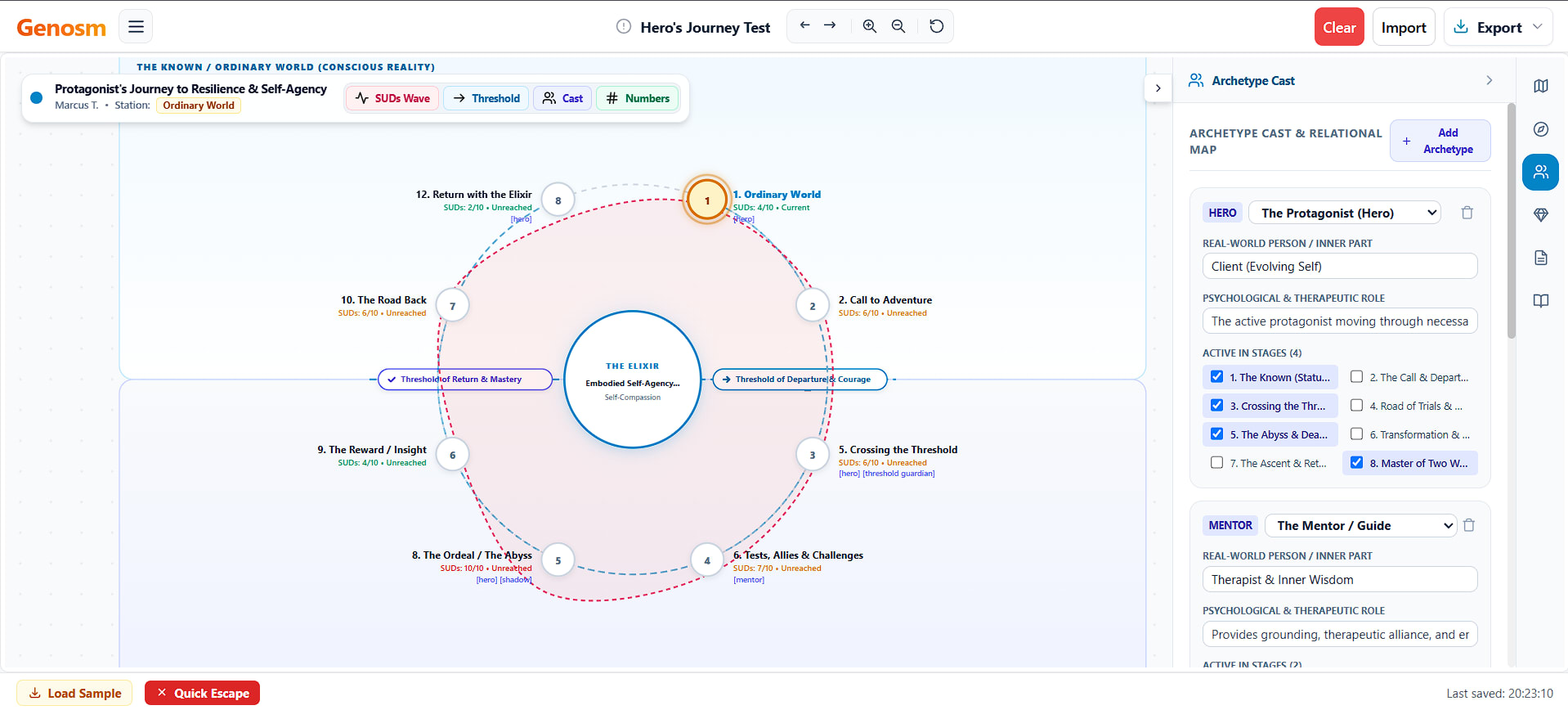
Unlike rigid linear worksheets, transformation is cyclical. Genosm arranges journey stations along a continuous orbital circle with intelligent polar coordinates:
Upper Hemisphere: The Known
Conscious RealityRepresents the Ordinary World, conscious daily routines, familiar defensive patterns, and the eventual return with mastery. Visually rendered with light, grounded background tones.
Lower Hemisphere: The Unknown
The Crucible & AbyssRepresents the Special World of therapy, subconscious shadow material, suppressed memories, and vulnerable ego surrender. Positioned below the horizontal threshold divider.
Adaptive Outward Text Radiance
Text labels on the left hemisphere radiate leftward with right-aligned typography, while labels on the right radiate rightward with left-aligned typography. This guarantees zero text overlapping regardless of screen width or title length.
Subjective Distress (SUDs) Spline Wave Curve
Trauma processing and personal growth involve predictable fluctuations in emotional activation. In Genosm, each stage record includes a Subjective Units of Disturbance (SUDs 1 to 10) rating.
The layout engine computes a dynamic radial displacement for each node, calculating a smooth closed Catmull-Rom spline wave around the circular orbit:
Low distress, grounding, reflective stability, and integrated calm.
Moderate friction, resistance, anticipatory anxiety, and skill tests.
Peak emotional exposure, confronting core shame, and cathartic breakthrough.
This visual pulse helps clients normalize anxiety, understanding that peak distress during the Ordeal is not a therapeutic failure, but a necessary passage before seizing the reward.
Eight Clinically Calibrated Archetype Entities
Personal transformation does not occur in isolation. Clients are surrounded by supportive resources, internal saboteurs, and relational triggers. Genosm allows clinicians to define real-world figures or internal parts across 8 therapeutic archetypes:
The active hero bearing the burden of transformation and expanding in resilience.
Therapist, inner wisdom elder, 12-step sponsor, or grounding spiritual figure.
Unprocessed trauma, suppressed grief, toxic shame, or compulsive addiction drive.
Avoidance mechanisms, fear of failure, the Inner Critic, or skeptical family members.
Supportive partner, trusted friend, support group peers, or healthy coping routines.
Ambivalence, fluctuating motivation, or unpredictable relational attachments.
Humor, ego-puncturing reality checks, cognitive reframing, and perspective shifts.
The wake-up call, panic attack, medical diagnosis, boundary ultimatum, or life transition.
Each archetype can be tagged to specific stages where they appear, rendering custom color-coded badges on the interactive orbital wheel.
The Central Elixir: Anchoring Meaning & Identity
At the geometric center of the formulation canvas sits the Elixir Hub. In clinical practice, this anchors what the client has gained from enduring their trials:
The primary clinical gift (e.g. "Embodied Self-Agency & Emotional Literacy").
The re-authored core belief (e.g. "I am the courageous author of my healing story").
"I do not have to eliminate all fear to live an expansive, deeply meaningful life."
How to Build a Hero's Journey Formulation in Genosm
Follow this five-step clinical procedure during intake formulation, mid-treatment reviews, or narrative exposure sessions:
Select Monomyth Preset & Input Journey Metadata
Choose between the Vogler 12-Stage, Campbell 8-Stage, Murdock Heroine's Journey, or Addiction Recovery Quest. Enter the client identifier, session date, and overarching quest title.
Identify Current Station & Explore Clinical Prompts
Locate the client's current station on the orbital wheel (e.g. "Meeting the Mentor" or "The Inmost Cave"). Review stage-specific exploration questions with the client to unpack their experience.
Calibrate SUDs Levels & Record Stage Details
Adjust the 1 to 10 SUDs slider to render the radial distress curve. Record the client's narrative, inner strengths discovered, shadow avoidance traps, and actionable homework tasks.
Cast Relational Archetypes & Formulate the Elixir
Populate real-world allies, mentors, and shadow triggers across the 8 archetype roles. Articulate the central boon, breakthrough insight statement, and new identity proclamation in the Elixir Hub.
Export in Multiple Formats for Charts & Client Sessions
Select the exact clinical export needed for your therapeutic workflow:
Scalable vector graphics for electronic health records (EHRs), case write-ups, and peer supervision presentations.
Encrypted data backup file for local archiving, longitudinal comparison, and cross-device restoration.
Structured clinical formulation summary compiling stage narratives, SUDs metrics, archetypes, and therapist notes for the medical chart.
Generate a clean, blank Hero's Journey reflection worksheet with stage prompts, SUDs blanks, and notes lines for clients to write on manually during sessions.
Therapeutic Modalities & Clinical Populations
The Hero's Journey formulation bridges narrative metaphor with structured clinical interventions:
Narrative Therapy & Re-Authoring
Externalize symptoms as obstacles on a path. Help clients re-author their identity from passive victim to courageous protagonist with distinct unique outcomes.
EMDR & Trauma Processing
Locate touchstone trauma targets in "The Abyss / The Ordeal". Use the Hero's Journey arc to anchor cognitive interweaves and resource installations.
Addiction & Relapse Prevention
Map rock bottom, cravings, and triggers as tests on the road, anchoring recovery as an ongoing journey of community service and serenity.
Adolescent & Young Adult Transitions
Engage resistant teenagers and college students with relatable quest archetypes, helping them navigate identity formation and independence.
Pairing Hero's Journey with Sister Clinical Diagrams
Genosm provides a comprehensive suite of 14 clinical formulation tools. Clinicians frequently combine the Hero's Journey with these related diagrams:
Somatic Body Mapping Tool
Interoception & AIPPair the macro-narrative of the Hero's Journey with micro-somatic tracking across 24 anatomical regions, locating bodily sensations during the Abyss.
Internal Family Systems (IFS) Parts Map
Parts MappingMap Threshold Guardians to protective Managers/Firefighters and Shadow figures to Exiles carrying core burdens during the unblending workflow.
ACT Matrix Formulation Tool
Psychological FlexibilityConnect "Toward" values-based actions with the Elixir of recovery, and "Away" experiential avoidance behaviors with Threshold Guardians and Refusal of the Call.
100% Local-First Data Privacy and HIPAA Alignment
Personal case formulations and trauma narratives contain sensitive Protected Health Information (PHI). Generic cloud diagram tools store your data on remote multi-tenant databases.
Genosm operates with an absolute zero-storage, local-first architecture:
- All diagram math, narrative logging, and vector rendering execute entirely inside your local browser.
- Client names, trauma narratives, archetype links, and therapist notes never touch Genosm servers.
- Files are stored directly on your computer or encrypted browser storage (IndexedDB).
- Dedicated De-Identification mode strips names and dates for peer supervision, case consultation, and research.
Why Genosm Outperforms Generic Whiteboards & Paper Worksheets
| Feature | Genosm | Generic Whiteboards (Miro/Lucid) | Paper Worksheets |
|---|---|---|---|
| 4 Clinical Monomyth Presets | Vogler, Campbell, Murdock & Recovery Quest | Manual unstructured shapes | Static single-model printout |
| Dynamic SUDs Spline Curve | Automated 1-10 radial distress wave | None | Hand-drawn line graph |
| Archetype Cast Integration | 8 Dedicated clinical roles & stage links | Disjointed sticky notes | Side margin notes |
| Central Elixir Hub | Dedicated boon, insight & growth tags | Generic text box | Bottom text block |
| HIPAA & PHI Protection | 100% Local-First (Zero Cloud Storage) | Cloud database storage (PHI risk) | Physical paper loss risk |
| Export & Printable Formats | Vector SVG, JSON, Full Reports & Blank Worksheets | Low-res PNG screenshots only | Manual scanning & filing required |
Hero's Journey Formulation Tool FAQ
What is the Hero's Journey in clinical psychotherapy?
The Hero's Journey is a narrative formulation framework derived from comparative mythology (Joseph Campbell) and adapted for psychotherapy (Christopher Vogler, Maureen Murdock, and Narrative Therapy). It reframes client suffering from passive pathology into an active transformational quest. Clients externalize problems, recognize internal and relational allies, face their core shadow wound in the abyss, and emerge with an integrated elixir of self-agency and post-traumatic growth.
What 4 clinical presets are available in Genosm?
Genosm features four standardized monomyth presets: 1) Vogler 12-Stage Classical Monomyth across 3 Acts (Departure, Initiation, Return); 2) Campbell 8-Stage Streamlined Model for brief therapy and youth; 3) Maureen Murdock 10-Stage Heroine's Journey for burnout, perfectionism, and internal healing; and 4) Trauma & Addiction Recovery Quest (8-Stage) structured for EMDR, 12-step recovery, DBT skills, and relapse prevention.
How does the SUDs Spline Wave Curve function in the diagram?
Each stage features an adjustable Subjective Units of Disturbance (SUDs) rating from 1 (serenity) to 10 (supreme crucible). Genosm computes a continuous Catmull-Rom closed spline wave around the circular orbit, visually demonstrating how emotional tension builds across departure, peaks in the abyss, and resolves into recovery.
How are Archetypes integrated into the case formulation?
Genosm provides dedicated archetype entities across 8 psychological roles: The Protagonist (Hero), Mentor / Guide, Shadow / Core Wound, Threshold Guardian, Ally / Companion, Shapeshifter, Trickster / Disruptor, and Herald / Catalyst. Therapists can link real-world people (such as a spouse, sponsor, or therapist) or internal parts (such as the Inner Critic) to specific journey stages.
What is the Central Elixir and Boon Hub?
Positioned at the center of the orbital journey, the Elixir Hub captures the transformative outcome of therapy: the Core Boon Title, Breakthrough Insight Statement, New Identity Proclamation, and integrated Post-Traumatic Growth Assets that the client brings back to everyday life.
How does Genosm safeguard client privacy and HIPAA alignment?
Genosm operates with a 100% local-first, zero-storage model. All narrative entries, client identifiers, archetype links, and case notes remain inside your local web browser. No Protected Health Information (PHI) is ever transmitted to or stored on remote cloud databases, ensuring complete HIPAA alignment.
What export formats are available for session notes and client handouts?
Genosm offers multiple flexible export options:
- Export as SVG: Scalable vector graphics suitable for embedding directly in electronic health records (EHRs) and clinical write-ups.
- Export as JSON: Complete client-side chart data file for local backups, data portability, and cross-device session tracking.
- Print Full Clinical Report: A structured clinical summary with patient identifiers, stage records, SUDs curves, archetypes, and therapist notes.
- Print Blank Reflection Worksheet (Fill Manually): A standardized printable worksheet featuring the orbital journey wheel, stage prompts, SUDs blanks, and notes lines for clients to write on manually during in-person sessions.
Legal, IP & Attribution Disclaimer
The Hero's Journey is an overarching narrative framework originally identified by Joseph Campbell in comparative mythology and expanded by Christopher Vogler and Maureen Murdock. This clinical mapping software is an independent educational and psychotherapeutic tool designed for case formulation. It is not affiliated with, endorsed by, sponsored by, or licensed by the Joseph Campbell Foundation, Christopher Vogler, or their respective estates and organizations.
All clinical presets and taxonomies are utilized under educational, fair use, and psychotherapy formulation principles for licensed mental health professionals and clients.