Home / IFS Parts Mapping Tool / 10 Clinical IFS Parts Examples
Clinical Casebook for Mental Health Professionals

10 Real IFS Parts Examples: Authentic Clinical Maps & Subsystem Dynamics

As clinicians, we know that Internal Family Systems therapy comes alive when we see real internal systems in motion. Here are 10 authentic, de-identified clinical case examples mapped in Genosm. Explore how proactive Managers, reactive Firefighters, wounded Exiles, and Core Self interact across anxiety, complex trauma, grief, burnout, and relationship conflict.

⚡

Map Any Client's Internal System in Seconds with Genosm

Genosm gives therapists the dedicated software to draw clear, professional IFS parts maps in seconds. You can build maps manually with intuitive drag-and-drop or use our AI-assisted Intake Scribe to turn session notes into structured parts diagrams automatically. Best of all, you have complete visual customization. Adjust node colors, line thickness, directional arrows, custom border styles, text notes, and somatic body locations to match your exact clinical workflow.

Read the complete IFS Parts Mapping Tool guide & feature specs
✓

Key Takeaways for Therapists, Counselors, and Clinicians

10 Diverse Clinical Scenarios: Covers the exact presentations therapists see daily, including high-achieving perfectionism, chronic people-pleasing, imposter syndrome, creative procrastination, bereavement grief, binge eating, relationship jealousy, health anxiety, complex PTSD, and caregiver burnout.

Real Subsystem Polarizations: See how inner conflicts operate in practice. For instance, notice how a harsh Taskmaster Manager triggers a Defiant Rebel Firefighter, and how an over-functioning Rescuer drives a complete Somatic Bed Crash.

Fast Diagramming with Full Customization: Genosm lets clinicians customize every element on the canvas. Adjust colors for Managers, Firefighters, and Exiles, change vector line thickness, add clinical unburdening notes, and map somatic loci from head to gut.

100% Local-First HIPAA Privacy: Genosm runs entirely in your local browser storage. No client notes, trauma memories, or sensitive identifiers are ever stored on external cloud databases.

Disclaimer: Internal Family Systems® (IFS®) is an independent psychotherapy model developed by Dr. Richard C. Schwartz and trademarked by its respective owners. Genosm is an independent clinical software platform and is not endorsed, sponsored, affiliated with, or licensed by the IFS Institute or trademark holders. All references to IFS terminology are for educational, nominative fair use to describe therapeutic concepts in the public domain. For trademark inquiries, please visit our contact page.

Quick Clinical Reference: The IFS Tripartite Subsystem

Every IFS parts map illustrates the delicate ecosystem between protectors and vulnerable exiles around the client's core healing center.

☀️

Core Self

The intact, compassionate essence of the client. It carries the 8 Cs: Curiosity, Compassion, Calm, Clarity, Courage, Connectedness, Confidence, and Creativity.

Seat of Healing
🛡️

Managers (Proactive)

Protectors that run day-to-day life. They use perfectionism, hyper-planning, people-pleasing, and criticism to prevent exiles from ever being hurt again.

Preemptive Defense
🔥

Firefighters (Reactive)

Protectors that trigger when an exile's emotional pain breaks out. They use urgent numbing, bingeing, dissociation, rage, or physical collapse to extinguish the pain.

Emergency Relief
💔

Exiles (Wounded Parts)

Usually young, tender parts carrying painful burdens from childhood, such as shame, unworthiness, grief, or terror. They are locked away in isolation by protectors.

Carriers of Pain & Wonder

Directory of 10 Clinical Case Studies

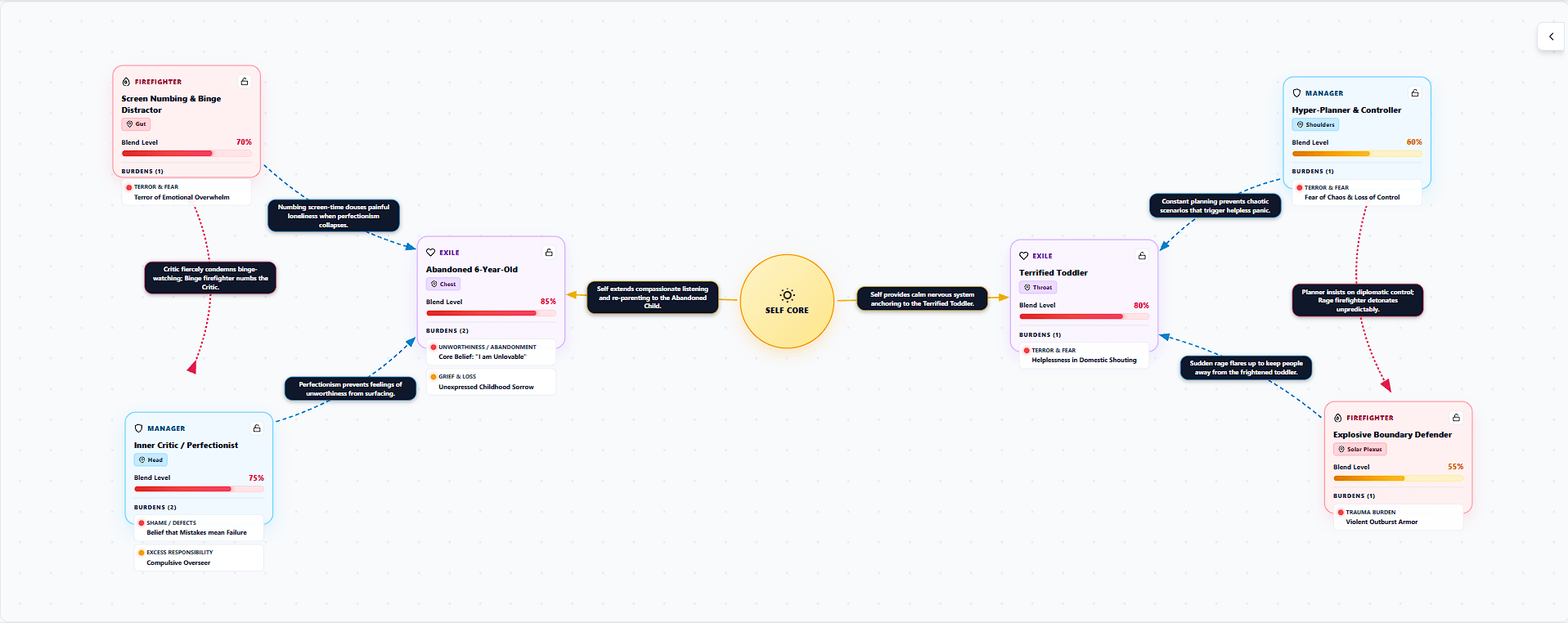
Case Example 01: Anxiety & Overwork

The High-Achieving Perfectionist, Hyper-Planner & Screen Numbing Firefighter

Client Profile: Jordan, 34, Senior Engineering Manager | Presenting Complaint: Chronic exhaustion, insomnia, and late-night binge watching
Clone Map in Genosm
IFS Parts Map Diagram: High-Achieving Perfectionist and Numbing Firefighter

Figure 1: Authentic Genosm parts map showing concentric layout and polarization vectors.

Clinical Presentation: Jordan sought counseling for severe burnout. At work, Jordan spent 12 hours a day checking pull requests, double-checking slide decks, and rewriting emails. By 9 PM, Jordan felt completely depleted. Instead of sleeping, Jordan would sit on the sofa and binge-watch television for five hours while eating snacks, unable to turn the screen off until 2 AM.

Internal Dynamics in the Room: When mapping Jordan's system in Genosm, we quickly uncovered a classic protector polarization. Jordan has an intense Inner Critic / Perfectionist manager sitting in the head and neck. This part works around the clock, telling Jordan that one small error will ruin his career.

When the emotional pressure becomes too great, Jordan's Screen Numbing firefighter steps in. This part takes over Jordan's body, clouds the mind with static fog, and demands hours of entertainment. Then, the next morning, the Perfectionist wakes up furious, berating Jordan for wasting time. This causes the cycle to repeat.

Part Name Role Somatic Locus Blend Level Positive Intention & Core Fear Burden Details
Self Core Self Chest 0% Unbroken core clarity; compassionate anchor for inner children. None (Pure Self-Energy)
Inner Critic / Perfectionist Manager Head 75% Intention: Guarantee error-free work.
Fear: Rejection and public exposure.
Shame burden: "Mistakes mean I am a total failure."
Hyper-Planner & Controller Manager Shoulders 60% Intention: Plan every contingency.
Fear: Sudden chaos will destroy the home.
Fear burden: "Chaos means defenselessness."
Screen Numbing Distractor Firefighter Gut 70% Intention: Cut off conscious thought.
Fear: Emotional flood will break the mind.
Fear burden: "Unbearable emotional overwhelm."
Abandoned 6-Year-Old Exile Chest 85% Intention: Longing for safe attachment.
Fear: Being forgotten in the dark closet forever.
Core unworthiness: "I am inherently unlovable."

💡 Clinical Trailhead & Unblending Intervention

In session, the clinician helped Jordan locate the Perfectionist in the forehead. Using the 6 Fs unblending steps, Jordan learned that this manager took on its burden in first grade when his parents only gave warmth after high report cards. When the Perfectionist felt Jordan's genuine curiosity and agreed to step back slightly, Jordan accessed the Abandoned 6-Year-Old exile. Instead of numbing, Jordan's Self offered comfort directly to the young part, reducing the need for both the Critic and the Screen Numbing firefighter.
Case Example 02: Codependency & Somatic Collapse

The Habitual Fawner, Conflict Sweeper & Somatic Fatigue Freeze

Client Profile: Elena, 29, Human Resources Specialist | Presenting Complaint: Autoimmune flare-ups, chronic fatigue, and inability to say "no"

Clone Map in Genosm
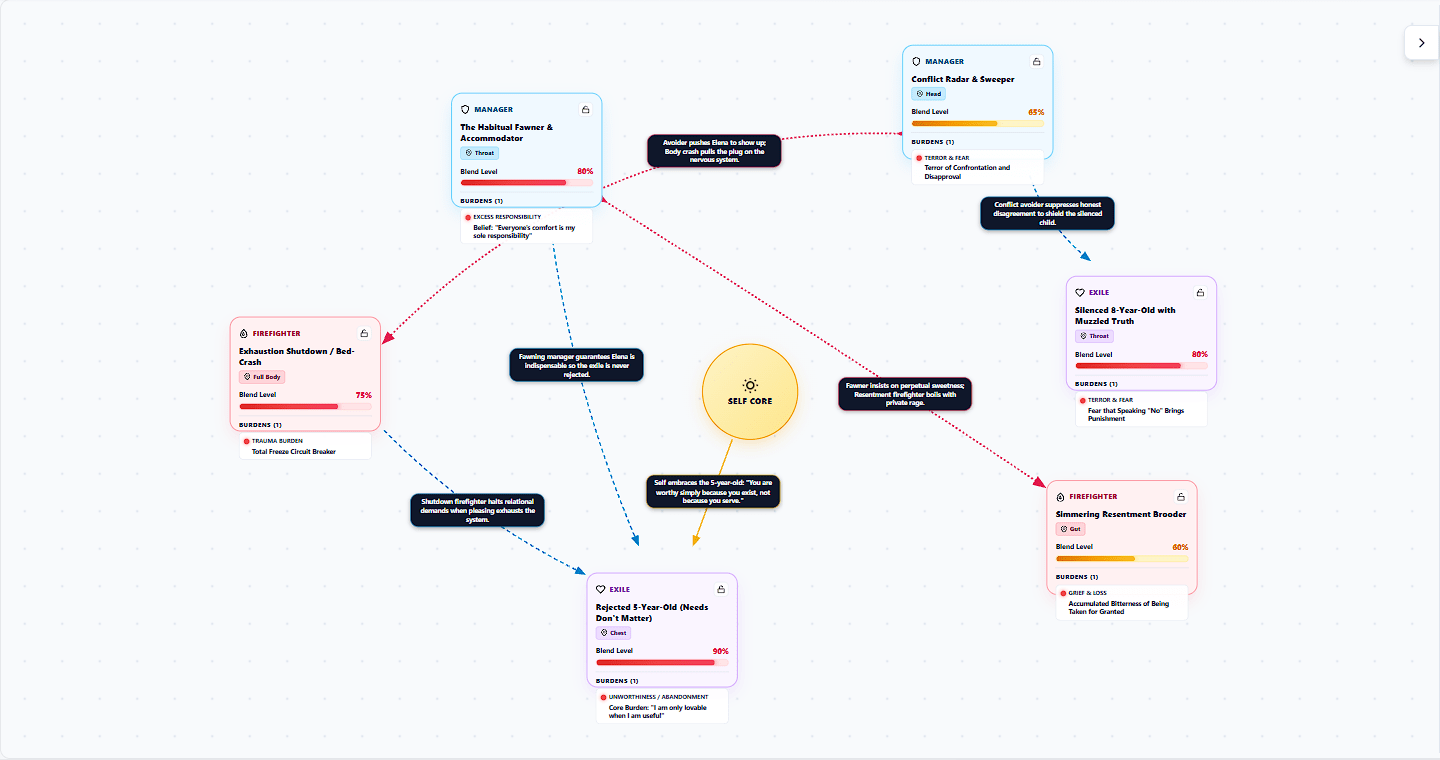
IFS Parts Map: Chronic People-Pleaser and Somatic Collapse

Figure 2: Subsystem cluster showing how over-functioning managers trigger full-body somatic freeze.

Clinical Presentation: Elena came to therapy after doctor visits for unexplained muscle fatigue and migraines. In her family and workplace, Elena was known as the person who never argued, volunteered for extra weekend shifts, and apologized even when others bumped into her.

Systemic Analysis: Elena's system is led by a powerful manager called the Habitual Fawner, located in her throat and jaw. This part works tirelessly to make everyone around her comfortable. It is allied with a Conflict Sweeper manager that scans vocal tones for irritation.

Because the Fawner never allows Elena to set a boundary, the internal system becomes overwhelmed. When psychological reserves hit rock bottom, the Exhaustion Shutdown / Bed-Crash firefighter activates. It pulls the circuit breaker on Elena's body, keeping her in bed with extreme fatigue for 48 hours. This forced freeze is the only way her system gets to rest without feeling guilty.

Part Name Role Somatic Locus Blend Level Positive Intention & Core Fear Burden Details
The Habitual Fawner Manager Throat 80% Intention: Appease others instantly.
Fear: Rejection, anger, and abandonment.
Responsibility burden: "Everyone's comfort is my duty."
Conflict Sweeper Manager Head 65% Intention: Detect and defuse disagreement.
Fear: Open conflict will destroy the relationship.
Fear burden: "Anger leads to disaster."
Bed-Crash Shutdown Firefighter Full Body 75% Intention: Force the body to stop giving.
Fear: The body will physically collapse or die.
Somatic freeze burden: Circuit breaker shutdown.
Rejected 5-Year-Old Exile Chest 90% Intention: Craves authentic love.
Fear: Being cast out if she expresses a real personal need.
Unworthiness burden: "I am only loved when I am useful."

💡 Clinical Trailhead & Unblending Intervention

When Elena unblended from the Fawner, she was surprised to find that the part felt exhausted. It told her, "I have been smiling for twenty-four years because when Mom got sad, she stayed in bed for months." By introducing Self-compassion, Elena gave the Fawner permission to take a step back. She then unburdened the 5-year-old exile, helping her understand that her worth comes from who she is, not from pleasing other people.

Case Example 03: Performance Anxiety

Social Anxiety, Imposter Syndrome & Meeting Dissociation

Client Profile: Marcus, 41, Newly Promoted Director | Presenting Complaint: Mind going blank during executive presentations and intense panic before speaking

Clone Map in Genosm
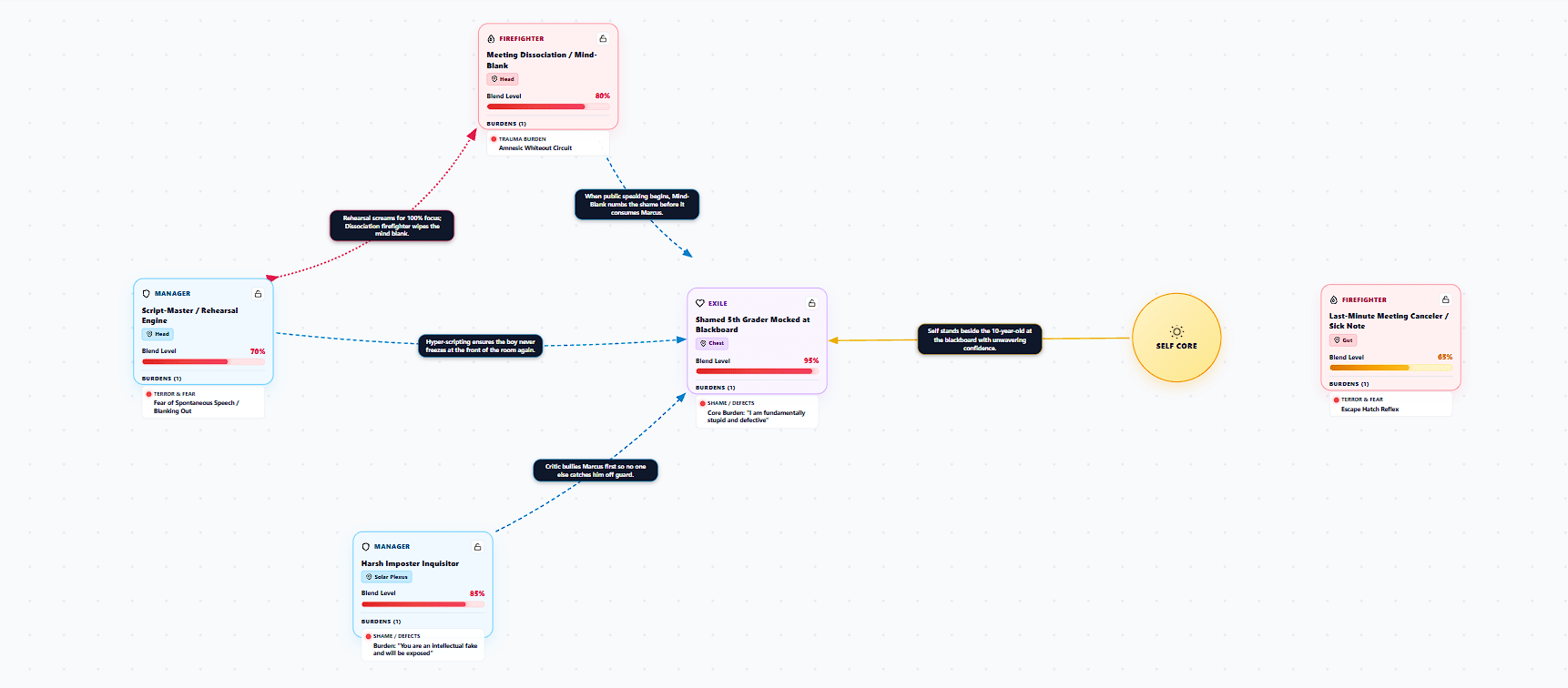
IFS Parts Map: Social Anxiety Imposter and Dissociation

Figure 3: Mapping the defensive link between intellectual criticism and cognitive dissociation.

Clinical Presentation: Marcus earned a promotion to director at a biotech firm. Despite strong technical skills, speaking in senior leadership meetings terrified him. The night before presentations, he stayed up until 3 AM rehearsing every word. Yet, when called upon in front of colleagues, his throat would tighten, his vision would blur, and his mind would go completely blank.

Systemic Analysis: Marcus is blended with a harsh Imposter Inquisitor manager in his solar plexus. This part constantly tells him, "You are a fraud, and they are going to find out today." To protect against this, Marcus's Script-Master manager drafts extensive scripts.

However, when Marcus stands in front of the boardroom, the terror becomes too intense. That is when his Mind-Blank Dissociation firefighter steps in. It cuts cognitive connections like pulling a plug from a wall. While Marcus experiences this as an embarrassing failure, the firefighter is actually saving him from acute panic. Both protectors are shielding a 10-year-old exile who was laughed at while standing frozen at the blackboard in school.

Part Name Role Somatic Locus Blend Level Positive Intention & Core Fear Burden Details
Harsh Imposter Inquisitor Manager Solar Plexus 85% Intention: Preemptively criticize Marcus.
Fear: Public exposure and humiliation.
Shame burden: "You are an intellectual fake."
Script-Master / Rehearsal Manager Head 70% Intention: Script every word in advance.
Fear: Spontaneous speech will reveal incompetence.
Fear burden: "Unscripted vulnerability brings ruin."
Meeting Dissociation / Blank Firefighter Head 80% Intention: Cut off conscious awareness.
Fear: Intense shame will cause a cardiac panic attack.
Trauma circuit: Amnesic whiteout response.
Shamed 5th Grader Exile Chest 95% Intention: Carries curiosity and vulnerability.
Fear: Being stared at, laughed at, and dismissed.
Core shame: "I am fundamentally stupid."

💡 Clinical Trailhead & Unblending Intervention

The key breakthrough occurred when the therapist asked Marcus, "How do you feel toward the part that blanks your mind?" Marcus initially replied, "I hate it; it is ruining my career." Recognizing this irritation as another manager, the clinician guided Marcus to ask the irritated part to soften. Once Marcus shifted into Self with genuine curiosity, the Dissociation firefighter explained its protective role. It agreed to stay present while Marcus's Self visited the 10-year-old boy at the blackboard, helping him unburden that early classroom shame.

Case Example 04: Creative Block & Procrastination

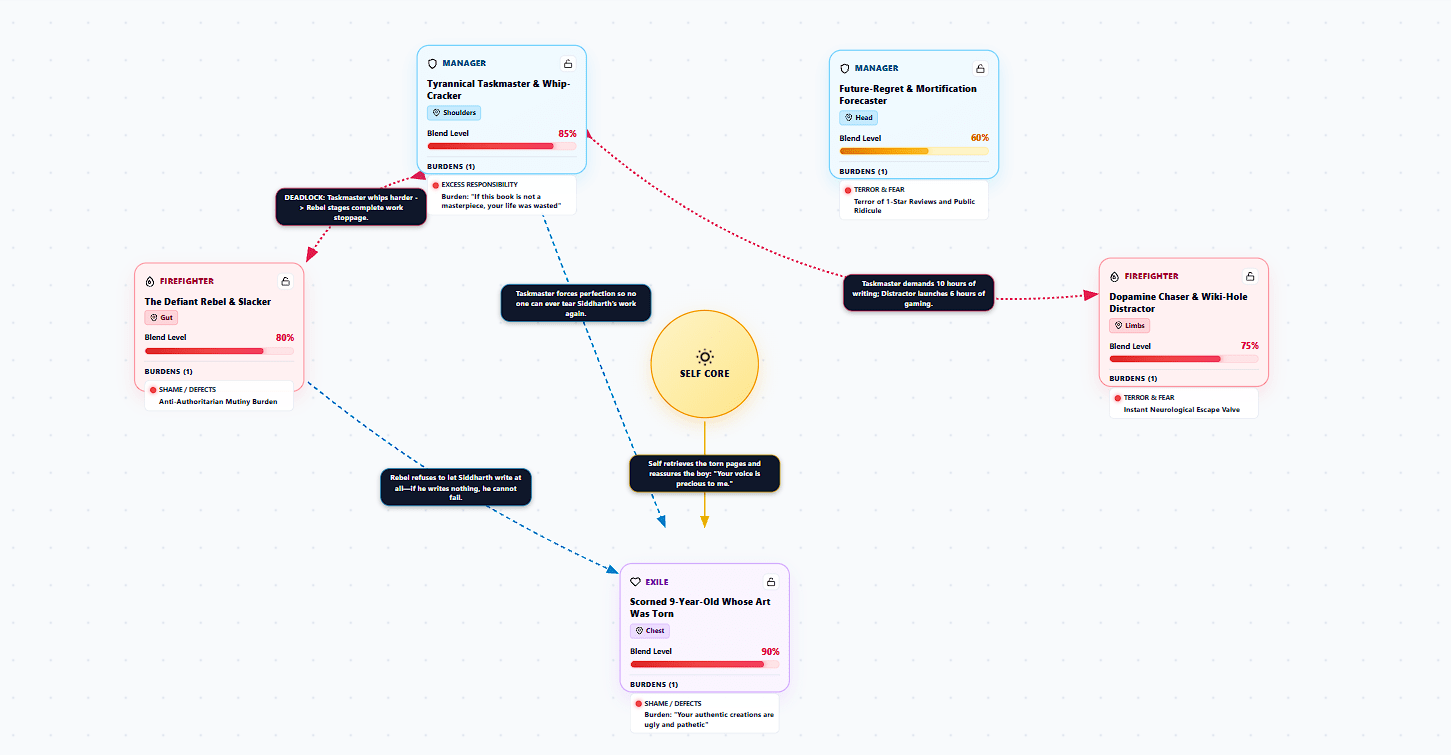
Chronic Procrastination: Tyrannical Taskmaster vs. Defiant Rebel

Client Profile: Siddharth, 33, Novelist and Content Strategist | Presenting Complaint: Paralyzing creative block and 8-hour internet rabbit-holes

Clone Map in Genosm
IFS Parts Map: Chronic Procrastination Taskmaster and Defiant Rebel

Figure 4: Polarization spring mode in Genosm showing how opposing protectors maintain creative paralysis.

Clinical Presentation: Siddharth received a book contract with a publishing house. Two years later, he had written only twelve pages. Every morning, he sat at his desk promising to write for six hours. Within fifteen minutes, he was reading articles about unrelated topics, organizing folders, or playing strategy games until dinner.

Systemic Analysis: In Genosm's polarization spring layout, we mapped an intense internal tug-of-war. On one side stands the Tyrannical Taskmaster manager. This part cracks an internal whip, saying, "If this novel is not a masterpiece, you are completely worthless."

Directly polarized with the Taskmaster is a Defiant Rebel firefighter. The Rebel refuses to be bullied. It stages an internal walkout, shouting, "You cannot force me to work!" Then, the Dopamine Chaser firefighter takes over the mouse and keyboard to provide entertainment. Both parts are working overtime to protect a 9-year-old exile whose childhood poetry notebook was torn up and thrown in the trash by a critical father. If Siddharth writes nothing, his work cannot be ridiculed.

Part Name Role Somatic Locus Blend Level Positive Intention & Core Fear Burden Details
Tyrannical Taskmaster Manager Shoulders 85% Intention: Drive legendary creative output.
Fear: Mediocrity, obscurity, and waste of talent.
Responsibility burden: "It must be genius or it is trash."
The Defiant Rebel Firefighter Gut 80% Intention: Protect freedom and autonomy.
Fear: Becoming a soulless corporate machine.
Anti-authority burden: "No one dictates my spirit."
Dopamine Chaser / Rabbit Hole Firefighter Limbs 75% Intention: Provide immediate stimulation.
Fear: Facing the blank page and feeling empty.
Escape valve: Digital numbing.
Scorned 9-Year-Old Creator Exile Chest 90% Intention: Pure artistic wonder and play.
Fear: Having his stories ridiculed and thrown away.
Core shame: "My creations are silly and worthless."

💡 Clinical Trailhead & Unblending Intervention

Rather than trying to help the Taskmaster force more writing, the therapist facilitated a direct dialogue between the Taskmaster and the Rebel. The clinician asked both parts to look at each other and notice their shared mission: both were desperate to protect the 9-year-old artist. When both protectors saw that adult Self was ready to protect the boy's creative joy without needing harsh perfection, the internal deadlock broke. Siddharth resumed writing in enjoyable 45-minute sessions.

Case Example 05: Substance Soothing & Grief

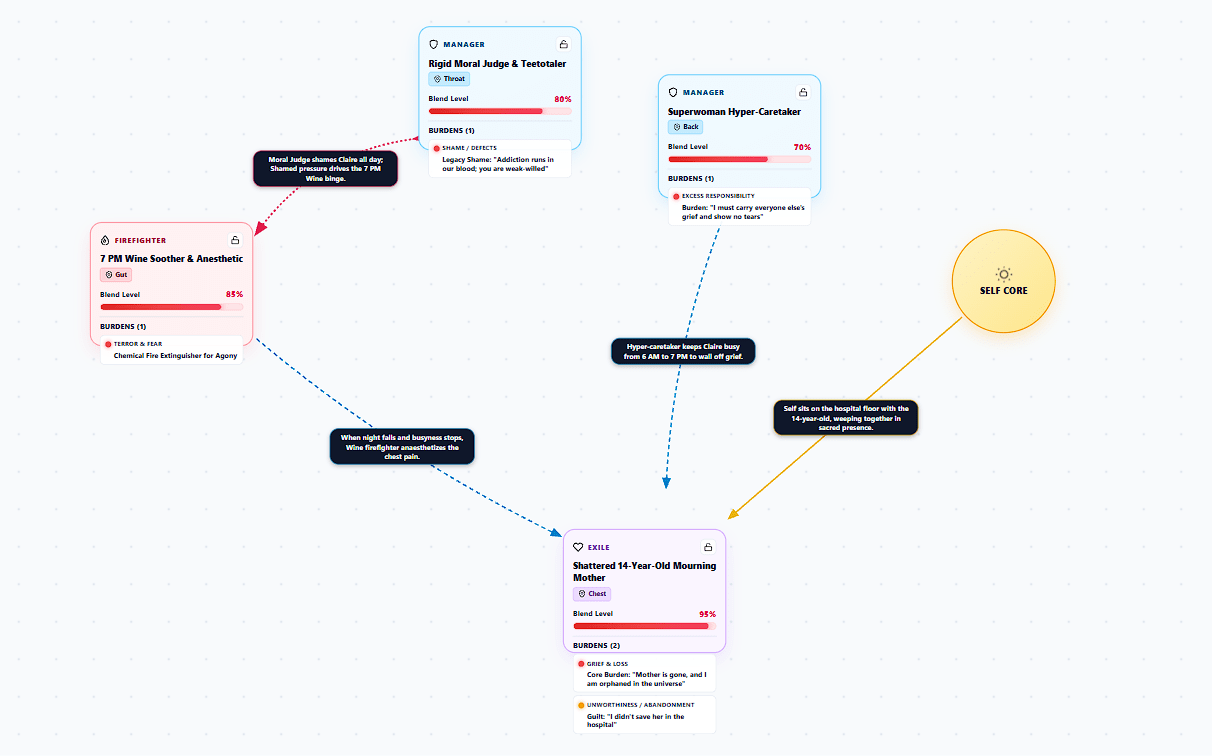
Alcohol Craving, Moral Enforcer & Bereavement Grief Exile

Client Profile: Claire, 47, Corporate Executive | Presenting Complaint: Nightly wine cravings after the death of her mother and intense self-loathing

Clone Map in Genosm
IFS Parts Map: Alcohol Craving and Grief Exile

Figure 5: Mapping chemical firefighter soothing against maternal bereavement burdens.

Clinical Presentation: Following her mother's death from cancer, Claire managed funeral arrangements, estate finances, and family care without shedding a tear. However, by 7 PM every evening, an overwhelming urge drove her to drink an entire bottle of wine alone in the kitchen.

Systemic Analysis: Claire's morning system is run by a Superwoman Hyper-Caretaker manager that keeps her occupied from dawn to dusk. It is accompanied by a severe Moral Judge manager that carries family legacy shame around substance use.

At night, when work stops and the quiet house settles, the painful ache of maternal loss begins rising into Claire's chest. This triggers the 7 PM Wine Soother firefighter. This part rushes in to douse the emotional fire with wine before the feelings can overwhelm her. The firefighter is not trying to damage Claire's health; it is desperately shielding a 14-year-old exile who felt completely abandoned in the hospital hallway when her mother passed away.

Part Name Role Somatic Locus Blend Level Positive Intention & Core Fear Burden Details
Rigid Moral Judge Manager Throat 80% Intention: Enforce family respectability.
Fear: Becoming an out-of-control alcoholic.
Legacy shame: "Addiction runs in our blood."
Superwoman Caretaker Manager Back 70% Intention: Carry everyone else's sorrow.
Fear: If I cry, the family falls apart.
Responsibility burden: "Never show weakness."
7 PM Wine Soother Firefighter Gut 85% Intention: Numb the physical chest ache.
Fear: Unbearable grief will swallow Claire whole.
Fear burden: "Raw grief is fatal."
Grieving 14-Year-Old Exile Chest 95% Intention: Holds deep love and attachment to mother.
Fear: Being forced to forget her mom.
Grief burden: "I am an orphan lost in the world."

💡 Clinical Trailhead & Unblending Intervention

Rather than treating the alcohol craving as a standalone habit, the clinician invited Claire to get curious about the Wine Soother. When Claire unblended from the Moral Judge and extended genuine warmth to the Wine Soother, the part revealed how exhausted it felt. It said, "I hate making her dizzy, but I cannot let that little girl cry all alone." Once the protector gave permission, Claire's Self embraced the 14-year-old exile, allowing her to mourn in a safe therapeutic environment. Within three weeks, the urgent evening alcohol cravings subsided.

Case Example 06: Eating Disorders & Body Image

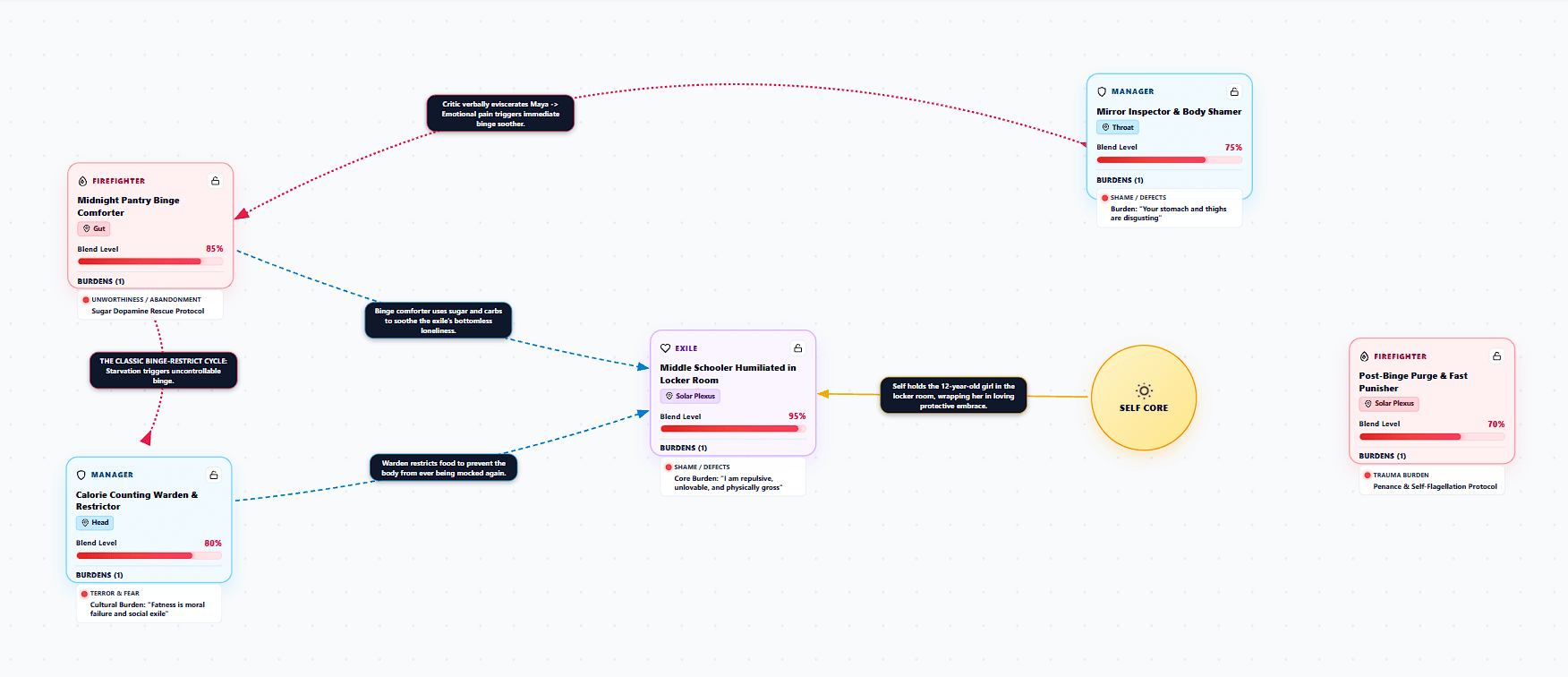
Binge Eating, Restriction Warden & Body Dysmorphia Shame

Client Profile: Maya, 26, Graduate Student | Presenting Complaint: Binge-purge cycles, severe mirror distress, and obsessive food tracking

Clone Map in Genosm
IFS Parts Map: Binge Eating and Body Shame

Figure 6: Mapping the circular trigger path between dietary restriction, binge relief, and body shame.

Clinical Presentation: Maya struggled with an exhausting cycle. Monday through Thursday, she strictly limited her food intake to 1,000 calories a day. By Friday night, extreme physical hunger and emotional fatigue triggered an uncontrollable binge on cookies, cereal, and bread. Afterwards, she experienced intense disgust, prompting weekend fasting.

Systemic Analysis: Maya's system features a rigid Calorie Counting Warden manager in her head that tracks grams and portions. Allied with it is a Mirror Inspector that criticizes her reflection in the bathroom mirror.

When the Warden starves the body, the nervous system enters an emergency state. This activates the Midnight Pantry Binge firefighter. It floods Maya with an urgent impulse to consume sugar and carbohydrates. Both protectors surround a 12-year-old exile who was bullied in middle school gym class when classmates laughed at her body shape. The Warden tries to prevent future teasing through thinness, while the Binge part uses food to soothe the exile's lingering loneliness.

Part Name Role Somatic Locus Blend Level Positive Intention & Core Fear Burden Details
Calorie Counting Warden Manager Head 80% Intention: Control body size strictly.
Fear: Gaining weight and facing social rejection.
Cultural burden: "Thinness equals safety and love."
Midnight Pantry Binge Firefighter Gut 85% Intention: Provide fast biochemical comfort.
Fear: Starving physically and emotionally.
Urgency burden: Immediate dopamine soothe.
Mirror Inspector & Shamer Manager Throat 75% Intention: Point out flaws before others do.
Fear: Letting down our guard.
Shame burden: "Your body is unacceptable."
Bullied 12-Year-Old Exile Solar Plexus 95% Intention: Holds natural hunger and body vitality.
Fear: Being exposed and laughed at.
Trauma burden: "I am repulsive and defective."

💡 Clinical Trailhead & Unblending Intervention

In session, the therapist helped Maya see that the Binge firefighter was responding to starvation from the Warden. When Maya invited both parts into conversation from Self, the Warden agreed to test flexible, consistent eating. Maya then connected with the 12-year-old girl in the middle school locker room. Maya's Self stepped between the bullies and the girl, wrapping her in a warm jacket. Unburdening that childhood shame transformed Maya's relationship with both food and her body.

Case Example 07: Relationship Attachment

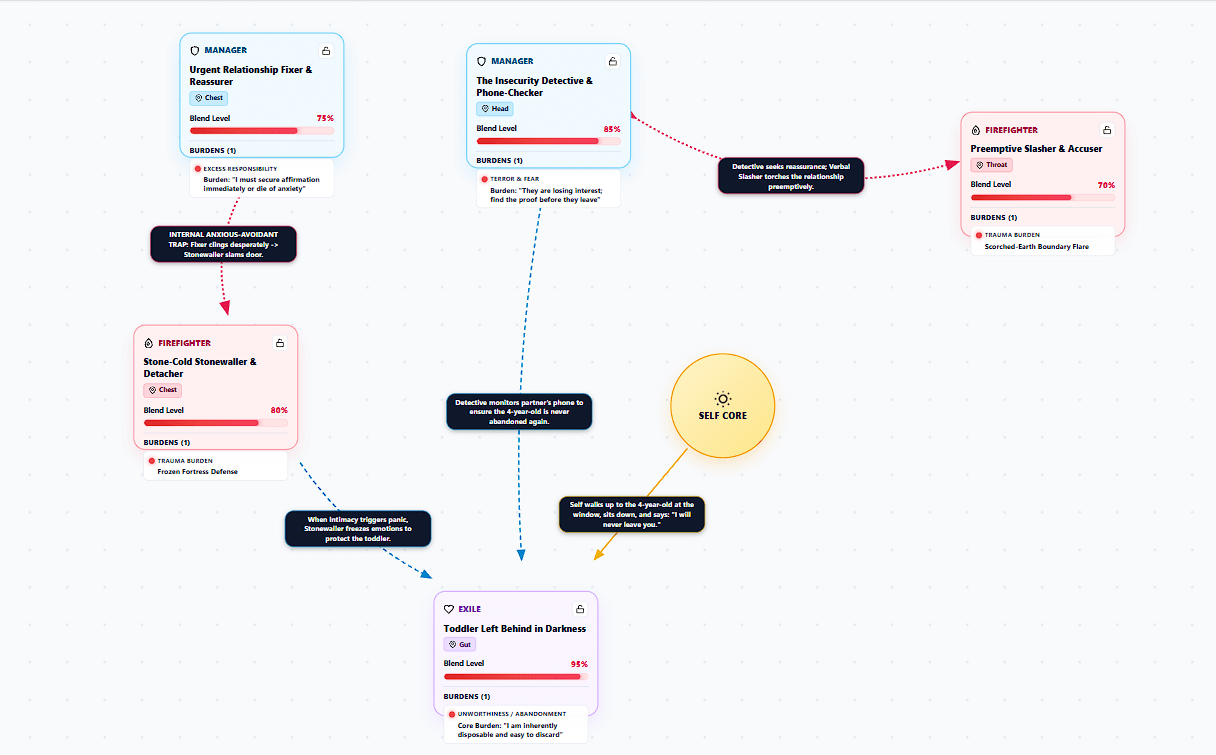
Relationship Jealousy, Anxious Detective & Avoidant Stonewaller

Client Profile: Devon, 31, Marketing Director | Presenting Complaint: Intense jealousy spirals, checking his partner's phone, followed by cold emotional shutdowns

Clone Map in Genosm
IFS Parts Map: Relationship Insecurity Detective and Stonewaller

Figure 7: Internal anxious-avoidant cycle mapped on the Genosm canvas.

Clinical Presentation: Devon came to therapy after a fight with his partner of three years. Whenever his partner took more than twenty minutes to reply to a text, Devon's chest constricted. He would analyze his partner's social media and check phone timestamps. When his partner arrived home, Devon would either send frantic accusatory questions or shut down completely for three days, refusing eye contact.

Systemic Analysis: Devon's parts map revealed an internal anxious-avoidant loop. The Insecurity Detective manager monitors for signs of withdrawal. An allied Anxious Fixer demands immediate verbal reassurance.

However, when Devon feels vulnerable or fears that his partner is angry, the Stone-Cold Stonewaller firefighter steps in. It drops an emotional iron gate, turning off Devon's facial expressions and empathy. Both protectors shield a 4-year-old toddler exile who was left alone in a dark house when his mother left for weeks at a time. The Detective tries to catch abandonment early, while the Stonewaller makes sure Devon hurts first rather than being caught off guard.

Part Name Role Somatic Locus Blend Level Positive Intention & Core Fear Burden Details
Insecurity Detective Manager Head 85% Intention: Find evidence of rejection early.
Fear: Being blindsided and betrayed.
Fear burden: "They are pulling away."
Anxious Fixer Manager Chest 75% Intention: Demand immediate reassurance.
Fear: Emotional distance equals permanent loss.
Responsibility burden: "Fix distance instantly."
Stone-Cold Stonewaller Firefighter Chest 80% Intention: Lock down vulnerability.
Fear: Giving someone the power to destroy us.
Freeze defense: Emotional stone fortress.
Abandoned 4-Year-Old Exile Gut 95% Intention: Carries deep love and devotion.
Fear: Vanishing into total darkness alone.
Core unworthiness: "I am inherently disposable."

💡 Clinical Trailhead & Unblending Intervention

Devon initially viewed his phone-checking and his stonewalling as two separate problems. Mapping them side-by-side in Genosm helped him see that both parts were trying to protect the same scared toddler looking out the window in the dark. In session, Devon's Self sat beside the 4-year-old and made a commitment: "I am here now. Even if someone takes time to reply, I will never abandon you." Healing this attachment wound helped Devon stop checking his partner's phone and talk openly about his feelings instead.

Case Example 08: Somatic Anxiety & Health

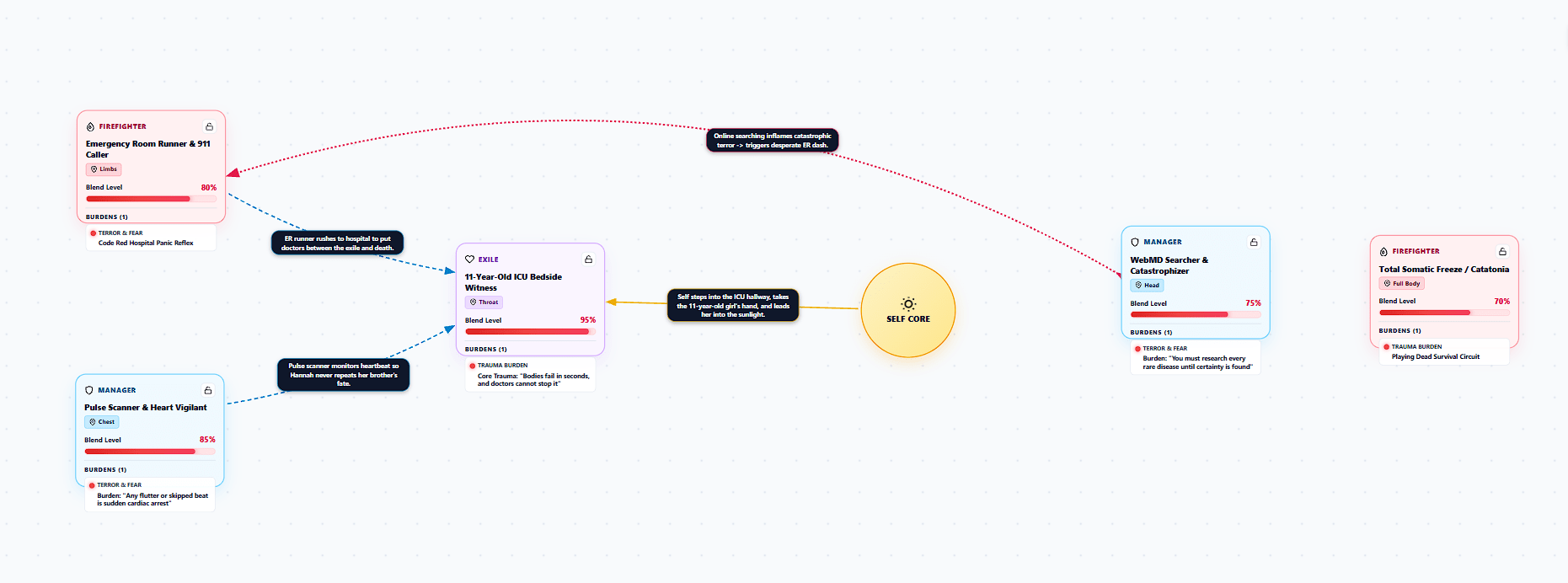
Health Anxiety, Heart Pulse Scanner & Emergency Room Runner

Client Profile: Hannah, 38, Architect | Presenting Complaint: Cardiophobia, repeated emergency room visits for benign palpitations, and medical research compulsions

Clone Map in Genosm
IFS Parts Map: Health Anxiety Scanner and ER Runner

Figure 8: Somatic loci mapping showing heart and throat connections during medical panic.

Clinical Presentation: Hannah underwent three clean cardiology evaluations with normal ECGs and Holter monitor tests. Despite clean bills of health, she checked her radial pulse sixty times a day. If her heart rate exceeded 85 beats per minute while sitting, she searched medical forums on her phone. Within thirty minutes, an adrenaline surge would convince her that cardiac arrest was imminent, prompting 911 calls.

Systemic Analysis: Hannah's system is supervised by an alert Pulse Scanner manager in her chest and fingers. An allied WebMD Catastrophizer searches symptoms online to try to find intellectual certainty.

When the online reading intensifies her fear, the Emergency Room Runner firefighter takes the wheel. It forces Hannah into her car to drive to the nearest hospital, believing that only a defibrillator can save her life. These protectors are guarding an 11-year-old exile who watched her older brother suffer a cardiac arrest in an intensive care unit. For this young part, sudden physical changes mean fatal danger.

Part Name Role Somatic Locus Blend Level Positive Intention & Core Fear Burden Details
Pulse Scanner Manager Chest 85% Intention: Catch heart irregularities early.
Fear: Sudden, unpredicted death.
Fear burden: "Skipped beats mean fatal arrest."
WebMD Catastrophizer Manager Head 75% Intention: Gain certainty through research.
Fear: Missing a rare diagnosis.
Cognitive loop: Obsessive symptom research.
Emergency Room Runner Firefighter Limbs 80% Intention: Place Hannah near doctors.
Fear: Dying helpless at home alone.
Emergency reflex: Urgent hospital flight.
11-Year-Old ICU Witness Exile Throat 95% Intention: Holds deep love for brother.
Fear: The sudden, terrifying fragile loss of life.
Trauma burden: "Bodies can fail without warning."

💡 Clinical Trailhead & Unblending Intervention

The therapist guided Hannah to place her hand gently over her heart and speak directly to the Pulse Scanner. Hannah asked, "How old do you think I am?" The scanner replied, "Eleven." It had no idea Hannah was an adult whose cardiovascular system was healthy. Once the protector learned that adult Self was present, it agreed to stop pulse-checking for thirty minutes. This allowed Hannah's Self to visit the 11-year-old girl in the hospital waiting room, witness her grief, and lead her out of that cold corridor into safety.

Case Example 09: Complex Trauma & Boundary Defense

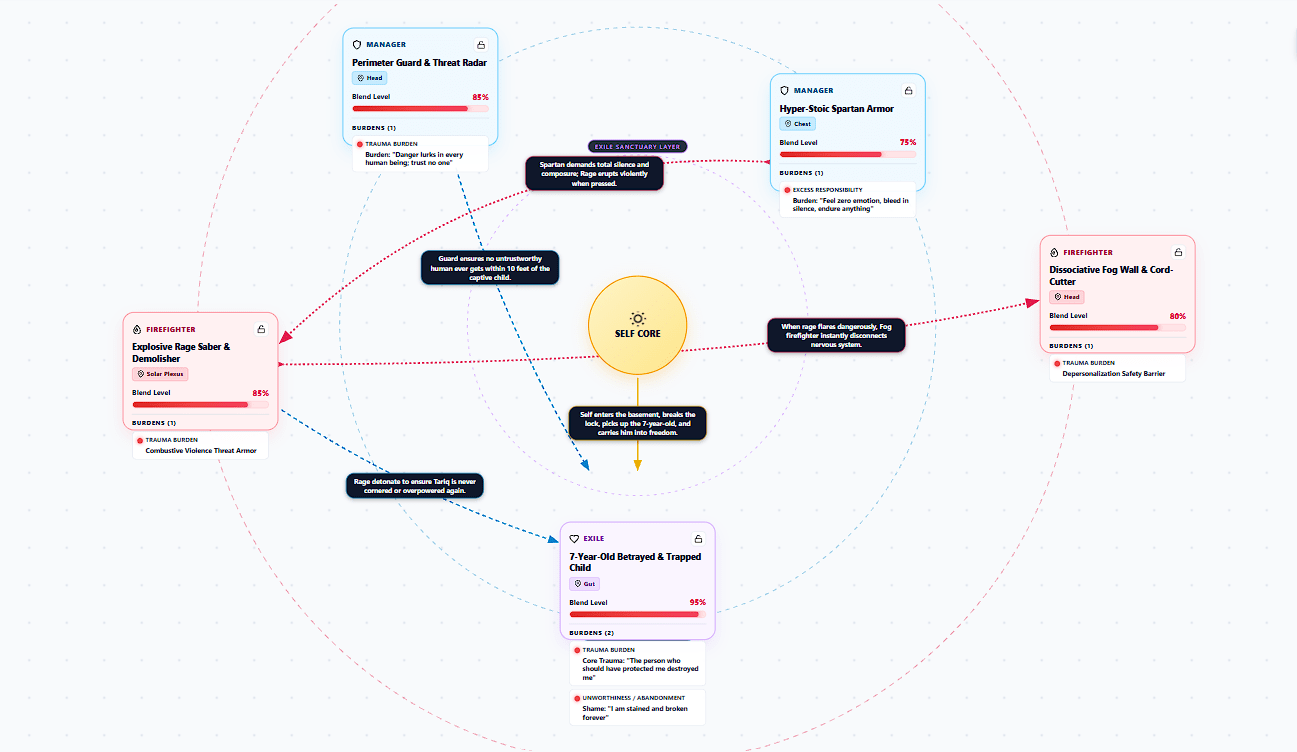
Complex PTSD: Perimeter Guard, Stoic Spartan & Explosive Rage Saber

Client Profile: Tariq, 36, Military Veteran and Social Worker | Presenting Complaint: Sudden road rage episodes, hypervigilance in public spaces, and emotional numbness with family

Clone Map in Genosm
IFS Parts Map: C-PTSD Perimeter Guard and Rage Saber

Figure 9: Mapping trauma hypervigilance and combative boundary enforcement.

Clinical Presentation: Tariq served eight years in the military before becoming a community caseworker. At work, he was dedicated and disciplined. In public, however, he could not sit with his back to a restaurant door. If a driver cut him off in traffic, an explosive rage surged through him, leading to yelling and confrontations. At home, his partner noted that Tariq seemed like an "iron statue" who showed almost no emotion.

Systemic Analysis: Tariq's system is guarded by a Perimeter Threat Radar manager that scans crowds constantly. Inside his chest sits the Hyper-Stoic Spartan, an armor part that says, "Feel nothing, endure everything, never show pain."

When someone crosses a physical boundary, the Explosive Rage Saber firefighter detonates. This part uses fierce intimidation to push people back. If the confrontation becomes too intense, a Dissociative Fog firefighter disconnects his feelings. These warrior parts protect a 7-year-old exile who was physically abused by a caregiver behind locked basement doors. The protectors made a vow that Tariq would never be cornered or helpless again.

Part Name Role Somatic Locus Blend Level Positive Intention & Core Fear Burden Details
Perimeter Threat Radar Manager Head 85% Intention: Scan for danger and deception.
Fear: Being ambushed and pinned down.
Trauma burden: "Danger is everywhere; trust no one."
Hyper-Stoic Spartan Manager Chest 75% Intention: Suppress soft emotions.
Fear: Vulnerability invites predators.
Stoic burden: "Bleed in silence."
Explosive Rage Saber Firefighter Solar Plexus 85% Intention: Intimidate boundary violators.
Fear: Being made helpless or overpowered.
Combative defense: Overwhelming counter-attack.
Betrayed 7-Year-Old Exile Gut 95% Intention: Holds deep loyalty and innocence.
Fear: Being trapped in the dark with the abuser.
Trauma burden: "The person who should have protected me broke me."

💡 Clinical Trailhead & Unblending Intervention

Instead of treating the rage as an anger management problem, the therapist thanked the Rage Saber for keeping Tariq alive in childhood. Hearing appreciation brought tears to Tariq's eyes. When the warrior protectors realized that Tariq was now an adult with physical strength and mature wisdom, they allowed Self to enter the basement memory. Tariq's Self picked up the 7-year-old boy, walked out into the open air, and helped the protectors understand that their 24-hour guard duty could finally soften.

Case Example 10: Caregiver Burnout & Parentification

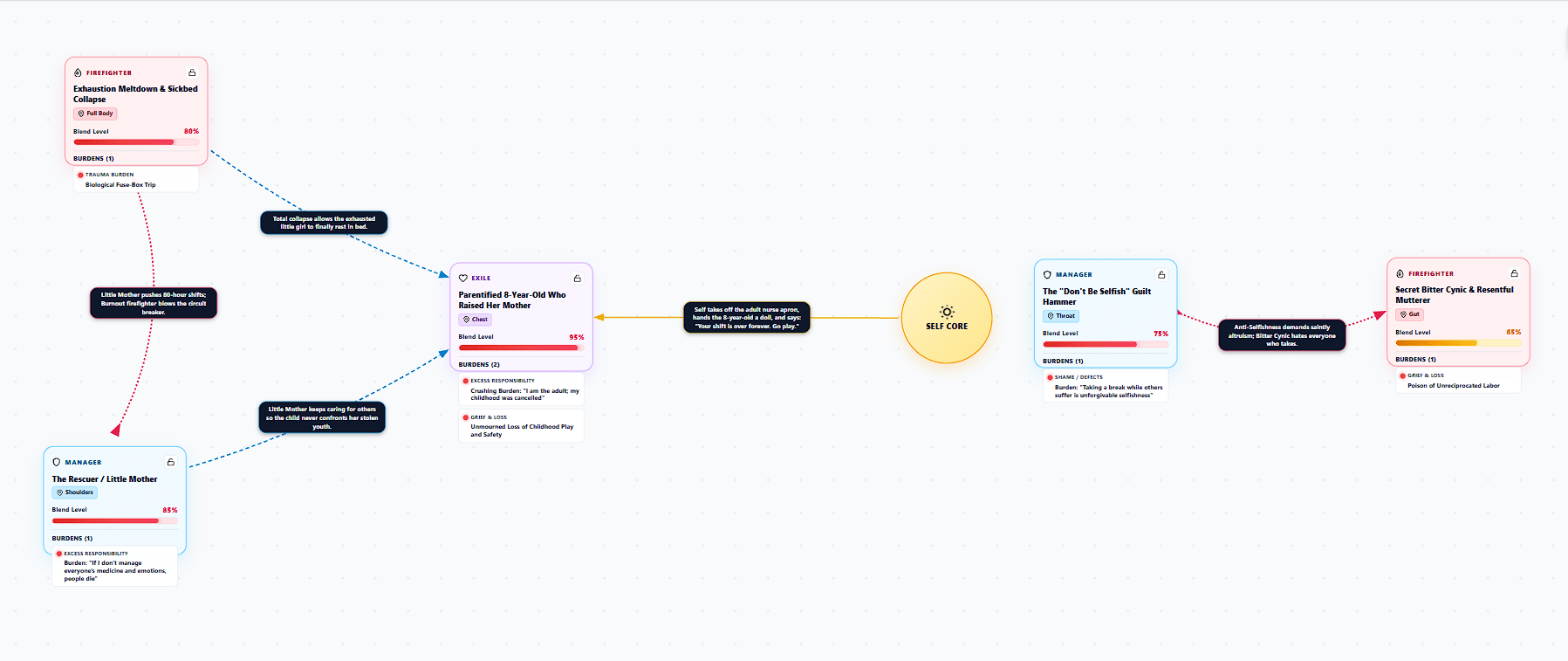
Caregiver Burnout, Rescuer "Little Mother" & Parentified Child Exile

Client Profile: Rachel, 44, Palliative Care Nurse | Presenting Complaint: Severe professional burnout, inability to take sick days, and secret resentment toward family

Clone Map in Genosm
IFS Parts Map: Caregiver Burnout Rescuer and Parentified Child

Figure 10: Mapping the parentified child system that drives healthcare worker burnout.

Clinical Presentation: Rachel spent twenty years working in palliative oncology. At home, she managed care for her elderly father, helped her adult siblings pay bills, and coordinated family gatherings. She had not taken a vacation in seven years. When her supervisor urged her to take time off, a wave of guilt hit her. Recently, she began having sudden dizzy spells and heart palpitations, forcing her into sick leave.

Systemic Analysis: Rachel's primary manager is the Little Mother / Rescuer, which holds heavy responsibility on her shoulders. Working beside it is the "Don't Be Selfish" Guilt Hammer, a part that shames Rachel whenever she sits down with a book or takes a long bath.

Because the managers never allow Rachel to pause, her Burnout Collapse firefighter pulls the plug with physical dizziness. An allied Bitter Cynic firefighter mutters under its breath, "Nobody ever takes care of you." These parts protect an 8-year-old parentified child exile who had to cook meals, buy groceries, and manage medication for an alcoholic mother. Her childhood was cancelled to keep the family afloat.

Part Name Role Somatic Locus Blend Level Positive Intention & Core Fear Burden Details
The Rescuer / Little Mother Manager Shoulders 85% Intention: Ensure everyone survives.
Fear: Someone will die or suffer on her watch.
Crushing responsibility: "I must save everyone."
Anti-Selfishness Guilt Hammer Manager Throat 75% Intention: Prevent moral failure.
Fear: Being labeled self-centered and cast out.
Shame burden: "Resting while others suffer is evil."
Burnout Meltdown / Collapse Firefighter Full Body 80% Intention: The only way Rachel gets to stop.
Fear: Complete biological collapse.
Somatic shutdown: Biological fuse trip.
Parentified 8-Year-Old Exile Chest 95% Intention: Carries lost playfulness, joy, and wonder.
Fear: Carrying the entire family until her back breaks.
Grief burden: "My childhood was stolen."

💡 Clinical Trailhead & Unblending Intervention

When Rachel connected with the Little Mother from Self, she realized this part was carrying the exact job she had at eight years old. Rachel's Self took off the invisible apron from the little girl's shoulders and told her, "Your shift is over. I am forty-four years old now, and I can handle the adult decisions. You are allowed to rest and play." With that unburdening, Rachel set clear boundaries at work, delegated family responsibilities, and took her first real holiday in seven years.

How to Unblend Parts in Session: The 6 Fs Protocol

In Internal Family Systems therapy, unblending helps clients separate from protector overwhelm and lead from Self. Genosm includes an interactive 6 Fs step-by-step wizard to guide this clinical sequence.

1

Find the Part

Help the client locate where the part shows up in or around the body (e.g., tight chest, clenched jaw, heavy gut). Genosm maps this directly onto our 9-region somatic body tracker.

2

Focus Inward

Guide the client to bring conscious, mindful awareness directly to that somatic sensation without trying to push it away or analyze it intellectually.

3

Flesh Out Details

Ask what images, colors, shapes, or ages emerge. Does it feel like an adult, an object, a wall of fog, or a scared young child?

4

Feel Toward (Check Self-Energy)

Ask: "How do you feel toward this part right now?" If the client answers with frustration or fear, another part is blended. Ask that second part to step back.

5

Befriend the Part

Express gratitude for how hard the part has worked. Learn its positive intention and how long it has been doing this protective job for the system.

6

Understand Its Fear

Ask: "What are you afraid would happen if you stopped doing this job?" This reveals the vulnerable exile that the protector is working so hard to shield.

Built for Clinicians

Why Therapists Choose Genosm Over Generic Whiteboard Software

Most therapists struggle with generic digital whiteboards that require thirty minutes of tedious drawing, lack clinical awareness, and store sensitive client notes on public servers. Genosm is custom-engineered for mental health professionals:

⚡
Map in Seconds (Manual + AI) Draw parts by hand with intuitive drag-and-drop, or paste intake notes into our AI Intake Scribe to generate a structured parts map instantly.
🎨
Full Visual Customization Customize every visual detail. Change node colors, adjust line thickness, pick vector curve styles, set border dashes, and anchor somatic body regions.
🔒
100% Local HIPAA Privacy Zero client names, trauma notes, or parts maps are stored on our servers. Everything stays locked in your browser's local memory.
📄
Vector PDF & EHR Exports Export high-resolution vector PDFs, transparent PNGs, or de-identified JSON backups to attach to SimplePractice, TherapyNotes, or Epic.

Frequently Asked Questions for Clinicians

Answers to common questions about mapping parts in therapy sessions.

Can a single part act as both a Manager and a Firefighter?

In Dr. Richard Schwartz's model, parts are defined by their primary role and strategy. However, some protectors can shift roles depending on context. For example, an intellectualizing part might act as a proactive Manager during office hours, but switch to a compulsive Firefighter reading forums late at night if panic rises. In Genosm, you can easily adjust part roles or link secondary firefighter functions.

How do I map parts when a client is heavily blended during intake?

When a client is blended, they cannot see the part because they are seeing through the part. Do not try to force them to unblend right away. Instead, invite them to map the blended part on the screen first. Seeing the part externalized on Genosm's visual canvas often provides enough perspective for the client to take a breath and access their first moments of Self-energy.

What is a "Self-Like Part" and how should therapists map it?

A Self-Like Part is an intellectual manager that imitates Self-energy. It talks about therapy concepts, sounds calm, and analyzes feelings, but lacks true somatic warmth, compassion, and open-hearted curiosity. Genosm provides a dedicated "Self-Like" indicator toggle so therapists can visually mark analytical parts that need to step back.

Is Genosm suitable for telehealth and screen sharing with clients?

Yes. Genosm is designed for live clinical sessions over Zoom, Google Meet, or Microsoft Teams. Therapists can share their screen, map parts collaboratively as the client speaks, and let clients watch their internal system organize in real time.

Fast & 100% HIPAA Private

Map Your First Client's Internal System in Seconds

Experience dedicated clinical software for Internal Family Systems. Full interactive unblending, somatic tracking, and instant EHR vector exports with zero cloud PHI risk.

Credit card required for free trial. 100% private, browser-based workflow.