Clinical Origins: David H. Malan's Dual-Triangle Model
The Triangle of Conflict and Triangle of Persons were developed in the 1970s by Dr. David H. Malan (1976, 1979) at the Tavistock Clinic to distill the intricate mechanics of psychoanalytic psychotherapy into an operational, empirical framework. Malan recognized that psychological suffering stems from a universal intrapsychic conflict: when an authentic, primary feeling or impulse rises toward consciousness, it triggers unconscious anxiety, driving the patient to deploy defensive maneuvers to suppress the feeling.
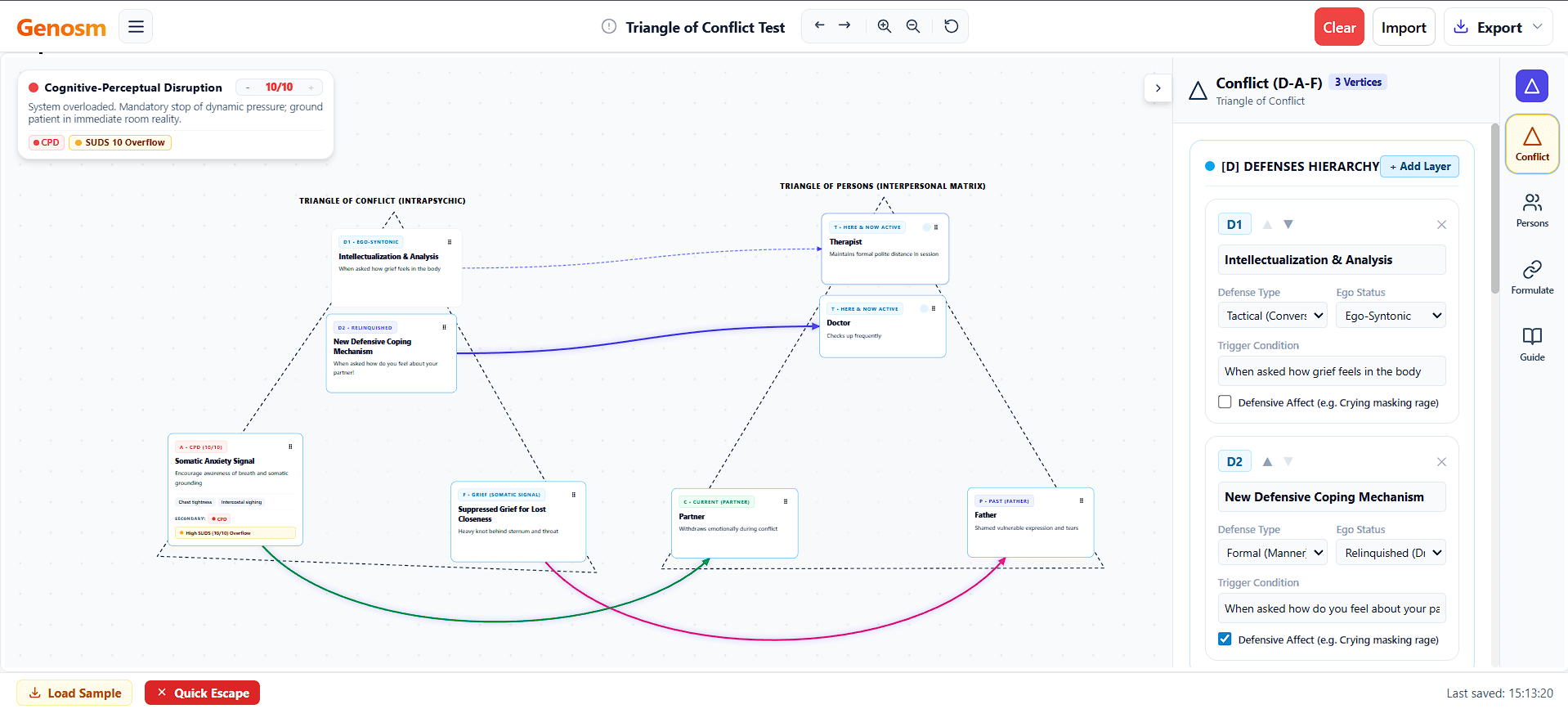
To make this intrapsychic process clinically actionable, Malan created two interlocking geometric triangles. The Triangle of Conflict maps what happens internally (Defense, Anxiety, Feeling), while the Triangle of Persons maps where this dynamic is lived out: in the therapy room with the clinician (Transference / T), in current everyday relationships (Current / C), and in historical childhood attachments (Past / P).
This foundational framework was expanded by Dr. Habib Davanloo (1990, 2000) in Intensive Short-Term Dynamic Psychotherapy (ISTDP) through the rigorous observation of autonomic somatic anxiety channels, and by Dr. Leigh McCullough (2003) in Affect Phobia Therapy (APT). Genosm provides the first purpose-built interactive canvas to operationalize Malan's dual-triangle framework in real-time clinical practice.
The Dual-Triangle Architecture: Intrapsychic vs Interpersonal
Malan's genius lies in pairing intrapsychic conflict with interpersonal enactments. When therapists understand both triangles simultaneously, they can formulate clear, evidence-based linking hypotheses that connect in-session defenses with childhood origins and current relationship distress:
Triangle of Conflict (Intrapsychic)
D • A • FMaps internal psychological tension and the mechanisms used to ward off painful or forbidden emotions:
Triangle of Persons (Interpersonal)
T • C • PMaps the three distinct relational spheres where defensive maneuvers and emotional conflicts repeat:
Three Somatic Anxiety Pathways: Davanloo's Safety Matrix
In Intensive Short-Term Dynamic Psychotherapy (ISTDP), Habib Davanloo established that unconscious anxiety discharges through three discrete neurobiological pathways. Assessing these pathways in real time gives the clinician immediate guidance on whether the patient has the physiological capacity to tolerate deeper affective exploration or requires immediate somatic regulation:
| Autonomic Pathway | Safety Status | Bodily Sensations | Clinical Action Required | Therapeutic Pacing |
|---|---|---|---|---|
|
Striated Muscle
Voluntary Motor System
|
Regulated • Safe | Intercostal deep sighing, clenched fists, jaw clenching, neck and shoulder tightness, chest pressure. | Safe for affective exploration, defense clarification, and direct feeling experience. | Continue Dynamic Pressure |
|
Smooth Muscle
Involuntary Visceral System
|
Dysregulated • Warning | Nausea, stomach cramping, sudden diarrhea/IBS, vascular migraine, bronchial constriction. | Visceral threshold reached. Immediately pause affective pressure; regulate anxiety somatically. | Pause & Regulate |
|
Cognitive-Perceptual
Sensory / Ego-Disruption
|
Critical • Overload | Tunnel vision, blurring, mind blanking, dizziness, vertigo, ringing ears, depersonalization/dissociation. | System overloaded. Mandatory halt of dynamic pressure. Ground client in immediate room reality. | Mandatory Grounding |
Defense Hierarchy Stratification & McCullough Core Affects
Genosm organizes defenses hierarchically, allowing psychotherapists to differentiate superficial conversational maneuvers from deep character armor, while anchoring authentic feelings in Leigh McCullough's Affect Phobia taxonomy:
Defense Hierarchy Stratification
- 1. Tactical Defenses: Momentary conversational detours in session (such as rapid topic changes, nervous laughter, vagueness, or answering questions with questions).
- 2. Formal Defenses: Recognized psychological mechanisms (such as intellectualization, rationalization, reaction formation, or projection).
- 3. Characterological Defenses: Habitual, lifelong personality armor (such as compulsive self-reliance, chronic compliance, chronic helplessness, or detachment).
McCullough Core Adaptive Affects
- Adaptive Grief & Mourning: Deep visceral release associated with genuine developmental or relational loss.
- Assertive Anger & Boundaries: Mobilizing empowering physical force to establish self-protection without destructive acting out.
- Tender Closeness & Attachment: Experiencing authentic intimacy, vulnerability, and mutual emotional bonding.
- Positive Self-Regard & Pride: Compassionate celebration of self-worth and internalized developmental achievements.
Software Capabilities: Interactive Formulation Matrix
Genosm transforms complex psychodynamic theory into an intuitive, responsive digital formulation suite designed for active therapy sessions, supervision, and clinical case conceptualization:
Dual-Triangle Interactive Canvas
Side-by-side rendering of the Triangle of Conflict (D-A-F) and Triangle of Persons (T-C-P) with live halo highlights, drag-and-drop node positioning, and connecting vectors.
Live Somatic Safety Traffic HUD
Monitors striated motor, smooth muscle visceral, and cognitive disruption channels with 0 to 10 SUDS distress ratings to guide clinical intervention pacing.
Automated Dynamic Linking Syntax
Synthesizes Malan linking interpretations connecting the intrapsychic conflict (feeling triggers anxiety leading to defense) with interpersonal spheres (transference, partner, caregiver).
Blank Homework & Case PDF Reports
Generate unshaded blank worksheets with clean dashed triangular guides for client self-observation, alongside comprehensive vector PDF clinical case summaries.
Step-by-Step Construction Guide in Genosm
Follow this standardized sequential clinical workflow during your initial assessment, ongoing formulation, or supervision review:
Assess Somatic Anxiety Discharge Pathway
Observe the patient's physiological response to emotional exploration. Select striated muscle motor tension, smooth muscle visceral reaction, or cognitive-perceptual disruption, and record the 0 to 10 SUDS distress intensity level.
Deconstruct Defenses & Core Feared Affects
Record the defensive coping behaviors observed in session (intellectualization, pleasing, sarcasm) and classify them as tactical, formal, or characterological. Identify the authentic core emotion beneath the defense and document its visceral bodily locus.
Populate the Triangle of Persons (T - C - P)
Map the three relationship domains where the defense manifests: live in session with the therapist (T), in current everyday life with partners or employers (C), and historically with primary attachment figures (P).
Synthesize Linking Hypotheses & Export Deliverables
Use the Dynamic Linking Formulation bridge to synthesize Malan's clinical interpretation sentence. Export your formulation as a high-resolution vector SVG, printable PDF clinical report, blank homework worksheet, or copy the formatted EMR progress note.
Clinical Modality Workflows & Use-Cases
How clinicians across different psychotherapeutic schools utilize the dual-triangle formulation matrix:
ISTDP & Affect Phobia Therapy
Track momentary defense restructuring, monitor striated muscle thresholds, and help patients build emotional capacity to experience warded-off grief and anger without somatic overflow.
Transference & Relational Psychotherapy
Clarify in-room transference maneuvers (avoiding eye contact, compliance, hostility) and link them directly to past childhood attachment conditioning and current marital tension.
Patient Psychoeducation & Homework
Print blank dual-triangle homework worksheets for clients to self-observe their defenses, somatic cues, and relationship triggers between weekly psychotherapy sessions.
Clinical Supervision & Case Consultation
Present dynamic formulations to supervisors and peer consultation groups with crisp vector graphics, clear defense stratification, and verifiable evidence trails.
Cross-Diagram Clinical Synergy & Multi-Modality Pairing
Combine the Triangle of Conflict with other Genosm clinical diagram tools to construct an integrated, multi-layered treatment formulation:
Pair with Window of Tolerance & Somatic Maps
Correlate striated muscle motor tension with the optimal Window of Tolerance and smooth muscle visceral breakdown with hyperarousal. Map visceral affect loci onto anterior and posterior body maps.
Pair with CBT Formulation & Schema Therapy
Translate characterological defenses into Early Maladaptive Schemas and CBT safety behaviors. Use Schema Mode Mapping to pair Malan defense postures with active Detached Protector modes.
Pair with IFS Parts & Transactional Analysis
Map Malan defenses as IFS Manager or Firefighter protective parts guarding young wounded Exiles (core grief/fear). Use Transactional Analysis PAC diagrams to map ego-state transference transactions.
Pair with Clinical Genograms & Sociograms
Trace the Past attachment origin (P) figures across multi-generational family trees using Genosm's genogram builder. Map Current life relationship dynamics with the Sociogram tool.
Zero-PHI Security, HIPAA Safeguards & Local Storage
Genosm is engineered with a strict 100% local-first, zero-knowledge architecture. All diagram calculations, client scores, session notes, and linking formulations execute strictly inside your local web browser:
Formulations and client data are saved exclusively in your browser storage. Zero cloud database risk.
Client names, session notes, and psychodynamic hypotheses never leave your local device.
Construct formulations seamlessly even without an active internet connection in private practice.
Clinical Comparison: Genosm vs Generic Diagram Tools
How Genosm's dedicated psychodynamic formulation suite compares against generic charting tools like Lucidchart, Miro, or static PDF worksheets:
| Capability | Genosm Tool | Generic Drawing Apps (Miro/Lucid) | Static PDF Worksheets |
|---|---|---|---|
| Dual-Triangle Architecture | Standardized Side-by-Side | Manual drawing required | Fixed static printed lines |
| Somatic Anxiety HUD (3 Channels) | Live Traffic Safety HUD | None | None |
| Dynamic Linking Syntax Generator | Automated Clinical Hypothesis | None | Manual handwriting |
| Zero-PHI Privacy Guarantee | 100% Local-First / Zero Cloud | Cloud database exposure | Physical paper storage |
| Blank Homework Worksheet Generator | 1-Click Unshaded Vector PDF | Complex export setup | Photocopy only |
| All 22 Diagram Types Included | Included ($9.99/mo) | Generic shapes only | Separate purchases |
Frequently Asked Questions
What is the Malan Triangle of Conflict and how does it relate to the Triangle of Persons?
David Malan formulated two interlocking triangles: the Triangle of Conflict maps intrapsychic dynamics between Defenses (D), Somatic Anxiety (A), and warded-off Core Feelings (F). The Triangle of Persons maps the relational domains where these patterns repeat: Transference with the therapist in the room (T), Current life relationships (C), and Past childhood attachment origins (P). Genosm renders both triangles side-by-side to help clinicians deliver cohesive linking interpretations.
Why are the three somatic anxiety pathways important in ISTDP?
In Intensive Short-Term Dynamic Psychotherapy (ISTDP), assessing autonomic discharge pathways tells the clinician if the patient has the physiological capacity to experience warded-off feelings. Striated muscle tension (sighing, motor tension) indicates safe affect tolerance. Smooth muscle activation (nausea, gastrointestinal cramps) and cognitive-perceptual disruption (dizziness, mental fog) indicate autonomic overload, requiring the therapist to pause pressure and regulate anxiety before proceeding.
Can I export blank worksheets for patient homework?
Yes. Genosm includes a dedicated Print Blank Worksheet feature. It generates clean, unshaded dual-triangle templates with empty write-in boxes and zero prefilled cards or lines, allowing patients to easily record their defenses, bodily sensations, and emotional triggers between sessions.
How does Genosm protect client confidentiality and comply with HIPAA?
Genosm utilizes a 100% local-first, zero-knowledge architecture. All diagram calculations, state updates, and exports occur entirely inside your web browser. Patient initials, session dates, and clinical formulations are stored locally in your browser IndexedDB and never transmit to external servers.
What is the pricing model for the Triangle of Conflict Tool?
The Triangle of Conflict tool is fully included in the Genosm professional subscription for $9.99 per month. This subscription gives you unlimited access to all 14 clinical diagram tools, high-resolution vector SVG exports, printable clinical PDF case reports, blank homework sheets, and progress note generators with zero hidden fees.
Can I copy formatted psychodynamic progress notes into my EHR?
Yes. You can copy a formatted psychodynamic progress note with one click to paste directly into SimplePractice, TherapyNotes, Epic, or any EHR system, or download a printable PDF report for your clinical binder.