Clinical Foundations: Michael White, David Epston & Dulwich Centre
Traditional diagnostic models often encourage clients to internalize their struggles, leading them to view themselves as inherently broken, defective, or disordered. In contrast, Narrative Therapy, pioneered in the late 1980s and 1990s by Michael White (Dulwich Centre, Adelaide, Australia) and David Epston (Family Therapy Centre, Auckland, New Zealand), operates from a radically empowering clinical axiom:
Drawing upon narrative psychology (Jerome Bruner) and social post-structuralism, White and Epston demonstrated that lives are lived through stories. When a person seeks therapy, they are typically trapped in a problem-saturated story. This dominant narrative filters out all contradictory evidence, blinding the individual to their own competencies, values, and historical acts of resistance.
Through externalizing conversations, clinicians help clients separate their genuine identity from the problem entity. By treating the problem as an external character with specific tactics, lies, and territorial ambitions, therapy creates the conversational space required to unearth Unique Outcomes ("Sparkling Moments") and re-author a preferred alternative narrative. Genosm provides the first comprehensive digital canvas designed specifically to support this rigorous clinical practice.
Dual Landscapes of Action & Identity (The Zig-Zag Protocol)
Adapted from Jerome Bruner's literary theory, Michael White established that rich story development requires navigating two parallel landscapes:
1. Landscape of Action
Observable EventsDocuments concrete, chronological biographical occurrences, specific behaviors, and tangible steps taken by the client. Categories in Genosm include:
- Direct Resistance: Defying problem invitations or orders.
- Alliance Seeking: Recruited a supportive witness or ally.
- Boundary Setting: Said "no" to intrusive demands.
- Creative Expression: Authentic art, movement, writing.
- Courageous Step: Stepped toward life despite anxiety.
- De-escalation: Soothed nervous system, refused rage bait.
2. Landscape of Identity
Consciousness & EthicsExplores the internal meaning, intentional state, values, and commitments that underpin the client's actions. Categories in Genosm include:
- Core Values: Deep personal ethics, integrity, care.
- Life Intentions: Chosen direction for the future.
- Cherished Hopes: Longings for connection and growth.
- Moral Commitments: Stands against injustice or cruelty.
- Ancestral Wisdom: Inherited cultural or familial strength.
- Secret Knowledge: Skills the problem obscured.
Zig-Zag Relational Linking & Sparkling Moments
Re-Authoring EngineIn narrative practice, therapeutic growth occurs by moving back and forth between Action and Identity. When a client reports a concrete victory (Action), the therapist asks Socratic questions to connect that action to their character and values (Identity). Genosm renders interactive Zig-Zag Arcs between paired nodes and illuminates Sparkling Moments (Unique Outcomes) with customizable 3-tier glow intensities.
Statement of Position Maps 1 & 2 (Michael White 2007)
Published in White's seminal work Maps of Narrative Practice (2007), the Statement of Position Map (SOPM) guides the therapist through four sequential categories of inquiry:
Map 1: Problem-Saturated Story
Deconstruct GripMap 2: Preferred Alternative Story
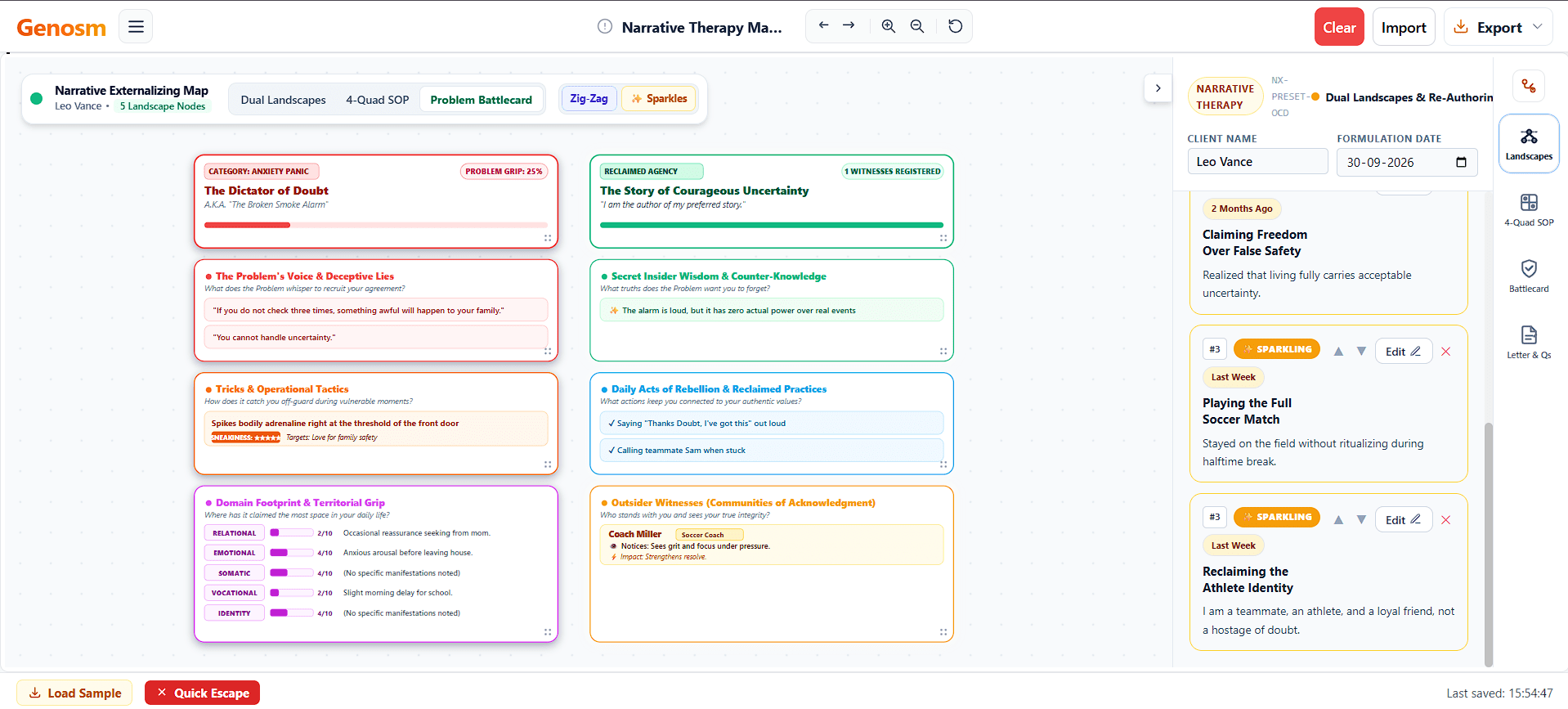
Thicken AgencyExternalized Problem Battlecard & Resistance Studio
To help clients outsmart persistent problems, clinicians create a tactical profile of the problem alongside the client's counter-practices:
Problem Persona & Tactics
Grip: 0-100%Map the problem's deceptive voice lies ("If you make one mistake, you are ruined"), sneakiness levels (1 to 5), and target vulnerabilities (such as fatigue or late-night isolation).
Resistance & Outsider Witnesses
Agency & AlliesDocument reclaimed practices (submitting work at 90% polish, pausing for a walk), insider secret knowledge ("The Critic screams loudest right before creative breakthroughs"), and supportive allies.
Socratic Question Co-Pilot & Re-Authoring Letter Generator
Genosm integrates clinical prompts directly into the workflow and generates formal documentation with one click:
Clinical Socratic Question Bank
White & Epston CanonAccess proven inquiry prompts across all 6 clinical stages of narrative therapy:
Official Certificate of Agency & Re-Authoring Letter
Therapeutic Counter-DocumentIn narrative practice, therapeutic letters provide lasting, tangible validation of a client's reclaimed agency. Genosm auto-populates a formal Certificate of Agency containing the problem separation declaration, documented sparkling moments, declared values, witness acknowledgments, and treating clinician signatures ready for print or EHR attachment.
How to Build a Narrative Externalizing Map in Genosm
Follow this five-step clinical procedure during intake assessments, ongoing therapy sessions, or case conceptualization:
Name and Externalize the Problem Persona
Open the Battlecard tab to name the problem in the client's own words (such as "The Harsh Auditor" or "The Fog of Despair"). Record its deceptive voice lies and rate its current influence across relational, emotional, somatic, and vocational domains.
Construct Statement of Position Map 1 (Problem Story)
Switch to the 4-Quad SOP tab. Guide the client through White's four quadrants: naming the problem, mapping its intrusions, evaluating its toll, and uncovering the underlying ethical convictions that justify why they reject its dominance.
Plot the Dual Landscapes & Connect Zig-Zag Arcs
In the Landscapes tab, add chronological events along the Landscape of Action (observable steps, defiance, alliance building) and link each event to a corresponding node in the Landscape of Identity (values, intentions, ancestral knowledge).
Spotlight Sparkling Moments & Recruit Witnesses
Toggle acts of resistance as Sparkling Moments with visual glow. Add outsider witnesses (mentors, loved ones, or chosen figures) who acknowledge the client's authentic strengths, logging the transport of meaning.
Complete Map 2 and Generate the Re-Authoring Letter
Formulate the preferred counter-story in Statement of Position Map 2. Navigate to the Letter tab to compile, preview, and print the official Certificate of Agency or export high-resolution vector PDF and SVG charts for your EHR.
Therapeutic Modalities & Clinical Populations
Narrative externalizing maps provide versatile utility across various clinical settings:
Anxiety, OCD & Perfectionism
Externalizes intrusive doubts and obsessive critic voices ("The Relentless Auditor"), allowing clients to examine their perfectionism without self-blame.
Depression & Chronic Shame
Separates core identity from depressive inertia ("The Heavy Blanket"), unearthing subtle sparkling moments where the client demonstrated quiet perseverance.
Child, Adolescent & Family Therapy
Children naturally engage with externalized character names (e.g., "The Worry Monster" or "The Sneaky Temper"), enabling families to unite against the problem instead of blaming the child.
Trauma Recovery & Moral Injury
Helps survivors deconstruct survivor guilt and internalized shame, distinguishing survival actions under threat from their core ethical commitments.
Pairing Narrative Externalizing with Other Genosm Tools
Genosm provides 14 integrated clinical formulation instruments. Therapists frequently combine Narrative Externalizing Maps with these sister tools:
Trauma Timeline & Lifeline Chart Maker
Lifespan ChronologyPair Narrative Exposure Lifelines with Dual Landscape mapping. Use the trauma timeline to identify historical adversity stones, then map the client's acts of resilience and values in the Landscape of Identity.
IFS Parts Mapping Tool
Internal MultiplicityDistinguish between internal protective parts (IFS Manager/Firefighter parts) and externalized cultural or systemic oppressions (Narrative problem entities) to avoid pathologizing survival strategies.
Culturagram Assessment Tool
Cultural StrengthsExplore ancestral knowledge and cultural heritage identified in the Culturagram to thicken the Landscape of Identity with rich community and familial resources.
Hero's Journey Formulation Tool
Archetypal NarrativeTranslate the preferred counter-story into a 12-stage mythic progression, framing unique outcomes as the seizure of the sword and the ultimate return with therapeutic transformation.
100% Local-First Data Privacy & HIPAA Alignment
Narrative therapy sessions delve into sensitive disclosures, family histories, moral reflections, and personal values. Generic cloud-based diagramming apps store client statements on shared remote servers, creating confidentiality and compliance concerns.
Genosm features an uncompromising zero-storage, local-first architecture:
- All dual landscape layouts, statement of position maps, and letters process directly inside your browser.
- Client names, case notes, problem personas, and clinical disclosures never transmit to Genosm servers.
- Files save directly to your local computer or secure browser database (IndexedDB).
- Ensures complete compliance with HIPAA, GDPR, and psychotherapeutic confidentiality ethical codes.
Why Genosm Outperforms Generic Whiteboards & Worksheets
| Capability | Genosm | Generic Whiteboards (Miro/Lucid) | Paper Worksheets & Forms |
|---|---|---|---|
| Dual Landscape Zig-Zag Engine | Native Action vs Identity lanes with relational arcs | Manual shape drawing | Static two-column printout |
| Statement of Position Maps | Built-in 4-quadrant SOP Map 1 & Map 2 matrices | Unstructured text boxes | Manual handwritten sheets |
| Sparkling Moments Highlighter | Interactive Unique Outcome toggle with 3-tier glow | Generic sticky notes | Highlighter pen |
| Problem Battlecard & Radar | Tactics, lies, dominance score, and 5-domain radar | Not available | Separate clinical worksheets |
| Re-Authoring Letter Generator | 1-Click Certificate of Agency & printable report | Not available | Manual word processor drafting |
| Patient Data Privacy (HIPAA) | 100% Local-First (Zero Server PHI) | Third-party cloud storage | Physical binder storage risk |
| All-in-One Clinical Suite | 14 clinical diagram types in $9.99/mo plan | Expensive enterprise tiers | Scattered paper folders |
Narrative Therapy Externalizing Tool FAQ
What is externalizing in Narrative Therapy?
Externalizing is a foundational clinical practice developed by Michael White and David Epston. It is based on the premise that "the person is not the problem; the problem is the problem." By separating a person's core identity from the diagnostic labels or distressing symptoms they experience, externalizing frees the client from internalized shame, encourages personal agency, and opens space to examine how the problem operates as an external force.
What are the Dual Landscapes of Action and Identity?
Derived from Jerome Bruner's narrative psychology and adapted by Michael White, Dual Landscapes organize a client's story across two parallel dimensions. The Landscape of Action documents observable biographical events, chronological sequences, and concrete steps of resistance. The Landscape of Identity tracks the internal meanings, cherished values, moral commitments, life intentions, and ancestral knowledge that give those actions significance.
What are Statement of Position Maps (Map 1 and Map 2)?
Statement of Position Maps are 4-quadrant clinical frameworks published by Michael White in Maps of Narrative Practice (2007). Map 1 explores the problem-saturated story through four steps: 1) Naming the problem, 2) Mapping its effects across life domains, 3) Evaluating those effects, and 4) Justifying the evaluation. Map 2 explores the preferred alternative story through parallel steps centered on unique initiatives, preferred outcomes, and identity commitments.
What is a Sparkling Moment or Unique Outcome in Genosm?
A Sparkling Moment (also known as a Unique Outcome) is any event, response, or instance where the client successfully defied, outsmarted, or survived the problem's influence. Genosm provides an interactive toggle to mark timeline nodes as Unique Outcomes with 1 to 3 levels of visual glow, linking them directly to the client's preferred counter-narrative.
How does the Re-Authoring Letter and Counter-Document Generator work?
In Narrative Therapy, written counter-documents and therapeutic letters serve as tangible declarations of agency. Genosm compiles clinical data from your session maps into a formatted Certificate of Agency and Re-Authoring Letter, complete with problem separation declarations, documented sparkling moments, affirmed values, outsider witnesses, and clinician signature blocks.
How does Genosm ensure client privacy and HIPAA compliance?
Genosm operates with a strict local-first architecture. All diagram calculations, client names, problem persona details, Socratic notes, and re-authoring letters are computed and stored directly inside your local web browser. No Protected Health Information (PHI) is ever transmitted to or stored on Genosm remote servers, ensuring complete client data sovereignty and HIPAA alignment.
Is the Narrative Externalizing Tool included in the standard Genosm plan?
Yes. The Narrative Therapy Externalizing & Dual Landscape tool is fully included in the $9.99 per month Genosm plan, which includes unlimited diagram creation and exports across all clinical diagram types including Trauma Lifeline, Window of Tolerance, CBT Formulation, Polyvagal Ladder, IFS Parts Map, and Genograms.